

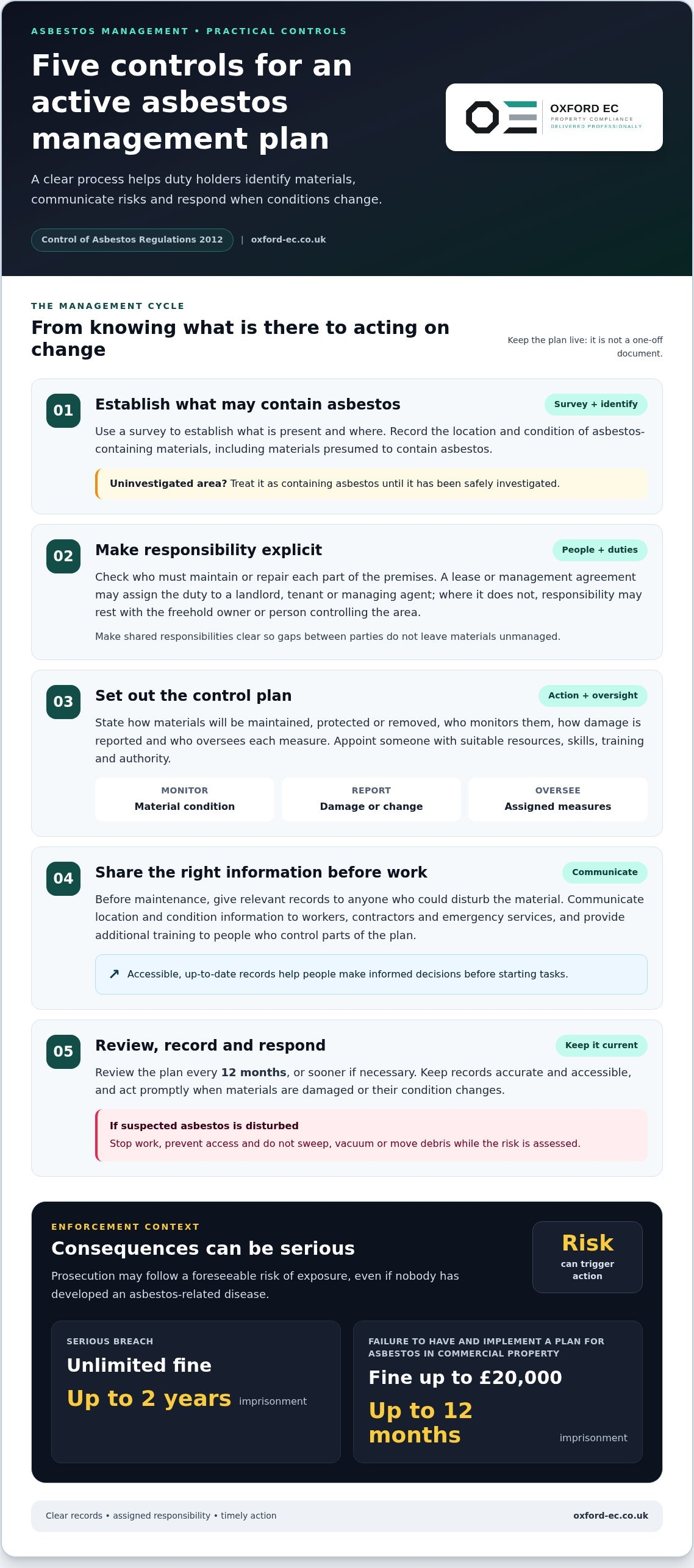
Penalties for inadequate asbestos management in the UK can include an unlimited fine and imprisonment for up to two years for a serious breach. Prosecution may follow where there was a foreseeable risk of exposure, even if nobody has developed an asbestos-related disease.
It’s understandable to focus on the possible sentence, but the first priority is knowing which legal duties apply and whether they’re being met. The Control of Asbestos Regulations 2012 set out key responsibilities for managing asbestos in non-domestic premises, including identifying and recording asbestos-containing materials and maintaining a management plan.
This article explains who may be a duty holder, what effective asbestos management involves and how enforcement can follow a breach. It also covers improvement and prohibition notices, factors that can affect penalties, and how an asbestos management survey can help establish what is present and support a workable management plan.
Key Takeaways
- Identify who controls the premises and what the lease or management agreement says, since responsibility can depend on who must maintain or repair the building.
- An asbestos management plan needs active oversight: according to the Health and Safety Executive, it must be reviewed every 12 months or sooner if necessary.
- Understand how improvement and prohibition notices differ, and why enforcement can follow a foreseeable exposure risk even before illness occurs.
- See how real enforcement cases illustrate the consequences of poor records, unmanaged materials and unsafe work practices.
- Learn when an asbestos management survey can help establish what is present and support day-to-day management of the premises.
Table of Contents
- What is an asbestos management plan and how could it have helped?
- What Are the Legal Responsibilities of Duty Holders?
- Asbestos management plans and monitoring
- Fines and imprisonment for asbestos management breaches
- Penalties for failing to manage asbestos
- Oxford Environmental Consultants (OEC): Asbestos Management Surveys
What is an asbestos management plan and how could it have helped?
An asbestos management plan records how asbestos risks in a building will be controlled, communicated and reviewed. Without effective management, workers and building users may be exposed to fibres, while duty holders risk enforcement, fines and imprisonment.
Practical compliance steps
Compliance means keeping asbestos information accurate, assigning responsibility and acting when material conditions change. Start with an asbestos survey and record the location and condition of asbestos-containing materials, including materials presumed to contain asbestos. Specify who monitors them, how damage is reported and how information reaches workers, contractors and emergency services. Keep the plan active rather than treating it as a one-off document. Before maintenance, share relevant records with anyone who could disturb the material. An asbestos survey from Oxford Environmental Consultants (OEC) can help establish what is present and where.
Common compliance failures
Common failures include missing or outdated records, inaccessible information, unclear responsibilities and delayed responses to damaged materials. A survey that excludes an area leaves a gap: treat that area as containing asbestos until it has been safely investigated. If suspected asbestos is disturbed, stop work, prevent access and do not sweep, vacuum or move debris. These steps limit further disturbance while the risk is assessed.
For a commercial property, a site-specific plan links the register to practical actions. It should state how materials will be maintained, protected or removed, and who will oversee each measure. Duty holders must give information about the location and condition of asbestos to people who may work on or disturb it. They must also provide additional training to people controlling parts of the plan. Clear records help workers make informed decisions before starting tasks.
The consequences can reach beyond enforcement. Failure to have and implement a plan for asbestos in commercial property can result in a fine of up to £20,000 and imprisonment for up to 12 months. In a separate housing case, the Local Government Ombudsman ordered Southwark Council to compensate a tenant after damaged asbestos took eight months to be dealt with. That outcome shows why complaints require a recorded response and timely action.
Costs in one cited example also show the value of addressing management gaps early. Those figures relate to that store, not a general price. A proper plan can identify what action is needed, where it is needed and how the work should be controlled, ultimately helping to avoid severe penalties for inadequate asbestos management UK.
What Are the Legal Responsibilities of Duty Holders?
The Control of Asbestos Regulations 2012 establish the main day-to-day duties for managing asbestos. Responsibility depends on the premises and who must maintain or repair them.
Who holds the duty to manage asbestos
A duty holder is someone responsible for maintaining or repairing non-domestic premises where asbestos may be present. Under regulation 4(1), that can include a person with repair or maintenance obligations under a lease or management agreement. Landlords, tenants and managing agents may therefore hold responsibility. Where an agreement assigns no such obligation, the freehold owner or person controlling the relevant area may be responsible.
Review the lease or management agreement to identify who controls each part of the building. Make shared responsibilities explicit so gaps between a landlord, tenant and managing agent do not leave asbestos unmanaged. Assigning tasks does not remove the need to establish who holds the legal duty.
Non-domestic premises covered by the duty
Regulation 4 applies to all non-domestic premises, including workplaces and commercial buildings. It also covers common parts of multi-occupancy domestic premises, such as shared corridors and stairwells. The duty is not limited to occupied buildings: owners of vacant or derelict premises and warehouses also need an asbestos survey.
Individual domestic premises are different from shared areas. A private home is not covered by the duty to manage in the same way as a workplace, but asbestos work still carries health and safety obligations. Regulations 5 and 6 of the Control of Asbestos Regulations 2012 concern identifying asbestos and assessing exposure risks during work, including work in domestic premises.
Duty holders’ management responsibilities
Duty holders must identify asbestos-containing materials, assess their condition and location, and consider the risk of airborne fibres. Materials must be presumed to contain asbestos unless strong evidence shows otherwise. Regulation 4 also requires an up-to-date record and a management plan, giving those responsible a basis for controlling risks and informing people who may encounter the materials.
These duties sit alongside the Health and Safety at Work etc. Act 1974. Duty holders should appoint someone with suitable resources, skills, training and authority to oversee asbestos management. They must also assess health and safety risks, communicate relevant information to workers and contractors, and ensure required asbestos removal is undertaken by a licensed contractor.
Responsibility is practical as well as legal. For example, a managing agent who controls shared areas may need to coordinate access, records and maintenance with the freeholder and tenants. Clear allocation helps prevent work starting without relevant asbestos information. It also establishes who must respond if materials are damaged or proposed works could disturb them.
Asbestos management plans and monitoring
An asbestos register records relevant materials, while a management plan sets out how risks will be controlled. Together, they translate asbestos regulations into practical actions for a building and its occupants.
Asbestos registers
An asbestos register is the working record of asbestos-containing or presumed asbestos-containing materials, including their locations and condition. It helps people planning maintenance understand what may be present before work starts. The register should reflect survey findings and identify any areas the survey could not inspect. Treat excluded areas as presumed to contain asbestos until they are safely investigated.
Monitoring keeps the register useful over time. Record changes in condition, such as damage to material previously assessed as intact, and update its location or status when new survey information becomes available. A register that no longer reflects the building can mislead workers and increase the risk of asbestos exposure during routine tasks.
Before planned work, compare its precise location and scope with the register and available survey information. If records do not cover the affected area, pause planning and establish what is present before disturbing materials. Keep updated information accessible to people who may work in, maintain or respond to an incident at the premises.
Management plans
A management plan explains how identified or presumed materials will be managed, who is responsible for each action and how information will be shared. It should cover monitoring, maintenance, access and arrangements for damaged materials. This gives duty holders a defined response instead of leaving workers to make assumptions when asbestos is present.
UK asbestos management plans must be reviewed every 12 months or sooner if necessary, according to the Health and Safety Executive. A review should consider whether the register remains accurate, whether materials have deteriorated and whether planned work changes the risk. Damage, a new survey or a change in how an area is used can prompt an earlier review.
For each material, the plan should link its recorded condition to a clear management action. This may involve monitoring it, maintaining it in good repair, sealing it or arranging professional removal where appropriate. The plan should identify who will carry out the action and how affected workers will receive relevant information. Asbestos-containing materials should not be disturbed simply because a register exists.
Keep evidence of monitoring and decisions alongside the register and plan. For example, a condition inspection record can show whether a material remains stable or needs further action. If contractors report damage or unexpected material, record the finding, restrict access where needed and reassess the plan. Consistent records help demonstrate that asbestos risks are actively managed, not merely documented.
Fines and imprisonment for asbestos management breaches
A breach of the Control of Asbestos Regulations 2012 can lead to prosecution, an unlimited fine and, for serious offences, imprisonment. The consequences depend on the breach, the risk created and the evidence available.
Court fines and custodial sentences
UK courts can impose unlimited fines for health and safety offences, including serious asbestos management breaches. A serious breach can carry imprisonment of up to two years, while minor breaches of asbestos regulations can lead to a prison sentence of up to six months.
Yes. Employers and individuals responsible for asbestos management may face legal consequences. The risk is not limited to cases where someone has developed an asbestos-related disease: creating a foreseeable risk of exposure may be sufficient for prosecution. Courts consider the offence and its circumstances when deciding the penalty.
These consequences make early action important when materials are damaged, records are inadequate or work could expose people to asbestos. A written plan and evidence of completed actions can show how risks were assessed and controlled, although documentation alone cannot correct an unsafe condition.
Potential fines and prosecution
Prosecution can follow a breach that creates a foreseeable risk, even without proof of illness. The Health and Safety Executive reported an average fine of £145,000 for health and safety breaches in 2020/21. That figure covers health and safety cases generally, not a set penalty for an asbestos offence.
For asbestos management breaches, a court can impose an unlimited fine, and serious cases may also result in imprisonment. Relevant factors include the nature of the breach, whether people faced exposure and whether the duty holder took effective action. Separate civil claims by exposed employees or contractors may also arise alongside enforcement.
Across England, Wales, Scotland and Northern Ireland, the offence and evidence determine how a case proceeds through the applicable legal system. The core UK duties arise under the Control of Asbestos Regulations 2012, while the Health and Safety Executive enforces asbestos-management requirements.
HSE enforcement action
The Health and Safety Executive can serve improvement or prohibition notices under sections 21-24 of the Health and Safety at Work etc Act 1974. An improvement notice requires a breach to be corrected within a stated period. A prohibition notice can stop an activity immediately where there is a risk of serious personal injury.
These notices are enforcement measures, not court sentences. A prohibition notice may halt work involving dangerous materials until the immediate risk is addressed, while an improvement notice specifies the correction required. The HSE can also prosecute an asbestos offence, allowing a court to consider fines or imprisonment.
Responding to a notice means addressing the underlying risk, not merely revising a document. For example, a duty holder may need to control access, deal with damaged materials and ensure workers receive relevant asbestos information before work resumes.
Penalties for failing to manage asbestos
Failing to manage asbestos can lead to enforcement, disruption and separate civil claims, as well as criminal prosecution. The Poundland Ipswich case shows how failures in day-to-day controls can expose workers and carry substantial financial consequences. For employers and property managers, the practical question is whether asbestos information informs maintenance decisions before work begins.
In 2022, Poundland was fined £565,000 over asbestos management failings at its Ipswich store. This example demonstrates that penalties for inadequate asbestos management in the UK can follow failures to control risks, not only deliberate asbestos removal. Employers should ensure that those planning and carrying out maintenance understand the relevant asbestos information and controls.
Earlier cases also illustrate the consequences of unsafe work. In 1998, Walsall Council was fined £35,000 after asbestos-containing ceiling tiles were removed in a way that endangered workers and a council caretaker. In a 2001 hearing, a contractor was found guilty on three charges after unlicensed operatives removed asbestos-containing insulation without precautions. In both examples, work disturbed materials and created exposure risks.
Enforcement may require immediate operational changes. An improvement notice can require a breach to be corrected within a stated period. A prohibition notice can stop an activity immediately where there is a risk of serious personal injury. Work may be delayed until the hazard is controlled. A concern raised by a contractor or tenant after disturbing material that should have appeared on the register is described as a common trigger for enforcement.
Housing and nuisance legislation can also apply. Under the Housing Act 2004, a local authority must take enforcement action where a category 1 hazard exists. Under section 80(1) of the Environmental Protection Act 1990, an authority should serve an Abatement Notice when satisfied that a statutory nuisance exists. The relevant route depends on the circumstances and the hazard identified.
Employees or contractors exposed to asbestos may bring personal injury claims separately from HSE enforcement. A duty holder could therefore face distinct processes: regulatory action addressing a breach and a civil claim concerning injury or illness. Because asbestos-related disease can emerge long after exposure, records of materials, work and management decisions may remain relevant beyond the immediate incident.
To reduce the risk of further failures, assess whether the asbestos management plan reflects current conditions, whether workers receive relevant information, and whether actions are recorded. Review it every 12 months or sooner if necessary, and update it after damage, a new survey or changes to planned work. These are practical controls, not a guarantee against the penalties for inadequate asbestos management in the UK.
Oxford Environmental Consultants (OEC): Asbestos Management Surveys
Oxford Environmental Consultants (OEC) provides Asbestos Management Surveys to help those responsible for premises understand where asbestos-containing materials are present and assess their condition. Arrange a survey when existing records need to be established or updated, or before routine maintenance if asbestos information is incomplete. The findings can inform the asbestos register and help duty holders plan monitoring and communicate relevant risks to workers.
A survey supports asbestos management, while duty holders remain responsible for implementing and maintaining the management plan. If materials are damaged or planned work may disturb them, the appropriate next steps depend on the findings and the work involved. Contact Oxford Environmental Consultants (OEC) to discuss an Asbestos Management Survey for your premises.
Turn asbestos findings into clear action
Understanding the penalties for inadequate asbestos management in the UK is only part of protecting a property. The next step is to ensure findings lead to clear ownership, recorded decisions and practical action. Where responsibilities are shared by owners, managing agents and occupiers, agreeing who will act on each issue can prevent gaps.
Oxford Environmental Consultants (OEC) offers Asbestos Management Surveys, Fire Risk Assessments and Legionella Risk Assessments for property compliance needs. An asbestos survey can inform management decisions, while the duty holder remains responsible for implementing the plan and managing risks.
For premises with incomplete records, planned maintenance or changing conditions, a focused discussion can clarify what information and action are needed next. Keep the process evidence-led, assign responsibility and maintain clear records as the building changes.
Clear information and accountable follow-through help you maintain more effective asbestos management.
Frequently Asked Questions
What Are the Current Asbestos Regulations?
The Control of Asbestos Regulations 2012 are the main UK regulations for asbestos work and management. Related duties also sit within the Health and Safety at Work etc. Act 1974 and the Management of Health and Safety at Work Regulations 1999. For construction projects, the Construction (Design and Management) Regulations 2015 require clients, designers and contractors to plan work safely, including by providing and using suitable asbestos information.
Who is responsible for preventing your exposure to asbestos?
Responsibility depends on the activity and the premises. Employers must protect employees from workplace risks, while a duty holder manages asbestos in relevant non-domestic premises and shared residential areas. Contractors also need suitable asbestos information before carrying out work that could disturb materials. For example, a maintenance employer and building manager may each have responsibilities, so their arrangements should establish who communicates hazards and controls the work.
What are the average fines and payout claims for asbestos exposure?
There is no single average that represents both fines and compensation claims. The average HSE fine for health and safety breaches was £145,000 in 2020/21, but that figure covers health and safety cases generally, not asbestos alone. A Department for Work & Pensions report estimated average civil compensation awards of £137,000 to £153,531 for occupational mesothelioma cases settled between 2007 and 2012. These are distinct measures from different periods.
What penalties can a court impose?
A court can impose an unlimited fine for a health and safety offence, and some offences carry imprisonment. For serious asbestos management breaches, imprisonment can reach two years; minor asbestos regulation breaches can carry up to six months. The offence and evidence matter: a prosecution can succeed where a foreseeable exposure risk was created, even if nobody has developed an asbestos-related disease.
What UK laws require asbestos management in non-domestic premises?
Regulation 4 of the Control of Asbestos Regulations 2012 sets out the duty to manage asbestos in non-domestic premises and shared parts of multi-occupancy homes. The regulations are cited as SI 2012/632. The Health and Safety at Work etc. Act 1974 provides a wider health and safety framework, while the Management of Health and Safety at Work Regulations 1999, SI 1999/3242, address risk assessment duties.
What fines have UK courts imposed for inadequate asbestos management?
Penalties vary with the offence and circumstances; there is no fixed tariff for every asbestos management failure. For context, the HSE’s reported average fine for health and safety breaches was £145,000 in 2020/21, not an asbestos-specific average. Individual cases can differ substantially, and courts can impose unlimited fines. The examples discussed in this article show why a figure from one prosecution should not be treated as a prediction for another.
Who is the dutyholder responsible for managing asbestos in UK buildings?
The duty holder is generally the person or organisation responsible for maintaining or repairing relevant non-domestic premises. A lease or management agreement may allocate those obligations to a landlord, tenant or managing agent. If no agreement assigns them, the freehold owner or person controlling the relevant area may hold the duty. In a multi-tenant building, responsibility can differ between individual units and shared corridors or stairwells.
What counts as inadequate asbestos management under UK regulations?
Examples include failing to identify or record asbestos risks, keeping an inaccurate register, not monitoring material condition or withholding relevant information from people carrying out work. An outdated plan may also fail to address damage or changes in how an area is used. For instance, maintenance that proceeds without checking whether the survey covers the work area may create a foreseeable exposure risk, even before anyone becomes ill.