
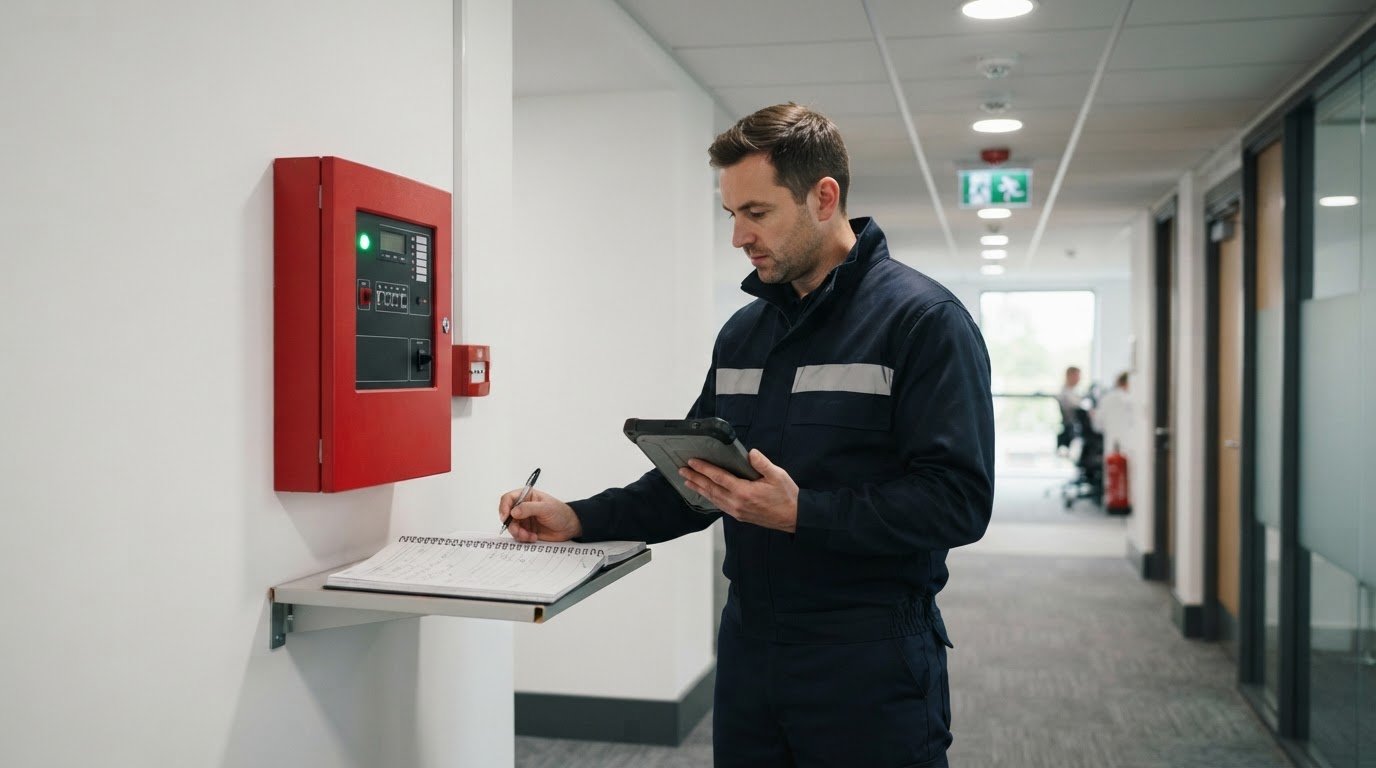
Commercial fire alarm maintenance isn’t an annual-only task. The annual fire alarm maintenance requirements sit within a wider routine: a full system check is typically carried out once a year, while inspection and servicing visits should take place at least every six months. According to the UK legislation portal, Article 17 of the Regulatory Reform (Fire Safety) Order 2005 requires the Responsible Person to keep fire safety measures appropriately maintained and in efficient working order.
Annual fire alarm maintenance requirements matter, but an annual service does not replace regular checks between professional visits. Knowing what to check and when helps you keep the system operational and demonstrate that maintenance is being managed.
This guide explains the usual schedule for commercial fire alarm checks and servicing, how weekly manual call point tests work, and what to record in the fire log. It also covers the devices and system components included in maintenance, showing how routine testing, planned servicing and clear records work together.
Key Takeaways
- Plan for regular checks between service visits: commercial systems are typically serviced at least every six months, with a full system check once a year.
- Rotate the manual call point used for the weekly alarm test so different points are tested over time, and confirm the alarm sounds and registers at the panel.
- Keep a clear fire log of tests, service visits, faults, corrective actions and system changes so maintenance activity can be reviewed.
- During inspections, pay attention to the control panel, detectors, alarm devices, wiring and backup power, and restore the system to its normal configuration after testing.
- Maintenance needs to reflect the system’s type and configuration; the article explains what to consider when planning checks and servicing.
Table of Contents
- How often will your fire alarm system need maintenance checks?
- Weekly manual call point testing
- Fire alarm maintenance records and certificates
- How Often Should a Commercial Fire Alarm Be Tested and Serviced?
- Maintenance for different fire alarm system types
- Oxford Environmental Consultants (OEC): Asbestos Management Surveys
How often will your fire alarm system need maintenance checks?
Commercial fire alarm maintenance combines routine site checks with planned professional servicing. Annual fire alarm maintenance requirements describe an ongoing schedule of checks, not just a single yearly visit.
Power and communication checks
Power and communication checks help confirm that the alarm can remain operational and transmit signals through the system. Monthly checks may include standby batteries, power supplies and sounders. Look for corrosion or leakage on batteries, and arrange replacement where needed. Check the panel and communication links for fault indications, since a failed connection can prevent a device’s signal from reaching the control panel. Record defects and actions in the site log.
Responsible-person checks and professional servicing
The Responsible Person oversees fire safety arrangements, while a competent person carries out technical inspection and servicing. According to the UK legislation portal, the Regulatory Reform (Fire Safety) Order 2005 forms part of the UK fire alarm regulations described here. Article 17 requires the Responsible Person to keep fire safety measures appropriately maintained and in efficient working order, according to the UK legislation portal.
For rented homes in England, Scotland and Wales, commercial servicing schedules are not blanket domestic rules. Landlords must follow the fire safety requirements that apply to the property type and nation.
Failure to maintain an alarm can leave fire safety measures ineffective and breach the Article 17 duty. It also creates a risk of enforcement action and increases the danger that a fault will go undetected.
A full system check is typically carried out once a year, with inspection and servicing visits at least every six months. The control panel is commonly checked every working day. Large sites may need more frequent minor maintenance because all devices cannot necessarily be serviced at one time.
Visual checks of detectors and control panels
Visual checks identify damage or conditions that could affect detector operation. During an annual inspection, examine automated and remote detectors for damage, paint or other adverse effects, then functionally test them. Check remote indicators for correct operation where fitted. Inspect the control panel for faults at least once every 24 hours, and include standby power supplies in monthly checks.
BS 5839 gives recommendations for periodic inspection and testing in Section 6. The annual fire alarm maintenance requirements therefore sit alongside frequent checks, with each activity serving a distinct purpose.
Maintenance contracts and inspection checklists
A maintenance contract should specify the system and devices covered, planned service visits, testing scope, reporting, and how faults and corrective actions are recorded. It should also explain how the system will be returned to normal operation after testing. Clear terms help the Responsible Person track completed work and outstanding defects.
A checklist can cover panel status, detector condition, call points, sounders, remote indicators, batteries, power supplies and communication links. Record results, faults, actions and system updates. For example, if a detector shows paint damage, note its location and the follow-up action rather than simply marking it as visually checked.
Weekly manual call point testing
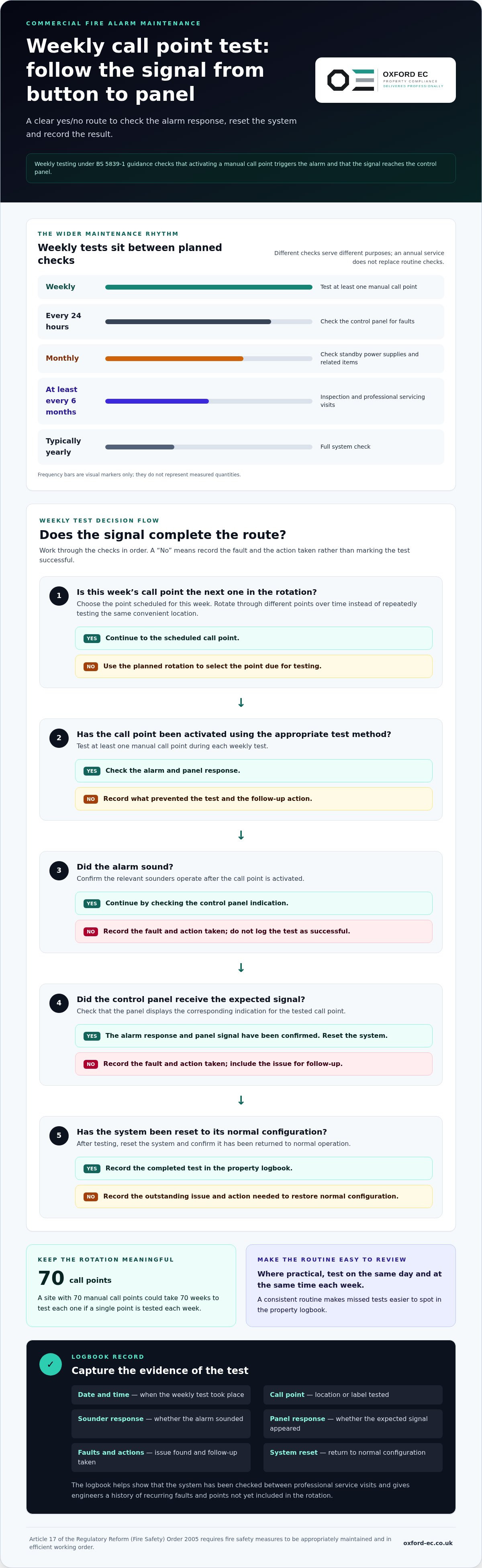
Weekly testing checks that a manual call point can trigger the fire alarm system and that the signal reaches the control panel. BS 5839-1 guidance recommends testing a different call point each week in commercial premises.
Functional testing of alarms and call points
Functional testing confirms that activating a call point produces an alarm signal and operates the relevant sounders. Test at least one call point during each weekly test, then check for an audible alarm and the corresponding indication at the panel.
Use a different call point each week and rotate through the building’s points over time. For example, a site with 70 manual call points could take 70 weeks to test each one using a single point per weekly test. A planned rotation helps avoid repeatedly testing the same convenient location.
- Choose the call point scheduled for that week.
- Activate it using the appropriate test method.
- Confirm the alarm sounds and the control panel receives the signal.
- Reset the system and return it to its normal configuration.
Where practical, run the test on the same day and at the same time each week. A consistent routine makes missed tests easier to spot in the property logbook.
Logbooks and checks between services
A property logbook records weekly tests and helps show that the fire alarm system has been checked between professional service visits. Note the date, time, call point tested, whether the alarm sounded, and whether the panel displayed the expected signal.
If a test reveals a fault, record the issue and action taken instead of marking the test as successful. The logbook gives engineers a useful history for their next visit, including recurring faults and points not yet included in the test rotation.
- Enter the weekly test date and time.
- Identify the tested call point by its location or label.
- Note the sounder and control panel response.
- Record faults, follow-up actions and the system reset.
Weekly testing under BS 5839 guidance is distinct from the statutory maintenance duty under the Regulatory Reform (Fire Safety) Order. The Order does not specify a statutory weekly testing interval for commercial fire alarms, but regular testing helps identify failures between servicing appointments.
Some weekly routines also rotate a smoke detector alongside a call point. A point smoke detector needs a functional test to confirm that smoke can enter its chamber and trigger a fire alarm signal. Visual inspection alone cannot confirm this response. Record the detector’s location and result separately, so the logbook distinguishes detector testing from call point activation.
Fire alarm maintenance records and certificates
Clear records link routine tests, faults and servicing in an auditable history. In non-domestic premises, the fire log should record testing, maintenance and fire risk assessments.
Test and maintenance records
A test or maintenance record documents what was examined, what worked and what needs attention. It helps the Responsible Person track defects and confirm whether follow-up work has been completed.
Record the date and time, the person carrying out the test, the device or area involved, and the result. For a call point test, note its location and whether the alarm sounded and registered at the panel. For a service visit, include any faults found, corrective actions and system updates.
A service report or certificate can evidence the work carried out, but the record should also make outstanding defects clear. Keep the report with the fire log rather than relying on a certificate alone. Fire logs are assessed during annual inspections and fire risk assessments, so entries should be legible and easy to follow.
Logbooks and staff training records
A fire alarm logbook is the working record of tests, maintenance and fire risk assessments at the premises. Its entries help staff and engineers understand the system’s recent history, including recurring faults and repairs.
Keep staff training records alongside the logbook, noting the training subject, date and attendees. For example, record who has been shown how to raise an alarm and report a fault. This helps the Responsible Person identify whether relevant staff have received instruction, without mistaking training evidence for proof that the alarm passed a test.
Store records where people responsible for fire safety can access them. After a building change or system update, record what changed and how it affects the installed system. This gives future inspections a clearer basis for checking whether the devices and documentation still match.
False alarm records
A false alarm record captures an alarm activation that did not result from a fire, together with the circumstances and any action taken. Recording each event helps reveal patterns that might otherwise be missed.
Note the date and time, the panel indication, the affected detector or call point, and the known cause. Possible causes include dust around a detector during building work or accidental call point activation. Record any investigation, repair or operational change, then track whether the issue happens again.
Review these entries with service reports and test results. A repeated activation from the same area can direct attention to a specific device or environmental condition. Keep the record factual; distinguish a confirmed cause from an initial observation. BS 5839 guidance addresses periodic inspection and testing, while the fire log preserves the site-specific evidence of what happened between visits.
How Often Should a Commercial Fire Alarm Be Tested and Serviced?
Commercial systems combine weekly user tests with professional inspections and servicing. A typical arrangement includes an annual service and an interim visit every six months.
Visual inspections of panels and detectors
A visual inspection looks for visible faults that could affect fire detection or system operation. Check the control panel for fault indications and inspect detectors for damage, paint or other adverse effects.
During the annual inspection, automated and remote detectors should also be functionally tested. Check remote indicators for correct operation where fitted. For example, a detector covered by paint may not respond as intended, so both its visible condition and functional response matter.
Professional inspection and servicing intervals
Professional inspection and servicing assess the system beyond routine user checks. Visits should take place at least every six months. In non-domestic premises, a common schedule is an annual service and an interim service every six months.
BS 5839-1 gives recommendations for periodic inspection and testing in Section 6. It calls for a competent person to test detectors, call points, panels and circuits every six months. The precise work at each visit should reflect the system and the devices installed.
Six-monthly comprehensive inspections
A six-monthly comprehensive inspection examines how the system operates across its connected components. The competent person tests devices and circuits, checks recorded faults, and reviews whether earlier defects have been resolved.
This inspection complements the annual full-system check rather than replacing it. Every device should be checked and tested at least once over a calendar year. On a large site, a planned sequence can spread device testing across visits when all devices cannot be serviced at one time.
Weekly testing remains a separate part of the schedule. It checks that a manual call point activates the alarm, sounders operate and the control panel receives the signal. Record the result in the property logbook so the engineer can compare routine test evidence with service findings.
Monthly checks add another layer. These may include sounders, standby power and battery condition, including signs of corrosion or leakage. Record defects and corrective actions, then confirm that the system has returned to its normal configuration after testing.
Building alterations can affect detector coverage, wiring or alarm zones, so additional checks may be needed after changes. Large or complex premises may also need checks beyond the routine schedule. The Responsible Person should ensure the inspection plan reflects the building layout, device count and relevant changes.
Maintenance for different fire alarm system types
Maintenance should reflect the alarm’s design, category and premises rather than treating every system identically. The system’s configuration determines which devices, circuits and functions need inspection and testing.
UK fire alarm systems include property-protection Category P and life-protection Category L systems. The maintenance focus follows the system’s purpose: a Category P system protects property, whilst a Category L system supports life safety. A competent person should identify the system category and grade, understand its model, and apply relevant BS 5839 guidance when planning work.
Testing protocols also depend on the system technology. For example, where an alarm provides analogue values, compare each value with the range specified by its manufacturer. This gives the engineer a system-specific basis for identifying abnormal readings instead of relying on a generic pass-or-fail check.
After testing, return the system to its normal configuration. Confirm that test mode has been cancelled, disabled zones have been restored, and faults or isolations have been resolved or clearly recorded. A final panel check helps confirm that the premises’ fire alarm system is ready to operate as intended.
An older alarm should be assessed against its condition, suitability and the needs of the premises. A fire alarm’s expiry is roughly 10 years from manufacture or installation, although this can vary. Age alone does not describe every system’s condition, so inspection findings and the manufacturer’s guidance matter when considering continued use or replacement.
Changes to a building’s use or layout can affect whether its installed devices still provide appropriate coverage. A fire risk assessment can help identify changes to occupancy, escape routes or hazards that affect fire precautions. Where changes affect the alarm, additional checks may be needed. Record alterations and resulting work so future inspections have an accurate system history.
For a structured maintenance review, the competent person should understand different system types and models, identify the system’s grade and category, and understand BS 5839. The review should account for faults, test results, manufacturer ranges and any changes to the premises. These details help determine whether maintenance has been carried out against the system’s actual design, rather than an assumed standard configuration.
Oxford Environmental Consultants (OEC): Asbestos Management Surveys
Oxford Environmental Consultants (OEC) supports wider fire safety management with Fire Risk Assessments and Fire Door Inspections. These services address related parts of a premises’ fire safety arrangements and complement its alarm maintenance schedule.
A Fire Risk Assessment helps identify fire hazards and review the premises’ protective measures. Fire Door Inspections focus on the condition and operation of fire doors, which form part of the building’s wider fire precautions. Together, these assessments help responsible people maintain a clearer view of fire safety issues across a property.
For other property risks, OEC also carries out Legionella Risk Assessments and Damp & Mould Surveys. Contact Oxford Environmental Consultants (OEC) to discuss your premises’ assessment needs.
Make your maintenance plan part of everyday fire safety
Make your maintenance arrangements clear, assigned and easy to review. A written schedule helps the Responsible Person coordinate site checks, professional work and follow-up actions, while keeping the fire log useful for future decisions. Treat annual fire alarm maintenance requirements as part of the wider fire safety plan, not as an isolated calendar appointment. If building use or equipment changes, review whether the documented arrangements still reflect the premises.
Oxford Environmental Consultants (OEC) offers Fire Risk Assessments to help assess fire precautions, alongside Fire Alarm Installation, Maintenance and Servicing. OEC also provides Asbestos Management Surveys and Legionella Risk Assessments for other property compliance needs through clearly scoped assessments.
A controlled maintenance plan gives your team a practical foundation for keeping responsibilities visible and safety records organised.
Frequently Asked Questions
Have a question about British Standards and Regulations?
British Standards provide technical recommendations, while fire safety legislation sets legal duties. For commercial premises, the Regulatory Reform (Fire Safety) Order 2005 and its maintenance duty are relevant; Article 17 requires fire safety measures to be appropriately maintained and in efficient working order, according to the UK legislation portal. Use the standard and the legal duty together when setting site procedures, rather than treating a British Standard as a substitute for the Responsible Person’s obligations.
Is weekly testing legally required?
No statutory weekly testing interval for commercial fire alarms is specified by the Fire Safety Order. Weekly testing is recommended by BS 5839-1 guidance, however, and provides a routine way to identify whether a call point activates the alarm and reaches the panel. For a site with rotating staff, assign responsibility for the scheduled test and record any missed test or fault, rather than assuming a service visit replaces routine checks.
Who can conduct fire alarm testing?
Routine weekly tests can be carried out by a designated person on site who understands the agreed test procedure and can report a fault. More technical inspection and servicing should be carried out by a competent person who understands the system’s model, grade and category, and BS 5839. For example, testing a call point is distinct from diagnosing a panel fault or assessing analogue readings, which requires system-specific knowledge.
What UK laws and regulations require fire alarm maintenance in buildings?
The Regulatory Reform (Fire Safety) Order 2005 is a key legal instrument in the fire safety framework described here. Under Article 17, the Responsible Person must keep fire safety measures appropriately maintained and in efficient working order, according to the UK legislation portal. The maintenance regime should also account for the building’s fire risk assessment and installed precautions. That helps connect alarm servicing to the wider fire safety arrangements, rather than viewing it as a standalone task.
How often should fire alarm systems be inspected and serviced in the UK?
A typical commercial arrangement combines an annual service with an interim professional visit every six months. A full system check is typically carried out once a year, while the building’s own checks continue between visits. Device numbers, site complexity and access can affect how servicing is planned. For example, on a large premises, work may need to be divided across visits so engineers can check devices systematically without overlooking areas.
What are the weekly fire alarm test requirements under BS 5839-1?
BS 5839-1 guidance recommends activating a different manual call point each week in commercial premises. Confirm that the alarm sounds and the control panel registers the signal, then reset the system to normal operation. Rotate locations rather than repeatedly selecting the nearest point. A consistent weekly test day and a clear log entry help site staff identify gaps in the rotation and provide a useful record for the next service visit.
What maintenance checks should be carried out on a fire alarm system?
Checks should cover the control panel, alarm devices, detectors, call points, power supplies and any fitted remote indicators. Organise the work by function: inspect visible condition, test device response, review faults, then confirm normal operation afterwards. A detector’s appearance, for instance, does not prove it can detect smoke. Functional testing must confirm that smoke can enter its chamber and produce an alarm signal.
Who is qualified to inspect and maintain fire alarms in the UK?
A competent person should carry out professional inspection and maintenance, with competence matched to the system being examined. They should understand different system types and models, identify the system’s grade and category, and understand BS 5839. This matters because an analogue system, for example, may provide values that need comparison with the manufacturer’s specified range. The Responsible Person retains oversight of fire safety arrangements, even when technical work is delegated.