

What good is a completed fire alarm test if nobody can show who carried it out, what they found or whether a fault was fixed? Creating a fire safety logbook isn’t about filling in a generic template. It’s about turning fire-safety duties into dated, assigned and traceable evidence.
If you’re unsure which checks belong in the record, how to adapt it to your building or who should follow up actions, start with the premises and its current fire risk assessment. In non-domestic premises in England and Wales, the Regulatory Reform (Fire Safety) Order 2005 places fire-safety management duties on the Responsible Person. A logbook can help organise evidence, but it doesn’t replace the fire risk assessment or the duty to manage hazards. Requirements differ across UK jurisdictions.
This guide explains how to structure records around your premises and fire risk assessment, assign responsibility, and document checks, faults and remedial actions. You’ll also learn how to keep entries current across staff and contractors, organise paper or digital records, and recognise when competent fire-safety support may be needed. The aim is a clear working record: who did what, when, and what happened next.
Key Takeaways
- Start creating a fire safety logbook by matching its sections to the premises and current fire risk assessment, rather than relying on a one-size-fits-all template.
- Record applicable checks and activities, including who completed them, what they found, who owns follow-up and how actions were closed.
- Choose paper or digital records according to how staff will access and update them. Prioritise complete, current and usable entries.
- Set clear roles for completing, reviewing and escalating entries, then schedule reviews so the system stays current when responsibilities change.
- Use a Fire Risk Assessment to identify which risks, controls and records need attention. OEC’s relevant Fire Safety services include fire-door inspections, compartmentation, alarms and emergency lighting.
Table of Contents
- Creating a fire safety logbook: what it is and what it can prove
- What to include when creating a fire safety logbook
- Paper or digital fire safety logbook: choose for the building
- How to create and maintain a fire safety logbook step by step
- How OEC's Fire Safety services can support reliable records
Creating a fire safety logbook: what it is and what it can prove
A fire safety logbook is an organised record system for managing fire-safety information at a premises. It may be a bound book, a set of controlled documents or a digital record. The format matters less than whether the information is accurate, current, accessible and relevant to the building. A logbook is not a fire safety measure in itself. It cannot prevent a fire, maintain an alarm or make an unsafe escape route safe.
Its value is traceability. A clear entry can show that a check took place, who completed it, what they observed and what action followed. If a defect is found, the record should show who was assigned to resolve it, when it was escalated and whether the corrective work was completed. A note saying “fault reported” is not evidence that the fault was closed out.
What is a fire safety logbook for?
Dated records help the responsible person oversee recurring activity and identify missed checks, unresolved defects or patterns that need attention. They also preserve operational knowledge when staff, contractors or building arrangements change. For example, a successor can check which inspection found a defect and whether follow-up remains outstanding, instead of relying on an informal handover.
Records support management, but they don’t establish that an inspection was suitable, thorough or completed by someone competent. An entry is evidence of what was recorded, not a substitute for the work itself. A reliable system links each record to the relevant equipment or area, the person responsible and any supporting report or action record.
Does every UK premises need the same logbook?
No single template should be treated as suitable for every premises. The need to manage fire safety should not be confused with a requirement to use one particular branded or printed book. Applicable duties depend on the UK jurisdiction, premises type and circumstances. In non-domestic premises in England and Wales, the Regulatory Reform (Fire Safety) Order 2005 is a central part of the fire-safety framework. It places duties on the responsible person, but that does not mean every building needs identical records or the same logbook format.
Before setting up records, establish which fire-safety regime applies and what the assessment identifies. Don’t assume that guidance written for a workplace applies unchanged to housing, or that a template designed for one jurisdiction covers requirements elsewhere in the UK. The logbook should reflect the actual risks, systems and management arrangements, not simply reproduce a generic checklist.
Creating a fire safety logbook is a practical way to organise evidence, not a shortcut to compliance. A premises-specific Fire Safety assessment and support can help clarify which risks and controls to reflect in the record plan. The responsible person remains accountable for managing identified actions and keeping records usable.
What to include when creating a fire safety logbook
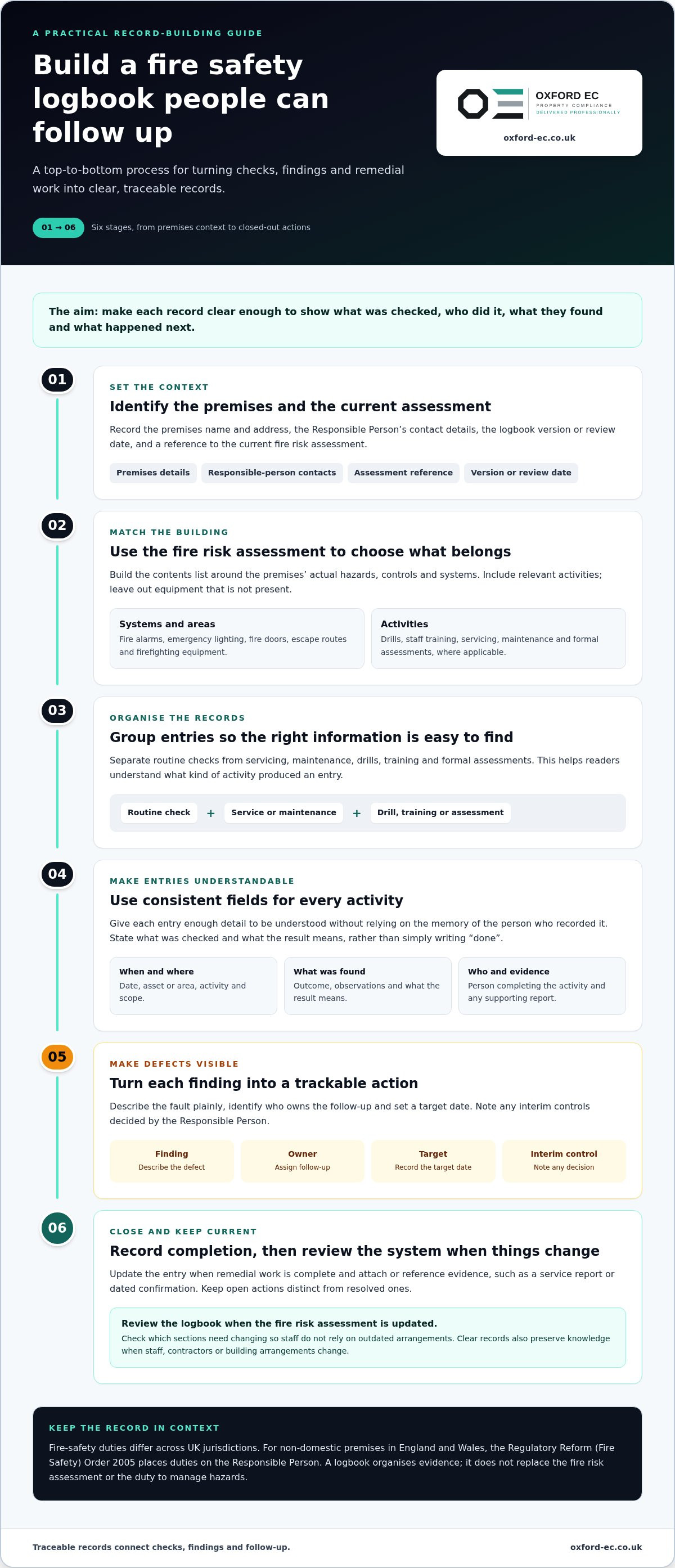
Start with enough context to identify every record. Include the premises name and address, the responsible person’s contact details, the record system’s version or review date, and a reference to the current fire risk assessment. If the assessment is updated, record its new version and review which logbook sections need changing. This document control helps prevent staff relying on outdated arrangements.
Build a premises-specific contents list
Use the fire risk assessment to identify relevant hazards, controls and checks. Include only systems and activities that apply to the building, such as fire alarms, emergency lighting, fire doors, escape routes, firefighting equipment, drills or staff training. Don’t copy a generic contents list without checking it against the premises. Recording equipment that isn’t present adds clutter, while leaving out a relevant control can create a gap in oversight.
Group entries by activity so routine checks are easy to distinguish from servicing, maintenance, drills, training and formal assessments. This helps staff find the right record and identify whether an issue arose during a routine observation or a more detailed inspection. For system-specific information, consult appropriate fire door inspection guidance and fire alarm installation guidance.
Create an entry format that supports follow-up
Use consistent fields so each entry can be understood without relying on the memory of the person who made it. Record the date, asset or area, activity and scope, outcome, name of the person completing it, and any supporting evidence, such as a service report. State what was checked and what the result means, rather than simply writing “done”.
A logbook is useful only when its records match actual site activity.
For a defect, describe the finding plainly and make the next step visible. Identify an action owner and target date, note any interim controls decided by the responsible person, and update the entry when work is complete. Attach or reference evidence of closure, such as a relevant service report or dated confirmation of remedial work. Keep open actions clearly distinguishable from resolved ones so an unresolved fault doesn’t disappear among routine entries.
- Premises and control: site details, responsible-person contacts, document version and fire risk assessment reference.
- Activity record: applicable asset or area, date, scope, result, responsible person and supporting evidence.
- Action tracking: defect description, assigned owner, target date, status and closure evidence.
There is little value in recording every conceivable activity if it doesn’t relate to the premises. Revisit the record plan when building use, systems or arrangements change, so its contents continue to reflect the risks identified. OEC’s Fire Safety services include Fire Risk Assessments and relevant inspections. If you need support aligning records with premises risks, you can discuss your requirements.
Paper or digital fire safety logbook: choose for the building
Choose a format staff can use consistently and the responsible person can keep controlled. Paper may suit a premises where checks take place on site and a physical record is easy to access. Digital records may work better when several authorised people need to update entries or attach reports. Neither format is compliant simply because it exists. Completeness, accuracy, currency and availability matter more than whether records are printed or electronic.
A purchased template is a starting structure, not evidence that the records suit your building. It can’t decide which checks apply, capture missing site-specific controls or ensure an identified fault is resolved. Before choosing a format, consider who records activities, where checks take place, how evidence is retained and how outstanding actions will remain visible.
When a paper logbook may be practical
A paper system can be straightforward if staff and contractors can reliably reach and complete it on site. Choose a fixed, known storage location and make sure authorised users know where it is. Protect completed records from loss or damage, and decide how reports or other supporting evidence will be filed alongside entries.
Corrections should remain legible and attributable. Set a consistent approach, such as striking through an error with a single line, adding the correction and recording who made it and when. Avoid removing pages or overwriting entries in a way that obscures the original information.
When digital records may suit a premises
Digital records can make it easier to share information between authorised staff and link an entry to a service report or photograph. Set clear access controls, a reliable backup process, a traceable amendment history and one identifiable current version. Decide who can add or amend records, how changes will be recorded and how users can retrieve evidence when needed.
Digital storage doesn’t remove the need to consider the applicable requirements for the premises. Make sure the system keeps records complete, usable and accessible to the people who need them, including during staff changes or system disruption. If you use a hybrid approach, define which record is authoritative and how paper entries and digital files are reconciled.
Use this practical test: can the person responsible find the latest record, identify who completed the activity, understand the result and trace any follow-up to closure? If not, improve the process before adding more templates. Creating a fire safety logbook should support real site activity, not merely produce a file that appears comprehensive.
If the risk assessment or fire-safety records need a more structured review, OEC’s Fire Safety support can connect identified premises risks with relevant assessment and inspection work. You can discuss the record system in the context of your building.
How to create and maintain a fire safety logbook step by step
A reliable process turns the record structure into a working management system. Start with the fire risk assessment, then define who records activity, who reviews it and how defects are escalated. Creating a fire safety logbook is not a one-off task: the record plan must stay aligned with the premises and its fire-safety arrangements.
Set up the logbook around the fire risk assessment
- Confirm the scope. Identify the premises covered, the responsible-person arrangements and the fire-safety systems and controls in place. If the record system covers several areas or buildings, make clear which entries relate to each one.
- Translate findings into records. Review the fire risk assessment and map relevant findings and controls to suitable records, responsible roles and review points. Include only activities relevant to the premises, and make sure significant findings can be linked to the action or control that addresses them.
- Set frequencies and ownership. Establish check and service frequencies from applicable requirements, relevant standards, equipment instructions and competent advice. Don’t adopt an interval simply because it appears in a generic template. Assign named people to complete entries, review them and escalate issues. Set up a deputy or handover process so responsibilities remain clear when staff change.
A useful entry identifies what was checked, when, by whom and what action followed.
Review entries and close out actions
- Check the record for completeness. A nominated reviewer should look for missing dates, unclear outcomes, absent names or missing references to evidence. They should also confirm that failed checks and defects have an owner and visible status, rather than being buried among completed routine entries.
- Escalate and document the outcome. Route faults through the premises’ established safety process. Record who was notified, what action was agreed and when it was completed. Keep relevant service reports, training records and drill records with clear references to the corresponding logbook entries, so the evidence can be retrieved without guesswork.
- Review the system on a planned basis. Set a review point for the logbook structure and its open actions. Revisit it when building use, occupancy, layout or fire precautions change, or when an assessment identifies new risks or controls. Confirm that named owners and access arrangements are still current.
Use each review to check whether the system reflects actual activity, not just whether its sections are filled in. A record may be complete yet no longer describe the building accurately if its use or precautions have changed. Keep changes controlled: update the relevant sections, note the review and make sure staff and contractors know which process and version to follow.
OEC’s Fire Risk Assessments can help identify premises-specific risks and controls that inform a record plan. Responsibility for maintaining the logbook remains with the responsible person.
How OEC's Fire Safety services can support reliable records
A logbook is strongest when it reflects the risks and controls at the premises. OEC’s Fire Risk Assessments can help identify relevant fire hazards and existing precautions, giving the responsible person a clearer basis for deciding what information to monitor and record. The assessment informs the record plan; it doesn’t replace the responsible person’s ongoing management duties or prove that actions have been completed.
Connect records with assessed fire risks
Assessment findings can help focus records on the controls that matter at the site. For example, where fire doors form part of the building’s fire precautions, records may need to capture inspection findings and follow-up work. OEC’s Fire Risk Assessments service supports this assessment-led approach, helping the responsible person relate identified risks to relevant records and actions.
OEC’s Fire Safety work also includes inspection and assessment services that can contribute to a coherent evidence trail:
- Fire-door inspections provide findings that can be referenced against relevant door records and follow-up actions.
- Compartmentation work can help document findings relating to the building’s fire-resisting separation.
- Fire alarm installation, maintenance and servicing supports records relating to the alarm system and associated work.
- Emergency light inspection and testing provides information to associate with relevant inspection and test entries.
Link reports to the relevant logbook entries and make the status of any action clear. A finding is not closed simply because it has been recorded: the responsible person needs to oversee the response and retain suitable evidence of completion. Consistent records support that process by making responsibilities, outstanding items and outcomes easier to trace.
Take the next step on fire safety record keeping
OEC provides audit-ready reporting to ISO 9001-aligned standards. This gives the responsible person structured documented information to use alongside active management of the premises, but it doesn’t guarantee a compliance outcome. Creating a fire safety logbook remains a site-specific management task: records must reflect the building, its assessed risks and the work actually completed.
If you’re reviewing the link between your premises’ fire risks and its records, OEC can provide relevant assessment and Fire Safety support. A free compliance quote is available with a no-obligation site visit.
Put your fire safety records into practice
Use your next review to test whether the record system works for the people who rely on it. Can someone covering a colleague’s duties locate the current records? Can a manager see which actions remain open and who owns them? These practical checks can expose gaps in access, handover or oversight before they reduce the usefulness of your records.
Creating a fire safety logbook is the start of a continuing process, not a document to file away once it has been set up. Keep responsibility clear, make updates part of everyday fire-safety management and revisit the system when the premises or its arrangements change. Where you need support aligning records with assessed risks, OEC can discuss the requirements for your premises.
A clear, well-managed record system gives your team a stronger basis for acting on fire-safety information.
Frequently Asked Questions
Does the same fire safety logbook law apply across England, Wales, Scotland and Northern Ireland?
No. Fire safety legislation and guidance differ across the UK, so don’t assume a record-keeping approach for one nation automatically applies in another. The Regulatory Reform (Fire Safety) Order 2005 is relevant to non-domestic premises in England and Wales; Scotland and Northern Ireland have separate frameworks. Before creating a fire safety logbook, identify the applicable jurisdiction, premises type and duties, then tailor the record system accordingly.
Can one fire safety logbook cover more than one building?
Yes, a shared system can cover multiple buildings if it keeps each building’s records distinct and easy to retrieve. Give every entry a clear premises identifier, such as a site name or building reference, and separate records by location, system and activity. For example, a group-level overview may track open actions, while each building has its own detailed inspection and maintenance records. Avoid entries that leave the relevant site unclear.
How long should fire safety logbook records be kept?
There isn’t one retention period that can safely be applied to every fire safety record and premises. The period may depend on the record type, applicable requirements and the building’s circumstances. Set a documented retention approach for each category, such as alarm servicing reports or training records, and check it against relevant legal duties and competent advice. Don’t destroy records simply because a newer inspection or assessment has taken place.
What should you do if a fire safety check has been missed?
Record the omission accurately and arrange the missed check as soon as practicable, taking account of the risk and the relevant system or equipment. Don’t backdate an entry or mark the check as completed when it wasn’t. If the delay could affect safety, escalate it through the premises’ established process and consider whether interim controls are needed. Record the eventual check, its outcome and any actions arising from it.
Can contractor service reports be used as fire safety logbook evidence?
Yes, a contractor’s report can support the logbook if it clearly identifies the premises, system or asset, date, work carried out, findings and recommendations. Reference the report from the relevant entry and retain it so it can be retrieved. If it identifies a defect, record who will manage the follow-up and how the action is closed. A report is evidence of the contractor’s work, not proof that every site duty has been met.
How should an error in a fire safety logbook entry be corrected?
Correct an error without obscuring the original entry. For paper records, use a single line through the incorrect text, then add the correction, date and initials or name of the person making it. For digital records, use the system’s amendment history or another traceable method. Never erase, overwrite or silently replace an entry if that would conceal what was originally recorded or who changed it.
Does a fire safety logbook need to be available during an inspection?
Organise records so relevant information can be produced promptly when requested by an authorised inspector or someone carrying out fire-safety work. Keep paper records in a known, accessible location; for digital records, make sure an authorised person can retrieve them and supporting documents. The exact duties depend on the premises and applicable regime. Clear indexing by building, system and date helps avoid delays.