

A clear escape route is a core part of commercial fire safety, not a detail to leave until an inspection. In England and Wales, fire safety duties for commercial premises sit under the Regulatory Reform (Fire Safety) Order 2005, according to The National Archives. Emergency lighting and clear, accessible escape routes can help people evacuate safely if normal lighting fails.
Fire alarms and risk assessments often get the most attention, but people also need to find and use an exit if normal lighting fails. Understanding the commercial property safety regulations UK businesses must follow means considering how fire duties, building control and evacuation arrangements fit together, and how requirements vary across the UK.
This guide explains the commercial property safety regulations UK businesses need to manage, including the Responsible Person’s duties, fire risk assessments and building control rules. It also covers emergency lighting and escape routes, with practical guidance on inspections and maintenance. The aim is to clarify what the rules require and where details depend on the building and its use.
Key Takeaways
- Identify who holds fire safety duties in each part of a commercial property, particularly where landlords and tenants share responsibility.
- Use a suitable fire risk assessment to determine the precautions, records and management arrangements the premises needs.
- Align building work with the applicable building control requirements, including the additional procedures that can apply to higher-risk buildings in England.
- Keep escape routes accessible and clearly marked, and ensure emergency lighting supports evacuation if normal lighting fails.
- Consider how asbestos, water hygiene and indoor conditions affect wider property compliance, alongside fire safety.
Table of Contents
- What are the fire regulations for commercial buildings?
- Responsible Person duties
- What are the current UK fire safety regulations?
- Emergency lighting and escape routes
- What health and safety laws apply to commercial properties in the UK?
- Oxford Environmental Consultants (OEC): Asbestos Management Surveys
What are the fire regulations for commercial buildings?
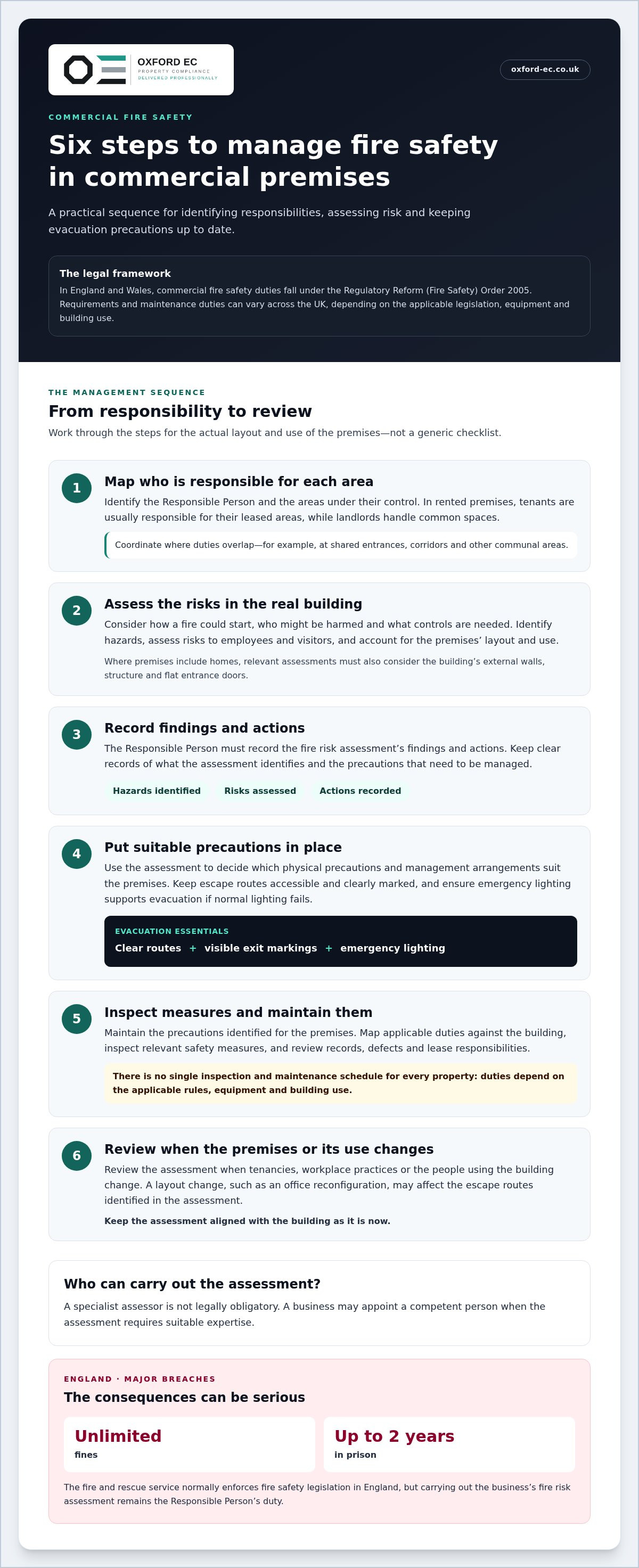
In England and Wales, commercial fire safety legislation falls under The Regulatory Reform (Fire Safety) Order 2005, according to The National Archives (legislation.gov.uk). Businesses operating from non-domestic premises must carry out a suitable and sufficient fire risk assessment to identify hazards and determine appropriate precautions. This is a central part of the commercial property safety regulations in the UK.
Fire risk assessments
A fire risk assessment examines how a fire could start, who might be harmed and what controls the premises needs. It should identify hazards, assess risks to employees and visitors, and set out physical precautions and management arrangements. The Responsible Person must record the assessment’s findings and actions. A specialist assessor is not legally obligatory, but a business may appoint a competent person when the assessment requires suitable expertise.
Review the assessment when tenancies, workplace practices or the people using the building change. Fire precautions should reflect the actual layout and use of the premises, not a generic checklist. For example, a change to an office layout may affect the escape routes identified in the assessment. Commercial property safety regulations in the UK require measures to address the risks identified and be maintained accordingly.
Office and shop fire safety guidance
Fire safety guidance for offices and shops explains practical measures for managing fire risks in these premises. The government’s guidance on fire safety in offices and shops is dated 12 September 2023. Its recommendations can help businesses interpret the duties applying to their workplace, including how to plan for evacuation and manage fire precautions.
Some fire safety guides offer non-statutory best-practice recommendations and may go beyond the Fire Safety Order’s scope. Use the assessment as the basis for deciding which precautions suit the premises. For example, an office’s layout, occupancy and escape arrangements affect the controls it needs. Guidance informs that decision, but does not replace the assessment.
Business fire safety responsibilities
The Responsible Person must carry out and record a fire risk assessment, then put general fire precautions in place and maintain them. In a rented commercial property, tenants are usually responsible for fire safety in their leased areas, while landlords handle common spaces. Clear responsibility is essential, particularly where shared corridors, entrances or other communal areas connect separate units.
Businesses must protect employees and other people visiting the premises. Landlords and tenants should coordinate where responsibilities overlap, so fire precautions work across the whole building. For premises containing two or more domestic premises, the Fire Safety Order also applies to common parts. A fire safety assessment can help identify hazards and required precautions within the relevant areas.
External walls and flat entrance doors
The Fire Safety Act 2021 clarified that the Fire Safety Order covers a building’s external walls, structure and flat entrance doors. These elements must be included in relevant fire risk assessments. This matters where commercial premises form part of a building containing homes, because the assessment must consider how fire risks relate to the wider building.
For example, a Responsible Person assessing common parts should consider relevant external-wall risks and flat entrance doors, not just internal corridors. The assessment should record findings and actions. The building’s structure and layout inform the precautions required, so the review must reflect the specific premises rather than assume every building presents the same risks.
Penalties for safety breaches
In England, major breaches of fire safety regulations can result in unlimited fines and up to 2 years in prison, according to The National Archives (legislation.gov.uk). The consequences make accurate assessments, maintained precautions and clear records central to compliance. A failure to address identified risks can expose people to harm and leave the Responsible Person facing enforcement action.
The fire and rescue service normally enforces fire safety legislation in England, but it cannot carry out a business’s fire risk assessment. That responsibility remains with the Responsible Person. Keep the assessment current, document findings and actions, and maintain the precautions identified for the premises. These records help show how fire risks are managed and which steps remain outstanding.
Responsible Person duties
The Responsible Person must manage fire risk and maintain appropriate precautions in the areas under their control. Property compliance also depends on clear arrangements between occupiers, landlords and managing agents.
Across England, Scotland, Wales and Northern Ireland, inspection and maintenance duties depend on the applicable legislation, equipment and building use. There is no single schedule for every property. To assess compliance, map applicable duties against the premises, inspect relevant safety measures, and review records, defects and lease responsibilities.
Landlord and tenant responsibilities
Landlords and tenants each manage hazards in the areas they control, while cooperating where their responsibilities overlap. This matters because a tenant’s unit may connect to landlord-managed common parts, such as a shared entrance or corridor.
The Responsible Person’s duties can arise from control of the premises, not simply ownership. The Fire Safety (England) Regulations 2022 and section 156 of the Building Safety Act 2022 introduced additional duties under the Fire Safety Order. Landlords and tenants should coordinate measures affecting shared spaces, access and building systems, and record who manages each area.
Compliance duties in leases
Lease terms allocate responsibilities between landlord and tenant, but they do not remove legal duties imposed on those who control workplace areas. This distinction matters when the lease assigns maintenance to one party while another manages day-to-day operations.
Review clauses covering repairs, access, shared facilities and fire precautions alongside who actually controls each area. For example, a tenant may manage hazards inside its unit, while a landlord oversees communal spaces. Document the division, report defects through the agreed process, and coordinate work that could affect other occupiers or evacuation arrangements.
Asbestos management responsibility
The Control of Asbestos Regulations 2012 applies to all non-domestic premises, regardless of the business conducted there. The person with the greatest degree of control must establish whether asbestos is present when responsibility is unclear.
Commercial buildings dating from before the mid-80s may contain asbestos, so property records and the condition of materials matter when planning maintenance. Work that could disturb building fabric requires particular care. Keep information about asbestos accessible to people who may carry out maintenance, and ensure responsibility for managing the risk is explicit. An asbestos management survey can help establish what materials are present and inform ongoing management.
Applicable health and safety laws
The Health and Safety at Work etc. Act 1974, the Workplace (Health, Safety and Welfare) Regulations 1992 and the Management of Health and Safety at Work Regulations 1999 form part of the framework for commercial premises. The Electricity at Work Regulations 1989 also apply to safe workplace electrical work.
These laws address different hazards, so a compliance review should link each duty to the relevant activity, area and responsible person. For example, electrical risks require attention to safe systems of work, while workplace arrangements include the condition and suitability of the premises. Keep evidence of inspections, identified defects and resulting actions together to create an auditable record.
What are the current UK fire safety regulations?
Fire safety regulations require commercial premises to plan for safe evacuation, including for people with disabilities. The fire risk assessment should shape procedures around the building, its occupants and the risks identified.
Disability evacuation policies
An evacuation policy explains how everyone using a workplace can reach safety during a fire. It matters because a standard procedure may not meet an individual’s access or communication needs.
Use the fire risk assessment to identify barriers, such as stairs, narrow exits or alarms that may not alert every occupant. Discuss practical arrangements with people who may need assistance, taking account of their circumstances and the building’s layout. Specify who provides support, how they communicate, and what happens if the usual route is unavailable. Review the arrangements when occupants, work activities or premises change.
Planning must be specific. A procedure that works on a ground floor may not suit an upper-floor office.
Guidance for evacuating disabled people
Evacuation guidance turns the assessment’s findings into clear arrangements for people with different access needs. It matters because effective support depends on the person, the alarm and the route available.
Consider mobility, hearing, vision and communication needs when planning how occupants will respond to an alarm. Explain the procedure in an accessible format and identify how someone can summon assistance. Staff should understand their roles and practise the arrangements, including what to do if a planned route becomes unusable. A fire risk assessment can identify evacuation hazards and the measures needed to address them.
Keep the plan clear and current. Share relevant instructions with staff and anyone responsible for supporting an evacuation.
Safe evacuation procedures
Safe evacuation procedures set out how occupants should respond to an alarm and leave commercial premises. They matter because clear actions can reduce confusion when people need to move quickly.
State how the alarm is raised, which exits are available and where people should assemble. Ensure the fire alarm can be heard clearly throughout the building; consider whether additional communication arrangements are needed for occupants who may not hear it. The government recommends installing and maintaining fire alarm and detection systems in accordance with British Standard BS 5839.
Appoint one or more competent people to assist with fire safety, including evacuation duties, and provide employees with regular fire safety training. Make responsibilities clear for each shift and work area. Practise procedures, record any problems, and update arrangements when building use or occupants change. A suitable procedure links the alarm, accessible instructions and usable escape routes into one coherent plan.
Emergency lighting and escape routes
Emergency lighting helps occupants find exits when normal lighting fails, including during a power cut or fire. Its purpose is practical: to illuminate escape routes, changes of direction and exit signs so people can leave commercial premises safely.
Emergency lighting can help keep escape routes usable if normal lighting fails. The route must also remain clearly marked and accessible, from occupied rooms through corridors to final exits. A stockroom trolley blocking a corridor, for example, can undermine an otherwise suitable escape plan. The Responsible Person should consider the full route, not just the final doorway.
Testing should establish whether equipment works when needed. Commercial emergency lighting should be flick-tested monthly and fully serviced annually. Record each test, note failures and arrange corrective work. A fitting that does not illuminate can leave a route unusable during an emergency. Inspections should cover relevant fittings throughout the premises, including stairs and exit approaches.
A monthly flick test checks that emergency lights operate, while annual servicing provides a fuller review of the system. Keep records with the building’s fire safety documents so recurring faults and completed repairs are traceable. For example, record a failed light on a stair landing with its location and remedial action, rather than treating it as a general lighting issue.
Escape routes must remain unobstructed and suitable for the people using the building. Check that doors open as intended, signs remain visible, and temporary storage or furniture has not narrowed the path. A route through a shared corridor also depends on arrangements between occupiers and whoever manages that common area.
Fire doors and protected staircases help maintain separation along escape routes. The guidance supplied for commercial buildings states that fire doors and fire boarding on escape routes should offer at least 30 minutes of protection. Fire doorsets should be inspected every six months. Damage, altered closers or doors that no longer shut correctly can compromise the route’s protection.
Building alterations can change how people reach an exit. Review escape arrangements when partitions, room use or access routes change, then update signs and emergency lighting coverage where needed. During a walk-through, follow the route from each occupied area to the final exit and look for dark sections, blocked doors or unclear signs. This physical check tests whether the plan works in the actual premises.
What health and safety laws apply to commercial properties in the UK?
Commercial property compliance draws on several laws, each addressing different risks to workers, visitors and building users. The relevant duties depend on the activity, premises and hazards being managed.
Workplace health and safety framework
The Health and Safety at Work etc. Act 1974 sets a central framework for health and safety in UK commercial properties. The Workplace (Health, Safety and Welfare) Regulations 1992 address workplace conditions, whilst the Management of Health and Safety at Work Regulations 1999 cover how employers manage risks.
For a business, these laws mean identifying hazards and organising suitable controls for its work and premises. A practical review might consider safe access, workplace conditions, equipment and the arrangements for employees. The Electricity at Work Regulations 1989 also require employers, self-employed people and employees to ensure electrical work is carried out safely and risks are minimised.
Specific hazards and reporting duties
The Control of Asbestos Regulations 2012 applies to all non-domestic premises, whatever business operates there. People responsible for maintenance need relevant asbestos information before work could disturb building materials. A building’s age, condition and planned work affect how the risk is managed.
Water hygiene is another property risk, particularly where building water systems can create conditions for Legionella. Businesses should assess relevant hazards and put appropriate control measures in place. The Reporting of Injuries, Diseases and Dangerous Occurrences Regulations, known as RIDDOR, concern reportable workplace incidents. Accurate incident records help businesses establish what happened and what action followed.
Accessibility, environment and cooperation
The Equality Act 2010 consolidates existing discrimination legislation, including the Disability Discrimination Act 1995. In property management, accessibility needs should be considered alongside safe use of workplace facilities and routes. For example, an access arrangement that prevents someone using a facility may require attention as part of the business’s compliance duties.
The Environmental Protection Act 1990 covers waste management and rules concerning pollution of land, air and water. Businesses should connect waste handling and pollution controls to the activities taking place on their premises. Occupiers may need to work with others responsible for the building to manage shared risks. This matters where a shared space or building system creates risks across separate units.
Applying the laws to a property
No single inspection schedule covers every commercial building or legal duty. Identify the laws relevant to the premises, then match each hazard to the responsible person, required control and supporting records. For example, electrical risks, asbestos information and workplace access concerns require different checks and evidence.
Local authorities enforce commercial building standards and can conduct audits or issue enforcement notifications for non-compliance. Keep inspection findings, maintenance records and corrective actions organised to show how the business manages identified risks. Review arrangements after changes to the building, its use or workplace activities.
Oxford Environmental Consultants (OEC): Asbestos Management Surveys
Oxford Environmental Consultants (OEC) carries out Asbestos Management Surveys to help those responsible for commercial premises understand asbestos-related risks. This service is relevant when building information is incomplete or maintenance planning requires a clearer picture of materials that could be disturbed.
Survey findings can inform asbestos management and help those controlling the premises share relevant information with maintenance teams. OEC also provides Fire Risk Assessments, Legionella Risk Assessments and Damp & Mould Surveys, addressing other property compliance concerns with services suited to those risks.
For support with asbestos management or related property assessments, contact Oxford Environmental Consultants (OEC) or visit oxford-ec.co.uk.
Make compliance part of ongoing property management
The next step is to turn safety responsibilities into a working property-management process. Assign ownership for inspections and records, then link reviews to changes in occupancy, building use or planned works. This keeps commercial property safety regulations in the UK relevant to how the premises operate, rather than treating compliance as a one-off exercise.
Oxford Environmental Consultants (OEC) supports specific assessment needs through Asbestos Management Surveys, Fire Risk Assessments and Legionella Risk Assessments. These services help property duty holders investigate distinct hazards and inform the measures required for their premises. Start with the risk or compliance question that remains unresolved.
A clear plan, accountable ownership and well-organised records can help you manage property safety with confidence.
Frequently Asked Questions
What is the Health and Safety Executive?
The Health and Safety Executive (HSE) is Great Britain’s national regulator for workplace health and safety. It provides guidance, investigates some workplace incidents and enforces health and safety law within its remit. For a commercial property operator, HSE guidance can help explain how to manage workplace hazards, but it does not replace the duties of employers and those controlling premises. Northern Ireland has a separate health and safety regulator.
Do I need to keep a record of the fire extinguisher testing?
Keep records of extinguisher checks and maintenance so faults, actions and servicing are traceable. The guidance covered in this article advises duty holders to log weekly and monthly equipment checks, and commercial extinguishers should receive annual professional maintenance. A useful entry identifies the extinguisher, inspection date, condition and any defect or corrective action. This helps the person responsible monitor equipment and show how maintenance is managed.
What are a landlord's responsibilities regarding asbestos in buildings?
A landlord responsible for non-domestic premises must ensure asbestos risks are managed, including establishing whether asbestos is present when responsibility is unclear. The Control of Asbestos Regulations 2012 applies regardless of the business operating there. Landlords should make relevant asbestos information available to people planning maintenance or other work that could disturb materials. For example, contractors need relevant building information before drilling into walls or working on ceilings.
What is a fire risk assessment?
A fire risk assessment is a structured examination of fire hazards, who could be harmed and what controls the premises needs. It helps the Responsible Person decide how to manage risks in the building’s actual use. For example, a change from private offices to a customer-facing layout may alter occupancy and evacuation considerations. Record the assessment’s findings and actions, then review it when circumstances change.
What is commercial property compliance?
Commercial property compliance means meeting the legal duties and safety requirements relevant to a building, its use and the people who occupy it. It involves more than a single fire inspection: asbestos, electrical safety, workplace conditions and water hygiene can also require attention. A practical compliance register can link each hazard with the responsible person, evidence of checks and outstanding actions, helping property teams coordinate work across occupied areas.
What should tenants know about fire safety?
Tenants should understand which fire safety responsibilities apply to their leased area and how these connect with shared parts of the building. The lease may describe maintenance and access responsibilities, but control of an area also matters. Request relevant building procedures, know how to report defects, and avoid blocking exits or altering fire doors. Coordinate planned work with the landlord if it could affect shared routes or systems.
What should tenants be aware of if they are concerned about asbestos in their property?
Tenants should avoid disturbing suspect materials and report their location and condition to the landlord or property manager. This is especially relevant before maintenance, drilling or refurbishment, because work can disturb asbestos-containing materials. Request the building’s asbestos information through the established property process and ensure it reaches anyone planning work. If material is damaged, restrict access to the affected area and promptly report the issue to the person managing the premises.
What are the fire safety requirements for UK commercial premises?
Requirements depend on the UK nation and the premises’ risks. England and Wales apply the Regulatory Reform (Fire Safety) Order 2005; Scotland’s requirements are covered by Part 3 of the Fire (Scotland Act) 2005. In Northern Ireland, relevant legislation includes Part 3 of The Fire and Rescue Services (Northern Ireland) Order 2006 and The Fire Safety Regulations (Northern Ireland) 2010. Premises also need suitable precautions, maintained equipment and workable evacuation arrangements.