
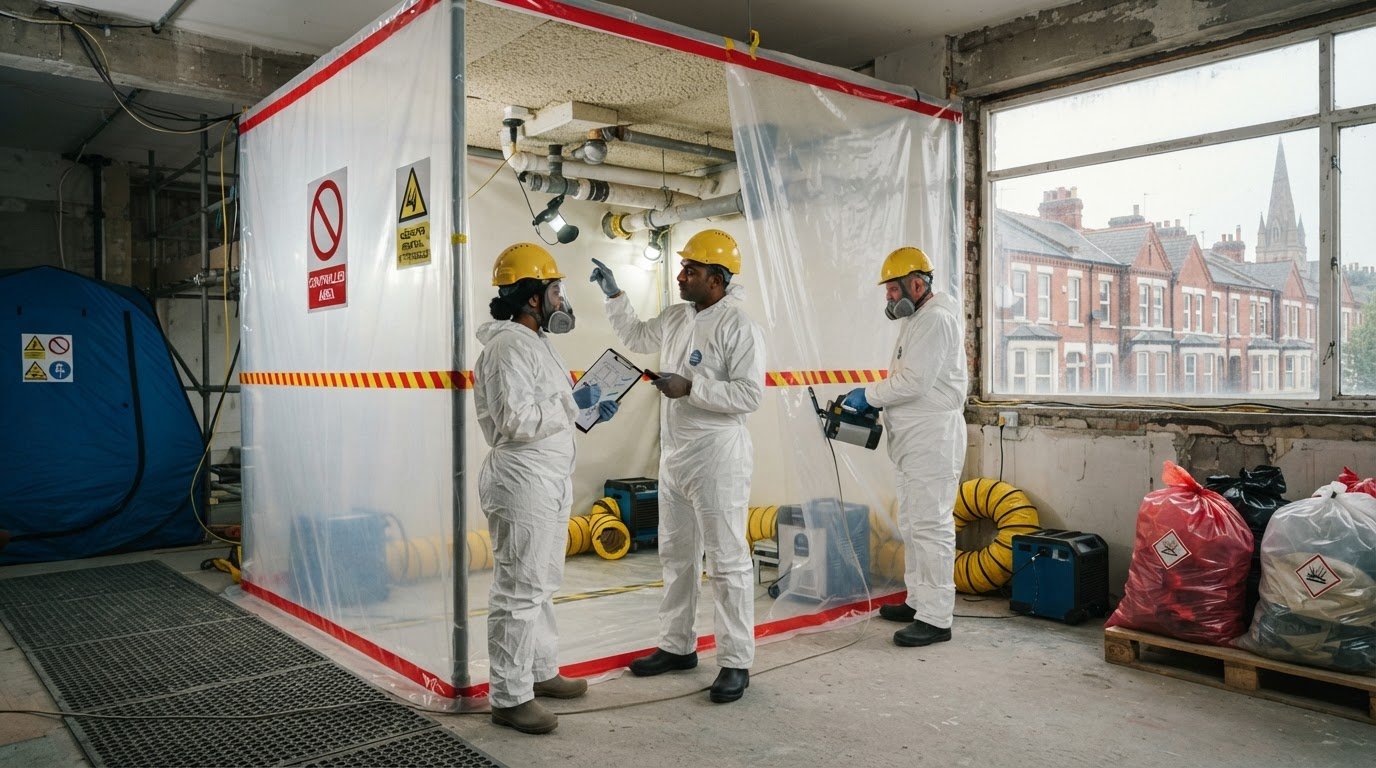
Finding asbestos doesn’t automatically mean removal requires a licensed contractor. The work category does. Understanding the licensed asbestos removal requirements means assessing the material, its condition and the task being planned. These factors determine whether work is licensed, notifiable non-licensed work (NNLW) or non-licensed work.
It’s understandable to be cautious: misclassification can lead to missed notifications, inadequate controls or unsafe exposure during refurbishment. Under the Control of Asbestos Regulations 2012, licensable work must be carried out by an HSE-licensed contractor and generally notified to the relevant enforcing authority at least 14 days before it starts.
This guide explains how to identify the applicable category, what notification, training and protective controls may be required, and how to manage documentation and asbestos waste. It also explains how asbestos consultancy and removal management can help duty-holders plan controlled, documented work, with responsibilities clear before the project begins.
Key Takeaways
- The licensed asbestos removal requirements depend on the material and the work being carried out. Classify the task before setting the removal plan.
- Licensed work generally requires advance notification, defined controls and appropriate training before site activity begins.
- Non-licensed work still requires suitable precautions, competent workers and clear records. The category does not make asbestos safe to disturb.
- Use current survey information and the planned construction scope to identify risks, brief building users and restrict access where needed.
- A structured assess, classify, plan, control, remove and document process helps coordinate responsibilities and maintain compliance.
Table of Contents
- Licensed asbestos removal requirements: when must work be licensed?
- What must happen before licensed asbestos removal begins?
- Licensed versus non-licensed asbestos work: what changes on site?
- How should duty-holders prepare for compliant asbestos removal?
- How can compliant asbestos removal be planned and managed?
Licensed asbestos removal requirements: when must work be licensed?
The licensed asbestos removal requirements depend on the task, not simply on the discovery of asbestos. Under the Control of Asbestos Regulations 2012 (CAR 2012), work with certain asbestos-containing materials (ACMs) is licensable unless a defined exception applies. The material type and condition matter, as do the work method, likely fibre exposure, duration and circumstances. A survey’s material description is a starting point for assessment, not a classification decision on its own.
For a general overview of asbestos, its uses and health effects, see Asbestos. For project planning, an asbestos survey and a clear description of the proposed work help establish what is present and what could be disturbed. Oxford Environmental Consultants provides asbestos consultancy and removal support to help coordinate controlled, documented work.
Which asbestos work usually requires a licence?
Work involving asbestos insulation, sprayed asbestos coatings or asbestos insulating board (AIB) can be licensable. These materials can release hazardous fibres if disturbed, but the material category alone does not determine the legal classification of every task. The work activity, exposure potential and specific conditions must also be considered.
Removing or repairing a material is not automatically classified in the same way as work involving only limited disturbance. Assess the task against the applicable rules and guidance, including any relevant exceptions. Before authorising work, use current HSE guidance in Great Britain or HSENI guidance in Northern Ireland to establish the classification for that specific activity. Don’t rely on a general material label or an example from another job.
How do licensed, notifiable and non-licensed work differ?
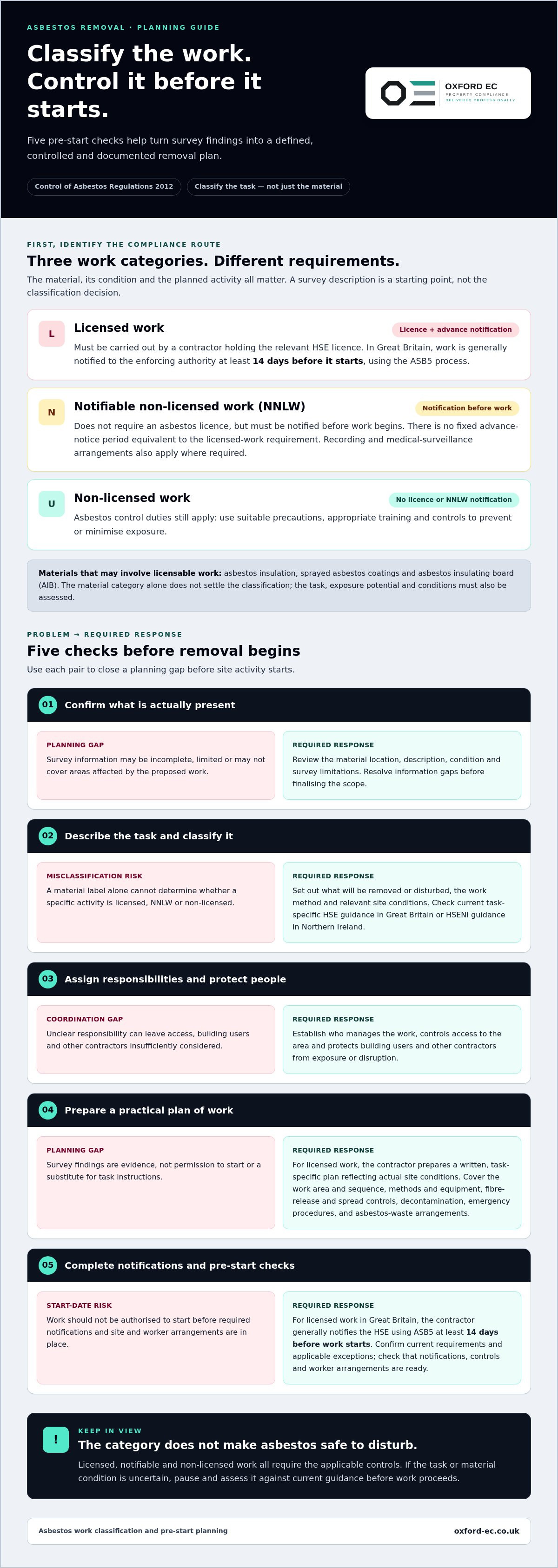
CAR 2012 distinguishes three categories. They are not interchangeable: each has different licensing and notification implications, while suitable controls and training remain essential. In Great Britain, the broad differences are:
- Licensed work: Must be undertaken by a contractor holding the relevant HSE licence. The work must generally be notified to the enforcing authority at least 14 days before it starts, using the ASB5 process.
- Notifiable non-licensed work (NNLW): Does not require an asbestos licence, but must be notified to the enforcing authority before work begins. There is no fixed advance-notice period equivalent to the 14-day requirement for licensed work. Additional requirements apply, including specific arrangements for recording and medical surveillance where required.
- Non-licensed work: Does not require a licence or notification as NNLW, but remains subject to asbestos control duties. Suitable precautions, appropriate training and controls to prevent or minimise exposure are still required.
Asbestos classification depends on the work being carried out, not simply on asbestos being present. If the task or material condition is uncertain, pause and assess it against current task-specific HSE or HSENI guidance before work proceeds. Correct classification establishes the relevant compliance route; it does not replace the need to plan and control the work on site.
What must happen before licensed asbestos removal begins?
Survey findings are essential evidence, but they aren’t permission to start removal. Before work begins, the duty-holder and project team need to turn the findings into a defined scope, confirm the legal category and assign responsibility for each control. This helps prevent the planned method from diverging from the material and conditions actually found on site.
- Review the survey and identify the material. Check the location, material description, condition and any limitations recorded in the survey. If information is incomplete or the proposed work may affect areas not covered, resolve the gap before finalising the scope.
- Define the task and classify it. Describe what will be removed or disturbed, how the work will be done and which site conditions could affect exposure. Confirm whether the task is licensed, notifiable non-licensed work or non-licensed work under the rules for the relevant UK jurisdiction.
- Confirm responsibilities and arrangements. Establish who will manage the work, control access to the area and protect building users and other contractors from exposure or disruption.
- Prepare and communicate the plan of work. The licensed contractor must prepare a written, task-specific plan setting out the removal method, controls and work arrangements. It must reflect actual site conditions and be understood by the people carrying out the work.
- Complete notification and pre-start checks. For licensed work in Great Britain, the contractor generally notifies the HSE at least 14 days before work starts using the ASB5 process. Confirm the current requirements and any applicable exceptions before scheduling. Do not authorise the start until required notifications, site controls and worker arrangements are in place.
What should the plan of work cover?
The plan should give workers practical instructions, not simply repeat the survey. It should identify the work area and removal sequence, methods and equipment, measures to prevent fibre release or spread, and arrangements for decontamination. It should also cover relevant emergency procedures and how asbestos waste will be contained and managed. Brief the site team on the plan, including what to do if conditions differ from those anticipated. Stop and reassess if the material, access or work area does not match the documented assumptions.
What training, notification, and health requirements apply?
Licensed, NNLW and non-licensed work carry different duties. Licensed work requires the appropriate HSE licence and advance notification in Great Britain. NNLW has its own notification and additional control requirements, while non-licensed work still requires suitable precautions. Training must be appropriate to the work, and medical surveillance and health records apply according to the category and relevant legal requirements. In Northern Ireland, check HSENI requirements rather than assuming Great Britain’s process applies. The Health and Safety Executive (HSE) guidance on asbestos sets out current guidance for Great Britain. Verify the applicable authority’s forms and deadlines before arranging work.
Oxford Environmental Consultants provides asbestos consultancy and removal support to help duty-holders coordinate project information and responsibilities. Explore asbestos consultancy and removal support.
Licensed versus non-licensed asbestos work: what changes on site?
The work category shapes site arrangements: who may carry out the task, whether notification is required, and which controls and records apply. The licensed asbestos removal requirements do not prescribe one universal removal method. Different materials, conditions and activities create different risks, so controls must match the work and be set out before it starts.
Use this comparison as a high-level guide, not as a substitute for classifying the specific task under current guidance. In Great Britain, HSE is the enforcing authority in most cases; HSENI is responsible in Northern Ireland.
| Work category | Licence and notification | Training, controls and records |
|---|---|---|
| Licensed work | An appropriately licensed contractor is required. Work is generally notified to the relevant enforcing authority in advance. | Requires task-specific controls, suitable protective equipment and arrangements to prevent fibre spread. The plan of work and required records should reflect the task and applicable rules. |
| Notifiable non-licensed work (NNLW) | No asbestos licence is required, but the work must be notified before it begins. | Additional requirements may apply, including medical surveillance and records. Appropriate training and controls remain necessary. |
| Non-licensed work | No licence or NNLW notification is generally required. | Work remains regulated. Appropriate training, precautions and exposure controls are still required, with records kept where applicable. |
Notifiable non-licensed work requires notification but not an asbestos licence; licensed work requires both a licensed contractor and advance notification. Notification does not replace risk assessment, training or precautions. The absence of a notification duty does not make work safe without suitable controls.
What controls apply while licensed work is carried out?
Control the work area so unauthorised people cannot enter and fibres are not carried into occupied or adjacent areas. The contractor’s method should specify suitable equipment and protective measures, including how exposure and contamination will be prevented, how workers will decontaminate, and how waste will be contained. The precise arrangements depend on the material, work method and site. A controlled work area, clear access restrictions and communication with building users and nearby trades help protect people who are not carrying out the removal.
Don’t assume every ACM can be removed using one standard procedure. A method suitable for one material or condition may be unsuitable for another. Only competent, authorised workers should undertake asbestos work.
What changes for notifiable or non-licensed work?
For NNLW, the employer must meet applicable notification duties and maintain required records, including relevant health records and medical surveillance arrangements where required. Non-licensed tasks also need suitable controls and training. The precise measures depend on the activity and current HSE or HSENI guidance. Oxford Environmental Consultants’ asbestos removal support helps duty-holders coordinate work planning and compliance documentation.
How should duty-holders prepare for compliant asbestos removal?
Preparation turns survey findings into practical site arrangements. Before authorising work, make sure the proposed scope matches the evidence, affected people know what is happening, and responsibilities are recorded. Existing survey information can support this review; this asbestos management survey guide explains how survey records help identify and manage known materials.
Use this readiness checklist before scheduling work:
- Check the survey against the intended works. Confirm the material’s location and condition, and whether the proposed removal or refurbishment will disturb it. If the work extends beyond the areas assessed, pause to resolve the information gap. An intrusive refurbishment or demolition survey may be necessary before work affecting the building fabric can be properly planned.
- Define the scope and sequence. Record what will be removed, the work area, interfaces with other construction activities and assumptions that could affect the method. Align the scope with the applicable work category and the contractor’s plan.
- Assign responsibilities. Make clear who authorises the work, manages access, communicates changes and keeps project records. Share relevant asbestos information with contractors whose activities could intersect with the work.
- Protect building users. Identify occupants and neighbouring work areas that could be affected. Set access restrictions, agree how the controlled area will be marked, and explain when people must keep clear and whom to notify if site conditions change.
What should the duty-holder check before work is authorised?
Check that the survey findings, removal scope and planned construction activity align. Document access arrangements and communication responsibilities, including how workers and building users will be told about boundaries or changes. If a survey does not cover the intended intrusive work, don’t treat it as clearance to proceed. Resolve the gap and update the project information before authorising the work.
How should asbestos waste and project records be managed?
Asbestos waste needs secure packaging, suitable labelling and controlled transfer through authorised waste arrangements. In Great Britain it is classified as hazardous waste and must be taken by a registered upper-tier waste carrier to a licensed disposal facility. A hazardous waste consignment note tracks its movement, and the record must be retained for at least three years. Waste terminology, classification procedures and documentation differ across UK jurisdictions, so confirm current requirements with the relevant environmental authority, including the arrangements that apply in Northern Ireland.
Keep the survey, agreed scope, work plan, notification evidence where applicable, communications and waste records together in the project file. This creates an audit trail of what was planned, controlled and removed. Oxford Environmental Consultants provides asbestos consultancy and removal support to help duty-holders coordinate these project requirements.
How can compliant asbestos removal be planned and managed?
A compliant project follows a clear sequence: assess, classify, plan, control, remove and document. Each stage informs the next. The duty-holder coordinates the project and ensures relevant information reaches those responsible for the work. The removal method and controls must reflect the task and site conditions. This creates a traceable process rather than treating removal as an isolated activity.
In practice, the sequence means:
- Assess: Bring together survey findings, building information and the planned construction scope. Identify gaps or changes that could affect the work.
- Classify: Establish the correct work category and resulting legal and control requirements before agreeing the programme.
- Plan: Define responsibilities, work boundaries, communication arrangements and how the project will respond to unexpected conditions.
- Control: Put the agreed site measures in place, including access restrictions and coordination with occupants and other contractors.
- Remove: Ensure competent people undertake the work, with licensed work carried out by a contractor holding the required HSE licence.
- Document: Collect relevant completion and waste records, and update property information for future decisions.
Specialist asbestos consultancy can help connect these steps. Oxford Environmental Consultants provides consultancy and facilitates and manages safe asbestos removal, supporting duty-holders with project coordination and compliance information. Its asbestos consultancy and removal services support a planned, documented approach while keeping project management distinct from the statutory licence required for licensed work.
What does a controlled removal project look like?
Responsibilities are agreed before work begins: who manages the site, controls access, communicates with building users and keeps project records. Controls are documented, briefed and coordinated with other planned work. If the material, access arrangements or scope differ from the assumptions in the work plan, review the change before the task continues. Clear communication keeps the project aligned from preparation through completion.
What evidence should be retained after work is complete?
Keep project records together, including relevant survey information, the agreed scope, work and notification records where applicable, waste transfer documentation and completion evidence. For licensed removal, records should also include applicable clearance documentation. The file shows what was undertaken and supports later maintenance, refurbishment and duty-holder decisions. Retain waste records for the period required by the applicable rules, which can vary by UK jurisdiction.
Oxford Environmental Consultants helps duty-holders coordinate asbestos compliance planning and removal management. Discuss asbestos compliance support.
Set the next project up for compliant delivery
Before fixing a refurbishment programme or granting access for intrusive work, make asbestos planning part of project decision-making, not a last-minute check. Set an approval point where the scope, property information and responsibilities are reviewed together. If the work changes, pause and revisit the arrangements before proceeding. This helps protect people and reduce the risk of avoidable disruption.
Applying the licensed asbestos removal requirements to a real project can involve several parties and overlapping property duties. Oxford Environmental Consultants provides UK-wide property compliance consultancy, with asbestos consultancy and removal management support to help duty-holders coordinate their next steps. A well-managed project starts with clear information and accountable decisions.
With the right planning in place, you can move forward with greater clarity and confidence.
Frequently Asked Questions
Is a licence always required for asbestos removal?
No. The licensed asbestos removal requirements depend on the material, task, potential exposure and conditions on site. Work falls into licensed, notifiable non-licensed or non-licensed categories, each with relevant controls. The classification can differ depending on whether work involves disturbing a material or only working nearby. Don’t decide from a material name alone: check current HSE guidance in Great Britain or HSENI guidance in Northern Ireland before authorising the task.
Can a property owner remove asbestos themselves?
Property ownership doesn’t determine whether asbestos removal is permissible or safe. The work category, material condition, potential exposure and applicable legal controls determine who may carry out a task and what precautions apply. Some work requires an appropriately licensed contractor; other categories still require suitable training and controls. Never disturb material you suspect contains asbestos. Arrange a competent assessment first, and follow current guidance for the UK jurisdiction where the property is located.
How much notice is required before licensed asbestos removal?
In Great Britain, licensed asbestos work generally needs to be notified to the HSE at least 14 days before it starts, using the applicable ASB5 process. Exceptions or different arrangements may apply, so verify current rules, forms and the responsible authority before setting a start date. Northern Ireland has its own enforcing authority, HSENI. Notification is one compliance step only; it doesn’t replace the required work plan, controls or other legal duties.
What happens if asbestos is disturbed before removal is planned?
Stop the work and prevent people entering the affected area. Don’t sweep, vacuum or handle debris, as these actions could spread fibres. Tell the responsible duty-holder and obtain competent advice on securing the area and assessing possible exposure. The response depends on what was disturbed and the circumstances. Record what happened, who may have been present and what immediate measures were taken. Follow current HSE or HSENI guidance, and don’t restart until appropriate controls are established.
What is the difference between licensed and notifiable non-licensed asbestos work?
Licensed work must be carried out by a contractor holding the relevant HSE licence and is generally subject to advance notification. Notifiable non-licensed work does not require that licence, but notification and additional duties, such as training, medical surveillance or record-keeping, may apply. These categories aren’t interchangeable. A task involving an ACM isn’t automatically licensed simply because asbestos is present; the specific work and exposure risk need competent classification under current guidance.
Does licensed asbestos removal require a plan of work?
Yes. Licensed asbestos work requires a written plan of work tailored to the task and site. It should explain the removal method, equipment, exposure controls, work-area access, decontamination and emergency arrangements where relevant. Workers need to understand the instructions before the job starts. If site conditions or the scope changes, review and communicate the plan again. A survey report informs this document, but it doesn’t replace it or authorise work by itself.
What happens to asbestos waste after removal?
Asbestos waste must be securely packaged, appropriately labelled and managed through authorised transport and disposal arrangements. It must not go into ordinary household or commercial waste. Waste classification and paperwork vary across the UK, so establish which rules apply in the project’s jurisdiction. Retain the relevant transfer or consignment documentation as required. In Great Britain, hazardous waste consignment notes are used where applicable; confirm current requirements with the relevant environmental authority.