
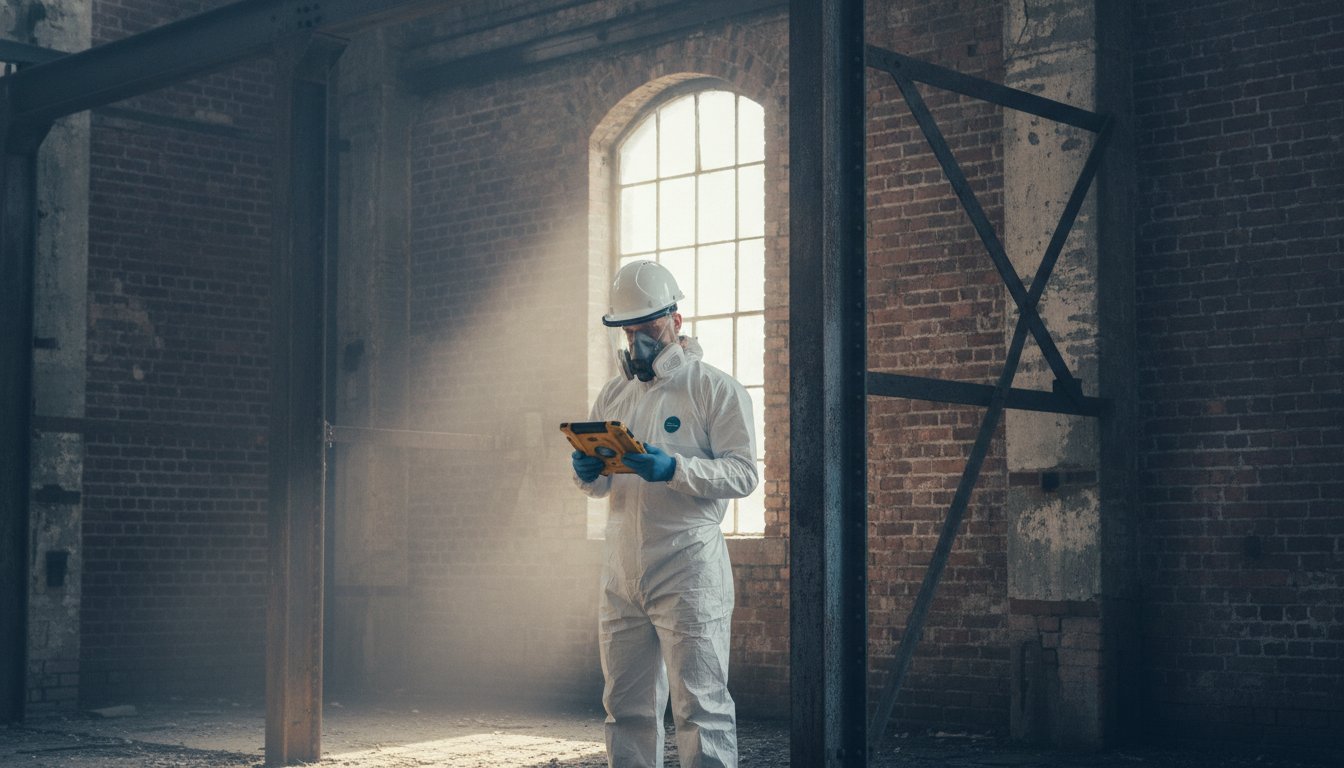
An asbestos demolition survey is not merely a preliminary check; it's a forensic engineering requirement that serves as the final barrier between a successful project and a catastrophic HSE intervention. Precision. Accountability. Compliance.
You likely recognise that the discovery of hidden asbestos-containing materials mid-demolition can trigger immediate site closures, substantial fines, and irreversible damage to your professional reputation. This comprehensive guide provides the technical mastery needed to navigate the Control of Asbestos Regulations 2012 (CAR 2012) alongside the 2026 HSE updates, ensuring your UK property project remains fully compliant whilst protecting the safety of every operative on-site. By understanding the rigorous, intrusive nature of these surveys, you can secure accurate cost forecasting for removal and eliminate the anxiety of unforeseen delays.
We shall examine the critical technical differences between management and demolition surveys, the legal necessity of independent analyst verification for four-stage clearances, and the strategic implementation of HSG 264 standards to guarantee a safe, audit-ready environment for total structural removal.
Key Takeaways
- Understand the stringent legal obligations under the Control of Asbestos Regulations 2012 and the 2026 HSE updates to shield your project from regulatory intervention.
- Recognise why an asbestos demolition survey necessitates a fully intrusive, destructive methodology that can only be executed within vacant premises to uncover hidden hazards.
- Differentiate between the distinct scopes of management, refurbishment, and demolition surveys to ensure your compliance strategy aligns with your specific structural objectives.
- Prepare for successful site logistics by establishing vacant possession and gathering historical building data to facilitate a thorough forensic inspection.
- Utilise your survey findings to develop a robust asbestos removal programme that ensures safety and precision during the final demolition phase.
Table of Contents
- What is an Asbestos Demolition Survey? UK Legal Requirements 2026
- The Methodology of Fully Intrusive and Destructive Inspections
- Comparing Asbestos Surveys: Management, Refurbishment, and Demolition
- Preparation and Logistics for a National Demolition Survey Programme
- Managing Post-Survey Outcomes: Removal and Safe Demolition
What is an Asbestos Demolition Survey? UK Legal Requirements 2026
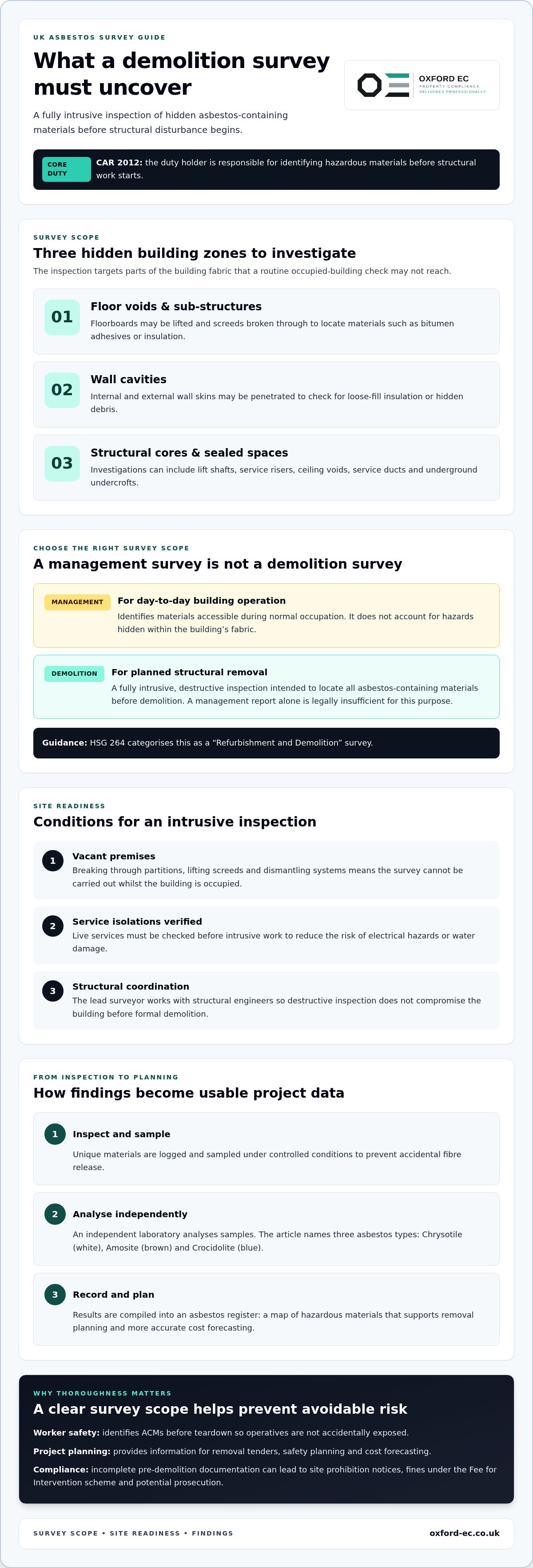
An asbestos demolition survey is a critical forensic engineering requirement that serves as the final barrier between a successful project and a catastrophic HSE intervention. Precision. Protection. Certainty. Under the Control of Asbestos Regulations 2012 (CAR 2012), the duty holder bears absolute responsibility for identifying hazardous materials before structural disturbance begins. The demolition survey is a fully intrusive, destructive inspection required to locate all ACMs within a building's fabric. Gaining a technical grasp of What is Asbestos? provides the essential context for why these surveys are non-negotiable for structural safety.
Whilst Asbestos Management Surveys are sufficient for day-to-day building operation, they are legally insufficient for demolition. A management survey only identifies materials accessible during normal occupation; it does not account for the hidden hazards buried deep within the building's infrastructure. If you rely on a baseline management report for a demolition project, you risk breaching CAR 2012 and exposing workers to lethal fibres.
The Core Purpose of Destructive Inspection
Identify. Quantify. Manage. The primary objective of an asbestos demolition survey is to ensure that no operative is accidentally exposed to asbestos during the teardown process. This requires a systematic, aggressive approach to uncovering materials that remain invisible to the naked eye. The survey specifically targets:
- Floor Voids and Sub-structures: Lifting floorboards and breaking through screeds to locate bitumen adhesives or insulation.
- Wall Cavities: Penetrating internal and external skins to identify loose-fill insulation or hidden debris.
- Structural Cores: Investigating lift shafts, service risers, and ceiling voids that are otherwise sealed.
By conducting these inspections before work begins, you provide the data necessary for an accurate asbestos removal tender. This eliminates the "hidden costs" that often plague demolition projects, allowing for precise financial forecasting and site safety planning.
Legislative Framework: HSG 264 and the Duty to Manage
The Health and Safety Executive (HSE) categorises these inspections under the HSG 264 guidance as a "Refurbishment and Demolition" survey. In the 2026 regulatory environment, the focus has shifted towards stricter enforcement of pre-demolition documentation. The HSE expects a level of scrutiny that matches the risk; a superficial report will not withstand a site audit. Failure to provide a comprehensive asbestos demolition survey can result in immediate site prohibition notices, substantial fines under the Fee for Intervention (FFI) scheme, and potential criminal prosecution for the duty holder. It's a matter of absolute accountability where there's no room for technical ambiguity.
The Methodology of Fully Intrusive and Destructive Inspections
An asbestos demolition survey requires a level of physical intervention that far exceeds standard inspection protocols. Intrusive. Destructive. Definitive. This methodology aligns with the UK Asbestos Survey Guidance, demanding that every part of the building's fabric is accessed, regardless of the damage caused to the structural finish. Because the survey involves breaking through partitions, lifting floor screeds, and dismantling mechanical systems, it's impossible to conduct these works whilst the building is occupied. The lead surveyor must work in close coordination with structural engineers to ensure that the destructive elements of the inspection don't compromise the integrity of the building before the formal demolition phase commences.
Accessing Hidden Voids and Fabric
Surveyors utilise a range of heavy-duty tools, including reciprocating saws and industrial drills, to penetrate claddings and partitions that have remained sealed for decades. Scrutiny. Access. Discovery. The process involves methodical entry into lift shafts, service ducts, and underground undercrofts where asbestos insulation or debris often lingers. Managing the risk of damaging live services is a primary concern; surveyors must verify service isolations before commencing intrusive works to prevent electrical hazards or water damage. Every unique material encountered, from textured coatings to hidden pipe gaskets, is logged for sampling to ensure no ACM remains unidentified. If you require expert guidance on managing these complex site logistics, you should speak with our consultancy team to ensure your project remains on schedule.
Sampling, Analysis, and Laboratory Reporting
The collection of samples is executed under controlled conditions to prevent the accidental release of airborne fibres into the environment. Containment. Precision. Verification. Each sample is analysed in an independent laboratory to determine the specific asbestos type, such as Chrysotile (white), Amosite (brown), or Crocidolite (blue), which dictates the complexity of the subsequent removal programme. This data is then compiled into a comprehensive asbestos register, providing the demolition contractor with a definitive map of all hazardous materials. This forensic level of detail is essential for accurate cost forecasting and ensures that the removal phase is tailored to the specific risks identified within the structural fabric.
Comparing Asbestos Surveys: Management, Refurbishment, and Demolition
Precision. Scope. Intent. Selecting the correct inspection protocol is fundamental to maintaining alignment with the Control of Asbestos Regulations 2012. Whilst many duty holders mistakenly group these surveys together, the technical requirements for an asbestos demolition survey are far more rigorous than those for management or targeted refurbishment works. The "presumption" rule remains a critical pillar of UK compliance; if a material cannot be accessed or sampled, it must be presumed to contain asbestos until proven otherwise. This ensures a "safety-first" framework that prevents accidental exposure during high-risk structural teardowns.
Management vs. Demolition: The Depth Gap
Condition. Risk. Occupation. A management survey is designed to facilitate the safe, ongoing use of a building by identifying materials that could be disturbed during normal activities. In contrast, an asbestos demolition survey is concerned solely with the presence and volume of ACMs, irrespective of their current condition. It is a common misconception that a management report can be "upgraded" through a simple desk study; however, the destructive nature of a demolition survey requires a fresh site visit to penetrate structural elements that were previously off-limits. Without this forensic level of physical investigation, the survey fails to meet the legal standard required for total structural removal.
Refurbishment vs. Demolition: Target vs. Total
Specific. Targeted. Comprehensive. The primary distinction between these two intrusive surveys lies in the geographic scope of the inspection. An Asbestos Refurbishment Survey is strictly limited to the specific areas affected by a planned renovation, such as a single floor or a specific service riser. Conversely, a demolition survey must cover the entire building footprint, including foundations, roof structures, and external cladding. Choosing the correct survey based on your project scope is essential for avoiding the unnecessary costs of over-surveying whilst ensuring that no area of the building remains a "blind spot" for the demolition contractor. Ensuring this clarity from the outset positions the duty holder as an accountable partner in the wider safety supply chain.
Preparation and Logistics for a National Demolition Survey Programme
Vacant. Secure. Prepared. Executing a national asbestos demolition survey programme requires meticulous logistical planning to ensure the safety of surveyors and the validity of the final report. The most critical requirement is 'Vacant Possession'; the building must be entirely empty of occupants and other trades to facilitate the destructive nature of the inspection. Any presence of unauthorised personnel not only compromises health and safety but also restricts the surveyor's ability to access structural cores and floor voids, leading to incomplete data and potential project failure.
Gathering historical building data is an essential preliminary step that shouldn't be overlooked. This includes reviewing previous management surveys, site plans, and architectural drawings to identify areas of high risk or historical 'over-boarding' where new materials were simply placed over older, potentially hazardous ones. This data ensures the survey aligns with the broader asbestos consultancy requirements, providing a baseline for the forensic investigation. Provision must also be made for safe access to all areas, including the installation of scaffolding or mobile elevating work platforms (MEWPs) to reach high-level soffits and roof structures that are otherwise inaccessible.
Site Safety and Isolation Requirements
Isolate. Protect. Audit. Before the intrusive inspection begins, all services including electricity, gas, and water must be professionally isolated to prevent accidental strikes during structural penetration. Providing a secure site perimeter is equally vital to prevent unauthorised access whilst destructive works are underway. For complex sites, we often coordinate with Fire Risk Assessment teams to ensure that the survey activities don't inadvertently compromise fire compartmentation or emergency escape routes in adjacent occupied sections of a larger property complex.
Defining the Survey Scope and Constraints
A significant danger in demolition planning is the inclusion of 'Limited Access' caveats in the report. These caveats undermine the legality of the asbestos demolition survey and create hidden risks for the demolition contractor. You must clearly communicate the intended demolition methods, whether high-reach machinery or hand-stripping, to the surveyor so they can tailor their intrusive techniques accordingly. The survey must be exhaustive, covering external elements like gutters, cement roofs, and subterranean foundations to ensure no ACM remains to cause a site closure or HSE intervention later in the programme.
Managing Post-Survey Outcomes: Removal and Safe Demolition
The completion of an asbestos demolition survey marks the critical transition from forensic investigation to active risk mitigation. It's not a static document. It's a strategic asset. The survey report, specifically the asbestos register and detailed site drawings, provides the definitive blueprint for structural clearance. By accurately identifying the location, type, and extent of ACMs, the duty holder can move from scrutiny to a controlled removal phase without the risk of mid-project discoveries. Oxford Environmental Consultants (OEC) provides the essential Asbestos Consultancy Services required to bridge the gap between initial discovery and safe site handover, ensuring that every legislative requirement is met with absolute precision.
From Survey Report to Removal Tender
Clarity. Budget. Accountability. A high-quality survey allows you to secure fixed-price quotes from removal contractors, effectively eliminating the financial volatility often associated with "provisional sums" in demolition contracts. It's essential to distinguish between licensed work, which requires a 14-day HSE notification via an ASB5 form, and non-licensed or NNLW tasks. For detailed financial planning and to align your procurement with 2026 market rates, you should consult our guide on Asbestos Removal Cost UK. This ensures your removal programme is both technically robust and commercially viable.
The Final Handover: Ensuring an Asbestos-Free Site
Verification. Safety. Finality. Once the removal contractor completes their work, the site must undergo a rigorous "Four-Stage Clearance" process. This is a mandatory requirement for licensed work, and in 2026, the HSE continues to emphasise that the analyst must be appointed independently by the client, not the removal contractor. This independence guarantees an unbiased assessment of the site's cleanliness. The surveyor verifies that every ACM identified in the initial asbestos demolition survey has been successfully extracted according to the agreed scope.
Upon successful air monitoring and a thorough physical inspection, a "Certificate of Reoccupation" or a "Cleanliness Certificate" is issued. This document serves as the legal evidence that the building is safe for the demolition team to begin structural teardown. The duty holder's final responsibility involves updating the site's health and safety file, ensuring a transparent audit trail for all stakeholders. This disciplined approach provides peace of mind, confirming that the property is entirely clear of hazardous fibres before the first machine enters the site.
Securing Your Project Lifecycle Through Regulatory Mastery
A rigorous asbestos demolition survey is the cornerstone of any successful teardown project, providing the technical certainty required to navigate the 2026 HSE landscape. By moving beyond baseline management checks and embracing fully intrusive forensic inspections, you eliminate the risk of unforeseen delays and catastrophic safety breaches. This disciplined approach ensures your project remains in full alignment with HSG 264 standards whilst protecting your workforce and your commercial reputation.
Effective compliance isn't just about identifying hazards; it's about managing the entire transition from discovery to final site clearance. With national coverage across the United Kingdom and comprehensive property compliance expertise, Oxford Environmental Consultants (OEC) acts as your safe pair of hands for even the most complex structural requirements. We provide the precise data needed for accurate removal tenders and the authoritative oversight required for a safe site handover.
Your path to a compliant, asbestos-free site starts with meticulous planning and uncompromising standards.
Frequently Asked Questions
Is an asbestos demolition survey a legal requirement for all buildings?
Yes, an asbestos demolition survey is a legal requirement for any building constructed before the year 2000 that is slated for total teardown. The Control of Asbestos Regulations 2012 (CAR 2012) mandates that duty holders identify all hazardous materials within the structural fabric before work begins. Failing to commission this survey constitutes a breach of health and safety law, potentially leading to site prohibition notices and heavy fines from the HSE.
Can we stay in the building whilst a demolition survey is carried out?
No, you cannot remain in the building whilst a demolition survey is being performed. These inspections are fundamentally destructive and involve breaking through walls, lifting floors, and dismantling ceilings to access hidden voids. The process creates significant physical hazards and potential fibre release, necessitating vacant possession. For safety and precision, the premises must be entirely clear of occupants and other trades to allow for a thorough forensic investigation.
How long does an asbestos demolition survey take to complete?
The duration of a survey depends entirely on the building's scale, structural complexity, and historical additions. A small commercial unit might take two to three days, whereas large industrial complexes or multi-storey office blocks can require several weeks of on-site investigation. We provide a detailed project timeline after reviewing your site plans, ensuring that the forensic inspection is completed without compromising the depth of the structural analysis.
What is the difference between a refurbishment and a demolition survey?
The primary difference lies in the geographic and structural scope of the inspection. A refurbishment survey is targeted specifically at the areas affected by a planned renovation, such as a single room or service riser. Conversely, a demolition survey is a comprehensive, building-wide inspection that covers the entire footprint, including foundations and roof structures. It's designed to ensure no hazardous materials remain before the total structural teardown commences.
Do I need a survey if the building was constructed after 2000?
Technically, buildings constructed after the year 2000 don't legally require an asbestos survey because the use of asbestos was banned in the UK in late 1999. However, caution is advised for projects involving buildings completed on the cusp of this date. If you're unsure of the exact build date or if there's a risk that older materials were used during construction, a precautionary inspection can provide the necessary legal protection.
What happens if the surveyor finds asbestos that wasn't in our management survey?
If the surveyor identifies new materials, the asbestos register is updated to reflect these findings. This is a common occurrence because an asbestos demolition survey is far more intrusive than a standard management check. These hidden ACMs, often found in wall cavities or floor screeds, are then incorporated into the licensed removal programme. Identifying these hazards early prevents accidental exposure and ensures your project remains in full compliance with HSE standards.
How much does an asbestos demolition survey cost for a commercial property?
Costs vary significantly based on the property's size, age, and the level of intrusion required to access structural cores. Factors such as the number of samples required and the necessity for specialist access equipment, like scaffolding, also influence the final investment. Whilst we don't provide fixed industry averages here, we offer bespoke quotations tailored to the specific requirements of your demolition project to ensure full budgetary transparency.
Can a demolition contractor carry out their own asbestos survey?
A demolition contractor can technically commission the survey, but the HSE strongly recommends using an independent consultancy to avoid conflicts of interest. The surveyor must be a competent person with the necessary training and experience to conduct intrusive inspections. Appointing an independent expert ensures that the results are impartial, providing a safe pair of hands that protects the duty holder from the risks of inadequate or biased reporting.