Water systems in commercial and residential properties present complex health risks that demand specialist attention. From Legionella bacteria thriving in poorly maintained cooling towers to biofilm accumulation in neglected pipework, the consequences of inadequate water management extend far beyond regulatory non-compliance. Property managers, facility directors and building owners must navigate an intricate landscape of legal obligations, technical standards and public health considerations. Understanding how professional water hygiene services address these challenges is essential for anyone responsible for building safety in 2026.
The Critical Role of Water Hygiene Services in Building Management
Water hygiene services encompass the systematic control, monitoring and maintenance of water systems to prevent microbial contamination and protect occupant health. These services operate at the intersection of public health legislation, engineering standards and risk management protocols.
The scope extends across multiple domains: hot and cold water distribution systems, cooling towers, evaporative condensers, spa pools, decorative fountains and even emergency shower installations. Each system presents distinct challenges requiring tailored intervention strategies.
Legislative Framework Driving Service Demand
The Health and Safety at Work etc. Act 1974 establishes the fundamental duty of care that underpins all water safety obligations in the UK. The Control of Substances Hazardous to Health Regulations 2002 (COSHH) specifically address biological agents in workplace water systems, including Legionella bacteria.
ACoP L8 (Approved Code of Practice) provides authoritative guidance on the legal duties under COSHH. Compliance is not optional-duty holders must identify and assess risks, implement control measures, maintain accurate records and verify effectiveness through regular monitoring. The Health and Safety Executive's enforcement approach in 2026 reflects increased scrutiny following several high-profile outbreaks.
For residential landlords, the Landlord and Tenant Act 1985 creates parallel obligations regarding fitness for habitation, which courts have interpreted to include water safety provisions. Social housing providers face additional requirements under the Social Housing (Regulation) Act 2023, with water quality explicitly captured within consumer standards.

Core Components of Professional Water Hygiene Services
Effective water management programmes comprise multiple interdependent elements, each requiring specialist expertise and methodical execution.
Legionella Risk Assessments
A compliant Legionella risk assessment follows the methodology outlined in BS 8580-1:2019 and HSG274. The process involves:
- Site survey and system identification – mapping all water outlets, storage vessels, pipework distribution and ancillary equipment
- Hazard characterisation – evaluating temperatures, flow patterns, stagnation risks and nutrient sources
- Population vulnerability assessment – considering occupant demographics, immunocompromised individuals and exposure pathways
- Control measure specification – defining temperature regimes, flushing protocols, cleaning schedules and monitoring frequencies
- Scheme of control documentation – producing the written plan required under L8
Professional water hygiene services deliver these assessments with schematic diagrams, photographic asset registers and prioritised action plans. The document becomes the foundation for all subsequent control activities.
| Assessment Component | Standard Requirement | Typical Output |
|---|---|---|
| Water system mapping | All outlets identified | Annotated floor plans |
| Temperature surveying | Representative monitoring points | Data logger records |
| Risk scoring | Numerical rating methodology | Priority matrix |
| Control recommendations | Specific, measurable actions | Costed remedial schedule |
Temperature Monitoring and Control
Legionella bacteria proliferate between 20°C and 45°C, with optimal growth at 37°C. Effective control therefore depends on maintaining water outside this range: hot water stored above 60°C and distributed above 50°C at outlets within one minute, cold water stored and distributed below 20°C.
Professional services implement systematic monitoring programmes using calibrated equipment. Monthly checks at sentinel outlets verify that engineered controls remain effective. Deviations trigger investigation protocols and corrective action before bacterial amplification occurs.
Modern water hygiene services increasingly incorporate continuous monitoring technology, with wireless sensors providing real-time temperature data accessible through cloud platforms. This approach enables immediate anomaly detection and audit-trail documentation.
Sampling, Analysis and Microbiological Testing
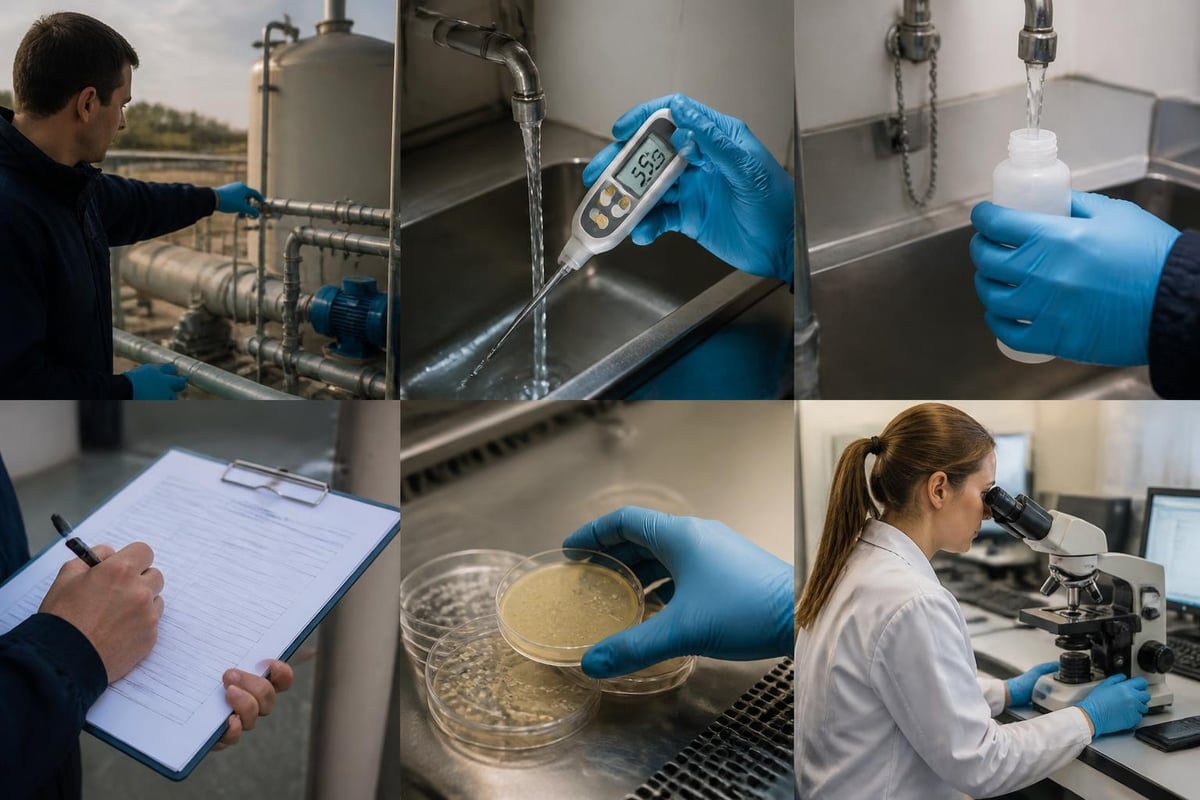
Laboratory analysis provides direct evidence of water system condition and control effectiveness. Water hygiene services coordinate sampling programmes aligned to risk assessment findings and regulatory expectations.
Sample Types and Testing Parameters
Different microbiological parameters serve distinct purposes within a comprehensive monitoring strategy:
- Legionella species enumeration – detects and quantifies Legionella pneumophila and other species, with results expressed as colony-forming units per litre (cfu/L)
- Total viable count (TVC) – indicates overall bacterial population and system cleanliness
- Pseudomonas aeruginosa – identifies another opportunistic pathogen, particularly relevant in healthcare environments
- Temperature profiling – verifies thermal control regime effectiveness
UKAS-accredited laboratories employ culture-based methods per BS 7592:2008 and ISO 11731. Results interpretation requires expertise-elevated Legionella counts demand immediate action, but negative results do not confirm absolute safety when sampling limitations and statistical confidence intervals are considered.
The World Health Organization's water quality monitoring guidance emphasises the importance of regular testing as part of comprehensive water safety plans.
Interpreting Results and Response Protocols
Action thresholds defined in HSG274 guide response to sample results:
- Below 100 cfu/L: system under control, continue routine monitoring
- 100-1,000 cfu/L: review risk assessment, increase monitoring frequency, consider additional controls
- Above 1,000 cfu/L: immediate remedial action required, resample to confirm effectiveness
- Above 10,000 cfu/L: urgent disinfection, notify relevant authorities, review entire control regime
Professional water hygiene services manage the entire response process, from emergency chlorination through to verification sampling and system recommissioning.
Cleaning, Disinfection and Remedial Works
Even well-designed systems require periodic intervention to remove biofilm, scale and sediment that compromise water quality and provide nutrients for bacterial growth.
Systematic Cleaning Protocols
Water storage tanks (cold water storage tanks and calorifiers) accumulate debris over time. Annual inspection and cleaning removes sediment, prevents corrosion and eliminates microbial reservoirs. The process involves:
- Isolation and drainage under controlled conditions
- Manual removal of sediment and debris
- Internal surface cleaning with approved biocides
- Thorough rinsing and disinfection
- Microbiological verification sampling
- Photographic documentation for compliance records
Shower heads and outlet fittings harbour biofilm within aerator screens and internal components. Quarterly descaling and disinfection prevents Legionella colonisation at the point of aerosol generation where human exposure risk is highest.
Disinfection Methods and Applications
Several disinfection techniques address different scenarios within water hygiene services:
Chlorination remains the most common approach for routine disinfection. Chlorine dioxide offers advantages over sodium hypochlorite in certain applications, particularly where pH control is challenging or where taste and odour concerns exist.
Thermal disinfection involves raising temperatures throughout the system above 60°C for sustained periods, followed by sequential flushing at outlets. This method suits systems with adequate calorifier capacity and where occupant safety can be managed during the procedure.
Ultraviolet (UV) treatment provides continuous disinfection at point-of-entry or point-of-use locations, though it requires pre-filtration and does not provide residual protection in distribution pipework.
The choice depends on system characteristics, contamination extent and operational constraints. Professional water hygiene services evaluate options and implement the most appropriate solution with validation testing to confirm effectiveness.
Ongoing Maintenance and Management Programmes
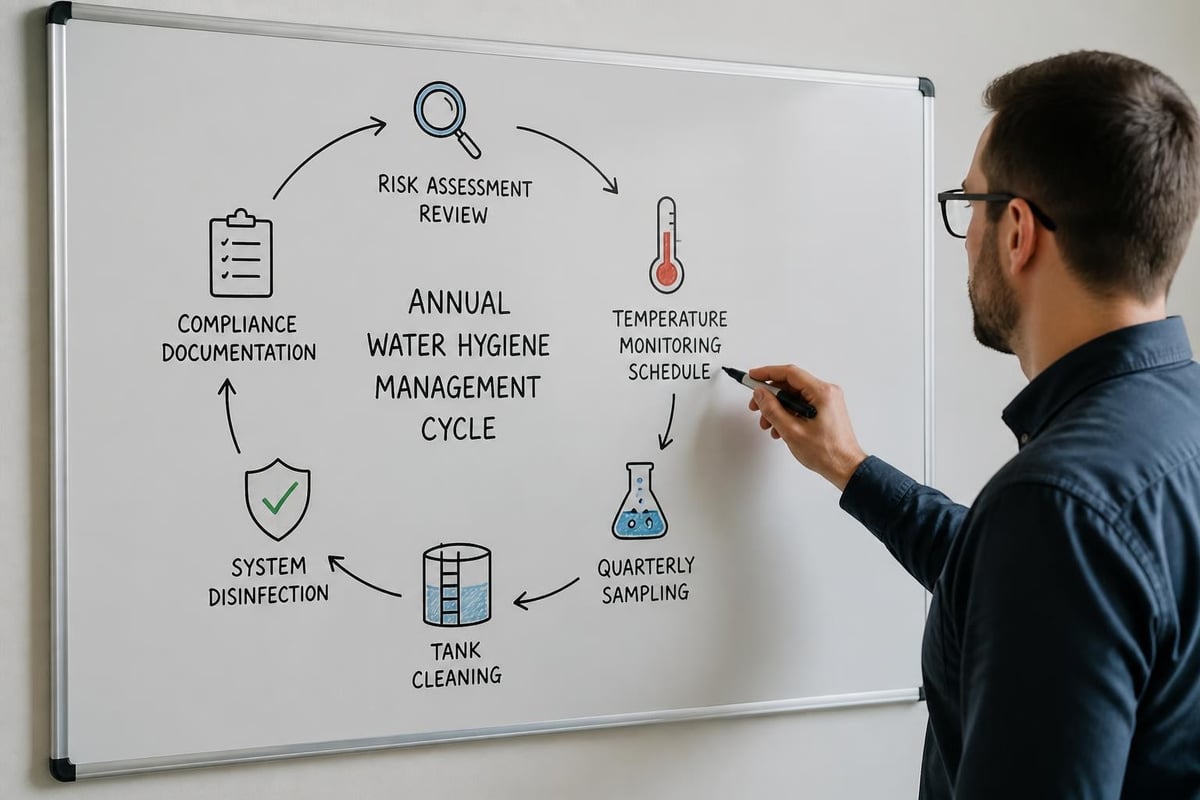
One-off interventions cannot sustain water safety. Continuous management programmes embedded within building operations provide the only reliable approach to long-term compliance and risk control.
Developing Effective Written Schemes of Control
The written scheme of control translates risk assessment findings into actionable procedures. It defines:
- Responsibilities and competencies for persons delivering each task
- Frequencies for monitoring, inspection, cleaning and testing activities
- Acceptance criteria and escalation thresholds
- Record-keeping requirements and document retention periods
- Review and audit protocols
Professional water hygiene services develop these documents collaboratively with duty holders, ensuring they reflect actual site conditions, available resources and operational realities. Generic templates invariably fail because every building presents unique configurations and constraints.
Staff Training and Competency Development
Effective implementation depends on competent persons conducting routine tasks correctly and consistently. Water hygiene services provide training programmes covering:
- Legionella ecology and transmission pathways
- Temperature monitoring techniques and equipment use
- Outlet flushing protocols for little-used areas
- Anomaly recognition and reporting procedures
- Emergency response and incident management
Training delivery should align to learning outcomes defined in ACoP L8, with documented evidence of attendance, assessment and periodic refresher sessions.
Specialist Applications and Complex Systems
Certain water systems present heightened risks or technical complexity requiring enhanced water hygiene services.
Cooling Towers and Evaporative Condensers
These systems create ideal conditions for Legionella amplification-warm water temperatures, aeration and nutrient availability. HSG274 Part 1 provides specific guidance for cooling system management.
Control measures include:
- Continuous or periodic biocide dosing to maintain residual concentrations
- Conductivity monitoring and automated bleed control to prevent scale formation
- Weekly visual inspections checking for debris, algae and drift eliminator condition
- Monthly water sampling for Legionella and supporting parameters (pH, conductivity, total dissolved solids)
- Biannual system shutdown, clean and disinfection
The Water Quality Association provides technical resources on treatment approaches and water chemistry management relevant to cooling systems.
Healthcare and High-Risk Environments
Hospitals, care homes and facilities housing immunocompromised populations demand augmented water hygiene services. Additional control measures often include:
- Point-of-use filtration at critical outlets (immunology wards, transplant units)
- Enhanced monitoring frequencies with expanded sampling programmes
- Supplementary disinfection systems (copper-silver ionisation, chlorine dioxide dosing)
- Outlet temperature monitoring at every patient-accessible tap
Specialist water hygiene services understand the clinical context and work within infection prevention and control frameworks to implement layered protection strategies.
Spa Pools and Hydrotherapy Facilities
The combination of elevated temperatures, vigorous aeration and high bather loading creates extreme Legionella risk. Compliance with HSG282 requires:
- Continuous automated disinfection and pH control
- Pre-use temperature and chemical verification
- Multiple daily water quality tests
- Weekly biofilm removal and shock disinfection procedures
- Comprehensive record-keeping demonstrating continuous compliance
Many organisations choose to outsource complete management to specialist water hygiene services rather than develop in-house expertise for these demanding systems.
Integration with Broader Property Compliance Strategies
Water safety does not exist in isolation. Progressive property managers recognise the efficiency gains from coordinating water hygiene services within consolidated compliance frameworks.
Multi-Discipline Risk Management
Buildings face concurrent risks across multiple domains-fire safety, asbestos, structural integrity, and water quality. Managing these through separate consultancies creates coordination challenges, duplicated mobilisation costs and fragmented compliance documentation.
Integrated compliance approaches deliver several advantages:
- Single point of accountability for building safety obligations
- Coordinated survey programmes minimising occupant disruption
- Consolidated reporting providing holistic risk visibility
- Unified quality management systems ensuring consistent standards
- Simplified audit trails for regulatory inspections
For duty holders managing substantial portfolios, this consolidation transforms compliance from an administrative burden into a strategic risk management capability. Professional water hygiene services delivered as part of a multi-discipline offering ensure water safety receives appropriate attention within the broader building safety context.
Digital Platforms and Compliance Technology
Modern water hygiene services increasingly leverage digital tools to enhance service delivery and evidence quality. Cloud-based platforms provide:
- Mobile data capture with GPS verification and timestamped photographic evidence
- Automated task scheduling with deadline alerts and escalation workflows
- Real-time compliance dashboard visibility for portfolio managers
- Searchable document repositories with version control
- Export capabilities for regulatory submission and insurance evidence
These technologies do not replace technical expertise, but they eliminate manual administration, reduce transcription errors and provide transparent audit trails. Integration with building management systems creates opportunities for predictive maintenance and early anomaly detection.
Selecting and Evaluating Water Hygiene Service Providers
The competence and reliability of your chosen provider directly determines your compliance position and occupant safety. Evaluation should extend beyond price to examine capability, quality systems and cultural fit.
Essential Qualifications and Accreditations
Look for providers holding relevant industry certifications:
- Legionella Control Association (LCA) membership demonstrating sector commitment
- UKAS ISO/IEC 17025 accreditation for in-house or partner laboratories
- Qualified person competencies under City & Guilds WMSoc qualifications
- ISO 9001 quality management systems evidencing process control
- Professional indemnity and public liability insurance at appropriate levels
Request evidence of ongoing professional development, participation in industry working groups and contribution to standards development. The American Water Works Association offers valuable resources on water industry best practices that leading UK providers actively engage with.
Service Delivery Model and Responsiveness
Consider practical service delivery factors:
- Geographic coverage and response times for your portfolio
- Out-of-hours availability for emergency situations
- Technician qualifications and supervision arrangements
- Equipment calibration and maintenance protocols
- Reporting timescales and document quality
Request sample reports from comparable sites. Assess clarity, completeness and actionability of recommendations. Vague findings like "improve flushing regime" lack the specificity needed for effective remediation.
Reference Sites and Track Record
Seek references from organisations with similar property types and compliance challenges. Discuss:
- Incident management experience and outcomes
- Flexibility during unexpected situations
- Communication effectiveness with facilities teams
- Value-add contributions beyond contracted scope
- Continuity of personnel and knowledge retention
Long-term relationships with existing clients provide stronger evidence than client lists featuring brief engagements or one-off projects.
Future Directions in Water Hygiene Services
The water hygiene sector continues evolving in response to technological innovation, regulatory development and changing building usage patterns.
Emerging Technologies and Methodologies
Several developments are reshaping service delivery in 2026:
Rapid microbiological methods using qPCR (quantitative polymerase chain reaction) deliver results in hours rather than the 10-14 days required for culture-based analysis. While not yet replacing traditional methods for regulatory purposes, they enable faster response to potential contamination events.
Automated monitoring systems with network-connected sensors provide continuous temperature and flow data. Machine learning algorithms identify anomalous patterns indicating control degradation before bacterial amplification occurs.
Advanced oxidation processes and novel biocides offer alternatives to chlorine-based disinfection, addressing emerging concerns about disinfection by-product formation in drinking water systems.
The WHO's guidelines on drinking water quality provide international perspective on evolving standards and treatment technologies.
Regulatory Landscape Evolution
Expect continued regulatory development driven by several factors:
- Increased enforcement activity following Building Safety Act implementation creates precedent for water safety prosecutions
- Potential introduction of mandatory competency schemes for persons conducting water risk assessments
- Enhanced tenant/occupant rights regarding water quality information and testing data
- Greater integration between water safety and broader building safety case requirements for higher-risk buildings
Proactive water hygiene services help clients anticipate these changes rather than react to new obligations after enforcement actions commence.
Cost Considerations and Value Optimisation
Water hygiene services represent essential expenditure, but costs vary significantly based on system complexity, service scope and provider efficiency.
Understanding Pricing Structures
Service costs typically comprise:
| Cost Component | Typical Range (2026) | Frequency |
|---|---|---|
| Initial risk assessment | £450-£1,800 per site | Once, then review |
| Annual re-assessment | £300-£900 per site | Annual |
| Monthly temperature monitoring | £120-£400 per visit | Monthly |
| Quarterly sampling (3 points) | £180-£350 per visit | Quarterly |
| Annual tank cleaning | £350-£1,200 per tank | Annual |
| Emergency disinfection | £800-£3,500 per system | As required |
Costs scale with building size, system complexity and access constraints. Portfolio agreements typically secure 10-25% reductions versus single-site pricing.
Optimising Service Investment
Several approaches maximise value:
- Right-size monitoring programmes to actual risk rather than applying maximum frequencies everywhere
- Invest in engineered controls (TMVs, automated flushing, point-of-use heating) that reduce ongoing management burden
- Consolidate providers to eliminate mobilisation duplication across disciplines
- Implement staff training for routine tasks, reserving specialist services for complex activities
The total cost of water safety extends beyond service fees to include remedial works, system modifications and staff time. Effective water hygiene services identify efficiency opportunities that reduce whole-life costs whilst maintaining compliance rigour.
Water hygiene services have evolved from reactive problem-solving into systematic risk management disciplines essential for modern property operations. Duty holders who embrace this shift-through professional assessments, proactive monitoring and integrated compliance strategies-protect occupants whilst simplifying regulatory obligations. Whether managing a single commercial building or a nationwide portfolio, oxford-ec.co.uk delivers water hygiene expertise within comprehensive, audit-ready compliance programmes that address every dimension of building safety risk.