A water hygiene policy that exists only on paper won’t protect residents or provide convincing evidence of control. A practical care home water hygiene policy turns responsibilities into repeatable routines, with clear records of what was checked, when it was checked and what happened if results fell outside the expected range.
Ownership can be unclear: care staff, facilities teams and external specialists may all have a role, while each home’s water systems and residents’ needs are different. A generic document can leave gaps between the risk assessment, daily controls and corrective action. Those gaps matter when residents may be more vulnerable to waterborne risks, including Legionella.
This guide provides a practical checklist for building and maintaining a site-specific policy. It explains how to assign responsibility for assessment, monitoring and follow-up, and how to keep records that show what was done. It also covers how specialist Legionella risk assessments and water sampling can inform the control programme without replacing the care home’s own responsibilities.
Key Takeaways
- Build a care home water hygiene policy around your premises, water systems and residents’ needs, rather than relying on a generic template.
- Separate the policy’s governance role from the risk assessment’s site-specific findings and the procedures staff follow day to day.
- Make responsibility clear by recording who oversees controls, who carries out delegated tasks and how cover and competence are managed.
- Use the risk assessment to shape monitoring and review, with controlled records that capture findings, actions and follow-up.
- Consider specialist Legionella risk assessment and targeted water sampling to help identify risks and strengthen an evidence-led control programme.
Table of Contents
- Why a care home water hygiene policy must protect residents and guide daily practice
- What a care home water hygiene policy should set out
- Policy, risk assessment or operating procedure: which document does what?
- Care home water hygiene policy checklist: implementation, monitoring and review
- When specialist water hygiene support can strengthen your care home policy
Why a care home water hygiene policy must protect residents and guide daily practice
A care home’s water system is part of its care environment. Outlets in residents’ rooms, assisted bathing facilities and shared spaces need to be managed in a way that reflects how people use them and how the system is maintained. A written policy gives the home a framework for assigning responsibilities and coordinating action to prevent and control Legionella and other water-system risks.
The policy must be practical, not just present in a folder. If care and facilities teams understand responsibilities differently, routine tasks can be missed during busy shifts or handovers. Clear instructions help staff know what they are responsible for, where to record completed checks and how to report an issue for follow-up.
What the policy is there to achieve
The policy sets the home’s approach: who oversees water hygiene, how site-specific risks are assessed, which controls are required and how the home checks they are being carried out. It connects management with day-to-day practice, while recognising that the appropriate controls depend on the premises, its water systems and the risk assessment findings.
A water hygiene policy sets the rules and responsibilities; practical control records show what was done, when and what action followed. The policy is distinct from the risk assessment, which identifies hazards and evaluates site-specific risks, and the operating procedures staff use to complete assigned tasks. Oxford Environmental Consultants provides a specialist water hygiene assessment and sampling service to help identify system risks and inform the home’s programme, without taking over its responsibilities.
Why care-home circumstances matter
Residents may be more vulnerable to the consequences of waterborne infection because of age or underlying health conditions. The policy should reflect how water is used across the home, including in assisted bathing, individual bedrooms and communal facilities. Changes in occupancy can also affect outlet use: a room may be occupied one week and little used the next, changing the practical risk of stagnation and the controls needed under the site assessment.
People and routines change, too. A task assigned to one staff member may be affected by absence, shift changes or a handover that doesn’t identify an outstanding check. Set out how responsibilities are handed over, how missed or abnormal results are escalated, and where follow-up is recorded. The policy should also describe relevant water treatment arrangements. Water Purification Methods provides a general overview, but the control approach must reflect the actual system and its assessed risks.
Check legal and guidance references against the home’s UK nation and care setting. The Health and Safety at Work etc. Act 1974, COSHH Regulations 2002, HSE ACOP L8 and HSG274 are relevant frameworks for Legionella risk management, but healthcare-specific guidance may also apply depending on the premises. Keep the policy aligned with applicable requirements and review it when the system, resident needs or operating arrangements change.
What a care home water hygiene policy should set out
A useful policy makes the home’s arrangements clear enough to follow and review. Define which premises and water systems it covers, identify who oversees the programme, and explain how assessment findings become assigned controls. Keep the policy concise: it establishes governance, while detailed task instructions and completed monitoring records belong in their respective documents.
Organise the policy around six areas:
- Scope: identify the buildings, systems, departments and activities covered.
- Accountability: name the person responsible for oversight and describe management approval and reporting lines.
- Risk controls: state how the home selects and maintains controls in response to the site-specific risk assessment.
- Monitoring: set out how required checks are scheduled, assigned and escalated if missed or abnormal.
- Records: define where evidence is kept, who updates it and how it can be retrieved.
- Review: explain when the policy is reconsidered, including after relevant changes to systems, use or risk findings.
Responsibilities, competence and communication
Make accountability operational. Set out management oversight, the responsible person’s remit and which tasks are delegated to facilities or care staff. For each task, identify the role expected to complete it, how task-specific instruction is provided and who provides cover during absence. Induction and shift handovers should make outstanding checks visible rather than relying on informal memory.
Contractors, agency staff and care teams may need different information to carry out their part safely. Specify how relevant instructions, access arrangements and reporting routes are shared, and how staff raise concerns or pass on incomplete work. A Legionella risk assessment can identify hazards and inform controls. The policy should record the management framework, not reproduce the full technical assessment.
Risk controls, records and escalation
Translate the assessment into procedures that apply to the home’s systems and identified risks. These may include monitoring, flushing infrequently used outlets or other specified controls. Avoid copying generic frequencies or limits into the policy without a site-specific basis. Record the source document for each control so staff can follow the current instruction and managers can trace why it is required.
Define the evidence trail for routine checks, maintenance, sampling, incidents, remedial work and close-out. If a result is unexpected, staff should know whom to notify, how the affected control or area is managed under the home’s arrangements, and who records completion of follow-up. Every control should have an assigned owner, a recorded check and retained evidence of any action taken.
Oxford Environmental Consultants provides Legionella risk assessments and water sampling to support an evidence-led programme. The water hygiene assessment and sampling service can help clarify system risks and evidence gaps. Discuss your care home’s requirements.
Policy, risk assessment or operating procedure: which document does what?
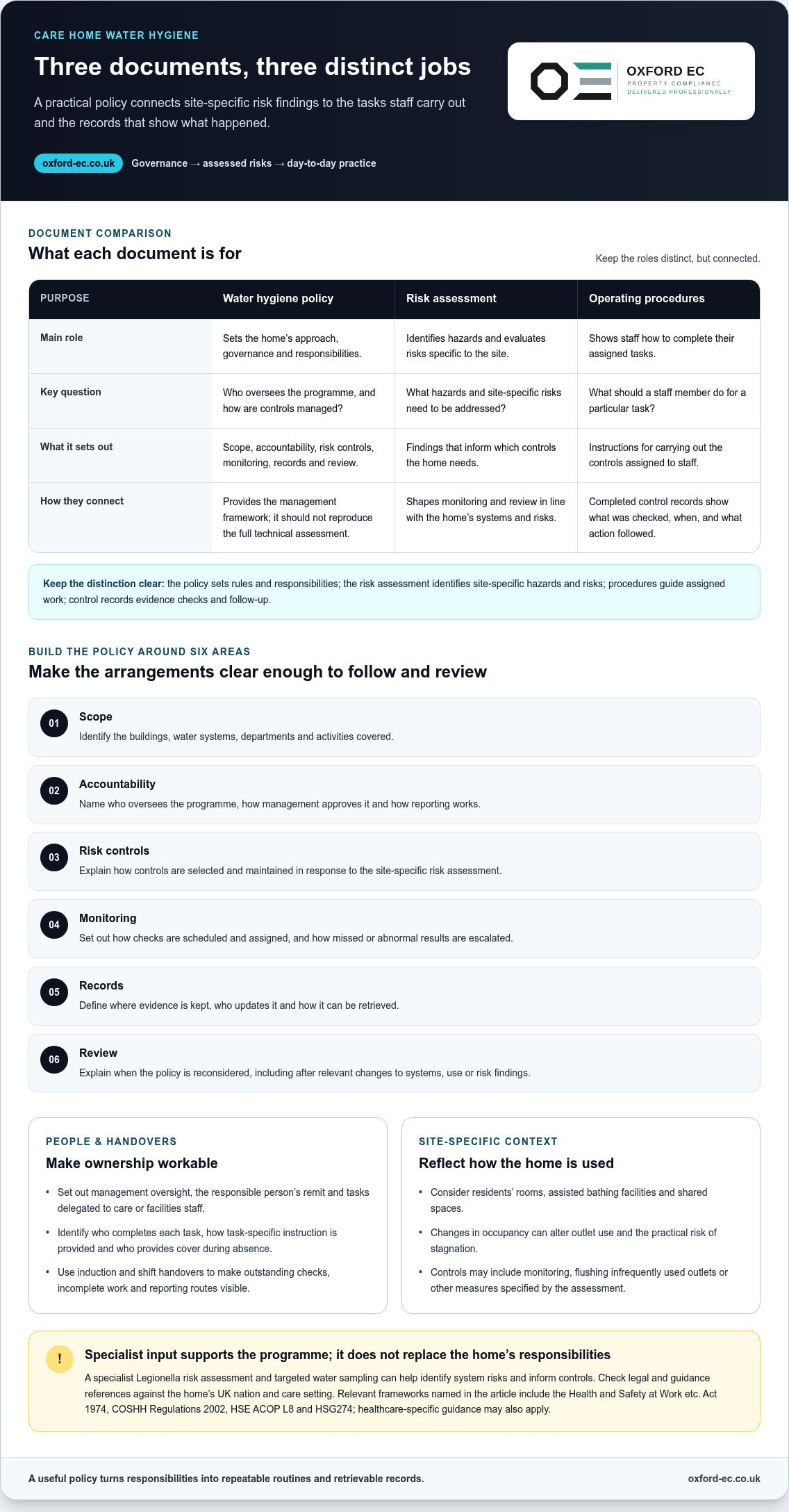
These documents are connected, but they aren’t interchangeable. A care home water hygiene policy sets the governance framework; the risk assessment examines the actual premises and water systems; operating procedures tell staff how to carry out the agreed controls. Treating one generic document as a substitute for all three can leave responsibilities unclear and site-specific actions unsupported.
Policy
Purpose: Establish the home’s management approach and accountability.
Owner: Management approves it; the responsible person oversees its implementation.
Contents: Scope, roles, arrangements for controls, records, communication and review.
Review triggers: Changes to management arrangements, premises or applicable guidance.
Risk assessment
Purpose: Identify relevant hazards and evaluate risks in the specific water system.
Owner: The dutyholder arranges the assessment and ensures its findings are acted on.
Contents: System details, risk factors, existing controls and recommended measures.
Review triggers: Changes to the system or its use, or new information that could affect the assessment.
Operating procedure
Purpose: Turn required controls into tasks that can be completed consistently.
Owner: The responsible person assigns tasks to relevant staff or contractors.
Contents: Task instructions, frequency where specified, responsible role, recording method and escalation route.
Review triggers: Changes to a control, task allocation or practical working arrangements.
How the three documents fit together
Think of the sequence as governance, evidence and action. The policy sets who is accountable and how the programme is managed. The assessment provides technical findings about which parts of the system present relevant risks and which controls are appropriate. Procedures translate those findings into practical steps, such as a defined check at an identified outlet, with a named role and a place to record completion.
Keep the documents aligned. If an assessment recommends a control, the procedure should explain how it is delivered, while the policy should make clear who oversees it and how exceptions are handled. A Legionella risk assessment can clarify how findings inform control arrangements. Keep the technical detail in the assessment rather than copying it wholesale into the policy.
Why a template needs site-specific detail
A template can provide structure, but it can’t describe a home’s system without being adapted. Layout, outlet locations, patterns of use and residents’ needs all affect which controls are relevant. For example, if the risk assessment identifies an infrequently used outlet as a risk, it may need a different control arrangement from an outlet in regular use.
Statements such as “staff will monitor the system” aren’t operational unless they say who checks what, how the result is recorded and where concerns are escalated. Oxford Environmental Consultants’ water hygiene services, including Legionella risk assessments and water sampling, can support site-specific assessment and evidence gathering. This specialist input informs the care home’s programme; it doesn’t replace the home’s own management and follow-through.
Use the comparison to check that each document has a defined owner, a clear purpose and a review route. Oxford Environmental Consultants can support care homes with Legionella risk assessments and water sampling. Discuss your water hygiene requirements.
Care home water hygiene policy checklist: implementation, monitoring and review
Turn the written framework into a working programme in a defined sequence. The care home water hygiene policy should reflect the current risk assessment, identify who completes each control and show how managers verify that tasks and follow-up are documented. Set monitoring requirements from the site’s assessment, not from a universal schedule copied into a template.
A practical roll-out sequence
Work through these steps before briefing staff. Each step should leave a clear record, so managers can see what has been established and resolve gaps before routine monitoring begins.
- Map the system. Review available system information and identify relevant plant, outlets and areas of use. Note changes in layout or use that may affect the assessment.
- Align documents. Compare the current risk assessment with the policy and procedures. Confirm that each required control has a practical instruction and a corresponding record.
- Assign ownership. Name the person overseeing the programme, task owners and deputies. Make the reporting and escalation route clear for each role.
- Brief relevant staff. Explain which checks apply to their duties, how to complete them, where to record results and what to do if a check is missed or a concern arises.
- Establish controlled records. Set up logs with the relevant outlet or task, completion date, responsible role, result and any action taken. Identify where current versions are kept.
Monitoring, corrective action and review
Build the monitoring schedule from the assessment. For each required check, specify the location or equipment, assigned role, expected completion evidence and how the result is reviewed. Avoid inserting standard temperatures or frequencies unless they are appropriate to the premises and supported by the assessment and applicable guidance.
A missed check, unexpected reading, equipment fault or change in water conditions should be reported promptly through the stated route. The responsible person or delegated lead should assess the concern, record decisions and actions, and track remedial work through to documented completion. A note that an issue was “reported” is not a close-out record: show what was done, by whom and whether further action remains.
Review the policy and associated arrangements when system alterations, occupancy or use patterns change, an incident occurs, or revised assessment findings affect controls. Check that role-holders, deputies and staff instructions remain current. Coordinating water hygiene with wider property duties can help managers maintain oversight. Oxford Environmental Consultants’ property compliance services support a structured approach to compliance responsibilities.
Use this checklist to identify gaps in assessment, monitoring or documented follow-up, then prioritise actions according to the site’s findings. Oxford Environmental Consultants provides Legionella risk assessments and water sampling. Make a water hygiene enquiry.
When specialist water hygiene support can strengthen your care home policy
A policy is only as reliable as the assessment and evidence informing it. Specialist support can help when system risks are unclear, alterations have changed how water is used, monitoring raises concerns, or managers identify gaps between written controls and completed records. A specialist technical assessment can clarify what the system requires and whether current arrangements reflect its assessed risks.
This input supports the care home’s management arrangements; it doesn’t transfer responsibility for implementing or overseeing controls. The home remains accountable for acting on relevant findings, assigning actions and keeping evidence of completion.
What specialist assessment and sampling contribute
A Legionella risk assessment examines the premises and water systems to identify relevant hazards, assess risks and inform suitable controls. Its findings can help managers understand which parts of a system need attention, whether existing measures are appropriate and where procedures or task ownership may need clarification. The assessment should inform the care home’s policy and working arrangements, rather than sit apart as a technical report with no assigned follow-up.
Water sampling can investigate a specific water-quality concern or contribute evidence where appropriate to the assessment and control programme. Its purpose and locations should be guided by risk and professional judgement. A result reflects the sample taken at a particular place and time; one sample cannot establish that every part of a system is, or will remain, safe. Sampling does not replace routine controls, maintenance or investigation of identified problems.
Turning findings into an auditable management approach
Translate relevant recommendations into actions the care home can manage. For each finding, record the decision, the person responsible, the required follow-up and how completion will be evidenced. Where remedial work is needed, track it to close-out and retain supporting records, such as work details or subsequent monitoring results where applicable. If a recommendation changes an existing control, update the procedure and brief the staff who carry it out.
Keep the chain visible: assessment finding, management decision, assigned task, completed action. This helps managers distinguish planned work from completed work and identify outstanding issues for escalation or review. It also helps ensure sampling results are considered in context and lead to proportionate action, rather than being filed without interpretation or follow-through.
Oxford Environmental Consultants provides Legionella risk assessments and water sampling, including analysis for Legionella and other bacteria. This specialist support can inform a site-specific, evidence-led programme, while the care home retains ownership of its responsibilities and control arrangements.
For support shaped around your premises and water hygiene responsibilities, discuss care-home water hygiene support.
Make your next water hygiene action count
Use the care home water hygiene policy as a live management tool, not a document to revisit only when an inspection is approaching. Choose a practical next step: review whether current records reflect how the building is used today, identify unresolved actions, or check that delegated responsibilities remain workable across teams. A focused review can turn uncertainty into a clear plan.
Oxford Environmental Consultants provides UK-wide property compliance services, including Legionella risk assessments and water sampling. These services can support a more informed view of system risks and evidence, while your care home retains responsibility for its own controls and follow-through.
Take the next step with clarity, and keep resident safety at the centre of your water hygiene arrangements.
Frequently Asked Questions
Is a written water hygiene policy a legal requirement for every care home?
Not necessarily as a document with that exact title. UK health and safety duties require risks to be assessed and managed, and HSE guidance sets expectations for written control arrangements. The documentation a care home needs depends on its setting and applicable guidance. A clear written policy can show how responsibilities are organised, but it cannot replace the site-specific risk assessment or evidence that required controls are operating.
Can a care home use one water hygiene policy across several sites?
A shared policy can set common governance principles, but it shouldn’t imply that each building has the same risks or controls. Maintain site-specific details for each home, including its water systems, relevant outlets, risk assessment, task allocations and escalation contacts. For example, a control needed at one site may not apply at another. Keep documents version-controlled so staff can identify the instructions and records that apply to their premises.
How often should a care home water hygiene policy be reviewed?
Set a review interval appropriate to the home’s arrangements, then review sooner if something changes. There isn’t one interval that suits every water system. Reconsider the care home water hygiene policy after alterations to plumbing or plant, changes in how areas are occupied or used, an incident, or new assessment findings. Record the review date, who completed it and whether procedures, training or task assignments need updating.
Does a care home need Legionella water sampling if routine checks are satisfactory?
Not automatically. Sampling should be considered in light of the risk assessment, system conditions and professional judgement, rather than used as a routine substitute for monitoring and controls. Satisfactory checks don’t, by themselves, establish that sampling is unnecessary; equally, a sample isn’t automatically required simply because the premises is a care home. A competent assessment can help determine whether sampling would answer a specific question or support further investigation.
What should a care home do if a water hygiene check is missed?
Report the missed check through the home’s escalation route and inform the responsible person or delegated lead. Arrange completion as soon as practicable under the relevant procedure, and record the omission, reason, date completed and any findings. The person overseeing the programme should consider whether the gap affects confidence in a control or requires additional action. Don’t enter a result as satisfactory if the check wasn’t actually carried out.
What should a care home do if Legionella is detected in a water sample?
Notify the responsible person promptly and follow the home’s incident and escalation arrangements. Review the laboratory result with appropriate competent support, taking account of the sample location and wider assessment rather than treating one result as a complete picture of the system. Determine and document any necessary investigation, control measures and remedial work. Keep a record of decisions, owners and follow-up evidence, and update the risk assessment or procedures if findings warrant it.
Can residents’ rooms and little-used outlets be left out of the policy?
No, not simply because an outlet is in a bedroom or is used infrequently. The policy should cover the water systems and areas within its scope, while the risk assessment determines which outlets need specific controls. A little-used tap or shower may require attention if the assessment identifies stagnation as relevant. Keep its location identifiable in the site records so staff can find it, complete any assigned task and report access or use changes.