
A universal tick-box can create a false sense of control. The UK building safety compliance checklist 2026 is most useful when it reflects the building’s use, condition and applicable duties, rather than treating every property alike. When fire, asbestos, water hygiene and maintenance records sit across different systems, it can be hard to see what is current, who owns each action and where evidence is missing.
This guide sets out a practical way to identify relevant safety workstreams, assign responsibility and create a clear record of risks, controls and follow-up actions. Requirements can differ across the UK and depend on factors such as building type and use, so use the checklist to guide your review, not as a replacement for current legal guidance or specialist advice.
Use the prompts below to organise records, review inspections and prioritise unresolved issues. Where a gap needs investigation, a specialist assessment can help establish what action is appropriate. The aim is clearer oversight, better-organised evidence and practical next steps across fire safety, asbestos, water hygiene, damp and mould.
Key Takeaways
- Use the UK building safety compliance checklist 2026 as a structured review aid, then tailor its scope to the building’s use, occupancy, ownership and planned work.
- Organise checks around relevant hazards and systems, including asbestos, fire precautions, water hygiene, damp and mould.
- Keep assessment findings, decisions and actions traceable in a central register, with clear ownership, review dates and action status.
- Prioritise outstanding work by assessed risk, legal relevance and the potential consequences of delay.
- Use specialist assessments to investigate identified gaps and inform a coordinated review of building safety workstreams.
Table of Contents
- UK building safety compliance checklist 2026: establish which rules apply
- Building safety compliance checklist: review the key risk areas
- Building safety records: prove what was assessed, controlled and actioned
- How to use a UK building safety checklist to prioritise work
- Get professional support for building safety compliance in 2026
UK building safety compliance checklist 2026: establish which rules apply
A checklist is a review tool, not a certificate of compliance. The UK building safety compliance checklist 2026 should help you identify the duties, evidence and unresolved issues relevant to a particular property. Completing it cannot establish compliance on its own or replace a competent, building-specific assessment.
A general checklist helps you ask the right questions; a competent building-specific assessment evaluates the actual building, its risks and the controls required. Start by recording the details that shape the review: the building’s location, use, occupancy, age, ownership arrangements and any planned refurbishment, demolition or other work. A residential block, workplace and mixed-use property can present different hazards and involve different responsible parties.
Which UK building safety rules apply to this property?
Map each potential duty to the property’s jurisdiction, building type, use and activities. Building safety legislation and guidance are not uniform across England, Wales, Scotland and Northern Ireland, so don’t assume that a requirement in one nation applies in the same way elsewhere. Consider the Building Safety Act 2022 where its provisions apply, taking account of the scope and operation of the relevant regimes. Use current government guidance for the relevant nation to verify how duties apply.
For a residential building, establish whether specific building safety arrangements apply before treating the property as subject to them. Record the basis for that decision, including the building’s characteristics and use, rather than relying on an assumption or an old checklist. Consider planned work too: refurbishment or demolition can create different assessment needs, including whether asbestos information is suitable for the work.
Build a scope record that captures:
- The property’s location, use, occupancy and relevant physical characteristics.
- The owner, employer, landlord, managing agent and any other parties with a role in its management or work.
- Planned changes, existing risk assessments and known unresolved safety actions.
- The legislation and current guidance used to decide which review areas are relevant.
Who should own the compliance review?
Responsibility depends on the property, activity and applicable legislation. Ownership alone does not necessarily describe every party’s duties. Owners, employers, landlords, managing agents and other duty-holders may have responsibilities in particular circumstances. Identify the roles that apply, then appoint a named lead to coordinate records, specialist assessments, decisions and outstanding actions. Each action should have an owner who can follow it through to a recorded outcome.
Where fire safety is part of the review, a professional assessment can help identify building-specific issues and inform follow-up work. Oxford Environmental Consultants provides fire risk assessments and related services as part of its UK-wide property compliance work. The scope should reflect the building and applicable requirements. A coordinated building compliance review can bring separate workstreams into view, while a completed checklist should not be treated as proof that every legal duty has been met.
Building safety compliance checklist: review the key risk areas
Once you’ve defined the scope, organise checks by hazard and building system. This makes the UK building safety compliance checklist 2026 more useful than a generic tick-box: each concern can be linked to the relevant assessment, inspection or test, its evidence and any follow-up required. Include workstreams relevant to the property and record why an area has been included or excluded.
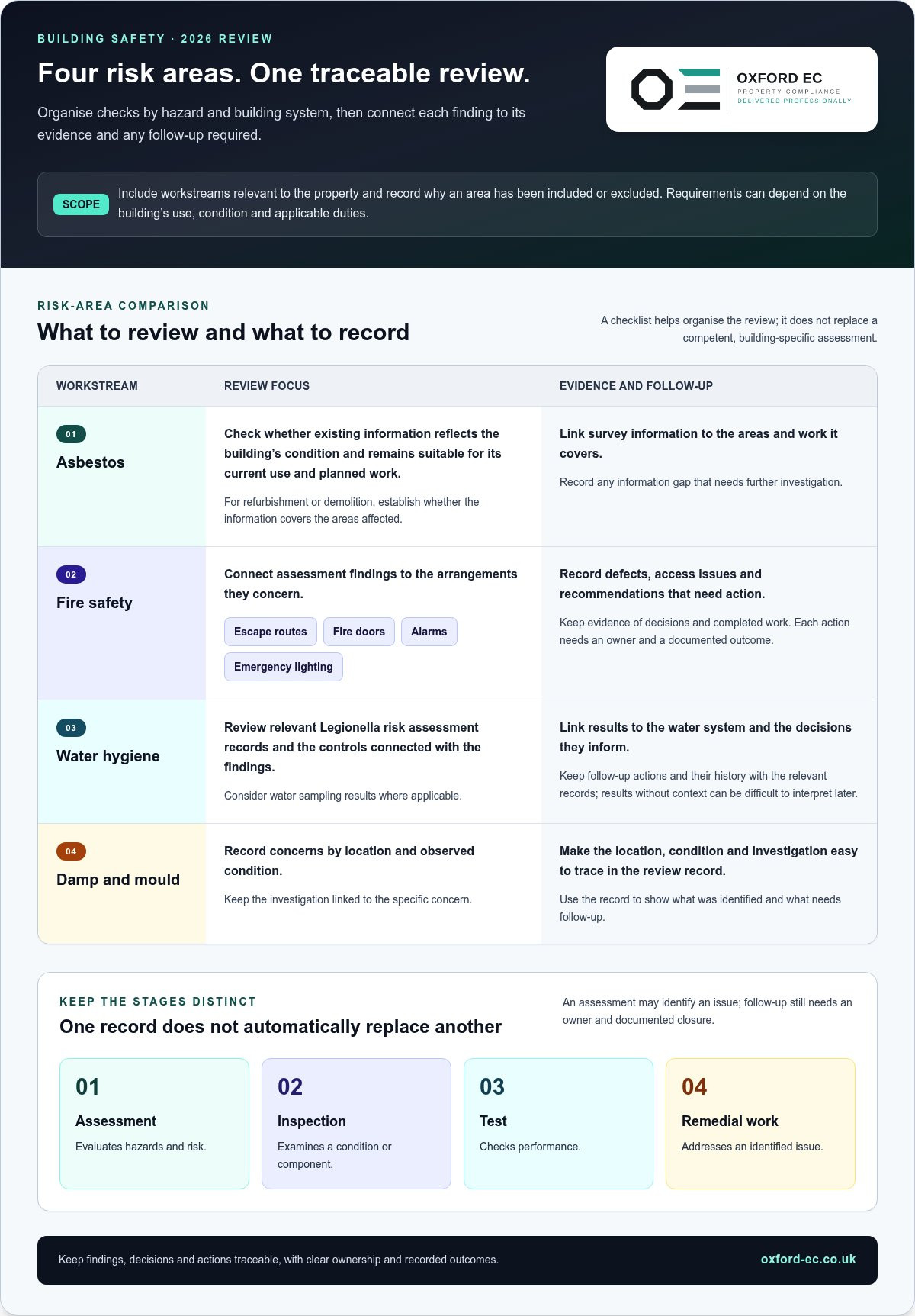
Keep four stages distinct. An assessment evaluates hazards and risk; an inspection examines a condition or component; a test checks performance; and remedial work addresses an identified issue. One record does not automatically replace another. For example, a fire risk assessment may identify a concern with an escape route, but the resulting action still needs an owner and documented closure.
Asbestos and fire safety checks
For asbestos, check whether existing information reflects the building’s condition and remains suitable for its current use and planned work. If refurbishment or demolition is planned, establish whether the information covers the areas affected. An asbestos management survey guide can explain the role of survey information in managing asbestos risks.
For fire safety, link assessment findings to the arrangements they concern, such as escape routes, fire doors, alarms and emergency lighting. Record defects, access issues and recommendations that need action, then retain evidence of decisions and completed work. A fire risk assessment guide provides further context on the assessment process. OEC’s fire safety services can support a coordinated review when the checklist identifies a need for specialist assessment.
Water hygiene, damp and mould checks
For water systems, review relevant Legionella risk assessment records and the controls or follow-up actions connected with the findings. Link water sampling results, where applicable, to the system and the decisions they inform. A result without context or an action history may be difficult to interpret later. For commercial or industrial sites managing more complex effluent standards and biological wastewater processes, check out QM Environmental International B.V. for specialised microbial solutions.
Record damp or mould concerns by location, observed condition, investigation and remedial action. If the cause or extent is uncertain, don’t treat surface treatment alone as evidence that the underlying issue has been resolved; addressing root causes such as moisture bridging or wall defects may require specialist contractors like CavClear. A damp and mould inspection guide can help you decide what to document and when further assessment may be useful.
- Assessment: record the scope, findings and recommendations.
- Inspection or test: identify the system or component examined and retain the results.
- Action: assign an owner, track progress and document the outcome.
Where gaps point to specialist work, Oxford Environmental Consultants can coordinate asbestos, fire, water hygiene, damp and mould assessments as part of a property compliance review. Discuss the assessment needs you have identified to establish practical next steps.
Building safety records: prove what was assessed, controlled and actioned
A completed assessment is only one part of the evidence trail. If findings are separated from decisions, controls and follow-up, the people managing the building may not be able to establish what was identified or whether action was taken. The UK building safety compliance checklist 2026 should connect each review area to records that can be retrieved, understood and updated.
An audit-ready safety record shows what was assessed, what was found, which decisions followed, who owned each action and what evidence supports its closure. A central register can provide that structure, even if detailed reports and technical documents are held separately. Record the document owner, review date, version and current action status so users can identify the authoritative copy and see what needs attention.
What should a building safety compliance file contain?
Keep the file specific to the property and its systems. Bring together relevant risk assessments, inspection findings, test results, control arrangements and supporting documents, alongside building plans and system information needed to interpret them. Contractor records can show what work was undertaken, where and when. Make sure authorised people can access current information, particularly those responsible for managing risks or coordinating work.
For each finding, record enough detail to follow its progress: its location or system, the source document, the issue identified, the decision made and the person accountable for the next step. Set a priority and due date based on the assessment and applicable requirements, then attach or reference evidence when the action is complete. If the response is to monitor rather than carry out remedial work, record the reason and how the control will be reviewed.
- Document control: title, property or system, owner, version and review date.
- Action tracking: finding, accountable person, priority, due date and status.
- Closure evidence: completed work, relevant test or inspection result, and recorded decision.
When asbestos, fire, water hygiene and damp or mould records sit in separate workstreams, a common register can make dependencies and gaps easier to spot. OEC’s property compliance services cover related assessment areas, supporting a coordinated view of evidence while the duty-holder retains responsibility for oversight.
How should duty-holders review open actions?
Review actions when their planned dates fall due and when a material change could affect the original assessment or controls, such as building work, a change in occupancy or an alteration to a system. Confirm whether the control remains suitable, whether further assessment is needed and whether the recorded status reflects what has actually happened. Don’t close an item just because a contractor has attended; retain evidence of the outcome.
Escalate overdue or potentially high-consequence actions through the organisation’s governance process. Record who made each decision, any interim controls, why a date changed and when the action will be reconsidered. Clear records. Accountable decisions. Traceable closure.
How to use a UK building safety checklist to prioritise work
A checklist becomes operational when it turns findings into decisions, named responsibilities and verified closure. Use the UK building safety compliance checklist 2026 as a workflow, not a scoring exercise: there is no universal pass mark or deadline for every property. Prioritise work by considering the assessed level of risk, the legal relevance of the issue and the potential consequences of delay. If the risk or required response is unclear, seek a competent assessment rather than assigning an arbitrary rating.
A five-step review for property duty-holders
- Define the scope. Identify the property, its jurisdiction, use and activities, the people with relevant responsibilities, and any planned work. This sets the review’s scope and helps prevent assumptions from being carried over from another building.
- Gather existing evidence. Bring together relevant assessments, inspection and test records, building information, control measures and outstanding actions. Note records that are missing, out of date or unclear, while distinguishing a documentation gap from evidence of a physical defect.
- Identify and assess gaps. Compare the available evidence with the building’s circumstances and applicable requirements. Arrange a specialist assessment where needed before deciding the scope of corrective work. For example, planned work in an area with incomplete asbestos information may require further assessment before decisions are made about that work.
- Set priorities and assign owners. Consider assessed risk, legal relevance and the likely consequences of delay. Record the reason for the priority, the accountable person, any interim control and the next review point. A serious concern should not sit in a general task list without clear escalation.
- Track actions to closure. Record progress, decisions and completion evidence, then review whether the action addressed the finding. Keep unresolved items visible for management oversight rather than removing them when a due date passes.
When should the checklist be revisited?
Revisit the review after a material change to the building, occupancy, use or safety systems, since existing assessments and controls may no longer reflect current conditions. Set review dates in line with applicable duties, competent risk assessment findings and current guidance. Don’t apply one inspection interval to different buildings or systems without a sound basis.
Urgency and review frequency should reflect competent assessment and current requirements. If an action date changes, record the reason, who approved the decision, any interim measures and when the matter will be reconsidered. This preserves oversight without implying that an extension removes the underlying risk or duty. Close actions only when the evidence supports closure, and keep unresolved items visible to the people responsible for building safety.
Get professional support for building safety compliance in 2026
A checklist can expose uncertainty, but it can’t inspect a building, interpret every technical finding or determine the right control for a specific risk. A competent specialist assessment may be appropriate when records are missing, conditions have changed, planned work could affect safety or findings need technical investigation. The UK building safety compliance checklist 2026 helps identify those needs; it does not replace professional assessment or the duty-holder’s responsibilities.
Match specialist assessments to identified risks
Link each concern to the relevant expertise. Asbestos questions may call for an asbestos management survey or asbestos consultancy. Planned refurbishment or demolition may require a survey suited to that work. Fire concerns can be examined through a fire risk assessment, fire door inspection or compartmentation survey. For water systems, a Legionella risk assessment and water sampling can inform the review of identified concerns. Each assessment should address the building and issue in scope.
For reported damp or mould, a damp and mould survey can investigate the concern and inform next steps. Oxford Environmental Consultants provides UK-wide property compliance support across asbestos, fire, water hygiene, damp and mould. Its property compliance services can bring related assessment workstreams into a coordinated review, so findings can be considered alongside relevant records and outstanding actions.
Prepare for a focused compliance discussion
A concise briefing helps make a discussion practical. Bring the building profile, existing assessments and inspection records, relevant plans or system information, and a summary of open actions. Identify immediate concerns, planned work and any changes to occupancy, use or building systems since the available assessments.
Group questions by hazard and note where evidence is missing, unclear or out of date. This gives the discussion a clear purpose: identify the specialist assessment needed, define its scope and understand how its findings can feed into the building’s ongoing review. The relevant duty-holder remains responsible for decisions and follow-up.
Oxford Environmental Consultants supports property compliance work across the UK, helping duty-holders address connected building safety assessment needs. Professional input can strengthen the evidence available for decisions, but no checklist or assessment alone guarantees that every applicable duty has been met.
Bring together the building information, records and concerns already identified, then set out the next assessment or action requiring attention.
Turn identified gaps into a clear next step
The value of the UK building safety compliance checklist 2026 lies in what happens after the review: decisions are made, responsibilities are clear and unresolved concerns receive appropriate attention. If technical gaps remain, targeted specialist input can help you move from uncertainty to a more informed plan. A checklist is a review aid, not a guarantee of compliance.
OEC’s UK-wide property compliance support brings together expertise across asbestos, fire, water hygiene, damp and mould. This breadth can help duty-holders consider related assessment needs together and plan practical next steps for their buildings.
Start with the issue that most needs attention, and gather the relevant records and questions. A focused discussion can help clarify which assessment or workstream should come next.
Clear priorities create momentum. Take the next step with confidence.
Frequently Asked Questions
What is a UK building safety compliance checklist?
A UK building safety compliance checklist is a structured aid for reviewing relevant safety topics, records and follow-up for a particular property. The UK building safety compliance checklist 2026 can help organise questions about building use, hazards and planned work, but it isn’t a legal certificate or a substitute for professional judgement. Treat each item as a prompt to verify evidence and decide whether further investigation is needed.
Who is responsible for building safety compliance in the UK?
Responsibility depends on the building, the activity and the legislation that applies. An owner, employer, landlord, managing agent or another duty-holder may have responsibilities, and more than one party may be involved. For example, a managing agent might coordinate records while an employer manages risks connected with workplace activities. Identify each party’s role from the relevant arrangements and legal requirements, then record important decisions and handovers.
Do building safety requirements differ across England, Wales, Scotland and Northern Ireland?
Yes. Building safety and fire safety frameworks can differ between the four UK nations, including the legislation, regulatory arrangements and official guidance that apply. A policy written for a property in England should not automatically be treated as suitable elsewhere. Identify the property’s jurisdiction first, then use current guidance for that nation to verify the relevant duties and how they apply to the building’s type and use.
How often should a building safety compliance checklist be reviewed?
There isn’t one review interval that suits every building or safety topic. Set review dates by considering applicable duties, current guidance, assessment findings and the nature of the risk. Review the checklist sooner if a change could affect existing controls, such as a change in how a space is used or work affecting a building system. Record why the review took place and whether it changed any actions or controls.
Can a checklist prove that a building is legally compliant?
No. A checklist can structure a review, but completing it doesn’t prove that every relevant legal duty has been met. Its value depends on whether the questions reflect the property and whether responses are supported by current, appropriate evidence. If a response relies on an assumption, mark it for verification rather than treating it as a pass. The legal scope may need to be reviewed against current legislation and competent advice.
What documents should a building safety compliance file include?
Include documents relevant to the property and its risks, such as current assessment reports, inspection and test records, plans, system information and evidence of completed work. Retain correspondence or decisions that explain why a recommendation was accepted, deferred or addressed another way. For example, keep a record of a fire door defect with the follow-up inspection or repair evidence, so someone reviewing the file can understand the sequence and outcome.
What happens if a building safety inspection identifies a serious risk?
Take the finding seriously and act promptly in proportion to the risk. The responsible people should understand the assessor’s findings, consider immediate measures to protect occupants and seek competent advice on appropriate controls or remedial work. If there may be immediate danger, use the relevant emergency arrangements. Record decisions, responsibilities and follow-up, and establish whether notification or escalation is required under applicable duties and procedures.