
What if the greatest fire risk in social housing is not one defect, but the way hazards interact in older, multi-occupancy buildings? Social housing compliance requirements UK providers must meet include keeping homes safe, responding to reported hazards and showing they comply with the frameworks that apply in each nation.
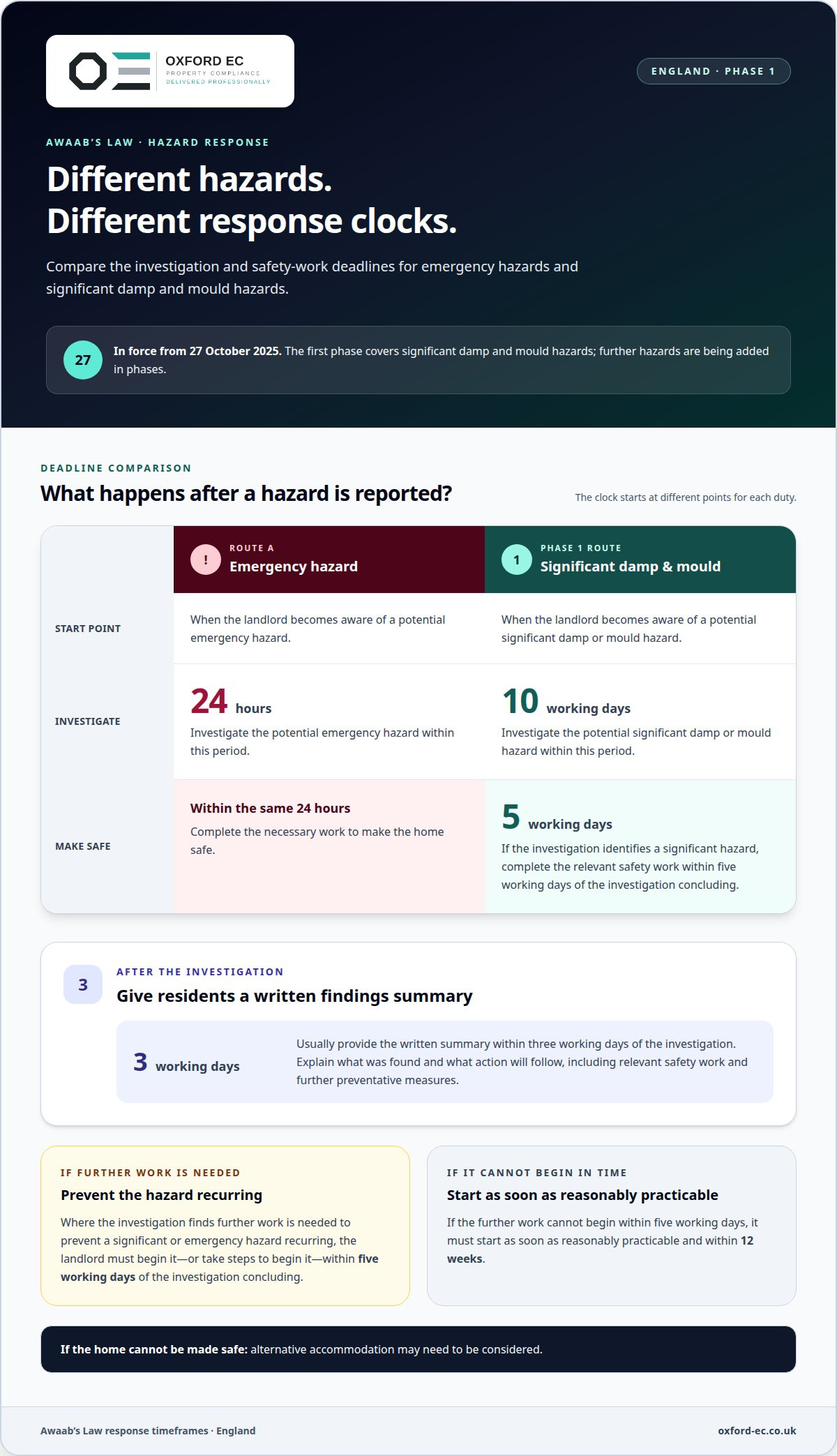
In England, these frameworks include the Regulator of Social Housing’s standards, the Decent Homes Standard and the Housing Health and Safety Rating System. Awaab’s Law came into force on 27 October 2025: landlords must investigate potential emergency hazards and complete necessary work to make the home safe within 24 hours of becoming aware of them, while significant damp and mould hazards must be investigated within 10 working days.
Providers need clear timelines and evidence of action, particularly when fire risks, building condition and tenant concerns overlap. This article explains the UK’s different regulatory frameworks, landlord duties, hazard response routes and tenant communication, then focuses on fire risks in older and multi-occupancy social housing. It offers a practical overview of compliance and how careful assessment supports a safer response.
Key Takeaways
- Separate the regulatory framework that applies across your organisation from the requirements specific to each UK nation.
- Build hazard response around prompt investigation, proportionate safety work and clear updates to tenants.
- Keep decisions, actions and tenant communications documented so compliance can be demonstrated.
- Assess how building age, shared areas and escape routes affect fire risk in multi-occupancy housing.
- Use specialist assessments to identify and address issues such as damp and mould, fire doors, asbestos and water-system risks.
Table of Contents
- The Regulator of Social Housing and provider registration
- Awaab’s Law hazard timeframes and tenant communication
- Emergency repair and hazard-resolution timelines
- Fire risks in older and multi-occupancy social housing
- What are the main social housing compliance requirements in England, Scotland, Wales and Northern Ireland?
- Oxford Environmental Consultants (OEC)
The Regulator of Social Housing and provider registration
In England, registered providers are overseen by the Regulator of Social Housing, whose standards set required outcomes for social landlords. The framework differs across the UK: Scotland, Wales and Northern Ireland have their own housing arrangements, and local authorities also have responsibilities within their areas.
Regulatory standards and enforcement
Regulatory standards define the outcomes registered providers must deliver, and inspections test whether landlords meet them. In England, the consumer standards apply to all registered providers under section 193(1) of the Housing and Regeneration Act 2008. The Safety and Quality Standard requires an accurate, up-to-date understanding of home condition under paragraph 1.1. Providers must also maintain homes to the Decent Homes Standard unless formally exempted.
The Regulator of Social Housing conducts routine inspections and grades consumer compliance. It can issue performance improvement plan notices and, under sections 219-220 of the 2008 Act, serve enforcement notices on providers that fail applicable standards. The Social Housing (Regulation) Act strengthened oversight, including proactive inspections and stronger enforcement powers. Its framework allows unlimited fines, and reduced the regulator’s notice period for entering and surveying homes to 48 hours.
Social Housing Regulation reforms
The Social Housing (Regulation) Act 2023 strengthened consumer protection and removed the serious detriment test, allowing the regulator to act without that threshold. It also strengthened the respective roles of the regulator and Housing Ombudsman. These reforms matter because providers must address compliance concerns and complaints as regulatory issues, not simply wait for a serious case to emerge.
The reforms require providers to inform the regulator about material actual or potential non-compliance with consumer standards. Landlords must give tenants information about their housing rights and complaint routes, and nominate a person responsible for health and safety standards. According to UK legislation, the Building Safety Act 2022 introduced building-safety and information-management roles and responsibilities for high-risk buildings. A structured compliance framework helps connect responsibilities, property information and evidence.
Safety duties include the applicable gas, electrical and fire requirements, as well as smoke and carbon monoxide alarms. Working with qualified contractors such as PSP & Gas Engineering for thorough gas safety and flue inspections helps landlords verify heating systems and maintain compliant records. Asbestos risks must also be managed as part of understanding a property’s condition and safety. The checks required depend on the building, its systems and the hazards identified. Records should show what was assessed and what action followed.
In England, the Smoke and Carbon Monoxide Alarm (Amendment) Regulations 2022 require at least one smoke alarm on each storey with a room used for living accommodation. Landlords should consider carbon monoxide risks where fuel-burning appliances are present. The regulations do not specify alarm grade or interlinking. These requirements sit alongside wider provider duties, not in place of them.
For social landlords, compliance means keeping reliable information about property condition, meeting applicable safety duties and acting on regulatory findings. An emergency risk identified during an inspection requires attention under the regulator’s enforcement framework. Clear records help demonstrate how the provider responded.
Awaab’s Law hazard timeframes and tenant communication
Awaab’s Law came into force in England on 27 October 2025. It establishes time-bound duties for social landlords responding to reported hazards. Its first phase covers significant damp and mould hazards, with further hazards added in phases. The legislation requires a proactive response, not simply recording a complaint and waiting for further reports.
Under Phase 1, landlords must investigate potential significant damp and mould hazards within 10 working days of becoming aware of them. If an investigation identifies a significant hazard in England, the landlord must complete the relevant safety work within five working days of the investigation concluding, according to the Ministry of Housing, Communities and Local Government. The timeframes begin at different points: awareness triggers investigation, while the investigation’s conclusion starts the safety-work deadline.
Emergency hazards have a shorter response. Landlords must investigate potential emergency hazards and complete necessary work to make the home safe within 24 hours of becoming aware. If the investigation finds that further work is needed to prevent a significant or emergency hazard recurring, the landlord must begin it, or take steps to begin it, within five working days of the investigation concluding. Where it cannot begin within that period, it must start as soon as reasonably practicable and within 12 weeks.
Communication is part of the response. After an investigation, landlords must usually give residents a written summary of findings within three working days. It should explain what was found and what action will follow, including relevant safety work and further preventative measures. If a home cannot be made safe, alternative accommodation may need to be considered. Clear updates help residents understand decisions, timescales and next steps.
Implementation is phased. Phase 2 is due to expand the requirements to a wider range of hazards from 30 November 2026. Phase 3 is planned to cover the remaining hazards under the Housing Health and Safety Rating System in 2027, except overcrowding. Providers need processes that can identify hazard type and urgency, then route each report to an appropriate investigation and response.
Tenant engagement also links hazard response with complaints handling. Social landlords must tell tenants about their housing rights and how to complain. The Housing Ombudsman can issue a code of practice on complaint procedures, publish good-practice guidance arising from investigations and require landlords to review their policies against that guidance. A recorded complaint should lead to a clear response, documented findings and timely communication, not an unexplained closure.
Where damp and mould reports require closer assessment, a Damp & Mould Survey can help inform the investigation and response.
Emergency repair and hazard-resolution timelines
Emergency repairs need a clear route from a report of danger to an effective response. In England, the Regulator of Social Housing may arrange emergency repairs after a survey identifies an imminent serious health and safety risk. This regulatory intervention is separate from the provider’s day-to-day repair process. Providers need to recognise when a reported defect indicates immediate danger and escalate it, rather than letting routine queues obscure its urgency.
Effective triage starts with the information received. A report of a damaged fire door, failure of a critical building system or an unsafe communal area calls for an assessment of who may be exposed and whether the hazard is worsening. The response should distinguish immediate protective action from permanent repair. For example, restricting access to an unsafe shared area may reduce immediate exposure, but it does not fix the underlying defect.
Inspections turn initial reports into decisions. The person assessing the property should establish the hazard’s location, extent and impact, then identify immediate controls and necessary repairs. If the findings reveal a more serious risk than the original report suggested, escalate the response. A clear record of observations and decisions helps providers explain why a repair was prioritised and what work remains.
Repair plans should specify the work required, access arrangements and any dependencies, such as specialist assessment or materials. If a temporary measure is used, record its purpose and how the permanent repair will follow. Do not mark a repair complete simply because someone attended. The provider needs evidence that the issue was addressed and any continuing risk considered.
Good records link every stage: the tenant’s report, inspection findings, risk decision, repair instruction, completed work and communications. They can also reveal repeat problems. If a defect returns, the provider can assess whether the original repair addressed the cause or only its visible effect. Accurate records support regulatory scrutiny and help managers spot patterns across homes and communal areas.
For tenants, communication should explain what the provider understands, what action is planned and what will happen if the risk changes. If circumstances worsen before repairs are complete, reassess the report instead of leaving it in its original category.
Timelines depend on the hazard, the relevant legal duty and inspection findings. Awaab’s Law sets specific deadlines for covered hazards, while the regulator’s emergency-repair power applies to an imminent serious risk identified through a survey. Distinguishing these routes helps providers follow the correct process, escalate appropriately and keep a reliable record of decisions and repairs.
Fire risks in older and multi-occupancy social housing
Fire risk in older social housing often depends on how building features work together, not on a single defect. A shared corridor, a flat entrance door and the route to an exit form part of the same escape arrangement. In multi-occupancy buildings, registered providers need assessments that consider residents, visitors and people who may need assistance, as well as the building’s layout and safety controls.
A fire risk assessment should identify hazards, who may be at risk and the measures needed to control those risks. In an older block, it can examine escape routes, shared areas, fire doors and how a fire could affect multiple households. Findings should lead to clear actions, assigned responsibility and records showing how each issue is addressed.
Fire risk assessments are not a one-off exercise. Review them annually or when circumstances change, for example, after alterations to the building or a change in its use. A change to a shared route may affect more than one flat, so assess its impact across the relevant building. Regular reviews help providers keep assessment findings aligned with actual conditions.
Alarm arrangements should reflect the property’s layout. Under Document B, alarms must be interlinked in properties covered by its fire safety provisions. A kitchen heat alarm is required if a door does not separate the kitchen from an escape route. The article’s recommendations also include a heat alarm in every kitchen and smoke alarms in the principal habitable room and escape routes of a rental property.
In multi-occupancy housing, fire safety records should bring together servicing information, evacuation plans and tenant communications. These documents connect system maintenance with resident information and the building’s emergency arrangements. When an alarm system is serviced or an evacuation plan changes, update the relevant records and tenant communications.
Prioritisation matters. A blocked escape route, a fire door that fails to close properly and an alarm issue present different problems, but each can undermine safety measures residents rely on. Assessments should distinguish immediate concerns from planned work, record the reasoning and track actions through to completion. This creates a practical risk-management framework, rather than a report disconnected from repairs.
The practical approach is to assess each property in context, then consider shared risks across the building. For registered providers, age, layout, occupancy and current condition shape the assessment findings and appropriate controls. Joined-up assessments, maintenance records and tenant communication give providers a clearer basis for managing fire risks and responding to changes.
What are the main social housing compliance requirements in England, Scotland, Wales and Northern Ireland?
Social housing compliance requirements in the UK are not a single checklist. Providers need to identify the regulatory framework for each home, then apply the relevant safety, housing-condition and tenant-protection duties. A rule that applies in England should not automatically be treated as the rule in Scotland, Wales or Northern Ireland.
In England, registered providers must meet the Regulator of Social Housing’s consumer standards. Section 193(1) of the Housing and Regeneration Act 2008 applies those standards to all registered providers. The Safety and Quality Standard requires providers to understand the condition of their homes accurately and keep that understanding up to date. Homes must also meet the Decent Homes Standard unless formally exempted.
England’s standards connect property condition with resident safety. The Housing Act 2004 introduced the Housing Health and Safety Rating System, which assesses hazards in homes. The Decent Homes Standard includes the absence of Category 1 hazards under that system, alongside requirements for repair, modern facilities and thermal comfort. These criteria help providers assess more than a property’s visible condition.
Scotland, Wales and Northern Ireland have distinct housing frameworks. Providers operating across borders should map each home to its applicable national requirements instead of extending England’s regulatory standards to every property. Social housing compliance requirements in the UK therefore depend on jurisdiction: identify the relevant landlord obligations, safety rules, property standards and complaint routes for each home.
Some duties concern the property itself; others govern how providers respond to residents and oversight. For example, England’s Smoke and Carbon Monoxide Alarm (Amendment) Regulations 2022 require a smoke alarm on each storey containing a room used for living accommodation. Carbon monoxide alarm arrangements should also be considered as part of a property's safety measures. These England-specific requirements do not replace checking the applicable rules elsewhere.
Building safety adds another layer. The Building Safety Act 2022 applies to high-risk buildings, while providers must consider relevant building-safety responsibilities alongside housing regulation. Across the UK, organisations may need to account for the Regulator of Social Housing, the Housing Ombudsman and the Building Safety Regulator, according to each body’s remit and the property concerned.
A practical compliance map should record each home’s nation, provider status, applicable standards, safety obligations and supporting evidence. Self-assessments, reviews and mock inspections can help identify gaps before external scrutiny. For providers with homes in several nations, this approach makes social housing compliance requirements in the UK easier to organise and helps prevent one jurisdiction’s checklist from obscuring another’s obligations.
Oxford Environmental Consultants (OEC)
Oxford Environmental Consultants (OEC) supports social housing providers with property assessments that help clarify safety concerns and inform next steps. A Damp & Mould Survey can investigate damp or mould. Fire Door Inspections can assess the condition of doors that form part of a building’s fire precautions. Asbestos Management Surveys and Legionella Risk Assessments address other property hazards within their respective scopes.
These assessments complement, but do not replace, a provider’s legal duties, tenant communications or repair arrangements. They can help when a reported concern needs specialist assessment, property information requires review or a provider is building an evidence-based picture of hazards across its homes.
Turn compliance findings into sustained action
Make compliance part of routine asset management, rather than treating each inspection or tenant report as an isolated event. Use findings to identify recurring risks, clarify responsibility and focus attention on homes or shared areas needing further assessment. This supports better-informed decisions as properties, residents and hazards change.
For organisations applying social housing compliance requirements in the UK, independent assessment can help build a clearer evidence base. Oxford Environmental Consultants (OEC) provides Fire Risk Assessments to assess fire hazards and controls. Its work can inform decisions, while the housing provider remains responsible for meeting legal duties and acting on findings.
With clear evidence and accountable follow-through, providers can make their next compliance decision with greater confidence.
Frequently Asked Questions
Which frameworks can help?
Use the framework that matches the home’s location, building type and hazard. In England, the Housing Health and Safety Rating System helps assess housing hazards, while the Decent Homes Standard addresses condition, repair and facilities. For high-risk buildings, the Building Safety Act 2022 sets building-safety and information-management roles. Providers can combine these frameworks with property assessments, complaint reviews and mock inspections to identify gaps and organise evidence.
Who's responsible for what?
The registered provider remains accountable for meeting its regulatory standards and managing its homes, even when it appoints contractors to inspect or repair them. Staff responsible for health and safety should coordinate risk information and actions. Tenants report problems and should receive information about their rights and complaint routes. The Regulator of Social Housing oversees registered providers in England; the Housing Ombudsman considers complaints and can issue complaint-handling guidance.
What are the social housing standards for property condition, repairs, damp and mould, and energy efficiency?
In England, the Decent Homes Standard covers a reasonable state of repair, reasonably modern facilities and services, and reasonable thermal comfort through effective insulation and efficient heating. The Housing Health and Safety Rating System assesses hazards, including those linked to damp and mould. Awaab’s Law adds response duties for covered hazards. When planning energy-efficiency work or reviewing EPC ratings with assessors such as Energy Smart, providers should consider ventilation alongside upgrades, as airtight designs can increase moisture concerns.
What are the current social housing regulatory standards and consumer standards in England?
England’s Regulator of Social Housing sets standards registered providers must meet, including consumer requirements for safety, quality, transparency, influence and accountability. The Safety and Quality Standard requires providers to understand home condition accurately and keep that information current. Consumer standards apply to all registered providers under section 193(1) of the Housing and Regeneration Act 2008. The regulator assesses compliance through routine inspections and grading.
What are the social housing landlord reporting, record-keeping and regulatory inspection requirements?
Providers should retain information about property condition, inspection findings, hazard reports, repair actions and tenant communications in a form that supports decisions and scrutiny. In England, providers collect and supply information for the Regulator’s Tenant Satisfaction Measures. They must also report material actual or potential non-compliance with consumer standards to the regulator. Inspection preparation is most effective when records link each issue to its assessment, responsible team and follow-up action.
What deadlines and penalties apply for social housing compliance failures, including enforcement action and compensation?
Deadlines depend on the duty and hazard. Under Awaab’s Law, an emergency hazard must be investigated and necessary work completed to make the home safe within 24 hours of awareness. The Ministry of Housing, Communities and Local Government says relevant safety work for an identified significant hazard must be completed within five working days after the investigation concludes. The regulator can serve enforcement notices and impose unlimited fines. Complaint remedies, including compensation, depend on the circumstances.
What steps should a social housing landlord take to audit compliance and prepare for a regulator inspection?
Start by mapping homes to the applicable national standards, then compare property records and safety assessments with those requirements. Identify overdue actions, recurring hazards and gaps in tenant communications. Assign responsibility for each corrective action and retain evidence of completion. A mock inspection can test whether staff can find records and explain decisions. Use the findings to update risk reviews and governance reporting, rather than treating an audit as a one-off exercise.