
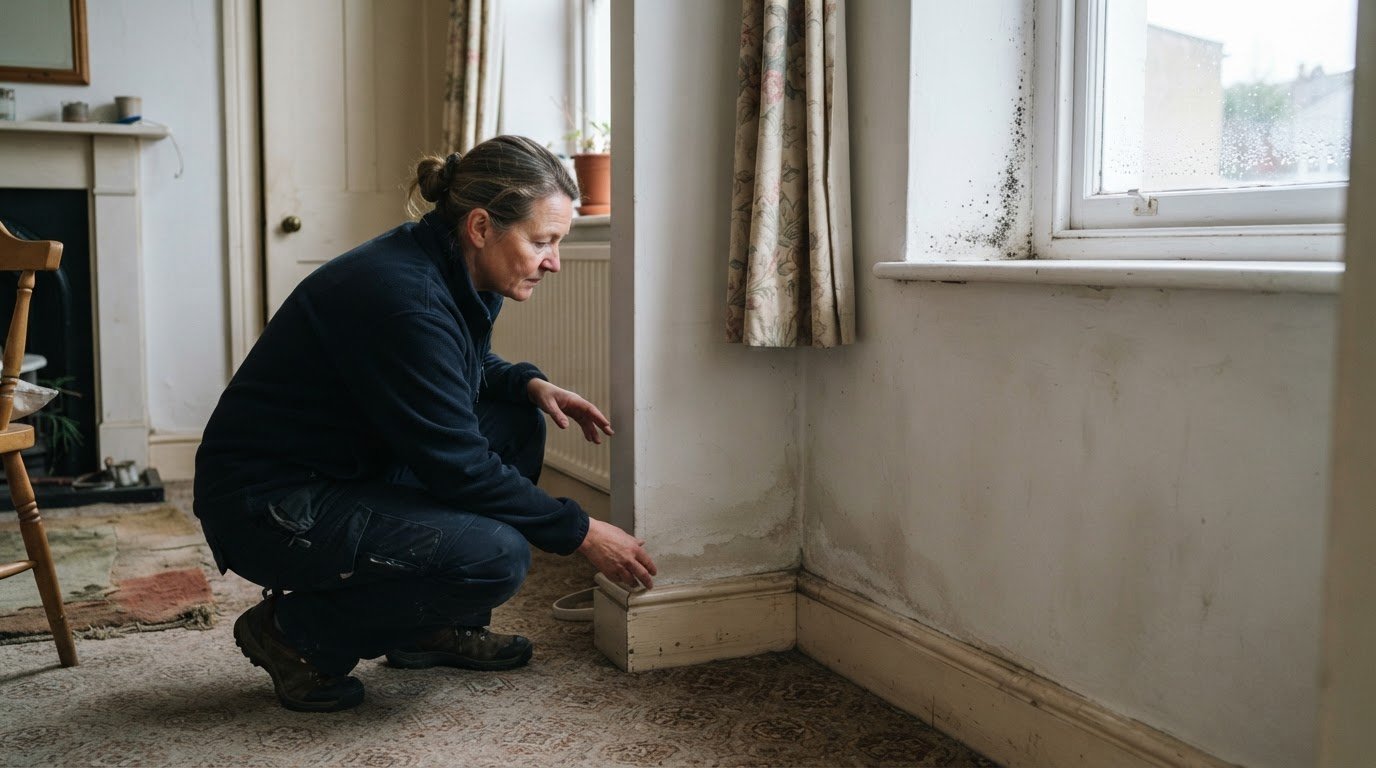
A damp patch at floor level does not, by itself, prove rising damp. Identifying rising damp versus condensation means considering where moisture appears and what accompanies it. Rising damp typically affects lower wall sections and may leave tide marks or salt deposits; condensation commonly forms on cold surfaces and can encourage black spot mould. A moisture-meter reading alone cannot establish the cause.
It is understandable to want a clear answer before deciding what to do next. The distinction matters because treating the wrong cause may leave the underlying moisture problem unresolved. This article explains the signs to look for, how salts and moisture readings inform an assessment, and which building details may indicate a damp-proof course issue or restricted airflow. Readings need to be interpreted alongside the damp pattern and the building’s condition, not in isolation.
Key Takeaways
- Use the pattern of damp as an initial clue: tide marks and salty deposits may point to rising damp, while cold surfaces and black spot mould are more typical of condensation.
- Don’t treat a single moisture-meter reading as a diagnosis; readings show moisture-related conductivity, not its source.
- Salt analysis and moisture readings taken at different depths can help build a stronger case for or against rising damp.
- Look at building details such as the damp-proof course and external ground levels, as changes around the wall can affect how moisture appears indoors.
- A Damp & Mould Survey can help assess the evidence together and distinguish between damp-related causes.
Table of Contents
What is Rising Damp?
Rising damp occurs when moisture from the ground moves upwards through porous walls. It is more likely in older buildings without an effective barrier between the ground and walls. A failed or bridged damp-proof course can also let moisture travel upwards. Typical clues include dampness near the floor, tide-mark discolouration, salt deposits and a musty smell. These signs support further inspection, but none proves the cause alone.
Condensation forms when moisture in indoor air meets a cooler surface. It commonly appears on window surrounds, cold corners and walls behind furniture, often alongside black spot mould. Everyday activities add water vapour indoors, and restricted ventilation allows it to build up. Penetrating damp, by contrast, enters through defects such as damaged pointing, leaking gutters or roof faults. It can appear at different heights, depending on where water gets in.
The Housing Act 2004 contains the housing health and safety rating system (HHSRS), according to UK Parliament. The HHSRS lists 29 hazards in the home, including damp and mould growth. For landlords, maintaining property standards and protecting rental investments against building risks can also involve reviewing tailored policies through WS Insurance Brokers. That context matters when assessing a home, but it does not identify the moisture source by itself.
| Possible cause | Typical location | Clues to consider |
|---|---|---|
| Rising damp | Lower wall sections | Tide marks, salts, musty odour |
| Condensation | Cold surfaces and corners | Black spot mould, window moisture |
| Penetrating damp | Any height | Water entry near a building defect |
Assess the likely cause by weighing the damp pattern against building details, rather than relying on one visible mark. Similar symptoms can have different origins, and more than one cause may be present.
What are typical UK treatment costs? There is no single useful figure for every property. Work for rising damp may involve correcting the moisture route and repairing plaster, while condensation measures focus on ventilation and moisture control. The scope of the work and extent of damage affect the cost.
Other causes mistaken for rising damp include condensation, penetrating damp and leaks from plumbing or rainwater goods. Low-level staining alone cannot distinguish them; the location, pattern and surrounding building condition all matter.
To assess condensation, note where moisture forms and whether cold surfaces or limited airflow coincide. RICS advises ventilating a room for about 5 minutes for every hour spent in it, and keeping indoor temperatures ideally between 18°C and 21°C. Use ventilation during moisture-producing activities and avoid blocking airflow around furniture.
A damp-proofing guarantee does not prove that rising damp was correctly diagnosed. Read its scope and exclusions alongside the evidence for the cause and proposed treatment. Chemical injection may not resolve condensation or a bridged damp-proof course.
Mould is a potential health concern, so tenants should report damp or mould to their landlord promptly, particularly where it is extensive or worsening. In England, from October 2025, registered social landlords must tackle emergency cases within 24 hours of a report. For reported cases presenting a significant risk of harm, they must inspect, report and outline remediation within 10 days, then begin repair works within 5 working days.
Bridged damp-proof courses and raised ground levels
A damp-proof course is intended to interrupt moisture moving through masonry from the ground. In an older property, the barrier may be absent, damaged or bypassed. Bridging occurs when another material connects damp ground or masonry below the course with the wall above it. Moisture can then travel across that connection, causing damage that resembles rising damp.
External ground levels can create this route. For example, a later patio, flower bed or path may sit higher against a wall than the original ground. Soil or paving can cover the damp-proof course, allowing moisture to pass above it. Check the wall beside each change in level, including the front path and rear patio. A problem confined to one raised section may indicate bridging rather than a course failing throughout the building.
Bridging can also occur within a wall. Render, plaster, debris in a cavity or a solid floor meeting the wall can form a continuous path around the barrier. Render that continues down to the ground is one example. Inside, plaster extending below the course may transfer moisture to the visible surface, even if the original barrier remains intact.
Assess the details, not just the stain. An inspection should record the damp pattern, internal and external finishes, ground levels, drainage and the position of the damp-proof course where visible. Compare affected and unaffected walls. Look for a clear relationship between a raised external surface and the damp area inside. This helps distinguish a local bridge from widespread moisture movement, leaks or condensation.
- Ground: note where paving, soil or a flower bed meets the wall.
- Wall finish: identify render or other materials that continue across the barrier.
- Internal junctions: examine where plaster, flooring or skirting meets the wall.
- Pattern: compare the affected area with adjoining walls and different ground levels.
Correct the moisture route before applying decorative treatments. Depending on the cause, work may involve lowering or separating an external surface, removing bridging material or addressing a defective barrier—work often managed alongside professional contractors such as WT Construction Services when masonry alterations are required. Replastering before correcting the route can conceal symptoms temporarily without preventing further moisture movement. The wall also needs time to dry; drying and redecoration should follow the underlying repair, not replace it.
Chemical damp-proof course injection can cost four figures and may not solve the problem if bridging or condensation is the actual cause. The key is to establish whether moisture bypasses the course, travels through the wall or forms on a cool surface. Choose treatments after diagnosis, not as a substitute for it.
Moisture readings and salt analysis
A handheld moisture meter measures electrical conductivity within a wall, not the source of moisture. Salts can increase conductivity, so a high reading alone cannot distinguish rising damp, condensation or salt contamination. Identifying rising damp vs condensation starts with separating what an instrument measures from what is happening in the building. Treat the display as one observation, not a diagnosis, and interpret it alongside the wall construction and visible conditions.
For suspected rising damp, a surveyor can take profile readings at different heights and depths. The distribution matters more than an isolated surface result. Comparing readings across a wall can show whether moisture levels vary by position, while observations from adjoining areas provide context. Profile readings are more informative when considered alongside the wall materials and the location of visible damage.
Salt analysis examines deposits in affected material. Soil nitrates in salts can help establish whether ground moisture has travelled through a wall. Their presence alone does not prove rising damp, since salts can have other sources. Consider the sample’s location and composition alongside moisture profiles and building details, including external ground levels and known water entry points.
Condensation requires a different set of measurements. An investigation should record surface temperatures as well as indoor humidity, because condensation forms when moisture-laden air meets a cooler surface. A digital hygrometer or thermohygrometer measures room humidity; temperature readings add useful context. For example, readings near a cold window reveal more than a humidity figure taken elsewhere in the room.
A survey is more useful when readings are mapped to specific parts of the property:
- Location: note whether readings are from a window reveal, external wall or floor junction.
- Profile: compare moisture readings at different heights and depths.
- Conditions: record humidity and surface temperatures near affected areas.
- Context: consider salts, materials, ground levels and nearby water sources.
Repeatable observations also help compare affected and unaffected areas. Interpret a damp reading beside a cold window alongside its surface temperature and room humidity. A lower-wall reading beside raised external ground levels prompts a different investigation. Neither example proves the cause without supporting evidence.
A sound method for identifying rising damp vs condensation combines readings with salt analysis, room conditions and building details. Each tool answers a different question: meters assess conductivity, hygrometers record humidity, thermometers measure surface temperature, and salt tests examine deposits. Together, these findings help distinguish possible causes and support a more reliable diagnosis than a single meter reading.

Avoiding damp misdiagnosis
A dark patch does not reveal its own cause. In a UK home, condensation can collect behind furniture or in cold corners, especially during winter. Rising damp usually follows a different pattern, but low-level condensation can occur where airflow is restricted. A sound diagnosis therefore considers location, surface conditions and building details together.
Penetrating damp can also resemble rising damp. Rain may enter through defective pointing, a leaking gutter or a damaged roof, then mark an internal wall below the entry point. Trace the stain towards the external elevation and inspect the corresponding building feature. A patch beneath a gutter joint, for example, calls for checking the rainwater route before assuming moisture is rising from the ground.
Some visible clues overlap. Mould can grow where a wall stays damp, while salts may remain after moisture has moved through masonry. A specialist assessment should distinguish current moisture from older damage and consider whether two causes are present together. A cold corner with mould and a separate nearby leak may need separate findings, rather than one explanation for every mark.
Use a structured inspection instead of relying on one test:
- Map the pattern: record affected rooms, wall positions and whether marks follow cold corners, windows or an external defect.
- Check the building: examine gutters, roof edges, pointing, drainage and external ground levels beside affected walls.
- Measure conditions: compare room humidity with surface temperatures where condensation appears.
- Assess moisture evidence: interpret meter readings with wall construction and any salt analysis.
A thermal camera can highlight temperature differences, such as a cool strip around a window reveal. It cannot confirm the source of moisture. Cool spots need further assessment, including moisture-meter testing, because cold surfaces may indicate a condensation risk rather than water ingress.
Heating and ventilation patterns also provide useful context. Supplemental propane or butane heaters release moisture into indoor air. Without adequate ventilation or dehumidification, that moisture can contribute to condensation. A room that develops window moisture after using such a heater presents a different lead from a wall marked beneath damaged external masonry.
Record changes regularly. Note whether mould returns in the same corner, a stain expands after rain, or it persists during periods of improved airflow. These observations help a specialist distinguish recurring condensation from penetrating damp or ground-related moisture. Avoid painting over marks before inspection, since fresh decoration can obscure their edges and progression.
Choose treatments only when the evidence supports a cause. Injecting a damp-proof course will not fix a leaking gutter, and improving airflow will not repair defective external masonry. Matching the intervention to the diagnosed source limits unnecessary work and helps address the damage rather than conceal its visible signs.
Capillary action and rising damp
Capillary action describes how liquid moves through narrow spaces in porous material. In a wall, connected pores in brick, mortar or plaster can draw ground moisture upwards. The movement depends on the material’s pore structure and moisture supply. Porous concrete and cement in old basement walls can also allow damp vapour to travel through them readily.
Rising damp is a moisture pathway, not simply a wet patch. Ground moisture enters masonry and travels through connected pores, potentially carrying dissolved salts. As water evaporates at the wall surface, salts may remain behind. A tide mark or salt deposit can reflect this process, but an accurate diagnosis still requires evidence from the wall and its setting.
The visible pattern provides context. Rising damp typically affects lower wall sections and the affected area may reduce higher up. It is often described as reaching a maximum height of 1 meter from the floor. Treat that height as a possible pattern, not a stand-alone test: wall materials, plaster, ventilation and moisture conditions can influence where signs appear.
Condensation follows a different mechanism. Water vapour in indoor air settles on cold surfaces, such as a bathroom window or an uninsulated external corner. It can also form behind furniture where air circulation is limited. These locations may be close to floor level, so a low damp patch does not automatically indicate capillary moisture from the ground.
Building layers complicate the comparison. Plaster can absorb moisture and salts from masonry, while later finishes may conceal the boundary between affected and dry material. A bathroom wall may also experience condensation from showers alongside another moisture source. Consider the location, surface temperature and moisture profile together.
A careful assessment links the physical mechanism to measurable evidence:
- Material: identify whether brick, mortar, concrete or plaster is porous and continuous.
- Moisture profile: compare readings at different heights and depths, rather than relying on one surface result.
- Salt evidence: examine deposits and assess whether soil nitrates support a ground-moisture route.
- Room conditions: compare humidity and cold surface temperatures, especially near bathrooms and windows.
Capillary action explains how ground moisture can move through masonry; it does not prove that this process caused every internal mark. A reliable conclusion must fit the material, moisture distribution, salts and building details. If these lines of evidence conflict, assess the damage more broadly before selecting treatments.
Oxford Environmental Consultants (OEC): Damp & Mould Surveys
Oxford Environmental Consultants (OEC) carries out Damp & Mould Surveys to assess signs of moisture and mould in a property. Arrange a survey when damp patches persist, mould returns or the cause remains unclear after considering ventilation, wall conditions and building details.
A survey brings the visible pattern and relevant evidence together, helping distinguish possible sources before remedial decisions are made. This is particularly useful when a single moisture reading or surface mark does not explain what is happening, or when condensation and another form of dampness may both be present.
Make the next decision evidence-led
Before approving remedial work, make sure the proposed action addresses a cause supported by evidence from the property. A clear assessment helps you understand the issue, consider suitable next steps and avoid work that does not meet the property’s needs. When identifying rising damp vs condensation, the key decision is whether the findings support the proposed response.
Oxford Environmental Consultants (OEC) also offers Asbestos Management Surveys, Fire Risk Assessments and Legionella Risk Assessments as part of its property compliance services. If damp or mould persists, or the next step remains unclear, an assessment can help clarify the decision.
A considered next step can help you move forward with greater clarity.
Frequently Asked Questions
What causes damp?
Damp is caused by moisture entering a building or remaining within it. The route may involve ground contact, rainwater, a plumbing fault or moisture generated indoors. These sources can occur together, so one room may show more than one pattern. For example, a leak can wet a wall while indoor moisture affects nearby surfaces. Establishing the source helps determine whether the response should address the building fabric, water supply or indoor conditions.
What is condensation in buildings?
Condensation in a building is liquid water formed when water vapour in the air changes state on a cooler surface. It may be brief, such as moisture appearing on glazing after a change in indoor conditions, or recur in the same area. The amount visible varies with room use and the temperature of surrounding materials. Distinguishing temporary moisture from persistent damp helps determine whether the issue needs further investigation.
Not sure which one you're looking at?
Keep a short record before arranging an assessment. Photograph affected areas in consistent lighting, note when marks first appear, and record whether they change after rainfall or particular room activities. Include the room, wall and approximate position in each note. This history can reveal a pattern that one visit may not show. A damp and mould survey can then consider those observations alongside the property itself.
What are the main types of damp?
The main categories are rising damp, penetrating damp and condensation, grouped by how moisture reaches or forms on building surfaces. A leak from a pipe or water appliance is another possible source to consider separately during an investigation. These labels describe different mechanisms, not a complete diagnosis of a room. Recording where damage occurs and whether it changes over time can help identify the source that needs attention.
What causes condensation?
Condensation occurs when moisture in indoor air meets a surface cool enough for water to form. Household activities contribute water vapour, including cooking, washing and drying clothes indoors. Poor air movement can leave moisture concentrated in a particular area, while a cooler surface provides a place for it to collect. A recurring pattern linked to room use can help distinguish condensation from a fault introducing water through the building.
What are the signs of rising damp in a UK home?
Possible signs include a damp area beginning close to the floor, staining that forms a horizontal boundary, deposits left as moisture evaporates, or damage to finishes near the wall base. Check whether the pattern follows one section of wall or continues across adjoining areas. That distinction can guide further investigation, but appearance alone cannot establish the source. The materials, wall construction and other moisture routes also need consideration.
What are the signs of condensation damp in a UK home?
Condensation may leave recurring wetness on indoor surfaces, with mould or discolouration developing where moisture persists. The pattern often corresponds with room use or areas where air circulation is limited. Note whether affected patches return after cleaning and whether other surfaces in the same room show similar changes. These observations help build a fuller picture, although persistent mould or damp still needs assessment to establish its cause before choosing remedial work.
Where on walls does rising damp typically appear compared with condensation?
Rising damp typically affects lower wall sections, whereas condensation can form wherever indoor air meets a sufficiently cool surface. This can include upper walls, window surrounds or enclosed spaces behind furnishings; restricted airflow can also allow condensation at low level. Compare the affected wall with other surfaces in the same room and note how the pattern changes by position. Height is useful context, but it cannot determine the cause by itself.