Inspectors look at how fire risks are assessed and controlled, whether escape routes, fire doors, alarms and emergency lighting are safe and usable, and whether staff understand what to do in an emergency. In England and Wales, the Regulatory Reform (Fire Safety) Order 2005 requires the Responsible Person to maintain a suitable and sufficient fire risk assessment, according to The National Archives. Knowing what inspectors look for in a fire safety audit helps you focus on the measures, people and evidence that demonstrate how your premises are managed.
A fire safety audit may include a building walk-through, questions for staff and a review of documents such as training records, fire drill logs and equipment maintenance records. The scope depends on the premises and the risks being assessed. Inspectors may examine all or part of the building, rather than every area.
This guide explains what inspectors may check, which records to prepare and how to get staff and premises ready. It also outlines possible feedback and enforcement action, so you can address any shortcomings methodically.
Key Takeaways
- Expect inspectors to examine how fire risks are controlled, including escape routes, fire doors, alarms and emergency lighting.
- Staff may be asked about evacuation procedures and their responsibilities in an emergency, so make sure they understand their roles.
- Have the fire risk assessment, training and drill records, and equipment maintenance logs ready to support your answers.
- Review your premises and records before an audit, paying particular attention to changes that could affect fire safety.
- Oxford Environmental Consultants (OEC) provides Fire Risk Assessments to help identify and assess fire risks at your premises.
Table of Contents
What Happens During a Fire Safety Audit?
If an audit identifies breaches, the fire and rescue service may require corrective measures through an enforcement notice. It may issue a prohibition notice if serious risk means premises use must stop or be restricted. The notice explains the action required and its deadline. A formal fire safety enforcement notice must be complied with or appealed within 21 days, according to The National Archives (legislation.gov.uk).
Audit outcomes depend on the fire safety arrangements inspectors find. A check may confirm general compliance in the areas sampled, or identify deficiencies that need attention. In Lincolnshire, outcomes can be good, tolerable or poor. A good result may bring verbal advice and no further action; a tolerable result may lead to support improving arrangements. A poor result can prompt further audit activity.
Formal action should be proportionate to the identified risk, but serious danger can require an immediate response. A prohibition notice may take effect immediately if using the premises presents a sufficiently serious risk to relevant people. An alterations notice may be issued if proposed changes could create a serious risk. These notices address different circumstances, including immediate danger, risky alterations and breaches requiring specified corrective work.
Inspectors can examine premises and require relevant records to support their findings. The responsible person should understand each deficiency, the measure required and the deadline recorded in any notice. If the notice is disputed, the formal appeal route and time limit matter. The National Archives (legislation.gov.uk) states that breaching fire safety law in the UK can lead to imprisonment for up to 2 years. Failure to comply with a formal notice is also a prosecutable offence under Article 32 of the Fire Safety Order 2005.
Records carry additional weight in higher-risk buildings. The Building Safety Act 2022 creates additional building information record obligations for these buildings, according to The National Archives (legislation.gov.uk). Where an audit identifies gaps, an action plan can set out what will change, who is responsible and when remedial work will be completed. In Scotland, the fire service may request an action plan when deficiencies need prompt attention.
Enforcement also varies across the UK. In Scotland, failure to comply with the Fire (Scotland) Act 2005 or an Alterations, Enforcement or Prohibition Notice is an offence and may result in referral to the Procurator Fiscal. That is distinct from guidance following an audit, which helps the responsible person understand improvements needed. Keep written feedback and evidence of completed measures together for follow-up.
Inspectors’ powers can include entering and inspecting premises at a reasonable time, examining relevant areas and requesting records. A fire and rescue service may also take formal action during an inspection if it considers there is a serious and imminent risk to life. The focus is on the evidence: the hazard, the risk to people and whether existing precautions control it.
When a notice identifies corrective work, map each requirement to an action, a responsible person and completion evidence. This makes follow-up clearer and helps show how deficiencies were addressed. A structured fire safety review can help organise premises information and improvement priorities alongside the audit process.
Premises inspection and staff awareness checks
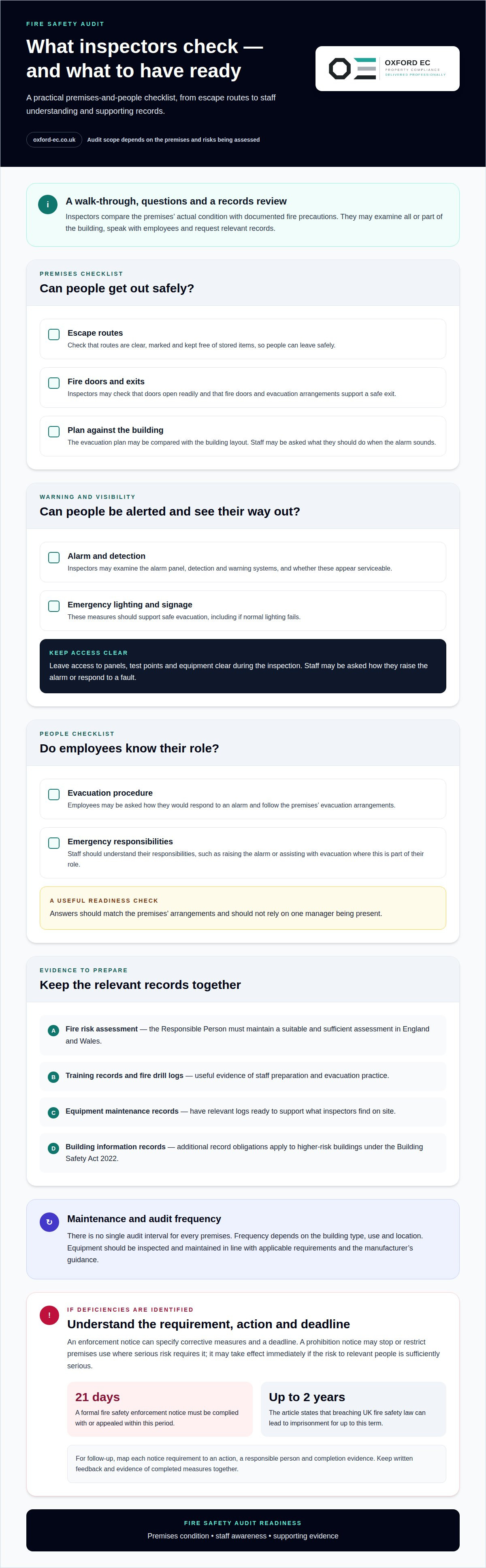
Inspectors compare the premises’ actual condition with documented fire precautions. They may inspect all or part of the building and speak with employees.
Premises and escape route checks
These checks assess whether people can leave safely and whether fire doors and evacuation arrangements support a safe exit. Inspectors look for clear, marked escape routes, doors that open readily and routes kept free of stored items. They may compare the evacuation plan with the building layout and ask how people should respond when the alarm sounds.
In England and Wales, the Regulatory Reform (Fire Safety) Order 2005 applies to workplace fire safety duties. Scotland has separate legislation, including the Fire (Scotland) Act 2005 and Fire Safety (Scotland) Regulations 2006. Fire safety is also governed by separate legislation in Northern Ireland.
Fire alarm and emergency lighting checks
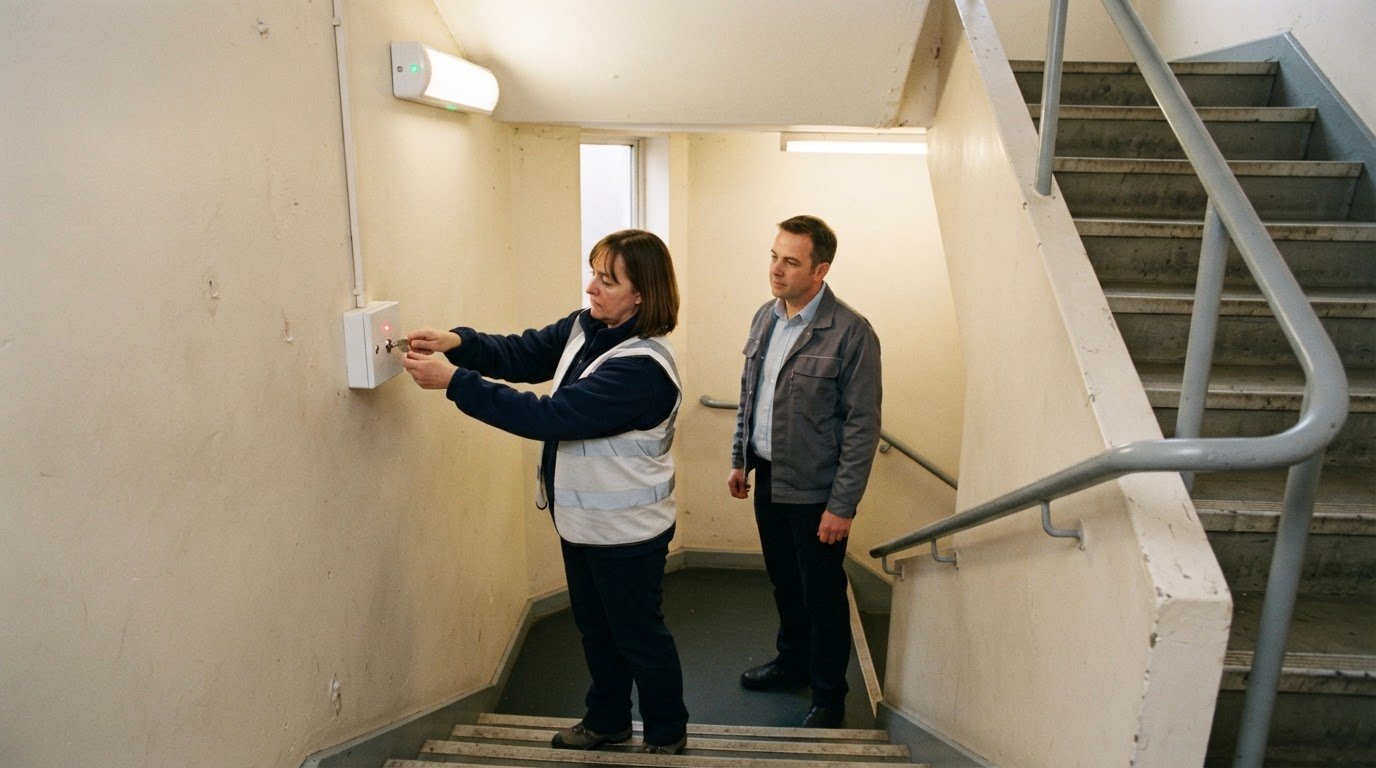
Inspectors may examine the alarm panel, detection and warning systems, emergency lighting and signage. They assess whether these measures appear serviceable and support safe evacuation, including if normal lighting fails. Staff may be asked how they raise the alarm or respond to a fault. Keep access to panels, test points and equipment clear during the inspection.
How often should checks happen? There is no single audit interval for every premises. Frequency depends on the building type, use and location. Equipment should be inspected and maintained in line with applicable requirements and the manufacturer’s guidance.
Staff awareness and safety checks
Staff awareness checks assess whether employees know the evacuation procedure and their emergency responsibilities. East Sussex Fire & Rescue Service inspectors may interview employees about their procedures and roles. For example, an inspector could ask a worker how they would raise an alarm or assist with evacuation. Clear answers should match the premises’ arrangements, not rely on one manager being present.
Short business safety checks can focus on visible conditions and key precautions rather than a full examination of every area. Inspectors may still ask questions, inspect relevant parts of the building and give guidance proportionate to risk.
Inspection records and regular checks
Inspection records help demonstrate that fire doors and other precautions are being monitored, defects recorded and follow-up completed. In England, responsible persons for buildings with two or more sets of domestic premises must check common-area fire doors quarterly and flat entrance doors annually, according to The National Archives (legislation.gov.uk).
In residential buildings, specific fire door requirements apply in England. Other checks depend on the premises and its fire risks. Missed checks can leave damaged doors or failed equipment unnoticed, weakening protection and leaving the responsible person without evidence of maintenance.
For a focused review of fire doors, alarms or emergency lighting, consider the relevant fire safety services alongside your ongoing checks.
Documents reviewed during a fire safety audit
Inspectors use documents to compare planned fire precautions with conditions at the premises. The fire risk assessment is central: its findings should reflect the building’s actual use, hazards and protective measures.
Records can show how the responsible person organises fire safety, trains staff and maintains equipment. Inspectors may request documents, ask questions about their entries and take copies of relevant records. Keep current versions together, with older records available where they explain how a defect or previous finding was addressed.
Documents commonly requested include:
- The fire risk assessment and records of reviews or changes to its findings.
- Fire safety policies and the fire precautions log book.
- Staff training records and fire drill records.
- Maintenance and testing records for alarms, emergency lighting and fire-fighting equipment.
- Records of previous fires, incidents or near misses and the actions taken afterwards.
Inspectors may compare records with what they see during the visit. For example, they may check an equipment maintenance log against the condition and accessibility of extinguishers. Firefighting equipment should be suitable, adequately fitted, maintained and accessible. If a record notes a defect, the inspector may look for evidence that it was reported and addressed.
How do inspectors assess fire extinguishers, firefighting equipment and maintenance records? They may review maintenance entries and check whether equipment is present, accessible and in suitable condition. They also compare recorded testing and servicing with the equipment on site.
Training and drill records help show whether written procedures have been put into practice. An inspector may ask staff about their emergency roles, then compare their answers with training records or evacuation drill entries. Differences can indicate that instructions need clarifying or refresher training. Records of incidents and near misses can also show whether lessons led to changes in precautions.
Review each document for clear dates, responsible roles, recorded findings and follow-up actions. A missing entry does not show whether a check was missed or simply not documented. The inspector may ask questions and seek supporting evidence. Keep evidence linked to the relevant system, such as an alarm maintenance entry alongside the related defect report and resolution.
Where records identify outstanding work, note the action, who is responsible and how completion will be evidenced. A formal audit finding may require further measures, while serious risks can prompt enforcement, including a prohibition notice. Accurate documents help the responsible person explain the premises’ precautions and show how identified issues are managed.
Preparation and expectations during an inspection
Prepare by aligning the premises, staff and current fire risk assessment before the fire and rescue service arrives. The responsible person should ensure the assessment reflects current operations and any changes to the building.
Practical audit preparation
Walk through the relevant areas and compare actual conditions with the fire risk assessment. Check that escape routes are clear, fire doors operate and staff can explain the evacuation arrangements. Make sure the nominated representative can access relevant areas and records during the visit.
Assign someone who understands the premises to accompany the inspector, answer questions and note findings. In Scotland, a nominated person should assist the officer, unlock doors and explain safety concerns. This preparation helps the audit examine the right areas without avoidable delays.
Audit duration and expectations
Visit length depends on the premises’ size and complexity, so allow time for questions and a building walk-through. The Scottish Fire and Rescue Service says an audit usually takes around 1.5 to 3 hours. A Fire and Rescue Service audit visit can take between one and five hours.
Expect inspectors to examine relevant precautions, ask about arrangements and provide feedback. North Wales Fire & Rescue Service says its inspectors work with premises representatives, offering advice proportionate to risk. An appointed representative should be ready to explain how the fire risk assessment informs day-to-day measures.
Before the visit, review whether building works, changes in use, new equipment or revised staffing have affected fire precautions. Under the Regulatory Reform (Fire Safety) Order 2005, the responsible person in England and Wales must maintain a suitable and sufficient fire risk assessment. A Competent Person may assist, but legal liability remains with the responsible person.
Use a short preparation schedule rather than relying on a last-minute sweep:
- Update the assessment to reflect current operations and premises changes.
- Walk escape routes and check that doors and signs are accessible.
- Tell relevant staff who will accompany the inspector and where to assemble.
- Make records accessible, including training, drills and equipment maintenance.
Some visits are arranged in advance. Lincolnshire Fire and Rescue says it sends a letter 4 to 8 weeks before a business safety check appointment. North Wales Fire & Rescue Service says inspectors have a written warrant, which they will show on request. Keep the appointment details available and identify a suitable representative.
Preparation should account for the audit’s scope: an inspection may cover all or part of the premises. If an inspector identifies a deficiency, record the finding, responsible person and corrective action. This creates a clear basis for follow-up and helps keep fire precautions aligned with the building’s use. In specialised sectors such as healthcare and social care, where premises safety forms part of statutory provider approval, teams like CQC Consultancy can provide guidance on wider registration and audit readiness.
What a fire safety audit assesses
In England, fire safety audits assess compliance with the Regulatory Reform (Fire Safety) Order 2005, according to The National Archives (legislation.gov.uk). The assessment considers more than visible equipment: inspectors examine how the responsible person identifies fire risk, selects safety measures and reviews whether those measures remain effective.
Article 11 of the Order concerns effective planning, organisation, control, monitoring and review of preventive and protective measures. In practice, an inspector may compare the fire risk assessment with the premises’ actual use. A storage area converted into a workshop, for example, could introduce ignition sources or combustible materials absent from the original assessment.
The assessment follows the chain of risk and control. Inspectors consider what could start a fire, what could fuel it and how fire might spread. They also assess whether people can detect a fire, raise the alarm, escape and reach safety. A control is useful only if it works in the circumstances identified by the assessment.
Inspectors examine whether fire detection and warning arrangements suit the premises, escape routes remain usable, and fire doors and compartmentation help limit fire spread. They may consider whether staff understand emergency procedures and whether firefighting equipment is appropriate and accessible. For example, a documented evacuation plan should match the building’s layout and the people using it.
Storage and housekeeping also affect the assessment. Inspectors may consider how flammable materials are stored, whether waste is removed and how ignition sources are controlled. For higher-risk industrial facilities where flammable atmospheres are present, sourcing certified apparatus from providers such as ExSafe helps ensure lighting, heating and power distribution do not become ignition hazards. A build-up of packaging near equipment, for instance, can undermine precautions recorded in the fire risk assessment. The key test is whether identified hazards have practical controls, not simply whether they appear in paperwork.
For multi-occupied residential buildings, the Fire Safety Act 2021 clarifies that the fire risk assessment must cover the building’s structure, external walls, cladding, balconies and flat entrance doors. This matters because an assessment limited to internal communal areas could miss features relevant to fire spread. The building’s design and use shape which hazards and safety measures require scrutiny.
An audit may assess the steps taken to address fire safety without examining every part of the premises. Inspectors can review relevant areas, records and systems to test the assessment’s significant findings. The scope depends on the premises and identified risks, so a sample inspection should not be mistaken for a detailed examination of every room.
Treat the assessment as a working explanation of risk: each significant hazard should connect to a suitable measure, a responsible role and evidence of review. When a building’s use or layout changes, assess whether existing precautions still address the new conditions.
Oxford Environmental Consultants (OEC): Asbestos Management Surveys
Oxford Environmental Consultants (OEC) provides Fire Risk Assessments for premises that need a structured assessment of fire hazards and precautions. Consider this service when an assessment needs reviewing or changes to the building or its use affect existing fire safety arrangements.
Where property compliance work also involves asbestos, an Asbestos Management Survey can help identify and manage asbestos-containing materials in a building. These services address different risks, so the appropriate assessment depends on the issue being investigated. OEC also provides Legionella Risk Assessments and Damp & Mould Surveys.
For a clear next step on fire risk or related property concerns, contact Oxford Environmental Consultants (OEC) or visit oxford-ec.co.uk.
Keep fire safety moving forward
A fire safety audit is one point in an ongoing process, not an end point. Use its findings to maintain a clear link between changes to the premises, identified risks and the measures in place. When operations or building conditions change, review whether the arrangements still address the risks and whether further assessment is needed.
Understanding what inspectors look for in a fire safety audit can help you decide what to do next. Oxford Environmental Consultants (OEC) offers Fire Risk Assessments, Asbestos Management Surveys and Legionella Risk Assessments. These address distinct property risks, helping you consider related compliance needs alongside fire safety.
Discuss your premises’ assessment requirements with Oxford Environmental Consultants (OEC) to take the next step.
Clear priorities and sound evidence help keep fire safety arrangements under active review.
Frequently Asked Questions
Why am I being inspected?
A fire and rescue service may arrange an audit as part of routine enforcement, after building changes, or following an incident or complaint. Timing and frequency can depend on the building type, use and location. For example, a change from office use to sleeping accommodation may alter the risks inspectors need to assess. An audit checks whether fire precautions reflect the premises and how people use them.
Fire Safety Basics: What is a Fire Safety Inspection?
A fire safety inspection assesses a premises and its precautions against relevant fire safety requirements. It may involve examining selected areas, considering how risks are controlled and asking how people would respond to an emergency. It is not necessarily a detailed examination of every room or system. The focus depends on the premises, its use and the risks being assessed.
What can you expect from an audit?
Expect the inspector to ask about fire safety arrangements, examine relevant areas and consider evidence supporting the premises’ precautions. You may receive feedback on compliant arrangements and areas needing improvement. Outcomes can range from advice to formal enforcement where serious risks or breaches require action. Understanding what inspectors look for in a fire safety audit helps you explain how precautions work in practice, not just how they appear in documents.
Who is the ‘Responsible Person’?
The Responsible Person is the duty-holder accountable for fire safety arrangements under the applicable legislation. In England and Wales, that person must carry out and maintain a suitable and sufficient fire risk assessment. They may appoint a Competent Person to assist, but legal responsibility cannot be delegated. The Responsible Person should understand the assessment’s findings and how the premises’ precautions address them.
What does a UK fire safety audit inspect?
An audit considers fire hazards, the precautions intended to control them and whether those precautions suit the premises’ risks. Inspectors may examine how fire could start or spread, how occupants would receive warning and whether people can evacuate. They can also assess whether staff understand the arrangements. The specific focus depends on the building and its use, rather than a single checklist applied identically to every site.
What fire risk assessment documents and records do inspectors check?
Inspectors may review the fire risk assessment, fire safety policies, training and drill records, equipment maintenance logs, and records of fires, incidents or near misses. They may ask for evidence supporting answers and take copies of relevant entries. For a useful audit trail, link a recorded issue to its follow-up, such as a maintenance entry, related defect report and evidence that corrective work was completed.
What do inspectors check about fire alarms, smoke detectors and emergency lighting?
Inspectors may examine the fire alarm panel, detection and warning arrangements, emergency lighting and related maintenance evidence. They can request records showing that a competent person tested relevant systems, then compare those records with the equipment and conditions on site. For example, a log noting a fault should make clear what happened next. They may also consider whether warning and lighting arrangements support evacuation if normal power fails.
What fire safety training and staff responsibilities must employers demonstrate?
Employers should be able to show that staff understand how to raise the alarm, follow evacuation procedures, report fire hazards and carry out assigned emergency roles. Training and fire drill records provide supporting evidence, while inspectors may ask employees about their responsibilities. For example, a staff member should know the designated response to discovering smoke, rather than rely on a manager to direct every action.