
A property may be safe, but responsible management also means being able to show how risks were identified and addressed. Proving due diligence in property safety management means keeping clear evidence of decisions, inspections, maintenance and staff training that support safe conditions. No single record tells the whole story: the evidence needs to reflect the property’s risks and the actions taken.
This distinction matters when safety arrangements are reviewed, a hazard is found or responsibility for a building changes hands. A folder of reports is not enough if findings have no clear follow-up. Records are most useful when they show what was assessed, what action followed and how ongoing controls are maintained.
This article explains the UK legislation property managers may need to consider, and how traceable records, risk assessments, maintenance documents and staff training can demonstrate a systematic approach. It also explores how property due diligence can identify safety issues requiring attention, helping you understand what evidence is relevant and when specialist assessment may support your records.
Key Takeaways
- Show how property risks are assessed, actions assigned and findings followed through, rather than relying on reports alone.
- Keep safety records organised and traceable so decisions, inspections and corrective actions can be understood over time.
- Use maintenance evidence and role-appropriate staff training records to demonstrate that safety controls are actively managed.
- Match assessments and supporting documents to the property’s specific hazards, including asbestos, water, damp and mould, and fire doors.
- Use specialist assessments to identify issues that need attention and strengthen the evidence behind your property safety arrangements.
Table of Contents
Commercial property health and safety legislation
Property safety duties depend on the building, how it is used and the risks people face there. Legislation, inspection findings and clear follow-up records help show how those risks are managed.
The Regulatory Reform (Fire Safety) Order 2005 is listed among health and safety requirements relevant to property management, according to The National Archives (legislation.gov.uk). The Building Safety Act 2022 is also relevant, according to The National Archives (legislation.gov.uk). It received Royal Assent in April 2022, according to The National Archives (legislation.gov.uk).
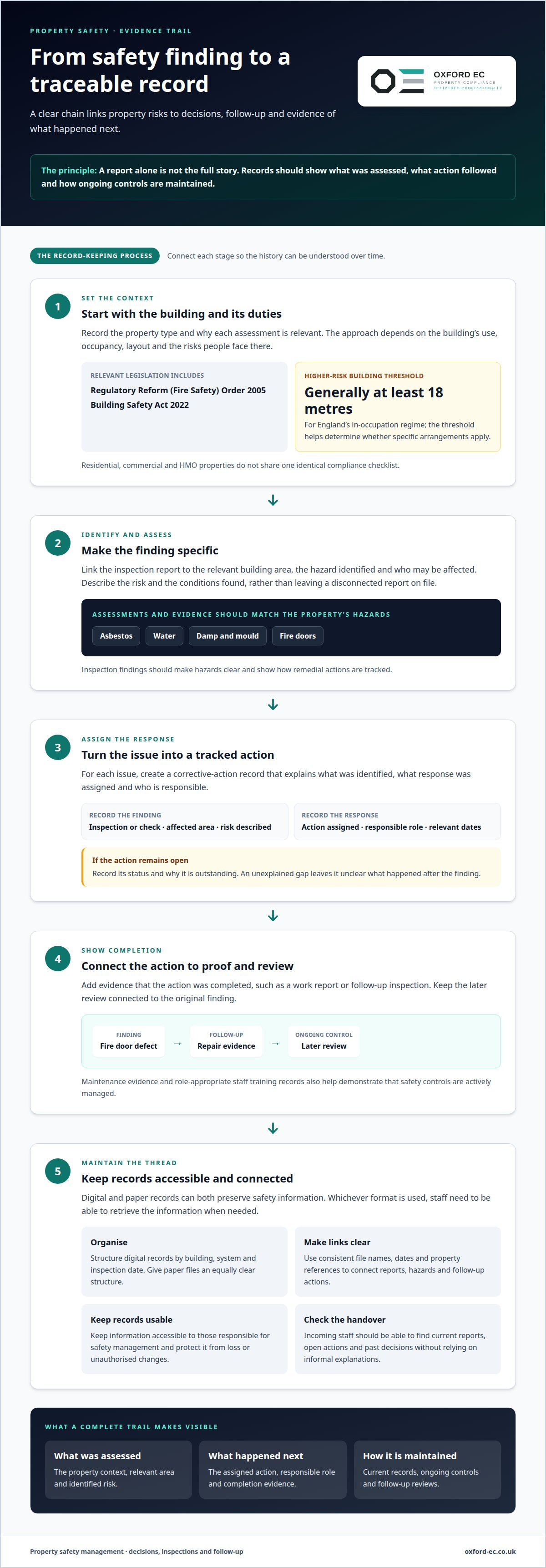
For England’s in-occupation regime, a higher-risk building is generally at least 18 metres in height, according to The National Archives (legislation.gov.uk). This threshold helps determine whether specific building safety arrangements apply. Residential, commercial and HMO properties don’t share one identical compliance checklist: the building’s use, occupancy, layout and applicable duties shape the required controls. Record the property type and the reasons for each assessment so the safety approach is understandable.
Environmental health officer inspections may examine conditions and records within the officer’s remit. For example, a food business may have checks and records reviewed during a visit, which can affect its food hygiene rating. In property management, inspection reports should make findings clear, identify hazards and show how remedial actions are tracked. Fire-safety requirements are one important consideration for non-domestic premises; relevant fire-safety information is available through fire safety services.
Hazards, consumer health and business liability
Hazards in use are conditions that could harm occupants, visitors or workers during everyday activities. A blocked escape route, unsafe access point or damaged building element can expose people to avoidable danger. Managers need to identify who may be affected, control the risk and retain reports showing what was identified and addressed. Clear evidence supports accountable decisions if an incident prompts scrutiny.
Penalties for safety failures
Penalties are enforcement consequences that may follow a failure to meet an applicable safety requirement. Outcomes depend on the breach, its seriousness and the circumstances, and may include corrective action or prosecution. The practical impact can extend beyond formal penalties: unresolved hazards can increase exposure to injury claims, disruption and remedial work. To mitigate these financial and operational risks, insurance brokers such as Just Quote Me highlight that demonstrable safety records are vital when arranging commercial cover. Inspection findings and records help demonstrate how concerns were handled.
Costs of mandatory checks and certificates
Assessment, inspection, testing and certification costs vary between UK properties. The scope depends on building size, use, systems, access and the condition of inspected areas. Separate the assessment from any remedial work, then plan the budget around the hazards and equipment identified. This makes obligations easier to plan and compare with maintenance records.
Golden Thread records and traceability
Traceable records connect building information with inspections, decisions and actions over time. They help managers assess whether information is current and accessible.
Digital and paper record storage
Digital and paper storage can both preserve safety information, provided staff can retrieve it when needed. For higher-risk buildings, the Golden Thread is intended to keep building safety information accurate, accessible and up to date throughout the building’s lifecycle.
That information should form a coherent record, not a collection of disconnected files. Link each inspection report to the relevant building area, identified hazard and follow-up action. For example, a fire door inspection record should connect a reported defect with repair evidence and a later review. Use consistent file names, dates and property references to make those links clear.
Organise digital records by building, system and inspection date; paper files need an equally clear structure. In either format, keep records accessible to those responsible for safety management and protect them from loss or unauthorised changes. A handover between property teams is a useful test: incoming staff should be able to find current reports, open actions and past decisions without relying on informal explanations.
Food businesses also rely on records to demonstrate how food safety is managed. Under the Food Safety Act 1990, relevant evidence can include temperature checks, cleaning schedules, supplier audits and pest-control reports. Records may be digital or paper-based, but should be accessible and stored safely. A supplier record, for example, can show that ingredients came from an approved, reputable source.
Recording corrective actions
A corrective-action record documents how a business identified a problem, responded and followed up. Without a recorded response to an inspection finding, it is unclear what happened next.
For each issue, record the inspection or check that identified it, the affected area, the risk described and the action assigned. Add the responsible role, relevant dates and evidence of completion, such as a work report or follow-up inspection. If the action remains open, record its status and why it is outstanding. This creates a traceable history rather than an isolated note.
Food safety records should also show how a problem was recognised and what corrective action followed. If a check identifies a concern, record the issue, the immediate response and evidence that the affected process was addressed. Keep related checks and reports together so the sequence is clear. Reviewing open actions alongside inspection records helps managers spot recurring issues and assess whether controls need attention.
Documents and evidence for due diligence
A property safety risk assessment documents hazards, who could be harmed and the controls selected. To conduct and document one, define the area and its use, inspect it, assess risks, record actions and review the evidence when conditions change. Proving due diligence in property safety management starts with an assessment that reflects the property’s actual condition.
The supporting file should connect the assessment to the building and the decision being made. A report about a plant room, for example, is more useful when it identifies the location, observations, risks and recommended follow-up. A structured approach helps managers distinguish current evidence from assumptions and identify obligations requiring further attention. When acquiring a property, proving due diligence in property safety management also means reviewing available evidence before accepting responsibility for unresolved issues.
- Set the scope. Identify the property, areas included and activities taking place. Note relevant information such as building plans, previous inspection reports and maintenance records. A warehouse assessment may need to cover loading areas as well as staff rooms, because people use them differently.
- Inspect the premises. Walk through the areas in scope and record hazards with enough detail to locate them. For example, describe a damaged floor covering by room and position, rather than writing only “trip risk”. Add photographs where they clarify the observation.
- Assess who could be affected. Consider occupants, employees, contractors and visitors, then record how the hazard could cause harm. An obstructed route may affect someone unfamiliar with the building differently from a regular member of staff.
- Record controls and gaps. Note existing precautions, their condition and any further action needed. Distinguish a control that is in place from one that is planned. This makes the reasoning behind each assessment visible to the person responsible for managing it.
- Assign and track action. For each gap, record the task, responsible role, priority and target date. Attach relevant work records or follow-up inspection evidence when the action is complete. Keep unresolved items visible for review, rather than closing them without supporting evidence.
- Review the assessment. Revisit it when building use, equipment or conditions change, or when new inspection findings emerge. Record what prompted the review, what changed and whether existing controls remain suitable.
Supporting documents can extend beyond the assessment itself. When acquiring a property, review whether historic building work complied with building regulations and whether approval was granted. Specialist reports may address structural integrity and environmental conditions, including soil analysis or flood risk. These documents can identify issues a visual inspection alone may not resolve.
Keep the assessment, reports and action evidence together under a clear property reference. A reviewer should be able to follow the chain from observation to decision and completed work. If findings need specialist interpretation, a suitably qualified professional can advise on the evidence needed to assess the issue and inform the next decision.
Equipment maintenance and staff training
Working equipment and capable staff are linked controls: one depends on the other. An estate’s fire alarm, emergency lighting and escape stairs need maintenance, while staff need to know how to respond to identified defects and safety procedures.
The Electricity at Work Regulations 1989 and Gas Safety (Installation and Use) Regulations 1998 are among legislation relevant to property management. Inspection and maintenance records should identify the equipment, the work completed, any faults and their resolution. A specialist report can help explain technical findings, but managers still need a clear process for acting on them.
Gas, electrical, fire and other safety inspections do not share one universal timetable. Frequency depends on the equipment, applicable requirements, risk assessment, condition and relevant manufacturer instructions. Record the basis for the schedule and review it when circumstances change.
Training should match each person’s role and responsibilities. Keep evidence of instruction, supervision and refresher training, and ensure staff understand the procedures relevant to their work. For example, staff who discover a damaged fire door should know how to report it and what interim arrangements apply. A useful training record identifies the subject, attendees and any follow-up needed.
Maintenance evidence should connect scheduled work with findings and decisions. A useful record can include:
- The asset’s location and identification, such as an emergency light in a named corridor.
- The inspection date, work undertaken and any fault identified.
- The action owner and progress of repairs or further assessment.
- Supporting documents, such as a service report or follow-up inspection record.
These details help managers distinguish a completed check from a resolved defect. If a fire alarm inspection identifies a fault, retain the report, record who is responsible for arranging remedial work and document evidence that the issue was addressed. Keep open actions visible until follow-up confirms their status. A record showing only that an inspection occurred does not explain what happened to a critical fault.
Staff also need a way to raise concerns between planned inspections. Explain how to report equipment damage, blocked escape routes or failed emergency lighting, and who receives each report. A simple reporting process gives managers information to assess promptly and helps prevent small defects from disappearing into informal conversations.
Review maintenance schedules and training records together. If reports repeatedly identify the same issue, assess whether staff instructions, supervision or maintenance arrangements need to change. This joined-up approach clarifies responsibilities: equipment is checked, findings are recorded and people know how to act.
Property management due diligence services
Property due diligence brings safety information into decisions about an asset’s condition, use and management. For a buyer in England, it can identify hazards and outstanding work before acquisition, helping clarify the risks and obligations attached to the property.
Shape the review around the building and the decision being made. For an acquisition, examine historic maintenance records, inspection reports and available information about building work. A gap between a reported defect and documented remedial work warrants attention: it may indicate a need for further investigation or action. If the building changes use, reassess whether existing arrangements address the new occupants and activities.
Technical due diligence can assess more than visible defects. A property condition assessment may examine structure, mechanical systems, roofing and common areas, identifying maintenance needs and deferred repairs. Environmental due diligence can investigate hazards such as asbestos, lead and contamination. Specialist reports may also assess structural integrity, soil conditions or flood risk. Together, these findings help decision-makers understand where further work, planning or cost forecasting may be needed.
A focused review can include:
- Comparing maintenance records with inspection reports and outstanding actions.
- Examining whether historic building work received building regulations approval.
- Identifying access, trip or structural concerns that affect people using the site.
- Reviewing safety equipment and relevant inspection evidence.
- Recording limitations, unresolved findings and the next decision required.
This matters because a buyer acquiring a non-compliant commercial property takes on its associated risks and remedial obligations. A clear report helps show what was identified before a transaction and supports informed decisions about negotiation, planned work or ongoing management. It also gives the incoming team a practical starting point, rather than leaving them to reconstruct the property’s history from scattered records.
Responsibility must remain clear after an appointment. An Accountable Person or Principal Accountable Person may appoint an agent or contractor to carry out activities, but cannot delegate legal accountability for building safety. The appointed party’s work can provide evidence and specialist knowledge; the accountable person still needs oversight of decisions and outstanding actions.
For an existing estate, use due diligence to prioritise work as well as identify deficiencies. Compare each building’s condition, the severity of recorded hazards and the status of remedial actions. This creates a defensible basis for allocating resources and planning upgrades. A report is most useful when its findings connect to named responsibilities, decisions and follow-up evidence.
Oxford Environmental Consultants (OEC): Asbestos Management Surveys
Oxford Environmental Consultants (OEC) supports property safety management with Asbestos Management Surveys to assess and document asbestos risks. The findings can inform building records and decisions about managing identified materials. This is particularly relevant when planning maintenance or reviewing a property’s safety information.
For other property hazards, OEC also provides Legionella Risk Assessments, Damp & Mould Surveys and Fire Door Inspections. These assessments address distinct risks, helping property managers build evidence that reflects the building’s actual condition rather than relying on general records alone.
Use the relevant assessment to investigate a specific concern and support informed follow-up. Contact Oxford Environmental Consultants (OEC) to discuss your property safety requirements.
Make your next safety decision evidence-led
Turn your property’s safety findings into a defined next step. Identify the issue that needs attention, assign responsibility and keep the resulting evidence connected to the decision. This keeps proving due diligence in property safety management focused on practical risk control, not paperwork alone.
Where specialist assessment is needed, Oxford Environmental Consultants (OEC) offers Asbestos Management Surveys, Fire Risk Assessments and Legionella Risk Assessments. These services help investigate specific property risks and inform appropriate management decisions. Choose the assessment that matches the concern, whether you’re reviewing asbestos information, fire safety or water-system risks.
Clear priorities make action easier to manage. Start with the finding that most directly affects people using the property, then establish what assessment or follow-up will address it.
A considered next step can strengthen safety management and help keep decisions accountable.
Frequently Asked Questions
What is due diligence?
Due diligence is the reasonable, relevant work undertaken to understand and manage risks before and during property ownership or management. In safety terms, it means understanding the building’s condition, identifying hazards and making informed decisions about controls. For example, a buyer reviewing a commercial building can consider inspection findings and maintenance history before accepting responsibility for outstanding issues.
Need Support With Building Safety And Compliance?
Oxford Environmental Consultants (OEC) provides property safety assessments to investigate specific risks. Its services include Fire Risk Assessments, Legionella Risk Assessments, Asbestos Management Surveys and Damp & Mould Surveys. These assessments address different concerns, from fire hazards to asbestos-containing materials and water-system risks. The appropriate service depends on the issue affecting the property and the evidence needed to inform its management.
What UK laws govern property safety management and an owner's duty of care?
Relevant legislation depends on the property, its use and the hazards present. Examples include the Health and Safety at Work etc. Act 1974, the Management of Health and Safety at Work Regulations 1999, the Control of Asbestos Regulations 2012 and the Building Safety Act 2022. The Regulatory Reform (Fire Safety) Order 2005 is also relevant, according to The National Archives (legislation.gov.uk). Consider applicable duties alongside the property’s specific risks.
What does due diligence mean for landlords and property managers in the UK?
For landlords and property managers, due diligence means understanding the risks connected with the building and acting within their responsibilities. A lease may allocate particular tasks, but it does not by itself resolve who holds legal accountability. In higher-risk buildings, an Accountable Person or Principal Accountable Person may appoint an agent or contractor to carry out activities, but cannot delegate legal accountability for building safety.
What property safety checks and certificates are legally required in England, Wales, Scotland and Northern Ireland?
There is no single checklist of certificates that applies to every property across all four UK nations. Requirements depend on the property’s location, use, occupancy, systems and hazards. For example, fire safety, asbestos and water-system risks may call for different assessments or evidence. Identify the relevant jurisdiction and building type first, then establish which checks apply and keep the resulting reports with the property’s safety records.
What records and evidence should property owners keep to prove safety compliance?
Keep records that show the property’s safety decisions and their basis. Useful examples include current assessments, inspection reports, maintenance records, building plans, approvals for historic work and relevant staff training records. Organise documents by property and system, and retain earlier versions when revised assessments change recommendations. This helps a new manager understand why a control was selected and whether it still reflects the building’s current condition.
How can property owners show they acted on inspection findings and safety defects?
Link each finding to a recorded decision and its outcome. For a defect in a shared entrance, document any immediate precautions, who was assigned the repair, the work completed and evidence of a follow-up check. If action remains outstanding, keep its status visible and record the reason. This makes it easier to distinguish a reported problem from a resolved one and explain decisions if the issue is reviewed later.
What official UK guidance and local authority rules apply to property safety management?
Start with the legislation relevant to the property and consult official guidance for the specific risk or duty. The National Archives (legislation.gov.uk) provides the text of legislation, including the Fire Safety Order and Building Safety Act. Local authority involvement depends on the property and issue. For example, an environmental health officer may inspect food business records and checks, which can affect its food hygiene rating.