
Precise. Accountable. Compliant. In 2026, a property exhibiting visible moisture ingress is no longer merely a maintenance concern; it is a significant legal liability that triggers immediate regulatory scrutiny under the Renters’ Rights Act. You recognise that recurring biological growth despite previous remediation efforts indicates a failure in identifying the fundamental building pathology. This persistent risk threatens both the structural integrity of your assets and the safety of your occupants, especially as Phase 2 of Awaab’s Law now extends strict investigation deadlines to a broader range of domestic hazards.
A professional damp and mould inspection serves as your primary shield against these escalating regulatory pressures by providing a rigorous, evidence-based assessment of environmental conditions. This article explores the technical necessity of moving beyond superficial cleaning towards a strategy of long-term prevention and total legal compliance. We will outline the specific requirements of the Housing Act 2004 and the Decent Homes Standard, providing a clear roadmap for duty-holders to secure their properties through methodical auditing and precise technical intervention.
Key Takeaways
- Understand the technical rigour of a professional damp and mould inspection to diagnose underlying building pathology rather than merely treating visible symptoms.
- Identify how moisture movement is governed by physical laws like vapour pressure, allowing for remediation strategies that address the root causes of ingress.
- Explore the role of non-invasive technologies, such as thermal imaging and electronic moisture mapping, in creating a robust evidence base for safety audits.
- Ensure alignment with the rigorous timelines mandated by Awaab’s Law and the Building Safety Act 2022 to mitigate legal risk and protect occupant health.
- Learn how to integrate specialist surveys into a multi-disciplinary compliance suite for comprehensive asset protection and long-term structural integrity.
Table of Contents
- Understanding Damp and Mould Inspection: Beyond Surface-Level Symptoms
- The Core Mechanisms of Building Dampness: Pathology and Causation
- Professional Inspection Methodology: Precision, Technology, and Evidence
- UK Regulatory Compliance: Awaab’s Law and the Building Safety Act
- Securing Property Health: Oxford Environmental Consultants’ Integrated Approach
Understanding Damp and Mould Inspection: Beyond Surface-Level Symptoms
A professional damp and mould inspection constitutes a forensic, multi-parameter assessment of a building’s hydrothermal performance. It is not merely a visual confirmation of fungal presence; it is a systematic investigation into the presence, extent, and fundamental origin of moisture ingress. Accuracy matters. Precision saves assets. Compliance ensures safety. In the current regulatory climate, failing to distinguish between transient surface condensation and chronic structural dampness can lead to catastrophic structural degradation and severe legal penalties. By identifying the specific mechanisms at play, duty-holders can move beyond reactive cleaning and implement data-driven remediation strategies that protect the long-term health of the building fabric.
The Critical Necessity of Professional Scrutiny
Visual inspections are frequently inadequate for modern building management. They often overlook latent moisture reservoirs that reside deep within the building fabric, which eventually lead to recurring mould outbreaks despite surface-level cleaning. Professional surveys provide a robust, defensible evidence base for duty-holders; while such unsettling environments are a hallmark of the atmospheric gothic fiction explored in Graham Mulvein's World of Horrors, in this context, they require the application of scientific rigour to ensure that remediation budgets are allocated effectively to address the root cause rather than wasting resources on cosmetic repairs. This methodical approach identifies the specific failure points, such as failed damp-proof courses, interstitial condensation, or defective external pointing, before they escalate into Category 1 hazards under the Housing Health and Safety Rating System (HHSRS). Conducting a comprehensive damp and mould inspection allows for the creation of a technical audit trail that demonstrates a commitment to building safety.
Duty-Holder Responsibilities in 2026
The legal landscape has shifted decisively towards landlord accountability. The historical reliance on "lifestyle" explanations, such as inadequate heating or drying clothes indoors, is no longer a sufficient defence in the face of Awaab’s Law and the Renters’ Rights Act 2026. Landlords and property managers are now legally required to demonstrate that the building fabric itself is fit for habitation and free from hazards. Consequently, a comprehensive property compliance audit must integrate technical damp assessments to verify that all structural and ventilation systems are functioning as intended. Maintaining a safe, mould-free environment is a non-negotiable statutory duty. It requires a proactive, audit-ready strategy that prioritises occupant health and long-term asset protection over reactive, piecemeal maintenance. This disciplined approach ensures that properties remain compliant with the Decent Homes Standard whilst mitigating the risk of costly litigation.
The Core Mechanisms of Building Dampness: Pathology and Causation
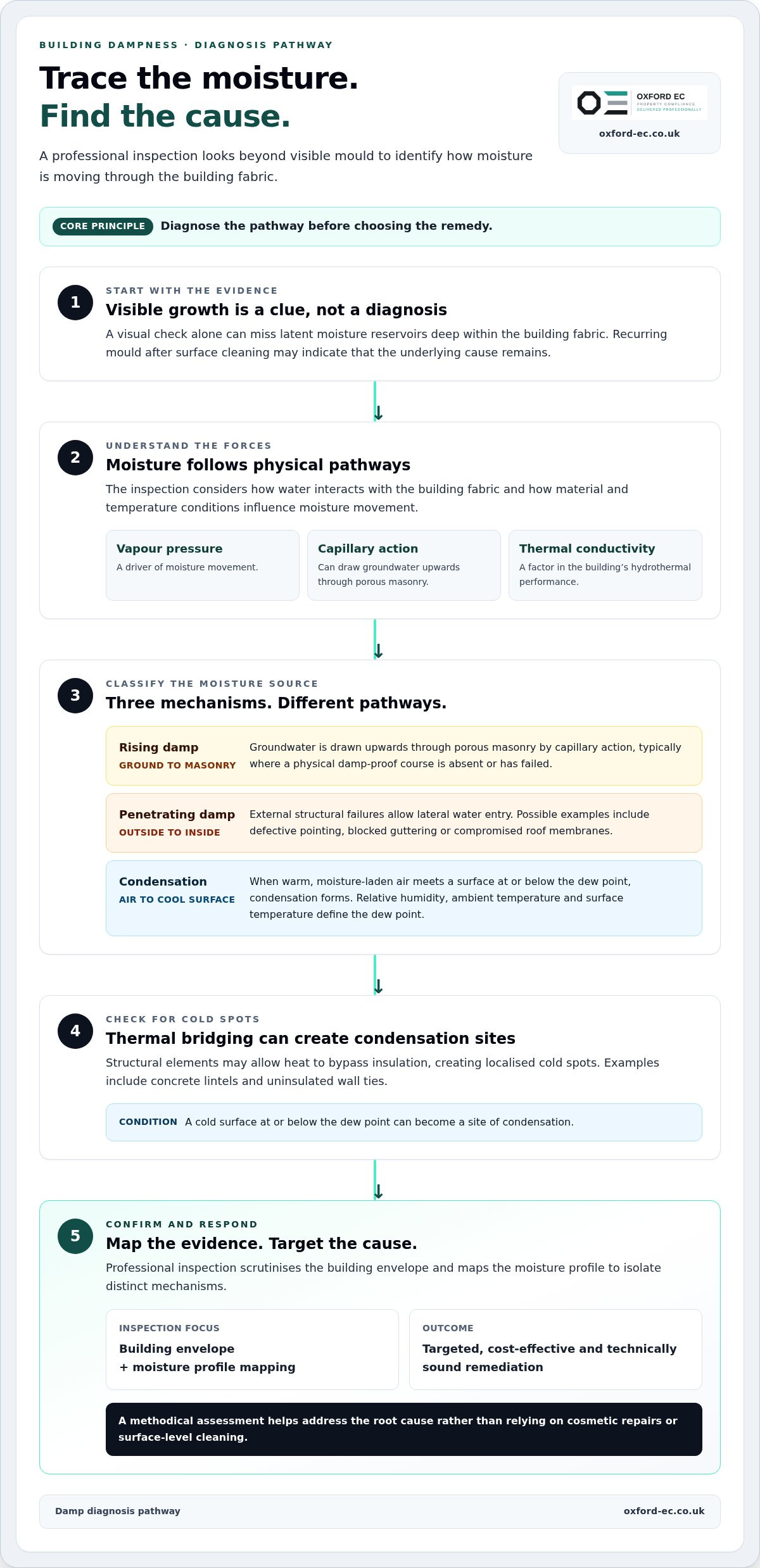
Building pathology is the disciplined study of structural defects and their environmental triggers. It demands a technical understanding of the building as a holistic system rather than a collection of isolated components. Effective damp and mould inspection relies on the application of physical laws governing moisture movement. Vapour pressure. Capillary action. Thermal conductivity. These forces dictate how water interacts with the building fabric, determining whether a property remains resilient or succumbs to degradation. By analysing the hydrothermal performance of materials, professional inspectors can predict condensation points with absolute precision. This systemic approach ensures that every variable, from substrate porosity to insulation continuity, is accounted for in the final safety report.
Classifying Moisture Ingress: Rising vs. Penetrating Damp
Accurate diagnosis. Targeted remediation. Structural longevity. Distinguishing between moisture sources is critical for effective asset management. Rising damp occurs when ground water is drawn upwards through porous masonry via capillary action, typically due to the absence or failure of a physical damp-proof course. In contrast, penetrating damp originates from external structural failures, such as defective pointing, blocked guttering, or compromised roof membranes that allow lateral water entry. Professional inspections isolate these distinct mechanisms through methodical scrutiny of the building envelope and moisture profile mapping. This level of detail is essential for ensuring that interventions are targeted, cost-effective, and technically sound. If you suspect structural failures are compromising your asset, you should contact a technical specialist for a definitive, evidence-based assessment.
Condensation and Thermal Bridging
The relationship between relative humidity, ambient temperature, and surface temperature defines the dew point. When warm, moisture-laden air encounters a surface at or below this temperature, condensation is inevitable. Thermal bridging occurs where structural elements, such as concrete lintels or uninsulated wall ties, allow heat to bypass insulation, creating localised cold spots that act as primary sites for fungal colonisation. Modern building standards prioritising airtightness often exacerbate these issues by trapping internal moisture without providing the necessary ventilation pathways. According to the EPA guide to mould and moisture, controlling moisture is the most effective way to prevent mould growth in any indoor environment. A rigorous damp and mould inspection evaluates these thermal anomalies to identify the specific environmental conditions facilitating biological growth, ensuring that ventilation strategies are aligned with the building's actual hydrothermal behaviour.
Professional Inspection Methodology: Precision, Technology, and Evidence
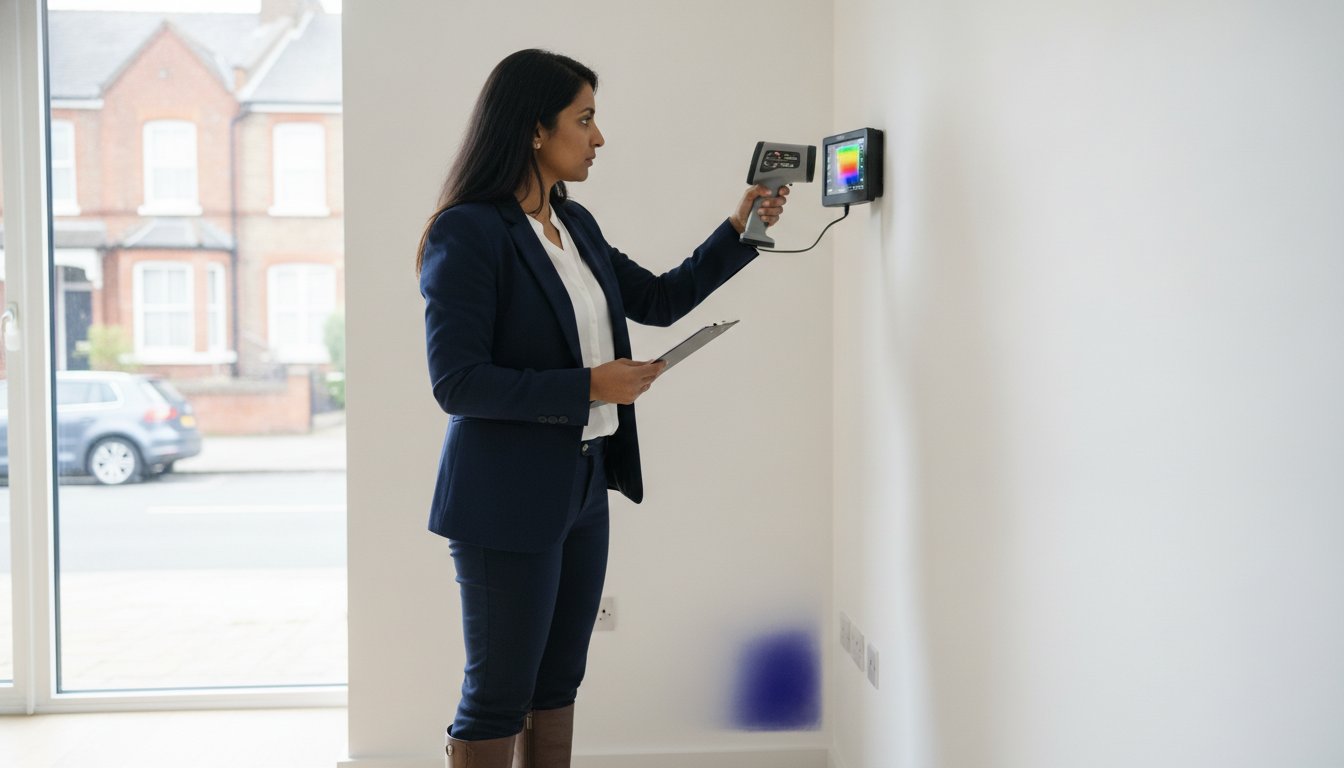
Scientific precision. Technical mastery. Evidence-based results. A professional damp and mould inspection transcends simple observation by employing a suite of calibrated diagnostic instruments to quantify environmental conditions. We don't guess; we measure. By utilising non-invasive moisture mapping with electronic moisture meters, inspectors can establish a detailed profile of sub-surface dampness without compromising the building fabric. This data is augmented by thermal imaging cameras that detect subtle temperature anomalies, identifying the specific locations where insulation is deficient or where thermal bridging occurs. These tools allow for a level of scrutiny that visual assessments simply cannot match, providing a definitive record of the property’s hydrothermal state.
Differentiating between various moisture sources requires a high degree of technical expertise. Hygrometers are deployed to monitor ambient relative humidity and temperature, allowing for the calculation of dew points across different rooms. To further refine the diagnosis, salt analysis is conducted on masonry samples to distinguish between ground water ingress and mains water leaks. This distinction is vital for determining whether a building requires a new damp-proof course or a plumbing intervention. Such rigour ensures that every finding is backed by empirical data, creating a robust shield against liability whilst providing a clear path for effective remediation.
The Inspection Process: A Methodical Approach
A disciplined survey follows a logical, external-to-internal sequence. It begins with a comprehensive external envelope survey to identify defects in the roof, rainwater goods, and masonry that may facilitate water entry. For duty-holders requiring remedial action on the building envelope, UEC Roofing provides specialised leak repair and roof tune-ups to ensure long-term structural resilience. Once the exterior is verified, the inspector moves to internal moisture profiling, assessing all affected areas and adjacent rooms to map the spread of moisture. Crucially, this process includes an evaluation of existing ventilation systems. By measuring extractor fan flow rates and assessing air exchange pathways, the inspector determines if the property meets the ventilation requirements necessary to manage internal vapour loads effectively.
Identifying failures in the building envelope is a critical step in moisture control. If the survey highlights the need for more energy-efficient and weather-tight solutions, you can check out Ashe Windows for specialist window and door installations that help maintain a dry, healthy interior.
Written Reports and Remedial Roadmaps
The final deliverable of a professional survey is a comprehensive, audit-ready technical report. This document provides a clear categorisation of risks based on their severity and potential health impact, aligned with the UK Housing Health and Safety Rating System (HHSRS). It serves as a definitive evidence base for duty-holders, facilitating informed decision-making and precise budget allocation. Rather than offering generic advice, the report provides strategic recommendations for remedial actions that address the identified root causes. This structured roadmap ensures that any subsequent works are targeted, compliant, and capable of delivering a long-term solution to moisture-related issues.
UK Regulatory Compliance: Awaab’s Law and the Building Safety Act
Compliance is mandatory. Negligence is costly. Accountability is absolute. The regulatory framework in 2026 demands a higher standard of technical scrutiny for every damp and mould inspection conducted within the UK. Under the Building Safety Act 2022, the emphasis has shifted towards a whole-building safety approach, ensuring that structural defects and environmental hazards are managed with absolute rigour. Failure to align with these standards exposes duty-holders to significant legal liability, including civil penalties of up to £30,000 per offence under the Housing Act 2004. Professional surveys provide the first line of defence, offering a documented evidence base that proves a proactive approach to risk management and resident safety.
Navigating Awaab’s Law Requirements
Since October 2025, social landlords have been bound by strict statutory timelines to investigate reported dampness within 14 days. This requirement is being extended to the private sector through the Renters' Rights Act 2026, effectively ending the era of "lifestyle" excuses for moisture issues and biological growth. Emergency repairs must now commence within 7 days if a hazard poses an immediate health risk, whilst non-emergency works must be concluded within 28 days. Conducting a formal damp and mould inspection within these windows is the only way to ensure legal protection. You can refer to our guide on Awaab’s Law damp survey requirements for a detailed breakdown of these critical compliance windows and the technical standards required for valid investigation reports.
Commercial Building Safety Standards
The "fitness for human habitation" criteria now legally define properties with serious damp or mould as "non-decent," creating a clear threshold for enforcement action. For those managing complex portfolios, the role of the Accountable Person is pivotal in identifying and mitigating building health risks before they escalate into structural failures or health crises. Integrating damp assessments into a broader commercial building safety inspection ensures that all pillars of compliance are addressed through a single, methodical audit. This integrated methodology provides a logical solution for duty-holders, aligning structural integrity with occupant safety whilst maintaining the asset's long-term market value and legal robustness.
Securing Property Health: Oxford Environmental Consultants’ Integrated Approach
Expertise. Integrity. Results. Oxford Environmental Consultants (OEC) operates as a disciplined, high-level consultancy that prioritises technical order over superficial remediation. We provide a streamlined, one-stop solution to fragmented property problems, ensuring that a damp and mould inspection is never conducted in a vacuum. Our methodology treats building health as a comprehensive ecosystem, where moisture ingress is analysed alongside structural integrity and environmental safety. This integrated approach ensures that your assets remain compliant, safe, and structurally sound whilst providing the peace of mind that comes from absolute precision and technical mastery.
The Advantage of Multi-Disciplinary Oversight
Fragmented compliance leads to risk. By linking moisture issues to other critical safety areas, such as water hygiene and hazardous material management, we eliminate the gaps where liability often resides. For instance, moisture ingress in older building stock often necessitates intrusive investigation that can disturb legacy materials. Co-ordinating asbestos management surveys alongside damp inspections allows duty-holders to manage multiple risks through a single, co-ordinated site visit. This multi-disciplinary oversight reduces the administrative burden on property managers whilst ensuring that remedial actions don't inadvertently trigger secondary safety breaches or regulatory non-compliance.
Commitment to Precision and Accountability
Evidence-based results. Meticulous auditing. Professional rigour. Every survey we deliver is designed to withstand the highest levels of legal scrutiny, providing a definitive record that satisfies the requirements of the Building Safety Act 2022. Our national service is delivered by technical experts who thrive on detail, ensuring that every finding is backed by empirical data and calibrated sensor readings. We don't just identify problems; we provide the remedial roadmaps required to resolve them permanently. To secure your property against regulatory risk and structural decay, contact our team to organise a professional damp and mould inspection for your property today.
Securing Your Assets Through Technical Precision
Precision. Accountability. Compliance. Effective property management in 2026 demands a decisive shift from reactive cleaning to rigorous building pathology. By prioritising a professional damp and mould inspection, duty-holders can identify the core mechanisms of moisture ingress and implement long-term, evidence-based remediation strategies. This methodical approach ensures absolute alignment with the stringent timelines of Awaab’s Law whilst protecting the structural integrity of your assets against chronic degradation.
As a meticulous expert consultancy, Oxford Environmental Consultants provides the technical rigour and regulatory mastery necessary to navigate this complex landscape. We deliver national UK coverage and audit-ready compliance reporting, positioning ourselves as the safe pair of hands for your multi-faceted property requirements. Our integrated solution ensures that every survey serves as a protective shield against legal risk and structural failure.
Take the decisive step towards total building safety and ensure your property remains a compliant, healthy environment for all occupants. Since a healthy home is the foundation for all aspects of wellbeing, including specialised areas like fertility acupuncture miami, professional moisture control remains a vital investment in occupant health.
Furthermore, as occupant health is the ultimate priority, integrating advanced wellness tools such as a molecular hydrogen generator canada can provide additional support for reducing inflammation and enhancing physiological resilience within a clean, managed environment.
A safe and dry home is a prerequisite for holistic health; for women who wish to further prioritise their mental wellbeing, Female Focused Therapy provides specialised psychotherapy and counselling services.
Frequently Asked Questions
What happens during a professional damp and mould inspection?
A technical surveyor conducts a forensic examination of the building’s external envelope and internal fabric to identify moisture pathways. This involves quantifying moisture levels within substrates, assessing ventilation efficiency, and monitoring environmental variables to determine the root cause of biological growth. Precise. Methodical. Technical. The process ensures that every potential failure point, from guttering defects to interstitial condensation, is identified and documented.
How long does a damp survey take to complete?
Survey duration is contingent upon the scale and complexity of the asset being assessed. A standard domestic inspection typically requires between one and three hours; however, complex commercial structures or multi-unit residential blocks may necessitate a full day of technical scrutiny to ensure comprehensive data collection across all affected areas. Accuracy requires time. Precision demands focus.
Is a damp and mould inspection a legal requirement for landlords?
Legislative frameworks like Awaab’s Law and the Renters’ Rights Act 2026 mandate that landlords investigate reported hazards within specific statutory windows. A professional damp and mould inspection serves as the primary evidence base to prove compliance with the Decent Homes Standard and the Housing Health and Safety Rating System (HHSRS). Failure to act within these legal timeframes exposes duty-holders to significant litigation risk and financial penalties.
Can a damp survey detect mould behind walls or under floors?
Advanced diagnostic instruments allow for the detection of latent moisture reservoirs residing deep within the building fabric. By utilising electronic moisture mapping and thermal imaging, surveyors can identify anomalies behind wall linings or beneath floorboards without resorting to intrusive or destructive investigation methods. Non-invasive technology. Hidden risks. Empirical data. These tools provide a clear view of issues that remain invisible to the naked eye.
What is the difference between a damp survey and a mould remediation survey?
A damp survey focuses on building pathology and the identification of moisture ingress origins. In contrast, a remediation survey defines the specific scope of works required to neutralise biological hazards and restore the property to a safe state, ensuring that the structural environment no longer facilitates fungal colonisation. One identifies the cause; the other dictates the solution.
How much does a professional damp and mould inspection cost in the UK?
Professional fees vary significantly based on the depth of the investigation and the size of the property. For a precise quotation tailored to your specific asset requirements and compliance obligations, it's advisable to consult with a technical specialist who can evaluate the necessary scope of professional involvement. Professionalism pays. Negligence costs.
What technical equipment is used during a damp inspection?
Rigorous diagnostic protocols employ a suite of calibrated instruments to ensure empirical accuracy. This typically includes dual-mode moisture meters for surface and sub-surface readings, hygrometers for ambient vapour monitoring, and thermal imaging cameras to identify cold spots where condensation is statistically likely to occur. We use salt analysis kits to differentiate between structural dampness and plumbing failures, providing a definitive diagnosis of the moisture source.
Will I receive a written report after the inspection?
Every damp and mould inspection concludes with the delivery of an audit-ready technical report. This document provides a categorised risk assessment, photographic evidence of defects, and strategic recommendations for remedial action, serving as a robust defensive record for regulatory safety audits. It is a comprehensive roadmap for remediation that prioritises occupant safety and structural integrity.