

Property compliance failures rarely announce themselves. Water systems develop biofilm gradually, fire doors deteriorate incrementally, and compartmentation weakens silently. By the time problems become visible, the risk has already escalated and the cost of remediation has multiplied. Planned preventative maintenance offers a methodical alternative: a structured approach that identifies deterioration before it becomes danger, ensures regulatory compliance before enforcement action, and transforms risk management from reactive firefighting into controlled, audit-ready assurance.
What Planned Preventative Maintenance Actually Means
Planned preventative maintenance is a scheduled, systematic approach to maintaining building assets and compliance-critical systems through regular inspection, testing, servicing, and component replacement. Unlike reactive maintenance, which responds to failures after they occur, or predictive maintenance, which relies on condition monitoring technology, planned preventative maintenance operates on predetermined intervals based on regulatory requirements, manufacturer specifications, and empirical risk data.
The discipline demands three core components. First, a comprehensive asset register that documents every system, component, and compliance obligation across the estate. Second, a maintenance schedule that aligns statutory testing frequencies with operational risk profiles. Third, a management framework that ensures work completion, records retention, and continuous improvement.

For property compliance, this methodology proves particularly critical. The Health and Safety at Work etc. Act 1974, the Regulatory Reform (Fire Safety) Order 2005, the Control of Substances Hazardous to Health Regulations 2002, and the Building Safety Act 2022 collectively impose strict duties on building owners and managers. Failure to demonstrate active, documented maintenance exposes duty holders to enforcement notices, unlimited fines, and in cases of serious harm, custodial sentences.
Building a Planned Preventative Maintenance Programme
Establishing a robust programme requires methodical groundwork:
- Conduct a comprehensive asset audit across all compliance disciplines
- Map statutory obligations against each asset type and location
- Establish risk-based inspection frequencies beyond minimum legal intervals
- Assign clear ownership for each system and maintenance stream
- Implement a centralised recording system with audit trail functionality
- Schedule work packages to balance operational disruption with compliance necessity
- Build supplier relationships with accredited, competent contractors
The initial audit phase separates effective programmes from paper exercises. Every water outlet, fire door, asbestos-containing material, and passive fire protection element must be identified, located, and assessed. This asset register becomes the foundation for all subsequent scheduling and prioritisation decisions.
Risk stratification ensures resources flow to highest-priority areas. A healthcare facility's water systems demand more frequent sampling than a standard office environment. High-occupancy residential blocks require shorter fire safety inspection cycles than single-occupancy commercial units. The programme must reflect these nuanced risk profiles rather than applying blanket frequencies.
Compliance-Specific Maintenance Streams
Different compliance disciplines demand distinct maintenance approaches. Water hygiene exemplifies the complexity. Beyond quarterly temperature monitoring and annual legionella risk assessment reviews, effective planned preventative maintenance includes monthly tap flushing, six-monthly shower head descaling, biannual calorifier servicing, and periodic system chlorination. Each intervention prevents biofilm development and reduces pathogen proliferation risk.
For fire safety systems, the schedule encompasses:
- Monthly visual checks of fire doors, signage, and escape routes
- Quarterly emergency lighting duration tests
- Six-monthly fire alarm system servicing
- Annual fire extinguisher maintenance
- Bi-annual compartmentation inspections
- Three-yearly fire risk assessment reviews
Asbestos management follows a different rhythm. Once identified and risk-assessed, asbestos-containing materials require annual re-inspection to monitor condition deterioration. High-risk materials in accessible locations may warrant six-monthly checks, whilst sealed, inaccessible materials might extend to 18-month intervals under specific circumstances.
| Compliance Area | Primary Frequency | Critical Assets | Escalation Trigger |
|---|---|---|---|
| Water Hygiene | Quarterly sampling | Calorifiers, dead legs | Positive legionella result |
| Fire Doors | Annual inspection | Compartment doors, flat entrance doors | Failed self-closure |
| Emergency Lighting | Quarterly duration test | Escape route luminaires | >10% failure rate |
| Asbestos | Annual re-inspection | Damaged ACMs, high-traffic areas | Condition score increase |
Technology and Documentation Standards
Modern planned preventative maintenance demands digital infrastructure. Paper-based schedules fragment across site files, maintenance logs disappear during staff transitions, and compliance evidence proves impossible to retrieve during audits. Cloud-based compliance management systems centralise asset data, automate scheduling, capture photographic evidence, and generate audit-ready reports.
Effective documentation extends beyond tick-box completion records. Each maintenance visit should capture specific condition observations, measurements against baseline data, remedial actions taken, and recommendations for future intervention. Photographic evidence timestamps asset condition and provides defensible proof of inspection quality.
The written scheme following each risk assessment must translate into executable work instructions. Generic maintenance schedules fail because operatives lack the specific detail required for effective inspection. A water hygiene scheme should list every outlet, its location, expected temperature range, and action thresholds. Fire safety work packages must identify each door by unique reference, floor plan location, and specific components requiring inspection.
Budgeting and Resource Allocation
Planned preventative maintenance represents an investment, not an overhead. Industry data consistently demonstrates that proactive maintenance costs approximately 30-40% of reactive failure costs when calculated across a five-year cycle. This calculation incorporates not only direct repair expenses but also regulatory enforcement costs, operational disruption, and reputational damage.
Budget planning requires three distinct cost categories:
- Routine maintenance: scheduled inspections, testing, and servicing delivered at predetermined frequencies
- Minor remediation: small-scale repairs identified during inspections and resolved before failure
- Major replacement: lifecycle component renewal planned through condition monitoring and predicted useful life calculations
A well-structured programme identifies major replacement requirements years in advance. Fire alarm systems approaching 15 years, emergency lighting batteries nearing capacity loss, and deteriorating water infrastructure all signal planned capital expenditure rather than emergency crisis spending.
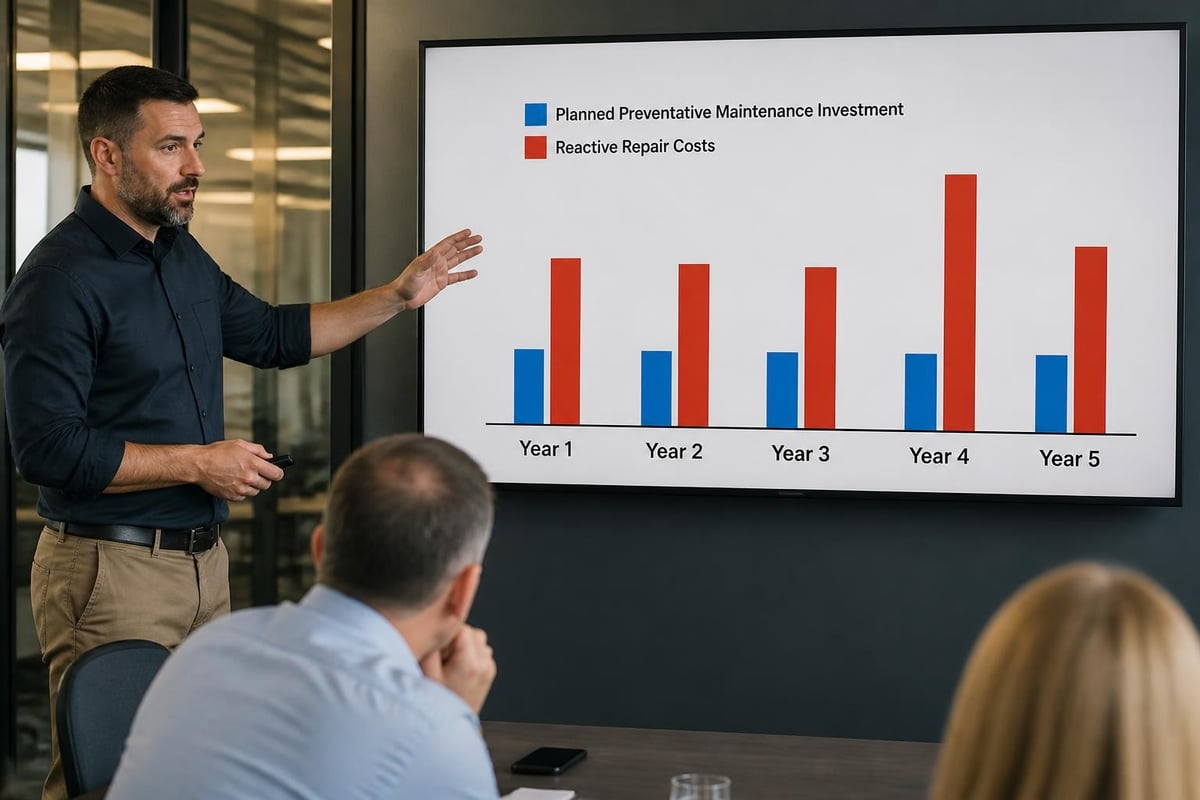
Resource smoothing prevents the feast-famine cycle that plagues reactive approaches. Spreading work across the calendar year maintains contractor relationships, secures preferential pricing, and reduces operational disruption. Quarterly water sampling, monthly fire safety walkthroughs, and rolling asbestos re-inspections create manageable work packages rather than annual compliance panics.
Competency and Quality Assurance
Planned preventative maintenance quality depends entirely on operative competency. The most sophisticated schedule becomes worthless when delivered by inadequately trained personnel using inappropriate methodologies. Duty holders must verify contractor accreditation, individual qualifications, and insurance coverage before appointment.
For specialist compliance work, accreditation standards provide quality benchmarks. Water sampling requires UKAS laboratory analysis. Asbestos surveying demands P402/P403/P404 qualified consultants operating under ISO 17020 inspection body accreditation. Fire risk assessment competence aligns with IFE/IOSH/FPA recognised qualifications and PAS 79-1/PAS 79-2 methodology.
Quality assurance extends beyond front-line operatives. Supervisory review of completed reports, peer checking of risk assessments, and technical director sign-off of critical documentation ensure consistent standards. Case studies from educational facilities demonstrate how structured oversight transforms maintenance quality and reduces liability exposure.
Building a Competent In-House Team
Organisations managing substantial estates face a strategic decision: build internal capability or outsource to specialists. Hybrid models often prove most effective, combining in-house coordination and day-to-day monitoring with specialist contractor delivery of technical inspections and remediation.
Internal teams require structured competency development. Asbestos awareness training for facilities staff who might encounter materials during minor works. Fire safety familiarisation so building managers recognise deteriorating compartmentation. Water hygiene understanding sufficient to identify temperature anomalies and system stagnation risks.
Competency matrices document training completion, assessment outcomes, and renewal dates. This evidence proves invaluable during HSE investigations and insurance claims, demonstrating that duty holders took reasonable steps to ensure work quality.
Integration Across Compliance Disciplines
Siloed maintenance approaches create inefficiency and missed connections. The facilities manager scheduling annual fire door inspections rarely coordinates with the water hygiene consultant planning quarterly sampling or the asbestos team conducting re-inspections. This fragmentation triples site visits, multiplies disruption, and obscures holistic building condition trends.
Multi-discipline risk management consolidates related activities into efficient site packages. A single quarterly visit can encompass water temperature monitoring, fire safety walkthrough, and asbestos re-inspection of accessible areas. This integration requires centralised coordination and contractors capable of delivering across multiple specialisms.
The benefits extend beyond logistics. Fire safety inspections that note water ingress inform damp and mould risk. Asbestos re-inspections that identify deteriorating fire-stopping highlight compartmentation defects. Water sampling that reveals elevated bacterial counts might indicate ventilation inadequacies relevant to building safety. Integrated data reveals patterns invisible to isolated disciplines.
Managing Change and System Evolution
Building systems evolve continuously. Tenant alterations modify compartmentation. Plant upgrades change water system configurations. Occupancy changes shift fire safety risk profiles. Planned preventative maintenance programmes must incorporate change management protocols that capture modifications and update maintenance schedules accordingly.
Change control requires:
- Pre-works notification procedures for all intrusive activities
- Post-completion surveys confirming no asbestos disturbance or compartmentation breach
- Updated asset registers reflecting system modifications
- Revised maintenance frequencies addressing new risk profiles
- Documented handover ensuring operational teams understand new equipment
Major refurbishments demand particular rigour. The guidance on maintenance programme development emphasises that maintenance strategies must align with current building configuration, not historical assumptions. A water system reconfiguration invalidates previous risk assessments and requires fresh baseline establishment.
Performance Metrics and Continuous Improvement
Effective programmes measure outcomes, not just activity completion. Work order closure rates confirm scheduling effectiveness but reveal nothing about inspection quality or risk reduction. Meaningful metrics track compliance achievement, defect trends, and safety performance.
Key performance indicators include:
| Metric | Target | Review Frequency | Escalation Threshold |
|---|---|---|---|
| Inspection completion rate | >98% | Monthly | Two consecutive months <95% |
| Critical defect closure time | <48 hours | Weekly | Any breach |
| Legionella positive sample rate | <2% | Quarterly | Single result >1,000 cfu/L |
| Fire door failure rate | <15% | Annual | >25% or increasing trend |
Trend analysis identifies deteriorating assets requiring intervention before catastrophic failure. Increasing water temperature fluctuations signal calorifier inefficiency. Rising fire door failure rates indicate specification inadequacy or building movement. Growing asbestos material scores warn of approaching remediation necessity.
Continuous improvement cycles use performance data to refine frequencies, methodologies, and resource allocation. An estate consistently achieving 100% emergency lighting compliance might extend testing intervals whilst redirecting resources to problematic fire door populations. This dynamic optimisation ensures programmes remain risk-focused rather than ritualistically following outdated schedules.

Regulatory Expectations and Enforcement Trends
Enforcement authorities increasingly scrutinise maintenance documentation quality. The Building Safety Regulator, local authority fire services, and HSE inspectors demand evidence of systematic, competent maintenance delivered at appropriate frequencies. Anecdotal claims of "regular checks" without supporting records receive short shrift during investigations.
The shift from prescriptive regulation to risk-based duty holder responsibility raises evidence standards. Under the Building Safety Act 2022, accountable persons must demonstrate not only that maintenance occurred but that frequencies, methodologies, and competency levels appropriately addressed identified risks. This evidential burden makes robust planned preventative maintenance programmes essential rather than optional.
Recent enforcement cases highlight common failings. Insufficient water system monitoring leading to legionella outbreaks. Inadequate fire door inspection missing critical defects. Delayed asbestos re-inspection failing to identify material deterioration. Each case emphasised that duty holders cannot delegate ultimate responsibility; outsourced maintenance requires active oversight and quality verification.
Understanding how property managers consolidate compliance helps navigate this regulatory landscape. Single-source providers offering coordinated maintenance across multiple disciplines reduce the coordination burden whilst maintaining specialist expertise in each area.
Sector-Specific Considerations
Healthcare facilities face unique maintenance demands. Patient vulnerability intensifies water hygiene risks, requiring augmented sampling frequencies and stringent temperature control. Clinical environments demand heightened fire safety standards with weekly alarm testing and continuous escape route monitoring. Asbestos presence in older hospital estates requires particularly rigorous management given patient susceptibility.
Educational establishments balance child safety obligations against budget constraints. School holidays provide maintenance windows but concentrate work into brief periods. Fire safety takes precedence given evacuation challenges with young children. Water systems risk stagnation during extended closures, requiring pre-term flushing protocols.
Residential blocks under the Building Safety Act encounter:
- Mandatory fire door annual inspections for all flat entrance doors
- Six-monthly communal area fire safety checks
- Quarterly water system monitoring in blocks with centralised systems
- Annual building safety reviews incorporating all compliance disciplines
- Resident communication requirements around access and work timing
Commercial offices optimise maintenance around occupancy patterns. Weekend water sampling minimises disruption. Out-of-hours emergency lighting tests avoid business interference. Flexible scheduling accommodates tenant requirements whilst maintaining compliance frequencies.
For organisations managing legionella risk, Legionella Risk Assessments provide the foundation for effective planned preventative maintenance programmes, establishing baseline conditions and defining the written scheme that governs all subsequent sampling, temperature monitoring, and system maintenance activities.

Legacy Estate Challenges
Older properties present compounded maintenance challenges. Outdated fire protection systems lack modern detection capabilities. Historic water infrastructure incorporates dead legs and undersized pipe work prone to stagnation. Widespread asbestos presence demands careful coordination to avoid disturbance during routine maintenance.
Planned preventative maintenance for legacy estates requires enhanced documentation. Detailed building fabric knowledge prevents inadvertent asbestos disturbance. Comprehensive fire compartmentation surveys identify hidden defects invisible during surface inspections. Extended water system investigations reveal concealed pipework requiring monitoring.
Adaptive strategies include:
- Photographic records establishing baseline conditions for comparison during subsequent inspections
- Enhanced inspection frequencies in areas with known deterioration or previous defect history
- Planned component replacement programmes addressing aged infrastructure before failure
- Coordinated access strategies minimising repeated entry to sensitive areas
- Specialist surveys establishing accurate as-built conditions where original drawings prove unreliable
The approach to maintenance in industrial and heritage contexts demonstrates how tailored programmes balance preservation requirements with safety obligations. Historic features demand specialist conservation techniques whilst still meeting contemporary compliance standards.
Selecting Maintenance Partners
Contractor selection determines programme success. Price-led procurement invariably compromises quality. The cheapest fire door inspection uses inexperienced operatives applying cursory methodologies. Budget water sampling selects non-UKAS laboratories producing unreliable results. Discount asbestos re-inspection employs P402-only surveyors lacking the P403 qualifications required for material assessment.
Effective procurement evaluates:
- Accreditation scope and currency across all relevant standards
- Individual operative qualifications and experience levels
- Insurance coverage including professional indemnity and public liability
- Quality management systems and internal peer review processes
- Reporting standards and audit trail documentation
- Technical support availability and response times
- Sample reports demonstrating deliverable quality
Reference checking proves essential. Site visits to previous clients reveal inspection rigour and report quality. Conversations with existing customers expose communication effectiveness and problem-solving capability. Case studies from similar sectors indicate whether contractors understand specific compliance contexts.
Long-term partnerships deliver optimal value. Contractors familiar with estate-specific risks provide increasingly refined service. Consistent operative deployment builds site knowledge and defect tracking continuity. Stable relationships enable proactive capacity planning and preferential pricing arrangements.
Crisis Prevention Through Proactive Planning
Planned preventative maintenance transforms potential crises into managed events. The fire door showing early intumescent strip deterioration receives scheduled replacement before complete failure. The water outlet demonstrating temperature drift gets investigated before legionella proliferation. The asbestos soffit showing minor damage undergoes controlled encapsulation before fibre release.
This crisis prevention extends beyond immediate safety benefits. Controlled interventions occur during planned downtime, minimising operational disruption. Scheduled work secures competitive contractor pricing versus emergency callout premiums. Proactive remediation avoids enforcement action and associated reputational damage.
The financial case proves compelling when crisis costs are fully calculated. Emergency fire door replacement during occupied periods costs approximately 150% of planned work due to out-of-hours labour and expedited procurement. Reactive legionella remediation following a positive sample includes system chlorination, extensive resampling, temporary control measures, and often building closure, costing ten times the annual monitoring investment.
Documentation as Defensibility
When enforcement action arises or insurance claims emerge, documentation quality determines outcomes. Comprehensive maintenance records demonstrating systematic compliance activity and prompt defect remediation provide robust legal defence. Conversely, gaps in inspection records, missing test certificates, and absent remediation evidence expose duty holders to liability.
Audit-ready documentation requires standardised formatting, consistent completion, and secure retention. Each inspection report should clearly identify the date, operative, methodology, specific locations examined, detailed findings, photographic evidence, and any immediate actions taken. Generic templates completed with minimal detail offer limited evidential value.
Digital systems enable sophisticated record management. Version control tracks document evolution. Metadata captures creation dates and author identity. Cloud storage ensures business continuity and facilitates rapid evidence retrieval during audits. Integration with comprehensive compliance frameworks centralises evidence across all disciplines.
Retention periods vary by compliance area but typically extend 6-12 years beyond property disposal. Asbestos records require permanent retention. Fire safety documentation should persist for the building's occupied life. Water hygiene records must span at least six years to demonstrate pattern analysis capability.
Planned preventative maintenance represents the cornerstone of effective property compliance management, transforming reactive crisis response into proactive risk control through systematic scheduling, competent delivery, and rigorous documentation. The methodology prevents safety failures, ensures regulatory compliance, protects building assets, and provides defensible audit trails when enforcement or insurance questions arise. Whether you're managing a single commercial building or a nationwide portfolio, oxford-ec.co.uk delivers integrated planned preventative maintenance across asbestos, fire safety, water hygiene, damp and mould, and building safety with the accredited expertise, technical rigour, and audit-ready precision that modern compliance demands.