

Compliance software cannot protect an estate from regulatory intervention; competent, unified technical surveying does. When managing multi-site property compliance across dozens of distributed commercial or residential premises, a digital dashboard merely catalogues failure if underlying statutory regimes remain fragmented. Disjointed contractors. Inconsistent methodologies. Unmitigated personal liability.
Every UK duty holder understands the operational friction of reconciling regional survey formats whilst attempting to track divergent re-inspection dates across asbestos, fire risk, and water hygiene disciplines. Under an independent Building Safety Regulator and heightened individual accountability, haphazard record-keeping leaves your organisation directly exposed during enforcement audits. You will master statutory property compliance across your distributed portfolio using a structured, multi-disciplinary management strategy that eliminates audit vulnerabilities and standardises technical oversight. We outline how to synchronise inspection schedules, streamline contractor governance, and establish uniform documentation that reliably defends against regulatory scrutiny across every property you control.
Key Takeaways
- Statutory duty holders retain strict legal liability for portfolio safety, meaning distributed operational structures cannot diffuse personal regulatory accountability.
- Successfully managing multi-site property compliance demands transitioning from fractured regional trades to a unified, multi-disciplinary surveying framework across fire, asbestos, and water disciplines.
- Synchronised statutory re-inspection programmes across all portfolio premises eliminate dangerous inspection gaps and resolve persistent tracking friction.
- A structured five-step profiling and lease-mapping roadmap provides duty holders with an audit-ready compliance schedule that withstands rigorous regulatory scrutiny.
- Consolidating multi-site oversight under a nationwide compliance partner establishes uniform technical reporting, mitigates administrative burdens, and secures robust legal defence.
Table of Contents
- What Is Multi-Site Property Compliance and Why Does Estate Governance Fail?
- The Core Pillars of Estate Compliance: Balancing Technical Disciplines
- Single-Discipline Contractors vs. Multi-Disciplinary Consultancies
- How to Implement a Multi-Site Property Compliance Strategy: A 5-Step Guide
- Selecting a National Compliance Partner: Governance, Competence, and Accountability
What Is Multi-Site Property Compliance and Why Does Estate Governance Fail?
Estate administration across geographically distributed premises demands continuous regulatory adherence rather than intermittent checks. In modern corporate environments, effective facility management positions health, safety, and statutory discipline as essential operational foundations rather than reactive administrative functions. Yet portfolio governance regularly breaks down when regional leadership confuses mobile task-logging applications with genuine statutory assessment. Operational apps log tickets, but statutory surveying demands qualified, accredited competence. Without unified technical surveying, estate safety collapses into administrative guesswork.
Statutory multi-site property compliance is the systematic, portfolio-wide execution and audit-ready documentation of mandatory health, safety, and environmental risk assessments across distributed premises under unified governance.
Successfully managing multi-site property compliance requires duty holders to maintain real-time visibility over critical re-inspections across diverse built assets. To understand the operational scope of modern portfolio governance, organisations partner with specialists delivering consolidated multi-site property compliance programmes across technical disciplines.
The Legal Reality for UK Duty-Holders
Strict liability governs portfolio safety. Under Sections 2 and 3 of the Health and Safety at Work etc. Act 1974, duty holders carry unambiguous civil and criminal exposure for systemic safety oversights across their physical premises. Corporate boards and senior executives cannot diffuse legal liability by delegating management to regional caretakers or outsourced trade firms. If an estate-wide failure precipitates harm or regulatory intervention, the judicial doctrine of personal accountability applies directly to the individual nominated as the Responsible Person or Duty Holder.
Modern building safety standards enforce direct statutory liability across commercial holdings and residential portfolios alike. The legal mandate is absolute: ignorance of localized risk offers no defence against prosecution.
The Common Pitfalls of Fragmented Record-Keeping
Decentralised administration creates compounding operational vulnerabilities. When estate managers rely on isolated branch files, critical data points disappear into operational silos:
- Methodological divergence: Varied trade contractors deliver conflicting hazard grading scales across different regions, obscuring portfolio risk.
- Missed statutory deadlines: Disparate local spreadsheets obscure forthcoming inspection dates for fire doors, asbestos registers, and water systems.
- Unverified remediation: Actionable survey defects lack documented audit trails proving timely corrective intervention before regulatory scrutiny.
Managing multi-site property compliance through disjointed regional spreadsheets leaves executive leadership defenseless when enforcement officers request verified asset registers. Without centralised technical records, proving statutory safety remains impossible.
The Core Pillars of Estate Compliance: Balancing Technical Disciplines
Estate safety is not an aggregate of disconnected tasks. It is an interdependent operational ecosystem. While digital task trackers treat statutory checks like basic facilities maintenance, genuine protection requires qualified surveyors executing defined scientific methodologies across distinct legislative regimes. International regulatory structures, such as a formal municipal compliance program for dense properties, prove that rigorous verification frameworks prevent catastrophe. Managing multi-site property compliance across distributed UK estates demands that same multi-layered discipline. To protect duty holders, an estate requires synchronized re-inspections across three primary technical pillars through consolidated property compliance services.
Asbestos Management and Annual Reinspections
Regulation 4 of the Control of Asbestos Regulations 2012 places strict statutory duties on commercial property operators to manage asbestos-containing materials. Initial baseline identification requires comprehensive asbestos management surveys across every pre-2000 structure. Statutory duty demands dynamic governance: material assessments degrade, requiring formal annual re-inspections to verify product condition, update register scores, and prevent airborne exposure across operational facilities.
Fire Safety, Compartmentation, and Passive Protection
Modern enforcement under Section 156 of the Building Safety Act requires all commercial entities to record their full assessment irrespective of organisation size. Routine walk-throughs do not suffice; duty holders must commission comprehensive fire risk assessments that audit active and passive systems. Statutory protection demands technical scrutiny across two critical elements:
- Compartmentation surveys: Systematic physical testing of floor slabs, service penetrations, and fire-resisting cavity barriers to guarantee containment integrity.
- Doorway compliance: Regular audits aligned with strict fire door inspection regulations uk, requiring rigorous checks of hinges, gap tolerances, self-closing devices, and intumescent seals.
Water Hygiene, Damp, and Mould Protocols
Water system governance under the Health and Safety at Work etc. Act 1974 and HSE Approved Code of Practice L8 demands continuous technical vigilance. Routine monitoring requires hot water storage at 60°C or above and distribution above 50°C, cold supply beneath 20°C, and professional commercial legionella risk assessment regimes reviewed every two years. Environmental safety also mandates prompt structural moisture auditing; duty holders must implement rigorous damp and mould inspection methodologies to eliminate systemic health hazards.
Synchronising these divergent re-inspection schedules across distributed buildings prevents enforcement notices. When coordinating multi-disciplinary safety cycles across your portfolio, consider speaking with our advisory team to request a statutory portfolio audit.
Single-Discipline Contractors vs. Multi-Disciplinary Consultancies
Fragmented trade procurement distributes accountability until it evaporates; unified technical consulting consolidates liability into an audit-ready defence. When managing multi-site property compliance, relying on isolated local contractors forces internal safety managers to act as technical arbitrators between conflicting operational standards. As highlighted in AMAROK's strategic guide for overseeing multiple properties, standardising operational protocols across premises forms the foundation of resilient estate governance. Disconnected supply chains undermine this foundation by introducing variable risk appetites and mismatched reporting structures across your physical estate.
The Administrative Friction of Multiple Suppliers
Fractured communication. Conflicting methodologies. Escalating overheads. Vetting dozens of independent regional contractors across asbestos, fire safety, and water hygiene generates debilitating administrative friction for central property teams. Each trade supplier operates under divergent assessment frameworks:
- Incompatible risk matrices: One regional fire assessor records findings using a numeric matrix, whilst another applies qualitative grading, making estate-wide risk prioritisation impossible.
- Siloed observations: Water engineers assessing pipework rarely cross-reference nearby unsealed service breaches that compromise fire compartmentation or disturb adjacent asbestos insulation boards.
- Diffused accountability: When multiple independent parties inspect isolated elements of a single facility, no single entity accepts responsibility for holistic estate safety.
This fragmented approach fractures audit trails and leaves duty holders managing spreadsheet reconciliation instead of addressing statutory building risks.
Strategic Advantages of a Unified Compliance Partner
Partnering with a single multi-disciplinary consultancy replaces regional operational variances with nationwide consistency. Coordinated surveying schedules substantially curtail operational disruption; a multi-disciplinary surveyor team assesses passive fire systems, audits asbestos registers, and collects water samples during synchronised site visits rather than subjecting site managers to constant contractor churn.
At executive level, unified delivery transforms fragmented property data into normalised, portfolio-wide intelligence. Statutory re-inspections align under a common calendar, remedial actions follow standardised urgency tiers, and board reports reflect defensible technical auditing. Duty holders can eliminate dangerous portfolio blind spots and streamline estate governance by contacting our compliance specialists to unify their national inspection framework.
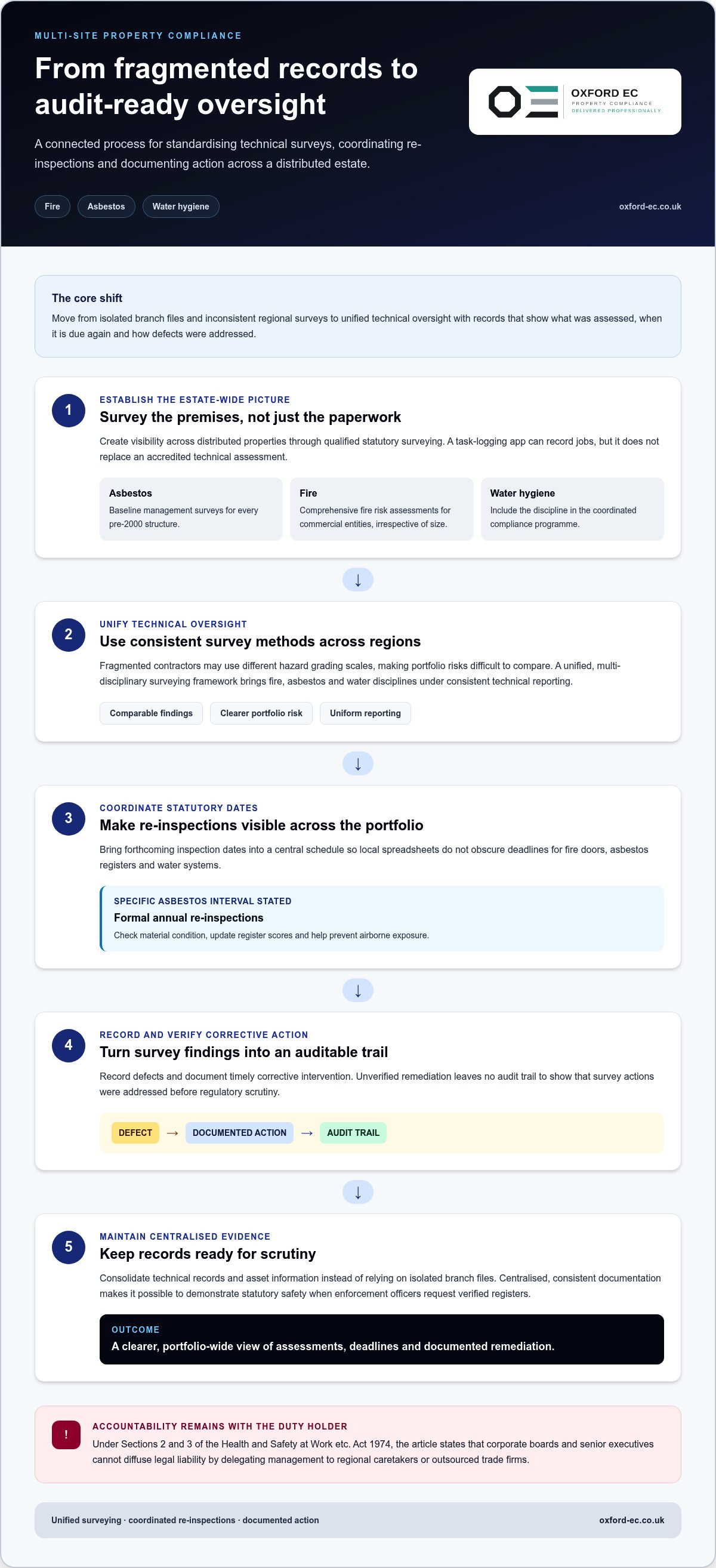
How to Implement a Multi-Site Property Compliance Strategy: A 5-Step Guide
Software onboarding dashboards promise instant control, yet real estate safety demands methodical on-site verification. Practical estate governance cannot rely on automated shortcuts or surface-level digital checklists. Duty holders must execute a disciplined, five-step operational framework to establish verifiable statutory integrity across all premises. Systematic profiling. Synchronised surveying. Rigorous verification. Successfully managing multi-site property compliance requires translating legislative demands into structured, phased delivery.
Phase 1: Portfolio Profiling and Statutory Mapping
Orderly governance begins by establishing technical baseline clarity across every built asset:
- Step 1: Portfolio asset profiling: Audit legacy inspection files to expose documentation voids, categorising physical assets by construction era, structural composition, and occupancy classifications to isolate high-risk properties.
- Step 2: Statutory lease mapping: Delineate landlord and tenant boundaries within commercial lease contracts, cross-referencing physical demises against mandatory statutory inspection frequencies under primary safety legislation.
This discovery phase exposes hidden liabilities, isolating lapsed re-inspections and unrecorded alterations before regulatory scrutiny exposes estate vulnerabilities. Where portfolios encompass educational or recreational amenities, duty holders can learn more about managing specialist sports equipment inspections and surface maintenance to maintain full estate safety.
Once estate baseline data is secured, duty holders must transition from passive data gathering to active operational governance:
- Step 3: Normalised risk matrices: Institute uniform hazard scoring across fire risk, water hygiene, and asbestos registers, establishing an objective scale that directs remediation budgets toward genuine statutory priorities.
- Step 4: Centralised inspection scheduling: Group regional survey appointments into coordinated, multi-disciplinary programmes to synchronise anniversary dates and eliminate unnecessary operational disruption.
- Step 5: Closed-loop remedial tracking: Enforce strict verification workflows for all maintenance notices, documenting physical defect repairs with competent re-inspection sign-offs to sustain uninterrupted audit-readiness.
Adopting this structured sequence gives organisations total operational visibility, turning disconnected branch reports into a defensible corporate safety record.
Selecting a National Compliance Partner: Governance, Competence, and Accountability
Procuring professional safety oversight is not a routine subcontracting exercise; it is the appointment of an institutional shield. Software dashboards catalogue tasks, but defensible statutory safety rests entirely upon the technical competence of the physical surveyors inspecting your built environment. Managing multi-site property compliance requires duty holders to evaluate partners through strict technical governance, ensuring inspection outputs withstand judicial scrutiny rather than collapsing during regulatory enforcement audits. True portfolio governance demands verifiable technical mastery, nationwide surveying capacity, and transparent reporting.
Critical Criteria for Auditing Compliance Partners
Due diligence must probe beyond commercial marketing promises. Before entrusting an estate to an external provider, safety executives must apply rigorous qualification criteria:
- Surveyor competency and discipline: Verify that assessors hold discipline-specific technical qualifications and demonstrably continuous professional training, ensuring rigorous on-site investigation rather than hurried visual walkthroughs.
- Dynamic, actionable reporting: Audit sample reports to confirm technical findings provide clear prioritisation, spatial clarity, and itemised defect remediation rather than ambiguous observations.
- Nationwide delivery capacity: Confirm the provider retains sufficient surveying capacity across the UK to reliably execute synchronised re-inspection cycles without compromising surveying depth.
Selecting an under-resourced contractor results in delayed surveys, expired statutory certificates, and unmitigated corporate liability.
Achieving Complete Estate Assurance with OEC
Oxford Environmental Consultants delivers institutional-grade risk management designed to unify fragmented operations under a single standard. By delivering fully integrated surveying programmes spanning asbestos registers, fire risk assessments, fire doors, compartmentation surveys, and water hygiene testing, OEC eliminates the operational friction inherent in managing multi-site property compliance across disparate regional vendors.
Multidisciplinary integration prevents critical hazards from falling between trade silos. When a single consultancy oversees environmental and structural fire safety, surveyor teams evaluate asset risks in context, aligning property data with the rigorous standards of the Building Safety Act 2022. You secure a dependable partner dedicated to absolute regulatory precision. To consolidate your surveying framework and protect your leadership team against compliance blind spots, speak with our senior team.
Standardise Your Estate Governance and Eliminate Audit Risk
Statutory duty holders can no longer afford operational blind spots under tightening UK building safety enforcement. Successfully managing multi-site property compliance requires replacing disjointed regional trade contractors with an integrated technical surveying framework. By harmonising inspection cycles across asbestos registers, passive fire safety assets, water hygiene regimes, and damp surveys, duty holders eliminate documentation gaps and convert unmonitored risk into continuous, audit-ready estate defence.
Standardised national reporting ensures complete statutory alignment across every premises, protecting corporate leadership from personal liability, severe fines, and reputational damage. Dedicated multi-disciplinary consultancy delivers the single point of accountability required to govern distributed facilities with absolute precision. Complete visibility. Rigorous methodology. Defensible governance.
Take decisive control of your portfolio's statutory obligations today, securing the specialist expertise needed to make every facility under your stewardship safe, compliant, and legally robust.
Frequently Asked Questions
How does multi-site property compliance differ from single-building management?
Multi-site compliance introduces compounding administrative friction and geographical fragmentation that single-building management avoids. When managing multi-site property compliance across distributed premises, duty holders face variable regional contractor standards, conflicting inspection timelines, and dispersed physical registers. This operational spread makes establishing a unified, audit-ready safety baseline across all locations substantially more complex.
What are the legal liabilities for duty-holders who fail to manage multi-site compliance?
Duty holders carry strict personal civil and criminal liability under UK statutory legislation. Failure to execute statutory risk assessments under the Health and Safety at Work etc. Act 1974 or Fire Safety Order exposes corporate officers to unlimited financial penalties and custodial sentences. The legal framework establishes that administrative delegation does not absolve appointed leadership of ultimate statutory accountability.
Can software alone guarantee compliance across an estate?
Software cannot guarantee statutory compliance; it only logs records and operational tasks. A digital dashboard cannot evaluate the physical condition of asbestos panels, assess structural compartmentation, or identify bacterial growth in cold water storage tanks. Verifiable legal protection relies on competent technical surveyors executing physical assessments according to recognised scientific methodologies.
What happens if our multi-site portfolio misses an annual statutory re-inspection date?
Missing a statutory re-inspection instantly invalidates your legal compliance status and exposes the business to regulatory intervention. Enforcing authorities can issue formal Improvement or Prohibition Notices, halting site operations entirely. Insurance carriers may also void property damage and public liability claims if an incident occurs while statutory inspections remain lapsed.
How often must asbestos and fire risk assessments be renewed across multi-site portfolios?
Asbestos registers require formal re-inspection at least every twelve months under the Control of Asbestos Regulations 2012 to monitor material condition. Fire Risk Assessments must be reviewed whenever structural or occupancy changes occur, with annual reviews considered standard practice. Section 156 of the Building Safety Act mandates that all commercial entities record these assessments in full.
Is it better to use regional contractors or a national multi-disciplinary consultancy?
National multi-disciplinary consultancies provide standardised methodologies and single-point accountability that regional contractors cannot match. Relying on regional trades creates mismatched reporting formats and divergent risk priorities across locations. Appointing a single nationwide partner ensures harmonised technical data, synchronised inspection schedules, and reduced access disruption across the entire portfolio.
How do emerging regulations like the Building Safety Act 2022 impact commercial estates?
The Building Safety Act 2022 introduces strict competency requirements and elevated documentation standards across commercial and residential portfolios. Regulators now demand comprehensive, permanent audit trails for all active and passive safety measures. Managing multi-site property compliance under this scrutiny requires duty holders to maintain verifiable proof that competent professionals surveyed every physical asset.