

Did you know that Legionnaires' disease can be fatal in as many as 30% of cases, or that a single UK safety breach resulted in a fine exceeding £1.8 million? Identify the risk. Implement the control. Ensure absolute compliance. Securing a professional commercial legionella risk assessment is not merely a box-ticking exercise; it's a fundamental legal requirement under the Health and Safety at Work etc. Act 1974 and the COSHH Regulations 2002 that serves as your primary defence against both biological hazards and devastating litigation.
You likely find the interplay between ACoP L8 and the updated HSG274 technical guidance complex, whilst the pressure to maintain a living record of safety for insurance audits can feel overwhelming. This definitive guide will empower you to master your legal duties, providing the clarity needed to protect your building occupants and your business reputation simultaneously. We'll examine the latest 2026 regulatory standards, break down the technical requirements for hot and cold water systems, and outline the exact documentation you need to remain audit-ready at all times.
Key Takeaways
- Understand your statutory obligations under the Health and Safety at Work etc. Act 1974 to mitigate legal exposure and protect your building occupants.
- Discover why a commercial legionella risk assessment is a mandatory physical audit rather than a simple certificate, focusing on stagnation and nutrient control.
- Identify critical biological hazards by monitoring water temperatures, ensuring systems remain outside the 20°C to 45°C range where bacteria proliferate.
- Streamline your compliance through a methodical site audit process that integrates maintenance log scrutiny with rigorous physical asset inspections.
- Achieve absolute precision with audit-ready reports that satisfy ACoP L8 and HSG274 requirements, providing a robust shield for duty holders.
Table of Contents
- Understanding the Legal Imperative: Legionella and UK Health and Safety Law
- What is a Legionella Risk Assessment? Defining the Scope of Compliance
- Categorising Risk: High-Risk Systems and Environmental Factors
- The Professional Assessment Process: From Site Audit to Risk Management
- Navigating Property Compliance with Oxford Environmental Consultants
Understanding the Legal Imperative: Legionella and UK Health and Safety Law
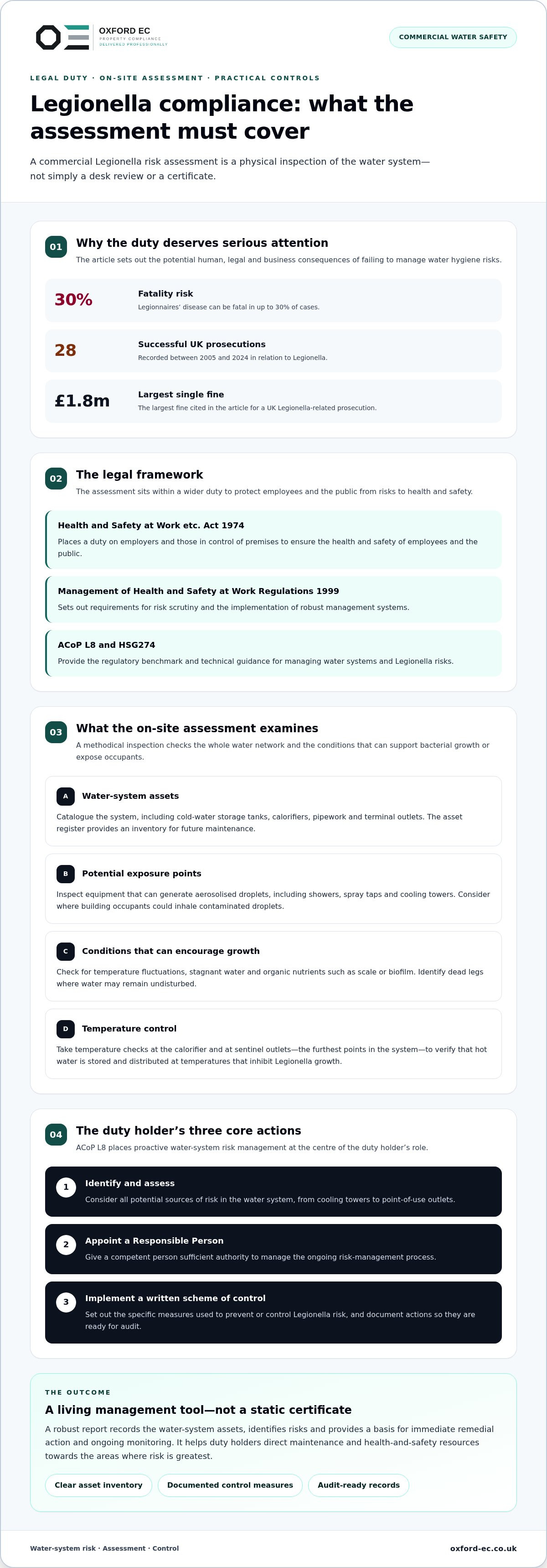
Identify the risk. Control the hazard. Secure the site. A commercial legionella risk assessment is a systematic evaluation of water systems designed to identify and manage the proliferation of Legionella bacteria. This process is not discretionary; it's a statutory mandate enforced by the Health and Safety Executive (HSE). Compliance is anchored in the Health and Safety at Work etc. Act 1974, which places an absolute duty on employers and those in control of premises to ensure the health and safety of both employees and the public. This primary legislation is further supported by the Management of Health and Safety at Work Regulations 1999, which define the specific requirements for risk scrutiny and the implementation of robust management systems.
Failure to adhere to these standards carries severe penalties. Between 2005 and 2024, the UK recorded 28 successful prosecutions related to Legionella, with the largest single fine reaching £1.8 million. Beyond the financial impact, custodial sentences for responsible persons and catastrophic reputational damage are very real possibilities for businesses that neglect their water hygiene duties. Protect the staff. Safeguard the tenants. Defend the business.
The Duty Holder’s Responsibilities under ACoP L8
The Approved Code of Practice L8 (ACoP L8) serves as the regulatory benchmark for managing water systems safely. It dictates that the duty holder, typically the employer or building owner, must proactively manage biological risks. This involves identifying and assessing all potential sources of risk within the water system, ranging from cooling towers to simple point-of-use outlets. You must also appoint a "Responsible Person" with sufficient authority and competence to manage the ongoing risk management process. Finally, duty holders are required to prepare and implement a written scheme of control that details the specific measures taken to prevent or control the risk of Legionella, ensuring every action is documented and audit-ready.
The Health Risks: Why Legionnaires’ Disease Demands Scrutiny
The necessity for such rigorous water hygiene management is rooted in the severity of the disease itself. What is Legionnaires' disease? It is a severe, potentially fatal form of pneumonia caused by the inhalation of contaminated aerosolised droplets. Whilst outbreaks in commercial environments are relatively rare, they're almost entirely preventable through methodical temperature control and system maintenance. Vulnerable populations, including the elderly and those with pre-existing respiratory conditions or compromised immune systems, remain at the highest risk. Given that fatalities can occur in up to 30% of cases, the margin for error in water system management is non-existent. Precise monitoring and regular commercial legionella risk assessment reviews are the only dependable barriers against this biological threat.
What is a Legionella Risk Assessment? Defining the Scope of Compliance
Audit the assets. Scrutinise the system. Mitigate the threat. A commercial legionella risk assessment is a rigorous, on-site physical inspection of a building's entire water infrastructure, far exceeding the scope of a simple desk-based review. It requires a meticulous examination of every component, from cold water storage tanks and calorifiers to individual terminal outlets, ensuring that the entire network operates within the parameters defined by UK government guidance on Legionella. By evaluating the specific conditions that facilitate bacterial proliferation, such as temperature fluctuations, water stagnation, and the presence of organic nutrients like scale or biofilm, the assessment provides a definitive baseline for safety. This process is the technical foundation of a broader water hygiene risk assessment, resulting in a dynamic document that serves as a roadmap for both immediate remedial actions and long-term monitoring protocols.
The resulting report isn't merely a static certificate; it's a living management tool. It bridges the gap between identifying a potential biological hazard and implementing a functional control scheme. For duty holders, this document provides the evidence-based justification for maintenance budgets and health and safety investments, ensuring that resources are directed where the risk is greatest. Precise. Accountable. Protective.
Identifying Potential Sources of Exposure
The primary objective of the audit is to pinpoint where building occupants are most likely to inhale aerosolised water droplets. This involves a detailed evaluation of high-risk equipment such as showers, spray taps, and cooling towers, alongside a technical review of the pipework to identify "dead legs" where water may sit undisturbed for extended periods. Such stagnation creates an environment ripe for bacterial colonisation. The assessor also conducts precise temperature checks at the calorifier and at the furthest points of the system, known as sentinel outlets, to verify that hot water is stored and distributed at temperatures that inhibit Legionella growth.
Key Components of a Compliant Assessment Report
A professional report must be robust, transparent, and audit-ready. It begins with a comprehensive asset register that catalogues every element of the water system, providing a clear inventory for future maintenance. Each identified hazard is then assigned a detailed risk rating based on the likelihood of bacterial growth and the severity of potential exposure to occupants. Finally, the document must include a prioritised schedule of remedial actions, ranging from simple valve replacements to complex system disinfections, to ensure the duty holder can achieve and maintain full legal compliance. If you require professional assistance in mapping these risks, you can speak with our technical team for expert guidance.
Categorising Risk: High-Risk Systems and Environmental Factors
Evaluate the infrastructure. Categorise the risk. Neutralise the threat. Whilst all man-made water systems can potentially harbour bacteria, a professional commercial legionella risk assessment must distinguish between simple domestic-style setups and complex, high-risk industrial configurations. The primary environmental driver for bacterial proliferation is temperature; Legionella bacteria thrive within the range of 20°C to 45°C, making temperature control the first line of defence in any water management scheme. Beyond thermal factors, the presence of organic nutrients such as biofilm, sludge, and corrosion provides the biological fuel required for colonies to multiply and persist within pipework. According to the Health and Safety Executive (HSE) legal duties, duty holders must maintain strict oversight of these environmental variables to prevent the colonisation of the system. Stagnant water, often found in infrequently used outlets or dead legs, further compounds the risk by allowing water to dwell within the dangerous temperature window whilst protecting bacteria from chemical biocides.
The scale of the system directly correlates to the level of management required. Large-scale water storage tanks and extensive recirculation loops present significantly more opportunities for temperature fluctuations and sediment accumulation than smaller, mains-fed systems. For the duty holder, understanding these environmental triggers is the first step toward implementing a robust written scheme of control that stands up to regulatory scrutiny and ensures the safety of all building occupants.
Cooling Towers and Evaporative Condensers
Systems that utilise evaporative cooling represent the highest tier of biological risk due to their inherent design, which involves the constant generation of fine water mists or aerosols that can be inhaled by anyone in the vicinity. These assets demand an uncompromising level of scrutiny, requiring rigorous chemical treatment regimes alongside mandatory monthly sampling and comprehensive quarterly inspections to ensure total microbial control. Under UK law, specifically the Notification of Cooling Towers and Evaporative Condensers Regulations 1992, duty holders are legally obligated to register these systems with their local authority to facilitate public health monitoring. Failure to maintain these systems not only endangers the public but invites the highest level of regulatory intervention and potential prosecution.
Hot and Cold Water Services in Complex Buildings
In large-scale environments such as hospitals, hotels, or multi-storey residential blocks, the complexity of the distribution network significantly increases the likelihood of thermal gain or loss. Maintaining the "cold water below 20°C and hot water above 50°C" rule is central to safety, yet this becomes increasingly difficult in buildings with extensive recirculation loops and high-volume storage calorifiers. For those managing residential portfolios, the requirements are equally precise, often necessitating a legionella certificate for landlords to demonstrate that a suitable and sufficient risk assessment has been conducted. Whether managing a single commercial unit or a vast healthcare estate, the objective remains identical: eliminate stagnation, remove nutrients, and maintain absolute temperature control to ensure a safe environment for all occupants.
The Professional Assessment Process: From Site Audit to Risk Management
Audit the records. Scrutinise the assets. Map the system. A professional commercial legionella risk assessment is a methodical, multi-stage operation that moves beyond a cursory walk-through to provide absolute regulatory assurance. The process begins with a rigorous deep-dive audit of your site's historical compliance data, including previous risk assessments, maintenance logs, and temperature records. This desk-based scrutiny identifies patterns of neglect or recurring thermal issues, providing the necessary context before the physical inspection commences. A disciplined approach to data ensures that the subsequent on-site audit is targeted, technically robust, and capable of withstanding external scrutiny.
During the physical inspection, the surveyor evaluates the mechanical integrity and biological safety of every water asset. They measure temperatures at sentinel outlets, calorifiers, and storage tanks using calibrated equipment to ensure data precision and alignment with HSG274 standards. In complex environments where the risk profile is elevated, water sampling may be conducted for analysis at a UKAS-accredited laboratory to confirm the presence or absence of Legionella bacteria. A critical output of this stage is the creation of a technical schematic diagram, which serves as a visual map of the water system to identify dead legs and ensure no part of the infrastructure is overlooked. The assessment process concludes with a formal report and a recommended monitoring frequency.
On-Site Scrutiny: What a Surveyor Evaluates
Meticulous observation remains the cornerstone of the audit. The surveyor examines cold water storage tanks for signs of biological fouling, vermin ingress, or inadequate lidding that could compromise water quality and facilitate bacterial colonisation. They verify that pipework is correctly insulated to prevent ambient heat gain, whilst also checking that cold water systems remain shielded from external heat sources. Additionally, the operation of thermostatic mixing valves (TMVs) is tested to ensure they deliver water at safe, compliant temperatures that prevent both Legionella growth and the risk of scalding to occupants.
Post-Assessment: Implementing Control Measures and Monitoring
The resulting report serves as your definitive blueprint for safety. Once hazards are identified, duty holders are required to implement a written scheme of control, which often includes a routine flushing regime for infrequently used outlets to prevent stagnation. Monthly temperature monitoring at sentinel points and annual internal inspections of storage tanks become the standard operational procedure for maintaining a safe environment. All findings, remedial actions, and test results must be meticulously recorded in a dedicated logbook, ensuring your documentation is always audit-ready for insurance or HSE inspections.
Navigating Property Compliance with Oxford Environmental Consultants
Identify the gaps. Close the loop. Secure the site. Oxford Environmental Consultants provides a rigorous, multi-disciplinary approach to building safety that transcends basic service provision. Our commercial legionella risk assessment services are delivered by a team of disciplined experts who possess an intricate understanding of ACoP L8 and HSG274. We don't just provide a report; we deliver a protective shield against legal risk and biological hazards. Every audit is conducted with the goal of producing a document that is fundamentally audit-ready, ensuring your property remains legally robust under the scrutiny of the HSE or local authorities. By positioning ourselves as your accountable partner, we provide the technical mastery required to manage complex water systems with absolute precision.
Efficiency is the cornerstone of our delivery model. We understand that duty holders face a fragmented landscape of safety requirements that can be difficult to coordinate. Our consultancy thrives on order and detail, offering a streamlined path to full compliance that reduces the burden on your internal resources. We don't just identify problems. We provide structured solutions. This commitment to evidence-based results makes us the safe pair of hands for businesses across the United Kingdom, from small commercial units to vast industrial estates.
The Benefits of a Multi-Disciplinary Compliance Strategy
Managing fragmented safety requirements often leads to administrative bloat and dangerous gaps in coverage. By consolidating your water hygiene needs with other critical requirements, such as asbestos management surveys and fire risk assessments, you prioritise operational efficiency without compromising on precision. This integrated approach ensures that no compliance pillar is left unsupported, providing a streamlined, one-stop solution for complex property portfolios. Our surveyors are trained to look beyond the immediate task, identifying cross-discipline risks that a single-service provider might overlook.
Securing Your Assets: Next Steps for Duty Holders
The path to absolute compliance begins with a definitive baseline. Duty holders must first book a comprehensive commercial legionella risk assessment to identify current system vulnerabilities and establish a clear asset register. Once the audit is complete, it's vital to implement the recommended control measures, such as temperature monitoring or system disinfection, to mitigate identified risks immediately. Finally, ensure that you schedule regular reviews and update your written scheme of control to reflect any changes in building usage or system configuration. Safety is not a one-time event. It is a continuous process of scrutiny and management. Maintain the standard. Protect the occupants. Secure the future.
Securing Your Statutory Compliance and Building Safety
Scrutinise. Manage. Protect. Statutory compliance within the UK water safety framework is a dynamic obligation that demands constant professional scrutiny. You've identified that a suitable and sufficient commercial legionella risk assessment is the essential foundation for any robust safety scheme, serving as your primary defence against both biological hazards and the threat of legal prosecution. By prioritising meticulous temperature control and eliminating stagnation in complex pipework, you transform your water system from a potential liability into a managed, safe asset.
Oxford Environmental Consultants provides expert national coverage across the UK, offering a comprehensive multi-disciplinary approach to property compliance that simplifies your administrative burden. Our technical specialists deliver audit-ready reports designed to withstand the most rigorous regulatory inspections, ensuring your records for water, fire, and asbestos are always precise and up to date. This high-level consultancy approach provides the peace of mind that comes from knowing your building is in a safe pair of hands.
Take the first step toward absolute precision and operational safety by securing your water systems against the biological threats of today and tomorrow.
Frequently Asked Questions
How often should a Legionella risk assessment be carried out?
There is no fixed legal expiry date for an assessment, but the HSE mandates a review whenever there is reason to suspect the current document is no longer valid. This typically occurs following significant modifications to the water system, changes in building usage, or the publication of updated regulatory guidance. Most duty holders adopt a biennial review cycle to ensure continuous compliance and to reflect any minor changes in the system’s behaviour.
Is a Legionella risk assessment a legal requirement for landlords?
Yes, landlords of residential properties have a statutory duty to ensure that the risk of exposure to Legionella for tenants is properly assessed and controlled. This legal obligation applies to all domestic rental properties regardless of the building's scale. Whilst a commercial legionella risk assessment for a single dwelling may be relatively straightforward, it must still be conducted by a competent person to satisfy the requirements of the Health and Safety at Work Act.
Can I carry out my own Legionella risk assessment?
You can perform the assessment yourself if you possess the necessary competence, which is defined as having the specific skills, knowledge, and experience to identify and evaluate biological risks. However, for complex commercial water systems or multi-occupancy buildings, most duty holders appoint professional consultants. This ensures the resulting report is sufficiently rigorous, technically accurate, and legally defensible in the event of an official audit or investigation.
What happens if Legionella is found in my water system?
If bacteria are detected, you must immediately implement the emergency control measures outlined in your written scheme of control. This usually involves a comprehensive chemical or thermal disinfection of the system, followed by laboratory re-testing to confirm the effectiveness of the treatment. You must also review your commercial legionella risk assessment to identify why the bacteria were able to proliferate and adjust your ongoing monitoring regime to prevent a recurrence.
Do I need to test the water for Legionella bacteria?
Water sampling is not a legal requirement for every type of water system, but it is mandatory for high-risk assets such as cooling towers and evaporative condensers. It is also highly recommended in buildings where occupants are particularly vulnerable, including care homes and hospitals. Sampling provides definitive, evidence-based confirmation that your primary control measures, such as temperature management and flushing regimes, are working effectively.
What is the difference between a Legionella risk assessment and water sampling?
A risk assessment is a holistic audit of the entire water infrastructure to identify potential hazards, whereas water sampling is a specific laboratory test to detect the presence of the bacteria. The assessment evaluates the physical condition of assets, management protocols, and environmental triggers. Whilst sampling is often a critical component of a wider safety programme, it cannot replace the comprehensive scrutiny provided by a full on-site risk assessment.