

What happens to your twenty-year asbestos warranty if the removal company ceases trading tomorrow? Asset protection. Legal certainty. Risk mitigation. These pillars are often compromised when duty holders rely solely on a contractor’s word rather than a financially regulated instrument. Whilst a standard warranty is a common industry deliverable, it remains fundamentally vulnerable to the risk of contractor insolvency, leaving you potentially liable for future remediation requirements or health and safety breaches. Securing a formal insurance backed guarantee for asbestos removal ensures that your protection survives the firm that performed the work.
We recognise that navigating the intersection of environmental law and insurance underwriting is a complex undertaking for any business owner. This guide provides the technical clarity you require to differentiate between standard liability insurance and a true backed guarantee, ensuring your property remains compliant with the Control of Asbestos Regulations 2012. You'll learn how to verify the robustness of your cover, how these policies protect your long-term asset value, and why this specific layer of scrutiny is essential for any professional abatement project. We move from the broad principles of risk management to the granular details of policy delivery.
Key Takeaways
- Differentiate between contractor warranties and a formal insurance backed guarantee for asbestos removal. This distinction ensures your liability remains covered even if the original contractor ceases trading.
- Identify the limitations of standard Public Liability insurance. These policies are often insufficient for managing the long-tail latency risks inherent in asbestos-related contamination.
- Execute a thorough audit of contractor documentation. You will learn to verify full policy schedules and insurer ratings to ensure financial robustness.
- Protect your property asset value and maintain regulatory alignment. Implementing the correct insurance framework provides a dependable shield against future legal and financial exposure.
- Leverage professional consultancy to manage the removal lifecycle. Oxford Environmental Consultants provides the meticulous oversight required to ensure all facilitated works meet the highest UK safety standards.
Table of Contents
What is an Insurance Backed Guarantee for Asbestos Removal?
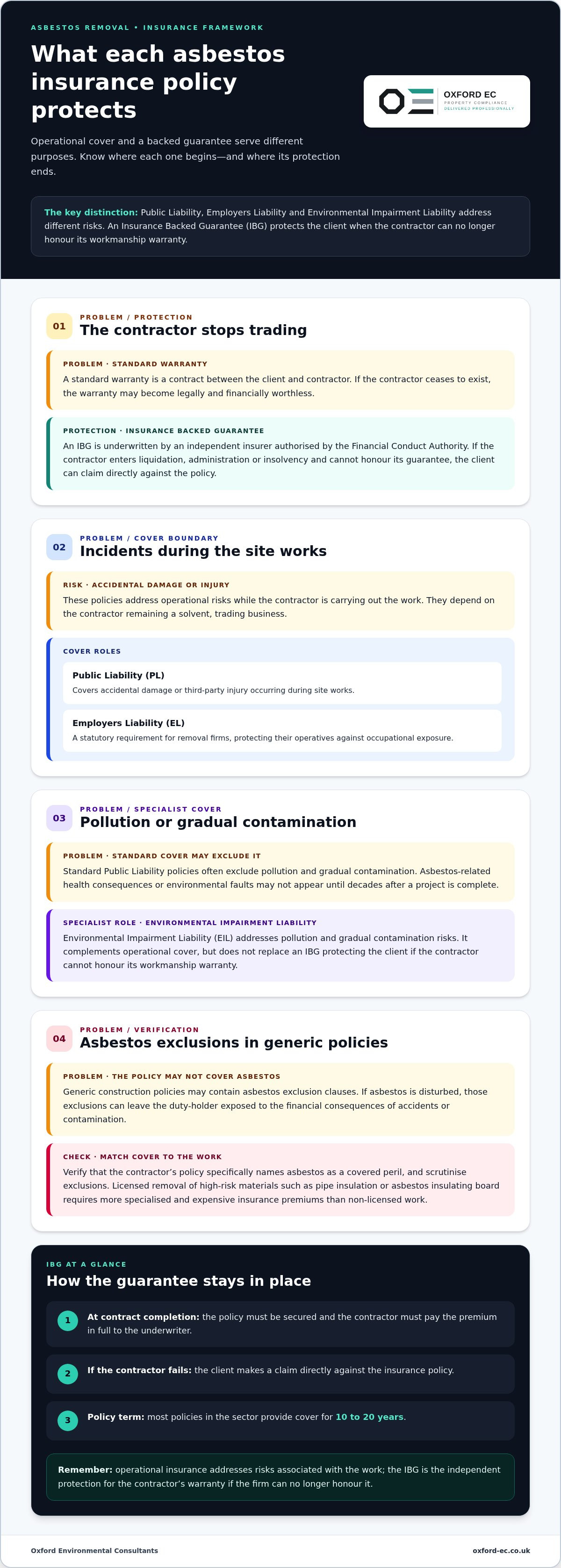
An insurance backed guarantee for asbestos removal is a specialist indemnity policy designed to protect property owners from the financial consequences of contractor insolvency. It acts as a secondary layer of security. It ensures that the terms of a contractor’s warranty remain enforceable even if the original service provider enters liquidation or administration. Given the risks of asbestos and the long-term nature of remediation monitoring, this security is a fundamental requirement for any professional project.
Standard warranties are often misinterpreted as absolute protection. They are not. A standard warranty is merely a contractual agreement between two parties; if the contractor ceases to exist, the document becomes legally and financially worthless. Conversely, an IBG is underwritten by an independent insurer authorised by the Financial Conduct Authority (FCA). This third-party involvement means the financial liability for remedial works is transferred from the contractor to the insurer, providing a "safe pair of hands" for the duration of the policy.
The Mechanism of Protection
Liquidation. Administration. Insolvency. These are the specific triggers for an IBG. When a contractor is no longer able to honour their guarantee due to business failure, the client makes a claim directly against the insurance policy. The policy must be secured at the point of contract completion, with the premium paid in full by the contractor to the underwriter. This ensures the protection is "live" and independent of the contractor’s future financial status. It is a streamlined, logical solution to the risk of contractor turnover.
Most policies in the sector provide cover for a term of 10 to 20 years. This duration is designed to align with the extended timescales of property management and the potential latency of environmental issues. It ensures that the protection remains in place throughout the lifecycle of the building's current management plan. This independent backing is critical for maintaining a continuous chain of accountability.
Why Duty-Holders Must Demand an IBG
Asset protection. Legal certainty. Risk mitigation. These objectives are compromised without a regulated guarantee. Future buyers, solicitors, and mortgage lenders will scrutinise remediation records during the due diligence process. If the original contractor is no longer in business and no insurance backed guarantee for asbestos removal is in place, the property may be viewed as a significant liability. This can lead to devalued assets or failed transactions during the sale of a commercial or residential building.
Professional asbestos consultancy services also highlight that robust insurance is a key component of meeting the stringent requirements of the Control of Asbestos Regulations 2012. It provides evidence that the risk has been managed with absolute precision and legal robustness. By demanding an IBG, duty-holders satisfy their obligation to manage asbestos risks effectively, ensuring that any future faults are addressed without further capital expenditure.
Types of Asbestos Insurance and Their Roles
Immediate protection. Legal mandate. Long-term security. These three tiers of insurance form the necessary framework for safe asbestos management. Public Liability (PL) provides cover for accidental damage or third-party injury occurring during the site works, whilst Employers Liability (EL) remains a statutory requirement for any removal firm to protect their own operatives against occupational exposure. These policies are operational essentials, but they only function as long as the contractor remains a solvent, trading entity.
Environmental Impairment Liability (EIL) is a more specialised policy that addresses pollution and gradual contamination, which standard PL policies often exclude. This is particularly relevant when considering The "Long Tail" Risk associated with asbestos exposure, where the health consequences or environmental faults may not manifest for decades after the project is complete. Whilst these operational policies cover the act of removal, they do not replace an insurance backed guarantee for asbestos removal; the latter is the only instrument that protects the client if the contractor is no longer in business to honour their workmanship warranty.
Licensed vs Non-Licensed Cover
Licensed asbestos removal involves high-risk materials such as pipe insulation or asbestos insulating board, necessitating far more specialised and expensive insurance premiums than non-licensed work. You must verify that the contractor’s policy specifically names "asbestos" as a covered peril. Many generic construction policies contain "asbestos exclusion clauses" that render the cover void if the material is disturbed, leaving the duty-holder with total financial liability for any accidents or contamination events. Scrutinising these exclusions is a non-negotiable step in your risk management process.
The Importance of Professional Indemnity
Professional Indemnity (PI) insurance is essential for the consultancy and surveying phase. It protects the technical advice provided during asbestos management surveys and refurbishment projects, ensuring that any errors in the identification or assessment of materials are financially covered. Since the survey and removal phases carry distinct risks, the insurance considerations must be managed separately to maintain a clear chain of accountability. OEC acts as your meticulous expert, ensuring every contractor we facilitate maintains these rigorous standards. If you require assistance in auditing a contractor's insurance portfolio, you can speak with our compliance team for a professional technical review.
The "Long Tail" Risk: Why Standard Liability is Not Enough
Asbestos management is defined by its timeline. Decades of latency. Residual risk. Latent liability. Unlike a burst pipe or a structural collapse, the failures associated with asbestos remediation often emerge twenty or thirty years after the final site clearance. This "long tail" nature makes standard Public Liability insurance fundamentally ill-equipped to provide long-term security. If a contractor ceases trading, their liability insurance typically terminates with them. Without an insurance backed guarantee for asbestos removal, the property owner is left to absorb the full financial burden of any future remediation or legal claims.
The "run-off" cover problem is a significant hurdle for many duty-holders. Most contractors don't maintain expensive run-off policies once they exit the market, which effectively creates a vacuum of accountability. An IBG solves this by providing a pre-funded, independent insurance policy that remains active regardless of the original company's status. This is why industry bodies such as the Asbestos Removal Contractors Association (ARCA) insurance standards emphasise the necessity of specialist cover. It's the only way to ensure that the financial responsibility for a fault doesn't revert to your balance sheet.
Transferability is another essential feature of these policies. A robust guarantee is assigned to the property asset, not the owner. It ensures that the safety records remain valid during a change of ownership, providing a "linguistic handshake" of quality to prospective buyers. This continuity is vital for maintaining the chain of custody required for complex property portfolios.
Asset Protection and Resale
Commercial and residential asset values depend on the integrity of remediation records. A "clean" asbestos file, supported by a regulated guarantee, facilitates smoother property transactions by removing the threat of re-remediation costs. Lenders and insurers are increasingly risk-averse; they demand evidence that any previous works are financially secured. Avoiding a financial "black hole" requires more than a simple contractor's invoice. It requires a document that satisfies the rigorous scrutiny of a building safety case report and provides peace of mind to future stakeholders.
Regulatory Scrutiny and HSE Standards
The Health and Safety Executive (HSE) prioritises contractor competence, but financial stability is a critical component of that assessment. Legal frameworks like the Building Safety Act 2022 place an increased burden of proof on duty-holders to demonstrate long-term compliance and safety. Ensuring your asbestos consultancy services align with these evolving standards is the only way to mitigate the risk of future prosecution. OEC acts as your guardian of compliance, scrutinising every detail to ensure your remediation strategy meets the highest level of regulatory robustness and legal accountability.
How to Verify an Insurance Backed Guarantee
Scrutiny. Accountability. Verification. These are the three essential actions required to validate an insurance backed guarantee for asbestos removal. You must move beyond a superficial review of a summary certificate to perform a deep-dive audit of the underlying policy documentation. A summary certificate is merely a notification; it does not provide the technical detail necessary to confirm that the underwriter has accepted the specific risks associated with your property. Without verifying the full policy schedule, you risk relying on a document that may contain restrictive exclusions or inadequate financial limits.
- Request the full policy schedule: A one-page summary is insufficient for legal due diligence. You require the complete wording to identify any hidden conditions that could invalidate a future claim.
- Check the insurer rating: Confirm that the underwriter is A-rated by a reputable agency such as A.M. Best or Standard & Poor’s. This ensures the insurer has the capital strength to honour long-term liabilities.
- Confirm scope alignment: The guarantee description must precisely match the remediation work performed on-site. If the policy specifies "non-licensed works" but the contractor removed high-risk insulation, the cover is void.
- Verify the "cease to trade" clause: This clause must be explicitly included and clearly defined. It's the critical trigger that activates the policy in the event of contractor liquidation or administration.
- Consult an independent expert: A professional technical review ensures the document provides the legal robustness required for your commercial or residential asset.
Red Flags in Asbestos Guarantees
Beware of "in-house" guarantees. These documents are often presented on the contractor's letterhead and lack any external insurance backing, meaning they're functionally useless if the firm enters administration. You should also scrutinise unrealistic expiry dates or highly restrictive maintenance clauses that allow insurers to void the policy for minor building management oversights. Excessive deductibles or excesses are another common pitfall; if the first £5,000 of any claim must be paid by the client, the guarantee offers little protection for smaller remediation faults that may arise during the policy term.
The Role of the Asbestos Consultant
Oxford Environmental Consultants (OEC) serves as your technical auditor throughout the procurement and delivery process. We ensure that all remedial services are executed with absolute precision and are fully compliant with UK health and safety regulations before final sign-off. It's essential to remember that an IBG is only one half of the safety record; it must be accompanied by a formal Clearance Certificate issued by an independent UKAS-accredited laboratory. OEC manages this fragmented documentation to provide a streamlined, audit-ready solution for your property compliance needs.
OEC: Managing Compliant Asbestos Removal Nationwide
Strategic oversight. Regulatory alignment. Financial protection. Oxford Environmental Consultants (OEC) operates as the expert intermediary between duty-holders and remediation contractors to ensure every stage of the abatement process is executed with absolute precision. We don't merely facilitate removal; we manage the entire lifecycle, from the initial identification of hazardous materials to the final verification of a robust insurance backed guarantee for asbestos removal. By conducting rigorous due diligence on contractor solvency and technical skill, we mitigate the risk of project failure and ensure that your legal liabilities are permanently addressed through a financially regulated instrument.
Our role is to act as the "safe pair of hands" for complex property requirements. We understand that for business owners, the fragmentation of safety documentation is a significant pain point. We solve this by providing a streamlined, logical solution that centralises all records, ensuring that every facilitated project is backed by evidence-based results and a guarantee that survives the contractor who issued it. This meticulous attention to detail is what defines our consultancy as a guardian of compliance.
A Multi-Disciplinary Approach
Compliance is rarely a singular requirement. We integrate asbestos safety within a broader framework of property compliance, ensuring that hazardous material management aligns with other critical safety streams. This includes linking asbestos risk with findings from fire risk assessments to prevent conflicting safety priorities during building refurbishment or maintenance works. For larger projects, our asbestos demolition surveys provide the technical blueprint for insured removal, creating a meticulous documentation trail that is essential for your building safety case. This holistic methodology ensures that no detail is overlooked in the pursuit of absolute safety and legal robustness.
Your Accountable Partner
Disciplined. Orderly. Transparent. Independence is our greatest asset. Because OEC is not a removal contractor, our scrutiny remains uncompromising and entirely focused on the interests of the client. We act as the "guardian" of compliance, auditing every piece of paperwork—including the insurance backed guarantee for asbestos removal—to confirm it meets the highest UK standards and contains no restrictive exclusions. This disciplined approach provides the peace of mind that comes from knowing your asset is protected by a professional consultancy that thrives on order and technical accuracy. We move beyond simple service delivery to provide an evidence-based result that protects both your personnel and your commercial balance sheet.
Secure your property with OEC’s expert asbestos management services today.
Securing Long-Term Property Compliance and Asset Value
Asbestos management is not merely about the immediate removal of hazardous materials; it's about the long-term mitigation of legal and financial risk. Relying on a contractor’s standard warranty leaves your asset vulnerable to the threat of insolvency, whereas a formal insurance backed guarantee for asbestos removal transfers that liability to a regulated insurer. This distinction is critical for maintaining building safety case reports and ensuring future property transactions remain unencumbered by residual environmental concerns.
Oxford Environmental Consultants operates as a meticulous expert and accountable partner, providing national UK coverage for multi-disciplinary property compliance requirements. We scrutinise every technical detail of the removal lifecycle to ensure your project aligns with the highest standards of safety and precision. Our comprehensive asbestos consultancy ensures that your remediation records are audit-ready and legally robust.
We look forward to providing the professional oversight and technical certainty required to keep your property assets safe and fully compliant with all UK health and safety regulations.
Frequently Asked Questions
Is an insurance backed guarantee a legal requirement for asbestos removal?
An insurance backed guarantee is not a statutory legal requirement under the Control of Asbestos Regulations 2012. However, whilst it isn't mandated by the Health and Safety Executive, it is considered an essential component of a robust risk management strategy for any duty-holder. Many commercial lenders and property insurers require this level of protection to ensure that future liabilities are covered if the original removal firm is no longer trading.
How long does an asbestos insurance backed guarantee typically last?
Most policies for an insurance backed guarantee for asbestos removal are issued for a duration of ten to twenty years. This timeframe is designed to align with the typical lifecycle of building maintenance plans and the potential latency period of environmental issues. It's important to verify the specific term on your policy schedule, as the duration should reflect the specific requirements of your commercial or residential property assets and their long-term management.
What is the difference between Public Liability and an IBG?
Public Liability insurance covers immediate accidental damage or third-party injury occurring whilst the contractor is active on your site. In contrast, an IBG provides protection after the project is completed, specifically triggering if a fault is discovered and the original contractor has ceased trading. Without an IBG, a contractor's Public Liability policy becomes inaccessible once the company enters liquidation or administration, leaving the property owner with total financial liability for any future remediation.
Can I get an IBG for non-licensed asbestos work?
Yes, you can obtain an insurance backed guarantee for non-licensed asbestos work, although they are most frequently utilised for higher-risk licensed projects. Whether the work involves floor tiles or textured coatings, the principle of insolvency protection remains equally valid for the property owner. You should ensure the policy wording explicitly covers the specific type of non-licensed material being removed to avoid any potential disputes if a claim is made years after the work.
What happens if my asbestos contractor goes into administration?
If your contractor enters administration and you have a valid insurance backed guarantee, the independent insurer takes over the financial responsibility for the workmanship warranty. You would make a claim directly against the policy to cover the costs of any necessary remedial works. If no such guarantee is in place, the contractor's personal warranty becomes legally worthless, and you will be required to fund any future remediation or contamination issues from your own capital.
How much does an insurance backed guarantee cost for the client?
The cost of an insurance backed guarantee is typically calculated based on the project's total contract value and is usually paid as a single premium at the start of the policy. Whilst the exact premium depends on the underwriter's assessment of the risk, it is often included within the contractor's overall project fee. You should ensure that the premium is paid in full at the point of completion to activate the long-term cover.
Does an IBG cover the cost of re-surveying the area if a problem is found?
Whether a policy covers re-surveying depends entirely on the specific terms and conditions of the insurance schedule. Most standard policies focus on the physical cost of remedial works rather than the initial investigative costs or consultancy fees. It is essential to have an independent expert review the policy wording to confirm exactly what is included. OEC can assist in auditing these documents to ensure they provide the comprehensive coverage required for your building safety case.
Is the guarantee transferable if I sell my commercial property?
Yes, a robust insurance backed guarantee for asbestos removal is typically transferable to new owners when a property is sold. This transferability is a significant asset during the due diligence phase of a commercial transaction, as it provides the buyer with technical and financial certainty. You must ensure that the policy is assigned correctly during the legal process to maintain the continuous chain of accountability and protect the long-term value of your property assets.