

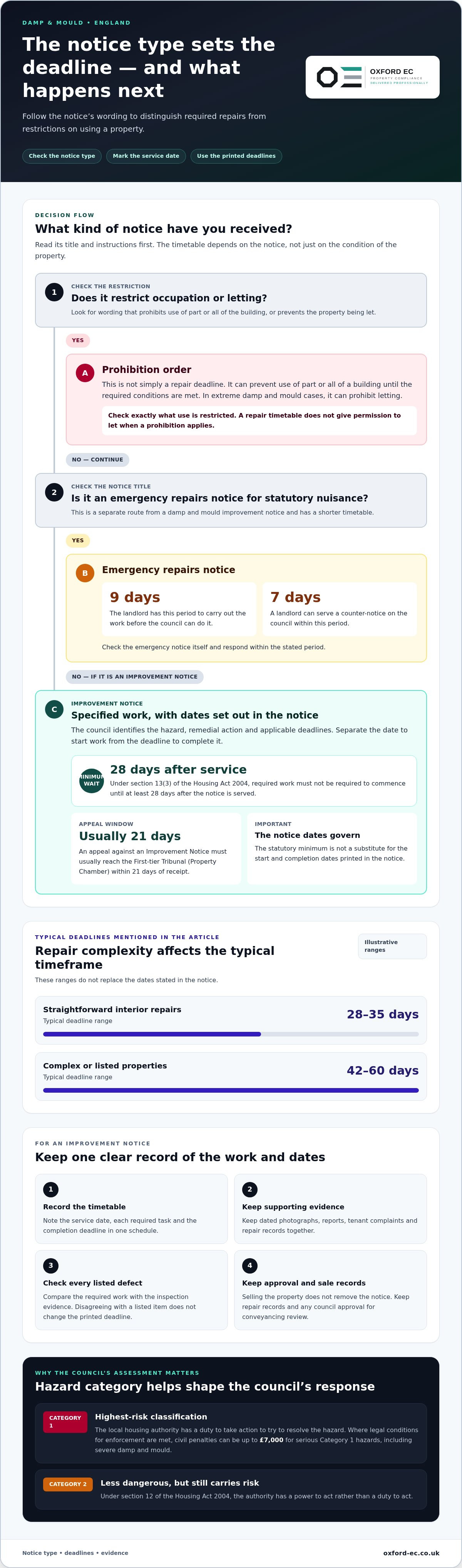
For a damp and mould improvement notice in England, the notice sets the deadline for the required work, but the work must not be required to commence until at least 28 days after service, according to UK Parliament under section 13(3) of the Housing Act 2004. The notice should identify the hazard, the remedial action and the applicable deadlines, so the date on the document matters.
It’s understandable to focus on how quickly repairs must begin. The key distinction is that an improvement notice requires specified work by a set time, while a prohibition order can prevent the use of part or all of a building until the required conditions are met. These are separate enforcement measures, with different consequences for the property and its occupants.
This article explains how councils assess damp and mould risks, what landlords must do after receiving a notice, and how to interpret deadlines and appeal rights. It also compares improvement notices with prohibition orders, so you can understand what the council requires and what may happen if the required action is not taken.
Key Takeaways
- Read the notice closely to identify the required work, the deadline and any appeal information.
- Understand how a council’s assessment of damp and mould risk affects the enforcement action it may take.
- Clarify the landlord’s responsibilities and keep a clear record of repairs and communication with the council.
- Distinguish a requirement to complete works from an order that restricts the use of a property.
- See when a Damp & Mould Survey can help identify the source and extent of a problem.
Table of Contents
- What are the fixed deadlines for landlords after a damp or mould improvement notice arrives?
- Who holds ultimate legal responsibility when councils issue a damp or mould improvement notice?
- Council assessment and inspection of unsafe conditions
- Landlord duties after receiving an improvement notice
- Improvement notices compared with prohibition orders
- Oxford Environmental Consultants (OEC): Asbestos Management Surveys
What are the fixed deadlines for landlords after a damp or mould improvement notice arrives?
In England, a damp and mould improvement notice is a formal council requirement to complete specified work addressing a housing hazard. It identifies the hazard, property deficiencies, remedial action, deadlines and appeal rights.
The date the notice is served starts the timetable, but the notice sets out what must happen next. Distinguish the deadline to start work from the deadline to complete it.
Formal notice repair deadlines
A formal improvement notice sets out the remedial work required and the time allowed to carry it out. Section 13(3) of the Housing Act 2004 sets a statutory minimum of 28 days from service of a notice before required works must commence, according to UK Parliament. UK Parliament says this minimum is the period before required works must commence.
Review each listed task, date and appeal instruction against the property’s condition. In England, an appeal against an Improvement Notice must usually reach the First-tier Tribunal (Property Chamber) within 21 days of receipt. Typical deadlines are 28-35 days for straightforward interior repairs and 42-60 days for complex or listed properties. These ranges do not replace the dates in the notice.
Record the service date, required tasks and completion deadline in one schedule. Compare the listed defects with inspection evidence, such as dated photographs, reports and the tenant’s complaint. If the notice identifies a leaking roof, for example, arrange the repair and keep evidence of what was done and when. Disagreeing with a listed item does not change the printed deadline.
Selling the property does not remove the notice. Before exchange, organise the notice, repair records and any council approval for conveyancing review. In one reported case, a sale completed five days after the council approved the repair works. This shows why documented completion and approval can matter in a transaction, but it does not set a general deadline for selling.
Statutory nuisance repairs
An emergency repairs notice for statutory nuisance is separate from an improvement notice and has a shorter timetable. In England, the council’s emergency notice gives the landlord nine days to carry out the work before the council can do it. A landlord can serve a counter-notice on the council within seven days.
Check the type of notice before applying the improvement-notice timetable. If the council identifies an immediate risk, the emergency route may affect access, repair scheduling and the evidence needed to show completion. Keep the notice, contractor records and photographs together, and respond within the stated period.
A prohibition order is different again. In extreme damp and mould cases, it can prohibit letting rather than simply require repairs by a deadline. Check whether the council has restricted occupation or letting. A repair timetable does not give permission to let when a prohibition applies.
Where the property needs further investigation, a damp and mould survey can help assess the condition and inform repair evidence. It does not replace the council’s notice or change its deadlines.
Who holds ultimate legal responsibility when councils issue a damp or mould improvement notice?
In England, a landlord may receive a notice for a rented property where a council assessment identifies housing hazards. Councils may issue damp and mould improvement notices under the Housing Act 2004 when a property fails the Housing Health and Safety Rating System safety criteria, according to UK Parliament. Tenants can report the issue to the local authority responsible for the property’s area, usually its environmental health team.
Housing hazards and council enforcement
The Housing Health and Safety Rating System (HHSRS) assesses how housing conditions may affect occupants’ health and safety. Councils use it to decide whether damp or mould presents a hazard and which enforcement action is appropriate.
Category 1 hazards are the highest-risk classification, and the local housing authority has a duty to take action to try to resolve them. Category 2 hazards are less dangerous, but still carry risk; under section 12 of the Housing Act 2004, the authority has a power, rather than a duty, to act. The category helps explain why complaints about similar conditions may lead to different responses.
Category 1 hazards and civil penalties
A Category 1 hazard can lead to a formal notice requiring the landlord to address identified defects. Where legal conditions for enforcement are met, landlords can face civil penalties of up to £7,000 for serious Category 1 hazards, including severe damp and mould.
The council’s assessment and notice identify the hazard and required response. Landlords should arrange the stated work and retain evidence, such as repair records and photographs. If a landlord fails to address the hazard, enforcement may continue under sections 30-32 of the Housing Act 2004. The assessed risk and failure to comply inform the council’s next steps.
Landlords, properties and council complaints
The landlord remains responsible for complying with a notice served for the property; a tenant’s complaint does not transfer that duty. In England, an environmental health department can inspect a home and serve a notice where it finds serious damp and mould hazards. Tenants can report the condition to their local council, giving the property address and describing the problem.
A useful report explains where mould appears, whether it returns, and any visible source of moisture. Dated photographs and copies of earlier messages provide evidence for the council’s assessment. The authority may inspect the home and assess the hazard under HHSRS rather than relying on the complaint alone.
After serving an improvement notice, the council must provide copies to occupiers and other parties with a relevant interest within seven days. The landlord should compare completed work with each requirement and retain repair records. Under Schedule 3 of the Housing Act 2004, a council may carry out required works itself and recover the full cost from the landlord.
Where the source or extent of mould needs investigation, a Damp & Mould Survey can help document conditions and inform remedial decisions.
Council assessment and inspection of unsafe conditions
A council inspection assesses reported damp and mould in the context of the home’s condition, not simply the presence of surface staining. The findings can help determine whether formal enforcement is appropriate.
Environmental health inspections
A council environmental health inspection examines reported conditions and considers whether they may risk a tenant’s health. The officer may inspect affected rooms, note visible mould and moisture, and consider structural defects or other possible causes.
Preparation matters. Gather dated photographs, the tenant’s complaint, repair history and records of previous inspections. For example, photographs showing mould recurring beside a leaking window help document its location and pattern. They do not establish the cause by themselves, so the council’s assessment of the property remains central.
Local processes can differ. Tower Hamlets Council usually gives a landlord three weeks to address a reported damp and mould problem before arranging an inspection when a tenant reports that the landlord has not responded. This is a local approach, not a deadline that applies to every council in England.
During an inspection, make relevant areas accessible and provide records related to the reported defect. If a roof leak, failed gutter or damaged window appears connected to damp, explain the repair history and identify any remaining issue. Clear evidence helps the council compare the report with the conditions it observes.
Inspections leading to legal notices
An inspection gives the council evidence to assess the hazard and decide whether formal action is warranted. If the authority finds conditions that risk a tenant’s health, it may serve a formal notice requiring specified remedial work.
The notice is not interchangeable with the inspection record: it sets out the authority’s requirements and relevant time limits. Compare the served document with the rooms and defects inspected. If a required repair appears to concern a different area, record the discrepancy and raise it with the council in writing.
After repairs, the local authority may inspect the property again to confirm that the hazards have been removed. Retain invoices, photographs and completion records so the council can assess the work against its original findings. Covering visible staining without resolving the underlying moisture source may not address the identified hazard.
If the work cannot meet the notice’s timetable, write to the council promptly to request more time. Explain the specific obstacle, such as access arrangements or a structural repair requiring further work, and provide supporting evidence and a realistic programme. Keep a copy of your request and any response. A request does not change the notice deadline by itself, so continue arranging the required work and follow the council’s written direction.
Landlord duties after receiving an improvement notice
A notice makes the specified repairs and deadlines central to a landlord’s compliance duties. The response should address the identified hazard, not merely cover visible mould.
Responsibility for damp caused by disrepair
In England, section 11 of the Landlord and Tenant Act 1985 requires landlords to keep the property’s structure and exterior in repair. This applies where damp is caused by a leaking roof, gutter or pipe, cracked wall, rotten window frame, broken heater or defective damp-proofing.
Landlords should identify the defect, arrange the necessary repair and retain evidence of the work. Treating surface mould alone may leave its source unresolved. The cause matters: repairing a leak addresses a different problem from cleaning a patch of mould, and the notice may specify which defects need attention.
Writing to the landlord
Tenants can write to the landlord or property manager when damp and mould persist, describing affected rooms and visible damage. Include dated photographs and earlier reports, then keep a copy of the message and response.
A written record helps establish what was reported and when. For example, a tenant can describe recurring mould beside a window and attach photographs of the area. If the landlord has received a formal notice, compare the complaint with its requirements and keep communications focused on the specified work.
Legal action against a landlord
If required repairs remain undone, tenants may pursue legal remedies to seek repairs or recover rent where statutory conditions apply. A Rent Repayment Order may cover rent for the period when a landlord failed to comply with an Improvement Notice.
A tenant may also be able to claim rent back if a landlord fails to carry out work required by an improvement notice or prohibition order. The notice, rent records and repair correspondence are relevant evidence. Keeping these documents together can help clarify the period involved and the landlord’s response.
Social landlords’ Awaab’s Law duties
For social landlords in England, emergency and significant damp hazards carry specific response periods under Awaab’s Law. A potential emergency hazard must be investigated within 24 hours; if confirmed, the landlord must make it safe within 24 hours after becoming aware of it.
If an emergency hazard cannot be made safe within that period, the social landlord must offer suitable alternative accommodation. For a potential significant hazard, investigation is due within 10 working days of awareness. If an inspection identifies one, the landlord must make it safe within 5 working days, or offer suitable alternative accommodation if it cannot resolve it within that time.
These timeframes do not replace the requirements in a council notice. Landlords should track each duty separately, record when the hazard became known, and retain inspection and repair records. When reporting the issue, tenants should identify whether their landlord is a social landlord, as this helps distinguish response duties from the council’s enforcement process.
Improvement notices compared with prohibition orders
The central difference is what each enforcement measure controls. Under the Housing Act 2004, an improvement notice requires the responsible landlord to complete specified work by a set time. A prohibition order can instead stop the use of part or all of a building until the required work is completed. The document served determines whether the immediate obligation is to repair, restrict use, or both.
An improvement notice identifies the hazard and the remedial action the council requires. For damp and mould, this could mean addressing the property defect causing moisture, rather than treating visible mould alone. The landlord remains responsible for completing the specified work within the notice’s timetable. Keep the notice, repair records and evidence of completion together so each requirement can be matched to the work undertaken.
A prohibition order has a more direct effect on occupation or use. Depending on its terms, it may apply to part of a building or the whole property. Do not assume that a repair schedule alone allows continued use of an affected area. Read the order carefully and ensure tenants and anyone managing the property understand the restriction.
The seriousness and assessed risk shape the council’s enforcement response. An improvement notice addresses a hazard by requiring work, while a prohibition order restricts use until the specified condition is met. In extreme damp and mould cases, Tower Hamlets Council may prohibit a landlord from letting a property. This is distinct from a notice requiring repairs, even when both measures relate to the same hazard.
The practical consequences differ, too. A landlord responding to an improvement notice must arrange the listed repairs and retain evidence that they address the stated deficiencies. If a prohibition order applies, the landlord must also respect its restrictions. For example, if an order prohibits use of a mould-affected room, repairing another part of the home does not lift that restriction.
After work is completed, the local authority may inspect the property to confirm that the hazards have been removed. Record the repairs and any council decision about the order. Do not treat a notice or order as discharged merely because the work appears finished; the key question is whether the hazard and the document’s requirements have been addressed.
For landlords, the key steps are clear: identify the enforcement measure, follow its terms, and distinguish repair duties from restrictions on use. That distinction affects how the property can be managed during enforcement and what evidence is needed to demonstrate compliance.
Oxford Environmental Consultants (OEC): Asbestos Management Surveys
Oxford Environmental Consultants (OEC) provides Damp & Mould Surveys for property owners who need an informed assessment of damp or mould concerns. After reviewing a council notice, a survey can help clarify the condition of affected areas and inform decisions about the appropriate response.
A survey is most relevant when the moisture source or extent of mould needs further investigation, rather than when the only requirement is to complete clearly specified repairs. The findings can help landlords understand the issue alongside the notice, repair records and council correspondence. They do not replace the council’s requirements or change its deadlines.
To arrange a survey, contact Oxford Environmental Consultants (OEC) or visit oxford-ec.co.uk.
Turn notice compliance into lasting property oversight
Use the work required by a damp and mould improvement notice as a prompt to strengthen how property risks are recorded and managed. Keep inspection findings, repair evidence and council correspondence together, then assign responsibility for following up unresolved defects. A clear record supports future maintenance and helps prevent the same issue being overlooked.
Oxford Environmental Consultants (OEC) supports wider property compliance through Asbestos Management Surveys, Fire Risk Assessments and Legionella Risk Assessments. These address separate risks and can form part of a considered approach to building safety alongside damp and mould concerns.
For a property where damp or mould needs further assessment, the next step is to identify what evidence would help clarify the issue and inform your response. A structured assessment can help you make that decision with greater confidence.
Clear records and considered action provide a strong foundation for the next stage of property management.
Frequently Asked Questions
Can an improvement notice be served on a letting agent rather than a landlord?
A letting agent’s involvement in managing a property does not, by itself, transfer the landlord’s repair responsibility. Check the notice to see who is named, what work it requires and where it was served. An agent may manage access, contractors and correspondence for the landlord, but handling the notice does not make the agent responsible for the landlord’s obligations. Keep written records of who is taking each action.
Does an improvement notice affect a landlord’s ability to serve a Section 8 notice?
An improvement notice does not automatically prevent a landlord from using a Section 8 notice, but possession depends on the applicable grounds and court process. In England, Section 21 was abolished from 1 May 2026. Ground 6B requires a court to order possession from that date where relevant enforcement action has been taken against the landlord and continuing the tenancy would be unlawful. A damp notice alone does not establish that Ground 6B applies.
How do landlords prove they’ve tackled the real problem beneath the surface, not just dressed it up?
Document the link between the suspected moisture source, the repair and the condition afterwards. For example, record a leaking pipe before repair, retain the plumber’s findings and invoice, then photograph the affected area after the work. If damp returns, note where and when it reappears and investigate the source again. A surface clean or fresh paint alone does not show that an underlying leak or building defect has been resolved. Routine independent property checks, as outlined by inspection providers such as anchorpointinspection.com, can help owners detect subtle structural moisture intrusion before it escalates into severe damage.
How should you communicate damp repairs and defend decisions without putting yourself at legal risk?
Use dated, factual written updates that distinguish observed conditions from suspected causes. For example, state that a ceiling stain was photographed and a roof inspection arranged, rather than asserting a cause before investigation. Keep tenant reports, access arrangements, findings, repair decisions and follow-up actions in one file. Avoid dismissive language or unsupported assurances. If the council has issued a notice, ensure communications accurately reflect its requirements and the work completed.
How can landlords and agents build a rock-solid evidence trail to defend against damp improvement enforcement?
Create a property record that traces the issue from the first report through to follow-up. Keep tenant messages, dated photographs, inspection notes, contractor findings, invoices, access attempts and council correspondence together. Label documents by room and defect, such as “bedroom window leak”, rather than storing them as unannotated attachments. Record decisions and their reasons. A clear chronology helps distinguish completed repairs from outstanding actions.
How can landlords manage these deadlines effectively?
Turn each notice requirement into a task with a named person responsible, any contractor or access dependency, and a completion record. Put the start date and final deadline in a shared property calendar, then schedule reminders before contractor appointments and tenant access. If one repair depends on another, record the sequence clearly; for extensive remediation schemes, advisory specialists like Hodge Construction Management & Consulting demonstrate how owner representation helps keep complex project schedules on track. Keep the council’s notice alongside the task list so staff and agents work from the same requirements.
What legal standards must a property meet for damp and mould under the Housing Act 2004?
In England, councils use the Housing Health and Safety Rating System (HHSRS) to assess whether damp and mould create a housing hazard. The Housing Act 2004 provides the enforcement framework. Category 1 hazards are the highest risk; councils have a duty to take action to try to resolve them. For Category 2 hazards, the local authority has power, rather than a duty, to act under section 12.
How does a local council assess damp and mould and decide whether to issue a notice?
The council assesses the conditions in the home and the hazard under HHSRS; it does not treat every mould complaint identically. An inspection may examine affected rooms, visible damp, possible building defects and information about the reported problem. The assessment informs whether formal enforcement is appropriate and what action may address the hazard. Tenants can help by giving the relevant council a clear account and dated photographs of affected areas.