

Three out of four fire doors fail to meet safety standards. 75% deficiency rates. A legacy of non-compliance. According to the Fire Door Inspection Scheme (FDIS), this staggering failure rate persists whilst enforcement notices and prosecutions have surged by 40% since 2018. Staying aligned with the fire door inspection regulations uk is no longer a matter of best practice but a rigorous legal mandate that carries the risk of unlimited fines and imprisonment for the responsible person. We understand that the transition from recommendations to mandatory enforcement creates significant pressure on duty-holders to maintain absolute precision in their safety protocols.
You likely feel the weight of these high-stakes requirements, particularly when navigating the complex 11-metre height threshold rules or the technical distinctions between FD30 and FD60 doorsets. This authoritative guide serves as your protective shield against risk, promising to clarify your specific obligations under the Fire Safety (England) Regulations 2022 and the Building Safety Act 2022. We will outline a definitive inspection schedule, detail the "golden thread" of digital documentation, and scrutinise the critical regulatory amendments coming into force on 6 April 2026 to ensure your property remains audit-ready and beyond reproach.
Key Takeaways
- Identify your specific legal obligations under the evolving legislative framework, including the expanded duty-holder responsibilities introduced by the Fire Safety (England) Regulations 2022.
- Establish a compliant schedule based on the fire door inspection regulations uk, ensuring mandatory quarterly checks for communal doors in residential buildings over 11 metres.
- Recognise the technical requirements of a complete fire doorset, focusing on the critical alignment of intumescent seals, frames, and hardware to ensure life-safety performance.
- Develop an audit-ready documentation trail that satisfies Regulation 38 and "golden thread" requirements, providing absolute certainty of occupant safety and legal robustness.
- Streamline your compliance regime by integrating professional fire door inspections with wider compartmentation surveys for a comprehensive, multi-disciplinary approach to risk management.
Table of Contents
- The UK Legislative Framework: Fire Safety Order and 2022 Regulations
- Mandatory Fire Door Inspection Frequencies for 2026
- The Anatomy of a Compliant Fire Door: Technical Scrutiny
- Duty-Holder Responsibilities and Audit-Ready Documentation
- Professional Fire Door Inspection Services: Protecting Your Assets
The UK Legislative Framework: Fire Safety Order and 2022 Regulations
Rigour. Precision. Accountability. The legal architecture governing fire safety in the UK has undergone a seismic shift, transitioning from a system of recommendations to one of uncompromising enforcement. At the heart of this framework sits the Regulatory Reform (Fire Safety) Order 2005 (RRO), which remains the foundational statute for all non-domestic premises and the common parts of multi-occupied residential buildings. However, the introduction of the Fire Safety (England) Regulations 2022 significantly expanded the obligations of duty-holders, specifically targeting the functional integrity of fire doors in residential blocks. As we move into 2026, the standards for fire safety demand a more proactive approach to passive fire protection, moving beyond reactive maintenance to a regime of scheduled, professional scrutiny.
The Building Safety Act 2022 and Higher-Risk Buildings
Identify. Document. Remediate. Higher-Risk Buildings (HRBs), defined as residential structures at least 18 metres in height or having seven storeys, are now subject to the most stringent oversight in British history under the Building Safety Act 2022. This legislation mandates the creation of a "golden thread" of information, which is a digitally stored, live record of a building’s safety assets and inspection history. For the Accountable Person (AP) and the Principal Accountable Person (PAP), the failure to maintain this evidence base is a direct breach of statutory duty. This digital trail ensures that every component, from the leaf to the Fire door components and standards, is tracked through its entire lifecycle to prevent the catastrophic failures witnessed in the past.
Regulatory Reform (Fire Safety) Order 2005: The Core Duty
The "Responsible Person" (RP) carries the ultimate burden of proof under the Regulatory Reform (Fire Safety) Order 2005. Whether you are an employer, building owner, or managing agent, the law requires you to ensure that fire-resisting doors are maintained in a "fit for purpose" state through a documented regime of assessment. Understanding the fire door inspection regulations uk is critical because the consequences of non-compliance are severe; fire and rescue authorities have the power to issue unlimited fines or pursue custodial sentences of up to two years. In an environment where deficiency rates remain high, the RP must demonstrate that inspections are conducted by competent professionals who can verify that doorsets provide the necessary fire resistance to protect means of escape. Compliance is not a suggestion, it is a non-negotiable requirement for the preservation of life and the limitation of legal liability.
Mandatory Fire Door Inspection Frequencies for 2026
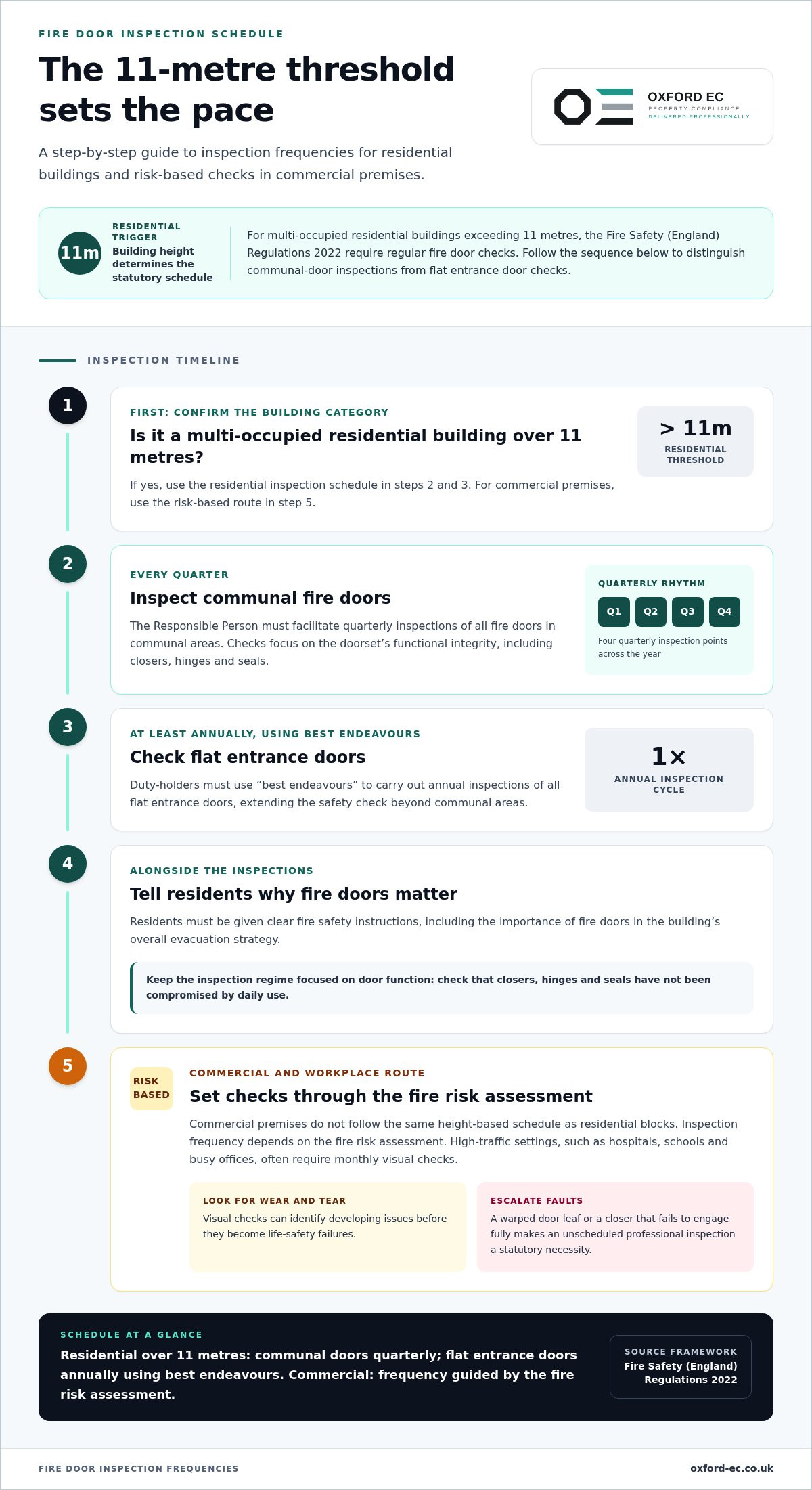
Precision. Frequency. Accountability. Building height is no longer a secondary consideration but the primary driver of your legal inspection regime. The 11-metre threshold serves as the definitive legal boundary for residential safety, dictating a rigorous schedule of professional scrutiny that duty-holders must implement to remain compliant. Under the Fire Safety (England) Regulations 2022, the frequency of checks is mandated by law to ensure that fire doors in high-density environments remain functional under extreme stress. Aligning your property with the fire door inspection regulations uk requires a methodical approach that leaves no room for ambiguity or deferred maintenance.
Residential Buildings Over 11 Metres
Identify. Inspect. Record. For multi-occupied residential buildings exceeding 11 metres, the "Responsible Person" must facilitate quarterly inspections of all fire doors within the communal areas. These checks focus on the functional integrity of the doorset, ensuring that closers, hinges, and seals haven't been compromised by daily use. Furthermore, the law mandates that duty-holders use "best endeavours" to conduct annual inspections of all flat entrance doors. This requirement bridges the gap between private dwellings and communal safety, ensuring that every fire door in the building provides a consistent level of protection. You're also legally required to provide residents with clear fire safety instructions, detailing the importance of fire doors in the building’s overall evacuation strategy.
Commercial and Workplace Inspection Cycles
Risk-based. Proactive. Rigorous. Commercial property standards don't follow the same height-based prescriptions as residential blocks but instead rely on the findings of your fire risk assessments. High-traffic environments such as hospitals, schools, or busy office hubs often require monthly visual checks to identify "wear and tear" triggers before they escalate into life-safety failures. Integrating these door checks into a wider fire safety maintenance programme ensures that passive fire protection remains a constant priority rather than an annual afterthought. If a door leaf shows signs of warping or a closer fails to engage fully, an unscheduled professional inspection becomes a statutory necessity to mitigate risk. Maintaining a safe and compliant environment starts with expert oversight, and you can speak with our compliance team to establish a schedule tailored to your specific asset profile. By moving from reactive repairs to a structured inspection cycle, you create a protective shield for both the building's occupants and your legal liability.
The Anatomy of a Compliant Fire Door: Technical Scrutiny
Precision. Harmony. Integrity. A fire door is never merely a leaf; it is a precision-engineered doorset where every component must work in absolute synchronisation to prevent catastrophic failure. To satisfy the fire door inspection regulations uk, the entire assembly, including the frame, hardware, and seals, must be verified as a unified system of protection. A single uncertified hinge or a compromised vision panel undermines the entire fire compartment. Intumescent seals are designed to expand when exposed to temperatures exceeding 200 degrees Celsius, sealing the gap between the door and frame to block the passage of fire. Cold smoke seals, whilst often overlooked, provide the critical first line of defence by stopping toxic gases before the intumescent material activates.
The structural interface between the door frame and the wall is equally vital. If the surrounding partition fails or if the fire-stopping material between the frame and masonry is absent, the door leaf becomes irrelevant. Under the Regulatory Reform (Fire Safety) Order 2005, the Responsible Person must ensure that these sets are maintained in a state that preserves the building's broader passive fire protection strategy. Scrutiny must extend beyond the visible surface to the technical compatibility of every fitted component.
FD30 vs FD60: Understanding Fire Resistance Ratings
Fire resistance is categorised by the duration a doorset maintains its integrity and insulation under rigorous test conditions. FD30 doors provide a minimum of 30 minutes of protection, whereas FD60 doors are engineered for 60 minutes and are typically mandated in high-risk areas or protected shafts. The "S" suffix in fire door ratings identifies that the doorset has been specifically tested to restrict the leakage of ambient temperature smoke to ensure clear escape routes. Choosing the correct rating is a matter of technical alignment with the building’s specific fire strategy and occupancy type.
Common Inspection Failures and Remedial Triggers
Identify. Measure. Rectify. The "3mm gap rule" is a non-negotiable tolerance in the industry; any gap exceeding 4mm between the door leaf and the frame often results in an immediate failure during a professional survey. Mechanical self-closing devices represent the most frequent point of non-compliance, as they must be capable of closing the door reliably from any angle to overcome the resistance of latches or seals. Unauthorised modifications, such as the retrofitting of digital locks or the addition of uncertified glazing, invalidate the manufacturer’s certification. When these triggers are identified, remedial action must be immediate to restore the protective shield of the compartment.
Duty-Holder Responsibilities and Audit-Ready Documentation
Evidence. Accuracy. Accountability. In the eyes of the Building Safety Regulator, a fire door that's been inspected but not documented is a door that remains non-compliant. The legal burden of proof rests entirely with the "Responsible Person," who must demonstrate a continuous, transparent history of maintenance whilst maintaining the "golden thread" of safety information as required for higher-risk buildings. Adhering to the fire door inspection regulations uk requires more than just physical checks; it demands an audit-ready digital trail that satisfies the rigorous requirements of the Building Safety Act 2022. Regulation 38 ensures that essential fire safety information is transferred to the duty-holder at the point of completion, forming the baseline for all future assessments. OEC provides a "safe pair of hands" by delivering meticulous reporting that stands up to rigorous scrutiny, creating fire door registers that categorise every component and record its precise condition against statutory standards.
The Role of the Competent Person
Identify. Verify. Protect. Competence is a legal requirement defined by having sufficient training, experience, and knowledge to identify complex failures that a visual check might miss. Relying on general maintenance staff introduces significant legal risk, as they may lack the technical insight to identify subtle failures in intumescent expansion or hardware compatibility. Professional consultancy ensures that your assessments are conducted with the technical mastery required to prove compliance, providing a robust defence amongst the increasing enforcement activities of fire and rescue authorities. By appointing an accountable partner, you ensure that every inspection is conducted with the precision necessary to satisfy both life-safety requirements and legal obligations.
Record Keeping for the Building Safety Regulator
A professional inspection report must be granular and evidence-based. It includes unique door IDs, photographic evidence of defects, and a clear prioritisation of remedial work, such as "Category A" life-safety failures that require immediate intervention. Managing these actions ensures your property remains aligned with your multi-disciplinary safety surveys, creating a unified strategy across fire, asbestos, and water hygiene management. This structured approach ensures that remedial triggers are not just identified but managed through to completion, maintaining the integrity of the building’s safety case for the Building Safety Regulator. Digital record keeping is no longer optional; it's the foundation of modern property management.
Professional Fire Door Inspection Services: Protecting Your Assets
Rigorous. Professional. Audit-ready. OEC operates as the guardian of your property’s integrity, providing a level of scrutiny that transcends basic visual checks to ensure absolute alignment with the fire door inspection regulations uk. We recognise that for multi-site duty-holders, the burden of maintaining a safe and compliant estate is substantial. Our national delivery model ensures that whether you manage a single high-rise residential block or a diverse commercial portfolio, every fire door is assessed against the same uncompromising technical standards. By shifting the weight of regulatory management to a meticulous expert, you secure the peace of mind that comes from knowing your assets are protected by a safe pair of hands. OEC bridges the gap between individual assets and whole-building integrity by integrating fire door checks with compartmentation surveys and strategic fire risk assessments to provide a holistic view of your passive fire protection.
A Multi-Disciplinary Compliance Solution
Consolidated. Efficient. Accountable. Property compliance is a multi-faceted challenge where fire safety cannot be viewed in isolation from other statutory risks such as asbestos or water hygiene. OEC provides a streamlined, one-stop solution by offering comprehensive property audits that address multiple regulatory frameworks simultaneously. This multi-disciplinary approach eliminates the fragmentation often found in safety management, ensuring that your asbestos management surveys and legionella risk assessments are as rigorous as your fire door inspections. Utilising a single, accountable partner for all safety requirements delivers significant cost-efficiency and ensures a consistent standard of reporting across your entire compliance landscape.
Securing Your Property Compliance Audit
Initiating a professional fire door inspection programme with OEC is a straightforward process designed for maximum precision with minimal operational disruption. During a site visit, our inspectors conduct a granular assessment of every doorset, utilising industry-standard software to record technical data and photographic evidence for your digital "golden thread." You can expect a methodical evaluation that identifies remedial triggers and prioritises actions based on risk, ensuring your documentation remains audit-ready for the Building Safety Regulator. Protect your occupants and your legal standing by choosing a partner that values transparency and evidence-based results. Contact the experts at OEC today to schedule a robust safety evaluation and secure the future of your property compliance.
Securing Your Statutory Compliance for 2026
Rigour. Precision. Accountability. Navigating the fire door inspection regulations uk requires more than a cursory visual check; it demands a deep technical understanding of doorset integrity and a commitment to meticulous digital record-keeping. By establishing a structured inspection frequency and maintaining a "golden thread" of information, you protect your occupants whilst shielding your organisation from the severe legal penalties of non-compliance. These obligations represent a significant shift toward proactive safety management that leaves no room for ambiguity or deferred maintenance.
OEC provides meticulous property compliance services delivered nationally, acting as a safe pair of hands for duty-holders facing complex regulatory requirements. We ensure rigorous adherence to the Fire Safety (England) Regulations 2022 through professional scrutiny that identifies critical defects before they become liabilities. Our team delivers the exactness and technical mastery required to keep your estate safe and your documentation audit-ready at all times.
Take the decisive step towards absolute precision in your fire safety regime and secure the expert oversight your property deserves.
Frequently Asked Questions
How often must fire doors be inspected in a commercial building?
Commercial buildings require a risk-based approach to inspection frequency as determined by your Fire Risk Assessment. Whilst legislation doesn't prescribe a universal timeframe for all commercial sites, BS 8214 recommends six-monthly professional checks as a minimum standard. High-traffic environments such as schools or hospitals often necessitate monthly visual scrutiny to identify mechanical failures or wear and tear before they compromise life safety.
What is the difference between an FD30 and an FD60 fire door?
The primary distinction lies in the certified duration of fire resistance provided by the doorset. An FD30 door is engineered to offer 30 minutes of integrity and insulation, whereas an FD60 door provides 60 minutes of protection. FD60 doors are typically mandated for high-risk areas, protected shafts, or lift lobbies where longer evacuation times or higher fire loads are anticipated within the building's compartmentation strategy.
Can my internal maintenance team carry out fire door inspections?
Legally, any competent person can conduct checks, but relying on internal maintenance staff carries significant legal risk. Professional inspectors possess the technical mastery to identify subtle failures in intumescent seals or hardware compatibility that untrained eyes often miss. Appointing a meticulous expert ensures your property aligns perfectly with the latest fire door inspection regulations uk and provides a robust defence during a regulatory audit.
What are the fire door regulations for residential buildings over 11 metres?
For residential buildings exceeding 11 metres in height, the Fire Safety (England) Regulations 2022 mandate specific, non-negotiable intervals. You're legally required to conduct quarterly checks on all fire doors in communal areas and must use best endeavours to inspect flat entrance doors annually. These requirements ensure that the protective shield of the building’s escape routes remains functional and compliant throughout the year.
Is a fire door inspection a legal requirement in the UK?
Yes, fire door inspections are a statutory requirement under the Regulatory Reform (Fire Safety) Order 2005 and the Fire Safety Act 2021. The "Responsible Person" is personally liable for ensuring that all fire-resisting doors are maintained in a fit-for-purpose state. Failing to facilitate these professional surveys can result in unlimited fines, enforcement notices, or custodial sentences if life safety is found to be compromised.
What happens if a fire door fails its professional inspection?
Immediate remedial action is required to restore the integrity of the building’s fire compartmentation. Professional reports categorise defects by severity, with Category A failures requiring urgent intervention to mitigate immediate life-safety risks. Every repair or adjustment must be recorded in your fire door register to maintain an audit-ready compliance trail that satisfies the requirements of the Building Safety Regulator.
Do I need to replace existing fire doors that don’t meet 2026 standards?
Existing doors don't always require immediate replacement if they were compliant at the time of installation and remain functional. However, if a professional survey identifies structural warping, uncertified modifications, or failed seals that cannot be remediated, replacement with a fully tested doorset is mandatory. Adhering to fire door inspection regulations uk often necessitates upgrading legacy assets to ensure they meet modern technical safety standards.
What documentation do I need to prove fire door compliance?
You must maintain a comprehensive fire door register that includes a unique identification for every doorset within the building. This documentation should feature detailed inspection reports, photographic evidence of any identified defects, and dated records of all completed remedial works. These digital records form a critical pillar of the "golden thread" of information, providing absolute certainty of occupant safety during a professional audit.