
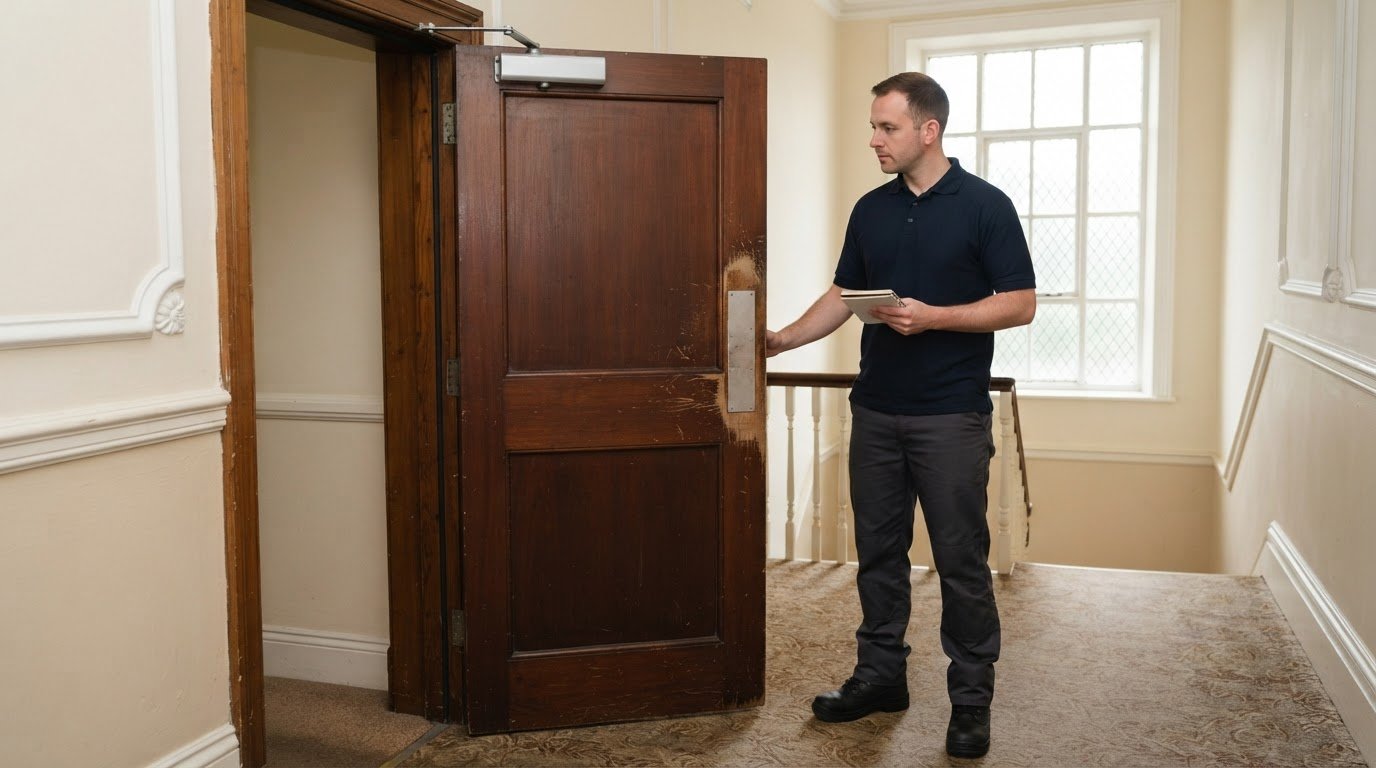
A practical starting point for deciding how often fire doors should be inspected in the UK is a routine check every six months in non-domestic premises. Check them more often if they are heavily used or the fire risk assessment identifies greater risk.
The right schedule depends on the building, its occupants and the condition of its doors. A fixed calendar interval cannot account for repeated impacts, wear or recurring defects. This article explains how to set a risk-based schedule, distinguish routine visual checks from formal inspections, choose a competent inspector and record findings clearly. It also shows how inspections fit into wider fire safety maintenance duties, helping you make the schedule practical, proportionate and evidence-based.
Key Takeaways
- Set inspection intervals around door use, condition and the risks identified in the fire risk assessment.
- Distinguish routine visual checks from formal inspections, and use a competent person for technical assessment.
- Record each door’s condition, defects, actions required and follow-up so maintenance decisions are traceable.
- Prioritise defects that could prevent a door closing correctly or compromising its fire and smoke protection.
- Use a Fire Door Inspection to identify issues and support a structured maintenance plan.
Table of Contents
- How often should fire doors be inspected?
- Risk-based inspection frequency in workplaces and other buildings
- Competency and accreditation of inspectors
- How should I record inspection findings?
- Consequences of failing to inspect and maintain fire doors
- Oxford Environmental Consultants (OEC): Fire Door Inspections
How often should fire doors be inspected?
There is no single inspection interval for every UK building. In England, specific duties apply to certain multi-occupied residential buildings. For other buildings, schedules should reflect fire risks and how frequently the doors are used.
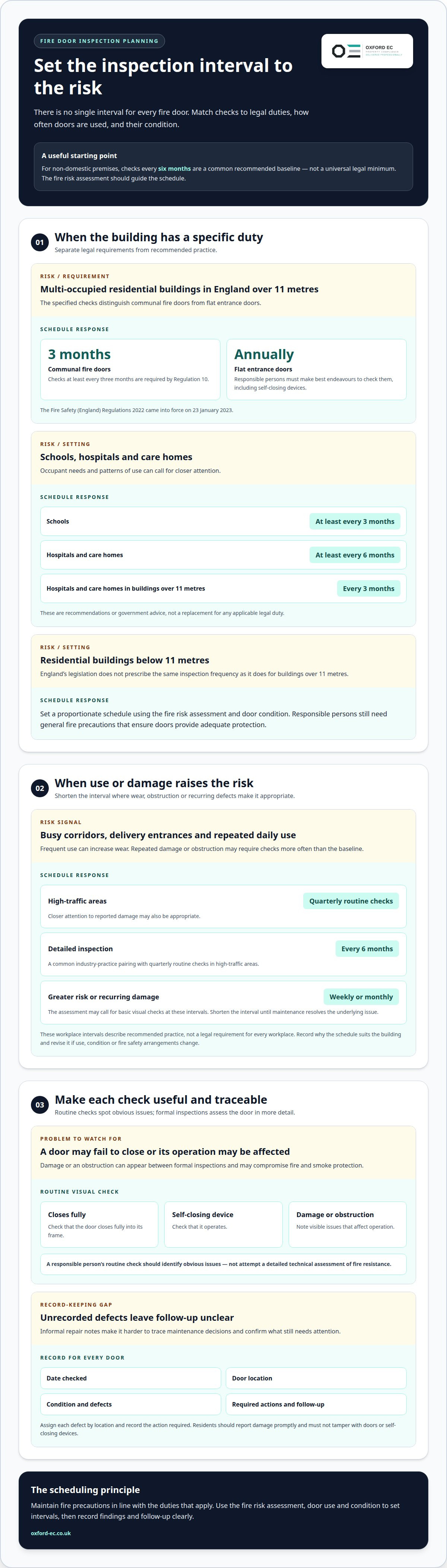
In non-domestic premises, checks every six months are a common recommended starting point, not a universal legal minimum. Use the fire risk assessment to set the schedule, considering whether busy routes or repeated damage call for more frequent checks. Schools, hospitals and care homes may need closer attention because occupant needs and patterns of use affect the risks.
Legal inspection requirements
The legal framework sets out fire safety responsibilities, but it does not create one inspection frequency for every fire door in England and Wales. The Regulatory Reform (Fire Safety) Order 2005 applies to buildings other than domestic housing, and its Article 17 duties require fire precautions to be maintained. This matters because a schedule must reflect the duties and risks that apply to the premises.
In England, the Fire Safety (England) Regulations 2022 came into force on 23 January 2023, according to the UK legislation register (legislation.gov.uk). For multi-occupied residential buildings with storeys over 11 metres, Regulation 10 requires checks of communal fire doors at least every three months. Responsible persons must also make best endeavours to check flat entrance doors, including self-closing devices, annually.
For residential buildings below 11 metres, legislation does not prescribe the same inspection frequency. However, responsible persons still need general fire precautions that ensure doors provide adequate protection. The Fire Safety Act 2021 clarified that flat entrance doors must be considered in fire risk assessments under the Fire Safety Order. In England, residents in buildings with two or more homes and common parts must receive fire door information when they move in and at least every 12 months, according to the UK legislation register (legislation.gov.uk).
Inspection frequencies and defect records
An inspection schedule sets planned intervals for checking door condition and operation. These checks matter because a door can be damaged or obstructed between formal inspections. Base the schedule on the fire risk assessment and record the date, door location, condition, defects and actions required. This makes follow-up clear instead of leaving repairs as informal tasks.
Schools should have fire doors checked at least every three months, according to government advice. Hospitals and care homes are recommended to check doors at least every six months; hospitals and care homes in buildings with storeys over 11 metres are recommended to inspect them every three months. These are recommendations, not a replacement for any applicable legal duty.
During a check, note whether the door closes fully into its frame, its self-closing device operates, and visible damage or an obstruction affects its operation. Record each defect by location and assign a follow-up action. A responsible person’s routine check should identify obvious issues, not attempt a detailed technical assessment of fire resistance. Residents should report damage promptly and must not tamper with doors or self-closing devices.
Risk-based inspection frequency in workplaces and other buildings
A risk-based schedule adjusts inspection intervals to the building’s use, fire risk assessment and door condition. It distinguishes legal duties from recommended practice, helping responsible persons prioritise doors exposed to frequent use, damage or obstruction.
Workplaces and commercial buildings
For offices and other non-domestic premises, checks every six months are a recommended baseline, not a legal minimum. Industry practice also commonly combines them with a detailed annual inspection. Use the fire risk assessment to decide whether this approach suits each door, rather than applying the same interval indiscriminately throughout the building.
Busy corridors, delivery entrances and doors used repeatedly during the working day experience more wear. Quarterly routine checks may suit high-traffic areas, with formal inspections every six months as a matter of industry practice. Where use or recurring damage creates greater risk, the assessment may call for basic visual checks weekly or monthly.
- Lower-use office doors: plan routine checks and detailed inspections around the assessment’s findings.
- High-traffic routes: consider quarterly routine checks and closer attention to reported damage.
- Doors with recurring defects: shorten the interval until maintenance resolves the underlying issue.
These intervals describe recommended practice, not a legal requirement for every workplace. Document why the schedule suits the building, and revise it if door use, condition or fire safety arrangements change.
Residential buildings and communal doors
In England, the Fire Safety (England) Regulations 2022 apply the specified checks to multi-occupied residential buildings with storeys over 11 metres in height, according to the UK legislation register (legislation.gov.uk). In those buildings, communal fire doors must be checked at least every three months, according to the UK legislation register (legislation.gov.uk).
For residential buildings below 11 metres, England’s legislation does not prescribe how often fire doors should be inspected, according to the UK legislation register (legislation.gov.uk). That includes buildings such as smaller blocks and HMOs, where the responsible person still needs to consider the doors’ condition and the findings of the fire risk assessment.
For high-rise residential buildings, distinguish communal doors from flat entrance doors: the applicable checks differ. The regulations’ specified regime applies to buildings with storeys over 11 metres; other buildings need a schedule informed by fire risk, door condition and use. Where occupants’ needs or repeated defects raise concern, more frequent checks may be appropriate.
Record the reason for each interval and review it after damage, changes in use or repeated faults. A fire risk assessment can help establish the relevant priorities; discuss a suitable inspection schedule.
Competency and accreditation of inspectors
Competence means having the knowledge, training and experience required for the inspection. The responsible person should assign each task to someone able to carry it out and report findings clearly.
Across England, Scotland, Wales and Northern Ireland, the person responsible for fire safety at the premises should arrange and oversee fire door checks. The legal framework differs between nations, so responsibility and inspection arrangements should reflect the building’s location and use.
Competent persons and inspection duties
A competent person can carry out an inspection to the level required for its purpose. This distinction matters because a routine visual check and a detailed technical inspection have different scopes.
In England and Wales, Article 18 of the Regulatory Reform (Fire Safety) Order 2005 requires the responsible person to appoint one or more competent persons to assist with preventive and protective measures. For simple visual checks under Regulation 10 in England, appropriately instructed on-site staff can perform the work; a specialist is not required for that task.
In residential premises, assign responsibility clearly between the person managing the building and those carrying out checks. A building manager may coordinate communal-door inspections, while checking flat entrance doors requires communication with residents. The responsible person should oversee findings and follow-up actions.
Deciding how often fire doors should be inspected in the UK is only part of managing the process. The person arranging the work must also determine who can carry out each check and who will address any defects found.
Specialist inspection competence
A specialist inspection assesses defects that a basic visual check may not resolve. The inspector must have appropriate competence to distinguish visible damage from issues requiring technical judgement or maintenance.
Choose an inspector whose knowledge, training and experience match the doors and the inspection scope. Checking whether a door closes and whether its closer appears damaged may require different expertise from assessing a complex defect or specifying remedial work. Accreditation can provide evidence of training, but the inspector must still be suitable for the task.
Before commissioning detailed work, define its scope using the fire risk assessment and relevant guidance. Provide door locations, previous findings and known recurring faults. This helps focus the inspection on issues such as damaged seals, loose hardware or doors that fail to close fully, rather than treating every observation as the same level of defect.
How often a fire door should be inspected in the UK does not determine who is competent to inspect it. Match the inspector to the required level of examination, from instructed visual checks to technical assessment of faults.
Keep routine visual checks proportionate: identify obvious damage or operational problems, then refer technical concerns to a suitably competent inspector. Clear allocation of responsibilities connects inspection, reporting and maintenance, so findings are acted on.
How should I record inspection findings?
A useful fire door record links each inspection to a specific door, its condition and any required action. Across England, Scotland, Wales and Northern Ireland, the person responsible for fire safety at the premises should ensure inspections and follow-up are managed. Exact statutory duties depend on the nation and building.
Inspection records and defect reporting
An inspection record is a dated account of checks, findings and decisions for each fire door. It helps the responsible person track defects through to completion instead of relying on memory or informal reports.
Use a consistent log that identifies the building, floor, door location and inspection date. Record visible damage to the door leaf or frame, whether hinges and other hardware appear secure, and whether the door closes fully. Include the inspector’s name, findings and photographs where they help explain a defect.
Describe issues precisely. “Door does not close fully into frame” gives a clearer maintenance instruction than “door faulty”. Include the immediate action taken, the person assigned to follow up and the status of any repair. For residential buildings, identify communal doors separately from flat entrance doors, especially where the 11 metres threshold affects the applicable checks.
Remedial actions and work
Remedial action is work arranged to correct a defect found during inspection. Clear records show how a fire risk was assessed, prioritised and addressed.
When an inspection identifies a defect, the building owner or responsible person should assess its effect on the door’s operation and arrange a suitable repair or replacement. In England, a competent contractor should carry out the work as soon as reasonably practicable. Record the decision, assigned contractor, evidence of completion and any follow-up check.
Prioritise defects that prevent a door closing or affect its self-closing device. For example, log a loose hinge, damaged frame or obstruction by location and operational impact. Distinguish temporary measures from completed repairs, so unresolved issues remain visible to those managing the premises.
For premises within the Regulatory Reform (Fire Safety) Order 2005, connect inspection findings to the fire risk assessment and maintenance plan. Article 17 requires fire precautions to be maintained. A record should therefore show not only that checks occurred, but also how identified defects were followed through.
In a block with communal doors and flat entrance doors, keep a separate entry for each location and inspection type. If access to a flat cannot be obtained for an annual check in England, retain evidence of reasonable steps taken to gain access. Close the record only after the action is complete and the door’s condition has been reassessed.
Consequences of failing to inspect and maintain fire doors
A fire door that does not close fully into its frame cannot be relied on to hold back fire and smoke. A damaged closer, obstructed doorway or deteriorated component can therefore undermine the door’s role in the building’s fire precautions. This is more than a missed maintenance task: it can compromise a protective route when it is needed.
Defects can weaken fire protection
Regular inspections by a competent person can identify defects requiring maintenance. Without them, faults may go unnoticed or recur after an incomplete repair. A sticking door, damaged frame or failed self-closing device can affect operation, so assess findings promptly against the building’s fire risk assessment.
Prioritise defects by their effect on the door’s ability to close and perform its intended role. For example, a flat entrance door that does not close properly needs attention, particularly where residents depend on it as part of the building’s fire precautions. In England, annual flat entrance-door checks apply to relevant multi-occupied residential buildings over 11 metres, alongside the applicable communal-door checks.
Enforcement and compliance consequences
For premises covered by the Regulatory Reform (Fire Safety) Order 2005, enforcing authorities can prosecute or close buildings where they find breaches. Breaching the Order can result in prosecution and unlimited fines. These consequences make inspection and maintenance records important evidence of how the responsible person manages fire safety duties.
A missed inspection does not, by itself, establish that a breach has occurred. What matters is the premises’ condition and compliance with applicable duties. However, an unresolved defect may indicate that a known fire safety issue has not been addressed. A door that cannot close fully presents an operational concern, not merely a paperwork gap.
Maintenance records must show action
Maintain a clear record from inspection finding through to completed remedial work. Identify the defect and its location, the decision made, who is responsible for action and evidence of completion. For example, if a closer is reported as faulty, record when it was assessed, what work was completed and whether the door then closed correctly.
Keep outstanding repairs visible in the maintenance record and communicate their status to those responsible for the premises. Do not mark a defect as resolved until the work is complete and the door’s operation has been checked. This prevents a temporary measure from being mistaken for a lasting repair.
Review inspection results alongside the fire risk assessment, especially when the same defect recurs. Repeated problems may call for a revised maintenance response or closer monitoring. In England, a competent contractor should complete relevant repairs or replacements as soon as reasonably practicable.
Oxford Environmental Consultants (OEC): Fire Door Inspections
Oxford Environmental Consultants (OEC) carries out Fire Door Inspections for building owners and responsible persons who need a clear assessment of door condition and maintenance priorities. An inspection can help when a scheduled check is due, defects recur or changes in building use prompt a review of the inspection plan.
Inspection findings can inform the fire risk assessment, maintenance decisions and records for each door. They give building managers practical evidence for follow-up and help keep inspection arrangements aligned with the premises’ risks and use.
Contact Oxford Environmental Consultants (OEC) to discuss Fire Door Inspections for your building.
Make fire door management part of the maintenance plan
A dependable inspection schedule needs a clear owner, a place in the property maintenance plan and a process for tracking actions to completion. For commercial organisations looking to integrate fire door oversight into wider building upkeep, planned facilities management services from atlassouthes.com help streamline site operations under a single contract. Review it when building use or responsibility changes, or when maintenance reveals recurring concerns. This keeps the schedule connected to how the premises operate, rather than leaving it as a date in a diary.
Deciding how often fire doors should be inspected in the UK is one part of wider building safety management. Oxford Environmental Consultants (OEC) also offers Fire Risk Assessments, Asbestos Management Surveys and Legionella Risk Assessments to support other aspects of premises management alongside fire door inspections.
Set out the next step clearly, whether that is arranging an inspection or reviewing how findings are managed. A considered process keeps fire door maintenance visible and accountable.
Take the next step towards a well-managed inspection schedule.
In England, according to legislation.gov.uk, fire doors in the common parts of multi-occupied residential buildings over 11 metres must be checked at least every three months, while flat entrance doors are subject to annual checks.
Frequently Asked Questions
Can my facilities team carry out inspections?
Yes, an appropriately instructed facilities team can carry out simple visual checks in England under Regulation 10. For example, staff can look for visible damage, obstructions and a door that fails to close. A detailed technical inspection is different: it needs a person with suitable knowledge, training and experience. Set out what staff should check, how they report faults and who decides whether specialist assessment is needed.
What actually gets checked on each door?
Check for obvious damage to the door and frame, confirm that the door closes fully and check that its self-closing device operates. Look for visible problems with hinges, seals, handles and other hardware, and note anything obstructing the doorway. Compare the result with the previous record: a new gap, loose fitting or recurring fault may need investigation. A basic visual check identifies apparent issues; it does not test fire resistance.
What does the Fire Safety (England) Regulations 2022 require?
For multi-occupied residential buildings in England with a top storey over 11 metres, the regulations require checks of communal fire doors at least every three months. The responsible person must also use best endeavours to check flat entrance doors annually, including their self-closing devices. These duties apply to the specified buildings in England. They should not be treated as the inspection rules for every building across the UK.
How often must fire doors be inspected in UK workplaces and commercial buildings?
There is no single statutory interval for every workplace fire door. Checks every six months and detailed annual inspections are common industry practice, not a universal legal minimum. Busy entrances or doors with recurring damage may need closer attention, guided by the premises’ fire risk assessment. Record why the schedule suits the building and review it if use changes or findings reveal new concerns.
How often should fire doors be checked in UK flats and houses in multiple occupation?
In England, communal fire doors in multi-occupied residential buildings with storeys over 11 metres must be checked at least every three months. For residential buildings below that height, legislation does not prescribe an inspection interval; the responsible person should consider the fire risk assessment and door condition. For an HMO, distinguish shared-area doors from flat entrance doors and set checks according to the building’s specific duties and risks.
What does UK fire safety law require for fire door inspections?
Requirements depend on the nation, building type and door location. In England, the Regulatory Reform (Fire Safety) Order 2005 requires relevant fire precautions to be maintained, while the Fire Safety (England) Regulations 2022 set specific checks for certain multi-occupied residential buildings. Scotland and Northern Ireland have separate fire-safety frameworks. Identify the rules applying to the premises, rather than assuming one inspection frequency covers the entire UK.
What should a routine fire door inspection checklist include?
Record the door’s location and check date, visible damage to the door or frame, whether it closes fully and whether its self-closing device works. Note obvious faults with hinges, seals or hardware, and any obstruction affecting the doorway. Mark each item as satisfactory or requiring action, with enough detail to locate the issue. A routine checklist flags apparent problems; a specialist assessment may be needed to investigate technical defects.
How often should fire door checks be recorded and documented?
Record each scheduled check or inspection when it takes place, so the entry reflects actual findings rather than later recollection. Include the date, door location, person completing the check, defects and follow-up actions. Update the record when work is complete, noting whether the door’s operation was reassessed. Keep failed checks visible until resolved, and use recurring findings to review the inspection plan.