
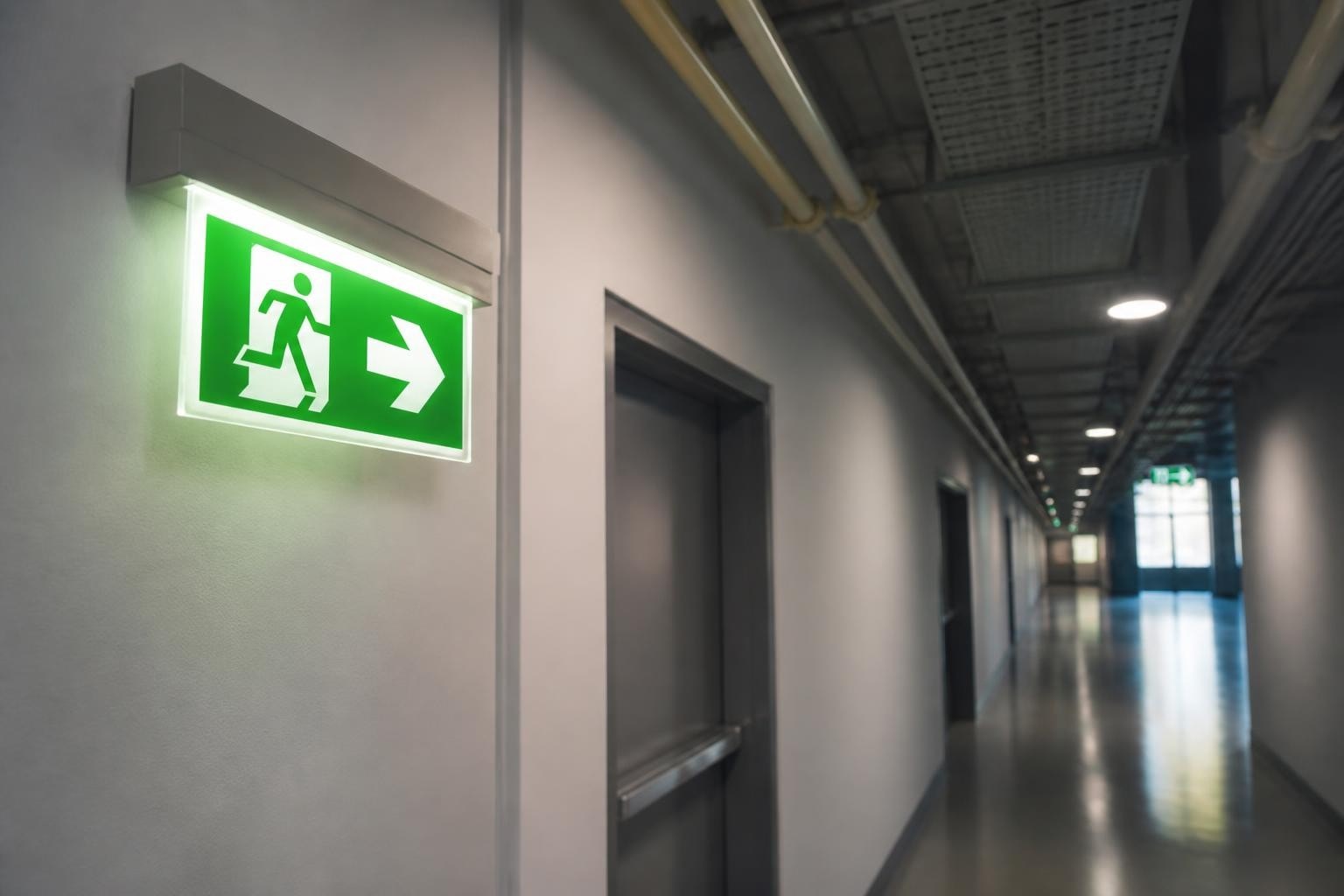
Emergency lighting systems represent the final layer of life-safety infrastructure when primary power fails. Yet their reliability hinges entirely on systematic testing protocols that many duty holders misunderstand or execute inconsistently. As regulatory oversight intensifies across fire safety disciplines, emergency lighting testing has shifted from a maintenance afterthought to a statutory obligation with documented audit trails and fixed compliance intervals. This article examines the legislative framework, testing methodologies, and record-keeping practices that define professional emergency lighting maintenance in 2026.
Legislative Framework and Statutory Duties
The Regulatory Reform (Fire Safety) Order 2005 places emergency lighting provision and maintenance squarely within the responsible person's legal remit. Article 14 of the Order specifies that emergency routes and exits requiring illumination must remain adequately lit, creating an implicit duty to verify operational readiness through routine testing.
British Standard BS 5266-1:2016 codifies the technical requirements for emergency lighting systems, establishing testing frequencies and documentation standards that regulatory authorities expect during inspection. The standard distinguishes between daily automated testing (for self-test systems), monthly functional tests, and annual full-duration tests, each serving distinct verification purposes.

The Responsible Person's Obligations
Under the Fire Safety Order, the responsible person must ensure:
- Emergency lighting activates automatically upon mains failure
- Illumination levels meet minimum lux requirements for escape routes
- Battery autonomy sustains lighting for the design duration (typically three hours)
- Test records demonstrate compliance with statutory intervals
- Defects identified during testing receive prompt remediation
Failure to maintain testable records constitutes a material breach during enforcement visits. Fire and Rescue Authorities increasingly request timestamped test logs extending back 24 months, with particular scrutiny applied to non-domestic premises housing vulnerable occupants or complex evacuation scenarios.
Monthly Functional Testing Protocols
The monthly functional test verifies that each emergency luminaire illuminates upon simulation of mains failure and that duration indicators (where fitted) function correctly. This procedure occupies approximately 30 seconds per fitting and forms the backbone of routine maintenance programmes.
Step-by-Step Monthly Procedure
- Isolate the circuit feeding each emergency luminaire individually or activate the test switch
- Confirm illumination occurs immediately and check that non-maintained lights achieve full brightness
- Inspect visual indicators to verify charging and readiness status
- Restore mains supply and confirm the luminaire returns to normal operation
- Record the test date, location, and any defects in the logbook
According to guidance from the Life Safety Code's emergency lighting provisions, monthly testing identifies approximately 80% of common failure modes, including lamp deterioration, battery disconnection, and inverter faults. The procedure should follow a documented route sequence to ensure comprehensive coverage across multi-floor or multi-zone premises.
| Test Element | Pass Criteria | Common Failure Modes |
|---|---|---|
| Lamp activation | Immediate illumination | Failed lamps, inverter fault |
| Light output | Full brightness achieved | Battery degradation, lamp aging |
| Charging indicator | Green/charging LED active | Charger failure, wiring fault |
| Test switch operation | Reliable circuit interruption | Switch defect, incorrect wiring |
Emergency lighting testing during monthly cycles rarely exceeds 0.1% of battery capacity, permitting safe sequential testing without compromising emergency autonomy. However, premises with more than 50 luminaires benefit from zoned testing schedules that distribute the workload across designated maintenance windows.
Annual Full-Duration Testing
The annual full-duration test represents the definitive verification of battery performance and system integrity. This procedure requires each emergency luminaire to operate continuously on battery power for its full rated duration-typically three hours for non-domestic premises-while monitoring light output degradation and eventual failure.
Planning and Execution
Annual testing demands careful coordination, particularly in occupied premises where escape route integrity must be preserved throughout the test period. Best practice involves:
- Scheduling during low-occupancy periods to minimise fire risk exposure
- Implementing phased testing across zones with alternative evacuation routes
- Deploying temporary standby lighting in critical areas lacking redundancy
- Monitoring each luminaire at 30-minute intervals to document performance degradation
The comprehensive maintenance checklist published by industry specialists emphasises the importance of pre-test inspection, noting that physical defects such as damaged diffusers or loose mountings compromise performance regardless of electrical function.
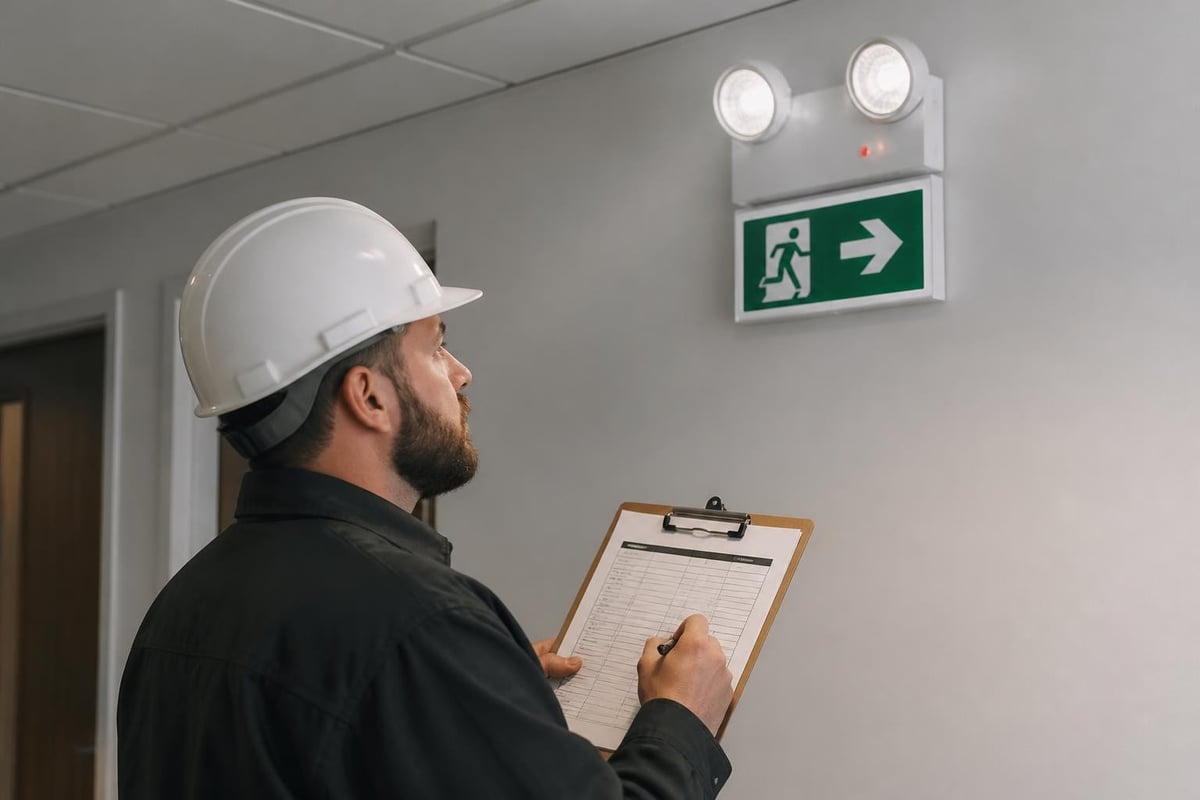
Luminaires that fail before reaching their rated duration require immediate battery replacement or complete unit renewal. However, performance degradation below 80% of rated duration also triggers replacement planning, even if the three-hour threshold is technically achieved. This preventative approach avoids emergency failures during genuine power interruptions.
Record-Keeping and Audit Compliance
Documentation separates compliant emergency lighting programmes from well-intentioned but legally deficient maintenance schedules. The test logbook serves as prima facie evidence of statutory compliance during regulatory inspections, insurance reviews, and due diligence audits.
Essential Documentation Components
Professional emergency lighting testing generates a cumulative compliance record containing:
- Building floor plans annotated with luminaire locations and unique identifiers
- Monthly test registers recording date, tester identity, and pass/fail status for each fitting
- Annual test certificates documenting full-duration performance and battery condition
- Defect remediation logs tracking identified faults through to completion
- Luminaire replacement schedules forecasting lifecycle renewal requirements
Fire safety services that deliver BS 5266 compliance recognise that documentation quality directly influences enforcement outcomes. Handwritten logbooks with missing entries, unexplained gaps, or unidentified testers fail the credibility threshold that regulatory authorities apply during contested enforcement notices.
Modern emergency lighting systems incorporate self-test functionality that automates daily and monthly test cycles whilst generating digital compliance records. These systems typically interface with building management platforms, creating timestamped audit trails that eliminate human recording errors and provide real-time fault alerting.
| Documentation Type | Retention Period | Regulatory Purpose |
|---|---|---|
| Monthly test logs | 24 months minimum | Demonstrate routine compliance |
| Annual certificates | Lifecycle of system | Prove statutory interval adherence |
| Defect remediation records | 6 years | Evidence duty discharge |
| Installation certificates | Permanent | Validate design compliance |
Integration with Fire Risk Assessment Obligations
Emergency lighting performance directly influences evacuation modelling within Fire Risk Assessment methodologies. PAS 79 risk assessors evaluate emergency lighting adequacy by reviewing test records, physical condition, and coverage against current occupancy patterns.
Common Fire Risk Assessment Findings
Risk assessments frequently identify emergency lighting deficiencies including:
- Inadequate coverage in areas of occupancy change since original installation
- Non-compliant testing intervals exceeding statutory monthly or annual frequencies
- Missing or illegible signage directing occupants towards illuminated escape routes
- Insufficient lux levels at floor level in stairwells or corridors
- Battery autonomy failure revealed through incomplete annual test documentation
The action plans emerging from risk assessments typically assign Priority 1 status to emergency lighting defects affecting immediate life safety, requiring remediation within 24-48 hours. Priority 2 actions address testing compliance gaps, with typical completion timescales of 28 days.
Duty holders managing portfolios across multiple premises benefit from centralised emergency lighting testing programmes that synchronise inspection cycles with wider fire safety compliance activities. This integrated approach ensures that emergency lighting condition informs compartmentation surveys, fire door inspections, and detection system verification, creating a unified life-safety compliance framework.
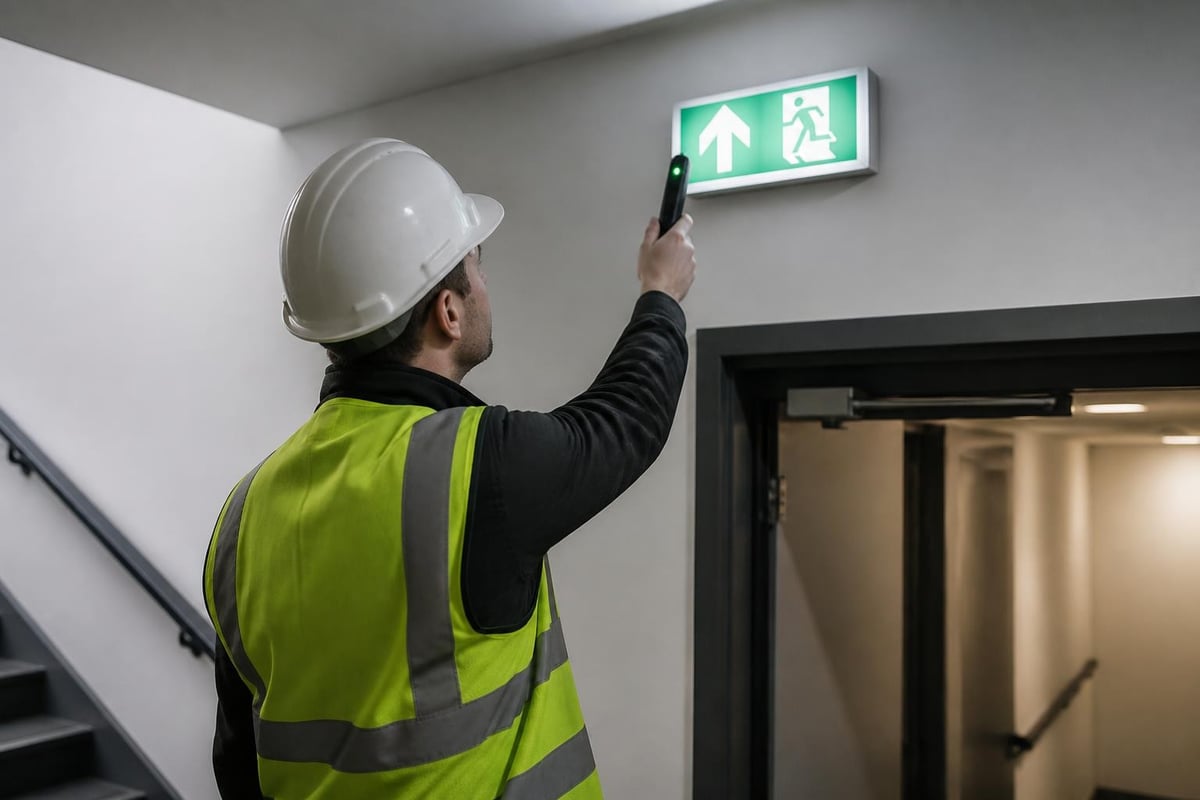
For properties subject to the Building Safety Act 2022, emergency lighting verification forms a component of the safety case regime, with testing records submitted as part of ongoing compliance evidence to the Building Safety Regulator. This elevated scrutiny has accelerated the adoption of digital testing platforms that generate audit-ready documentation automatically.
System Types and Testing Variations
Emergency lighting systems employ diverse technologies and power architectures, each requiring tailored testing approaches to verify operational readiness. Understanding these variations prevents inappropriate test methods that either underestimate or invalidate performance verification.
Maintained vs Non-Maintained Systems
Maintained emergency lighting operates continuously from mains supply and transitions to battery power during outages. Monthly testing of maintained systems requires isolation of the mains supply whilst verifying that battery autonomy sustains continued operation. These systems commonly appear in public areas where constant illumination serves dual functions.
Non-maintained emergency lighting remains dormant during normal operation, illuminating only upon mains failure. Testing non-maintained systems involves simulating power loss through test switches or circuit isolation, then confirming immediate activation and sustained illumination throughout the rated duration.
Self-Test Emergency Lighting
Self-contained luminaires equipped with microprocessor control perform automated functional and duration tests according to programmed schedules. These systems execute monthly functional tests and annual duration tests without manual intervention, storing results in onboard memory or transmitting data to centralised management systems.
The regulations governing emergency lighting testing in regulated environments emphasise that automated testing does not eliminate the duty holder's verification obligations. Competent persons must review self-test results, investigate reported failures, and maintain independent verification schedules that confirm automated systems function correctly.
| System Architecture | Testing Method | Typical Applications |
|---|---|---|
| Self-contained non-maintained | Manual test switch activation | Retail, office, education |
| Self-contained maintained | Circuit isolation or test switch | Theatres, care homes, hotels |
| Central battery non-maintained | Sub-circuit isolation per zone | Large commercial, industrial |
| Self-test with reporting | Automated with digital verification | Modern fit-outs, portfolios |
Common Testing Failures and Remediation
Emergency lighting testing programmes consistently reveal recurring defects that compromise evacuation safety. Identifying these failure patterns enables proactive maintenance strategies that reduce statutory compliance risk.
Battery-Related Failures
Battery deterioration represents the dominant cause of emergency lighting failure, typically manifesting as:
- Reduced autonomy falling below three-hour statutory minimum
- Failure to hold charge requiring replacement within 12-18 months of installation
- Physical swelling or leakage indicating imminent battery failure
- Complete discharge during annual duration testing before rated period expires
Modern emergency lighting batteries employ nickel-cadmium (NiCd), nickel-metal hydride (NiMH), or lithium technologies, each exhibiting distinct failure characteristics. NiCd batteries demonstrate memory effect requiring periodic deep discharge, whilst lithium cells offer extended lifecycle but higher replacement costs.
Lamp and LED Degradation
Light source failure modes differ substantially between traditional fluorescent emergency lighting and contemporary LED systems. Fluorescent lamps exhibit gradual lumen depreciation and catastrophic end-of-life failure, whilst LED arrays typically demonstrate progressive output reduction across multiple emitters.
Emergency lighting testing identifies lamp defects through visual inspection and illuminometer verification, with replacement triggered when output falls below 50% of original specification or individual lamps fail completely. The emergency lighting maintenance guidance recommends group replacement of fluorescent lamps in self-contained fittings to maintain consistent illumination characteristics.
Testing in Specialist Environments
Certain occupancy types demand enhanced emergency lighting testing protocols that exceed minimum statutory requirements. These specialist applications require competent persons familiar with sector-specific regulatory expectations and operational constraints.
Healthcare and Care Settings
Care homes, hospitals, and assisted living facilities face particular scrutiny regarding emergency lighting provision due to vulnerable occupant profiles and complex evacuation dependencies. Testing protocols in healthcare environments typically incorporate:
- Weekly visual inspections supplementing monthly functional tests
- Quarterly battery capacity assessments using electronic testers
- Illuminated escape signage verification ensuring visibility from bed positions
- Backup generator integration testing confirming automatic changeover operation
The testing requirements for hotels and similar premises established by regulatory authorities demonstrate the elevated expectations applied to buildings housing sleeping occupants, where evacuation assumptions differ fundamentally from alert, familiar occupants in workplaces.
High-Risk Industrial Premises
COMAH sites, licensed premises, and industrial facilities with hazardous processes implement emergency lighting testing schedules aligned with process safety management systems. These programmes typically feature:
- Monthly testing conducted during planned shutdowns to avoid production disruption
- Dedicated emergency lighting for safe shutdown procedures beyond pure evacuation
- Explosion-proof luminaire testing requiring specialist competence
- Integration with emergency shutdown sequences and process alarms
Emergency lighting provision in industrial settings frequently supports safe haven strategies rather than total evacuation, requiring illumination of control rooms, refuge areas, and shutdown stations in addition to conventional escape routes. Testing protocols must verify these mission-critical lighting functions alongside standard escape illumination.
Competence and Training Requirements
Effective emergency lighting testing demands competence extending beyond basic electrical knowledge. Test personnel require understanding of photometric principles, battery chemistry, regulatory frameworks, and documentation standards that together constitute professional emergency lighting maintenance.
Competence Framework
Organisations delivering compliant emergency lighting testing typically implement structured competence development covering:
- BS 5266-1:2016 interpretation and application to diverse building types
- Fire Safety Order duties specific to emergency lighting provision
- Testing methodology for maintained, non-maintained, and self-test systems
- Illuminance measurement using calibrated light meters
- Defect recognition and appropriate remediation specification
- Digital compliance platforms for audit-ready record generation
The comprehensive fire safety services delivered by specialist consultancies embed emergency lighting testing within broader competence frameworks covering fire risk assessment, passive fire protection, and detection system verification. This integrated approach ensures that emergency lighting condition informs wider fire safety decision-making rather than existing as an isolated compliance activity.
Formal training pathways such as FIA Emergency Lighting courses provide certificated competence verification, though regulatory authorities focus primarily on demonstrated ability to execute compliant testing and maintain defensible records rather than specific qualifications.
Digital Testing Platforms and Innovation
Technology advancement has transformed emergency lighting testing from clipboard-and-logbook exercises into digitally orchestrated compliance programmes generating real-time data analytics and predictive maintenance insights.
Connected Emergency Lighting Systems
Contemporary emergency lighting installations increasingly incorporate addressable luminaires networked through building management systems or dedicated emergency lighting control panels. These systems deliver:
- Automated test scheduling eliminating manual intervention and recording errors
- Real-time fault notification via email, SMS, or building management system integration
- Centralized compliance dashboards aggregating test results across multi-site portfolios
- Predictive battery replacement based on charge curve analysis and degradation trends
- Remote test initiation enabling testing coordination across geographically dispersed estates
The commercial property testing standards emphasise that digital platforms enhance but do not replace competent verification. Duty holders retain responsibility for validating automated test results, investigating anomalies, and ensuring physical luminaire condition supports documented electrical performance.
Mobile Testing Applications
Field testing increasingly employs tablet or smartphone applications that guide technicians through systematic test routes, capture photographic evidence, and generate georeferenced compliance records. These tools reduce documentation time by 40-60% compared to paper-based systems whilst improving data quality through standardised entry fields and mandatory documentation.
Advanced testing applications integrate with maintenance management systems, automatically generating remedial work orders when luminaires fail testing and tracking completion through to final verification. This closed-loop workflow ensures that identified defects receive timely resolution and that re-testing confirms successful remediation.
Cost Implications and Lifecycle Planning
Emergency lighting testing represents a recurring operational cost that increases proportionally with building size and system complexity. Duty holders managing compliance budgets benefit from lifecycle cost analysis that balances routine testing expenditure against equipment replacement and emergency failure risk.
Testing Cost Structure
Professional emergency lighting testing services typically charge through fixed-price annual contracts or per-luminaire visit rates. Indicative cost structures include:
- Monthly functional testing: £2–£5 per luminaire per annum for buildings with 50–200 fittings
- Annual duration testing: £8–£15 per luminaire including battery condition assessment
- Defect remediation: Typically quoted separately based on parts and labour requirements
- Digital compliance platforms: £500–£2,000 annual licence fees for portfolio-scale deployments
These costs must be evaluated against risk exposure from non-compliance, including prohibition notices potentially closing premises, unlimited fines for Fire Safety Order breaches, and corporate manslaughter liability in worst-case evacuation failures.
Lifecycle replacement planning extends testing value by identifying degradation trends before catastrophic failure occurs. Emergency lighting systems typically require complete luminaire renewal every 10–15 years and battery replacement every 4–5 years, with proactive scheduling reducing emergency call-out costs and compliance gaps.
Emergency lighting testing delivers measurable life-safety assurance only when executed systematically, documented comprehensively, and integrated within broader fire safety governance. The testing intervals, methodologies, and record-keeping standards established under BS 5266 create an audit-ready framework that withstands regulatory scrutiny whilst protecting vulnerable occupants during their moment of greatest need. For duty holders seeking unified compliance delivery across fire safety, water hygiene, asbestos, and building safety disciplines, oxford-ec.co.uk provides the multi-disciplinary expertise and nationwide coverage that transforms fragmented maintenance contracts into cohesive risk management programmes backed by audit-ready precision.