
Could your current safety records withstand the scrutiny of a rigorous Fire Office inspection tomorrow? For many property managers, the answer is often shrouded in the uncertainty of fragmented reports from an inadequate emergency light testing company. This lack of clarity represents a significant liability. It compromises occupant safety. It risks legal prosecution. Precise auditing. Absolute transparency. Total compliance.
We recognise that managing a multi-site portfolio requires a level of technical rigour that standard maintenance providers often fail to deliver. Selecting the right partner is about more than just checking bulbs; it's about securing an expert who understands the granular requirements of BS 5266-1:2016 and the evolving landscape of UK safety legislation in 2026. This guide provides the definitive framework for ensuring your assets remain fully compliant and audit-ready at all times. You'll discover how to transition from fragmented manual records to streamlined digital logbooks while maintaining the highest standards of life-safety infrastructure across your entire estate.
Key Takeaways
- Understand the stringent requirements of the Regulatory Reform (Fire Safety) Order 2005 and how professional oversight protects the "Responsible Person" from legal liability.
- Master the technical nuances of BS 5266-1:2016 to ensure every luminaire, battery, and control gear component meets the latest 2026 safety standards.
- Identify the critical accreditations and national capabilities needed when selecting a professional emergency light testing company to ensure portfolio-wide consistency.
- Discover the operational efficiency of integrating lighting maintenance with fire alarm systems and door inspections to create a robust, multi-disciplinary safety shield.
- Learn how to achieve total peace of mind with streamlined, audit-ready digital reporting that simplifies the complexities of annual duration tests and Fire Office audits.
Table of Contents
- The Legal Mandate: Why Your Choice of Emergency Light Testing Company Matters
- Understanding BS 5266-1: The Professional Standard for Testing
- Evaluating an Emergency Light Testing Company: Selection Criteria
- The Testing Process: What to Expect During a Professional Audit
- Integrated Compliance: The Multi-Disciplinary Advantage
The Legal Mandate: Why Your Choice of Emergency Light Testing Company Matters
Statutory duty. Legal risk. Operational safety. The Regulatory Reform (Fire Safety) Order 2005 remains the primary legislative framework governing UK businesses, mandating that every commercial premises must be equipped with functional emergency lighting systems to ensure safe evacuation during a crisis. Choosing an unqualified emergency light testing company introduces a critical point of failure into your broader safety strategy. Compliance isn't optional; it's a fundamental legal requirement that demands professional precision and technical mastery.
The Duty of Care and Legal Accountability
The role of the "Responsible Person" is central to UK fire safety law. This individual bears personal liability for the adequacy of life-safety infrastructure, meaning you're legally accountable for any system failures that occur on your watch. Professional testing acts as your protective shield against prosecution. Without documented evidence of regular duration tests and monthly function checks, you remain vulnerable to several severe outcomes:
- Hefty financial penalties that directly impact your organisation's bottom line.
- Prohibition notices that can close your premises overnight.
- Custodial sentences in cases where gross negligence is identified.
Insurance providers now view this documentation as non-negotiable. They require proof of consistent third-party auditing to validate your policy, as a lack of evidence can lead to the immediate withdrawal of coverage or the refusal of claims following an incident. A professional audit provides the legal robustness required to satisfy both Fire Officers and insurers alike.
Navigating the 2026 Regulatory Landscape
The 2026 regulatory environment has been permanently reshaped by the Building Safety Act 2022. This legislation imposes a higher level of scrutiny on high-rise residential and commercial assets, introducing the concept of the "golden thread" of information. This requires a digital, transparent record of all maintenance activities that's easily accessible to the Building Safety Regulator at any moment. An expert emergency light testing company doesn't just check bulbs; they manage this critical data flow to ensure your portfolio is always audit-ready.
Following the findings of the Grenfell Tower Inquiry, the shift towards rigorous, evidence-based compliance is absolute. You must be able to prove that your fire safety systems are not only present but fully operational through a continuous chain of accountability. This rigorous management of data protects the duty-holder by providing an immutable history of compliance that stands up to the most intense scrutiny from local fire authorities. It ensures your assets remain safe, your people protected, and your legal obligations fulfilled.
Understanding BS 5266-1: The Professional Standard for Testing
Technical rigour. Absolute precision. BS 5266-1:2016 compliance. This code of practice serves as the definitive methodology for the design, installation, and ongoing maintenance of systems intended to operate when mains power fails. It is the technical backbone of the Regulatory Reform (Fire Safety) Order 2005; providing the specific benchmarks that a professional emergency light testing company must verify during every audit. Understanding these standards is not merely an exercise in paperwork; it is the difference between a safe evacuation and a catastrophic failure in the dark.
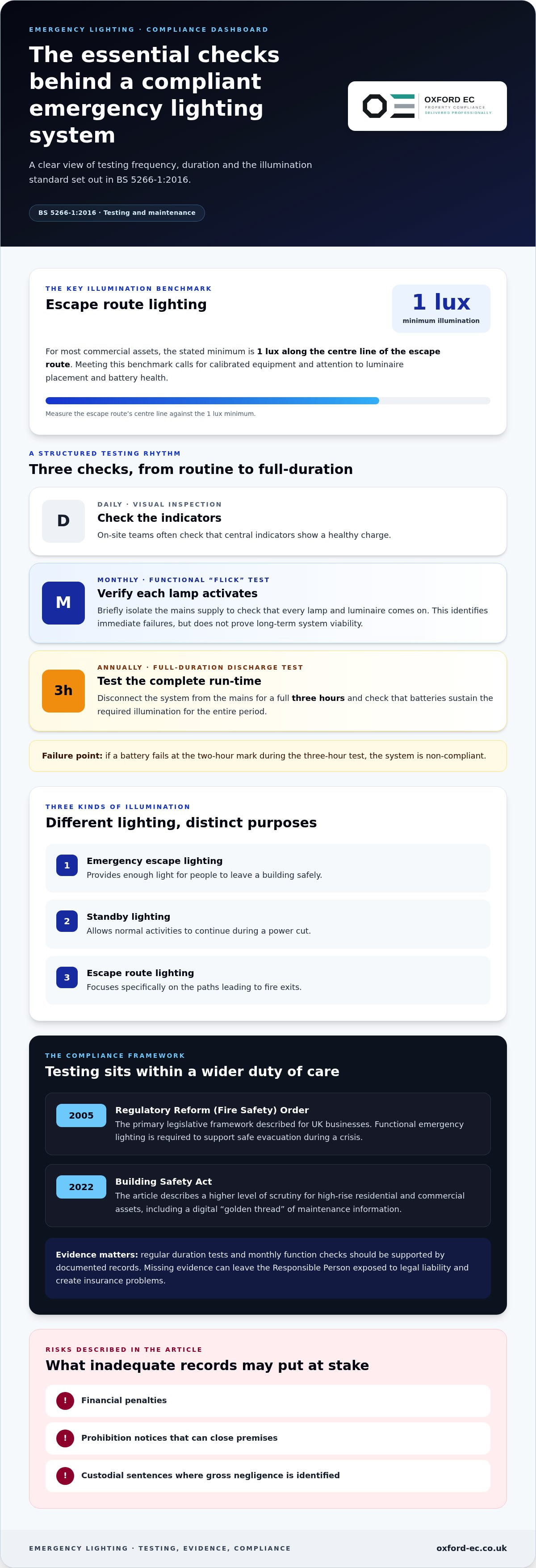
The standard distinguishes between three primary categories of illumination. Emergency escape lighting provides enough light for people to leave a building safely. Standby lighting allows normal activities to continue during a power cut. Escape route lighting specifically focuses on the paths leading to fire exits. For most commercial assets, the mandatory requirement is a minimum of 1 lux along the centre line of the escape route. Achieving this level of exactness requires calibrated equipment and a deep understanding of luminaire placement and battery health.
Mandatory Testing Frequencies and Protocols
Compliance is maintained through a structured schedule of scrutiny. Daily visual inspections are often handled by on-site teams to ensure that central indicators show a healthy charge. However, the more technical monthly functional "flick" tests require a brief isolation of the mains supply to verify that every lamp and luminaire activates correctly. These short tests identify immediate failures but do not prove the long-term viability of the system.
The annual full-duration discharge test is the most critical event in the safety calendar. During this process, the system is disconnected from the mains for a full three hours to ensure the batteries can sustain the required illumination levels for the entire period. If a battery fails at the two-hour mark, the system is non-compliant. A professional emergency light testing company will manage this process to ensure minimal disruption to your operations while capturing the evidence-based data required for your logbook. If your current records lack this level of detail, it may be time to speak with a compliance expert to bridge the gap.
The Technical Components of a Compliant System
Systems are generally categorised as maintained or non-maintained. Maintained luminaires operate continuously, often found in cinemas or high-occupancy public spaces, whereas non-maintained units only ignite when the local power supply fails. Whether your property utilises self-contained battery units or a centrally supplied system, the integration of clear directional signage is essential. These components must work in perfect synchronisation to guide occupants toward safety, meaning every exit sign and directional arrow must be part of the rigorous annual audit to satisfy UK safety inspectors.
Evaluating an Emergency Light Testing Company: Selection Criteria
Technical validation. Operational consistency. Risk mitigation. Selecting an emergency light testing company is a strategic decision that extends beyond simple price comparisons. It requires a partner who possesses the technical infrastructure to manage complex property compliance requirements while maintaining absolute transparency. When the safety of occupants and the legal standing of the "Responsible Person" are at stake, the criteria for selection must be uncompromising.
Accreditations serve as the primary indicator of technical competence. You should prioritise providers aligned with NICEIC or ECA, as these bodies verify the electrical safety standards of the contractor. Alignment with BAFE SP203-4 provides specific assurance regarding emergency lighting systems. These certifications act as a technical handshake of expertise, confirming that the engineers attending your site understand the nuances of the workplace fire safety responsibilities you must uphold. Without these credentials, a provider cannot guarantee the legal robustness of your documentation.
National Reach vs. Local Expertise
For facilities managers overseeing multi-site portfolios, national coverage is a non-negotiable requirement. Fragmented local contractors often produce inconsistent reports, making it nearly impossible to maintain a unified view of your estate's safety status. A national provider delivers uniform standards. They use the same methodology in every region. They provide a single, centralised point of contact. This structured approach eliminates the administrative friction of managing multiple vendors and ensures that every asset, regardless of location, receives the same level of professional scrutiny.
Digital Compliance and Asset Management
The era of the dusty paper logbook is over. Modern compliance demands a digital-first approach that supports the "golden thread" of building information required by the Building Safety Regulator. A professional emergency light testing company will offer secure, cloud-based portals for asset management. These systems provide real-time visibility into your compliance status, allowing you to access certificates and track remedial actions instantly. This transparency is vital during a Fire Office inspection; the ability to produce evidence-based results within seconds can prevent the issuance of a deficiency notice.
Finally, scrutinise the pricing structure for remedial works. Many providers offer a low-cost testing fee only to inflate the price of replacement batteries and luminaires later. A dependable partner provides transparent, pre-agreed rates for common repairs. This avoids the "low-cost test, high-cost repair" trap and ensures your budget remains controlled while your life-safety systems stay fully operational.
The Testing Process: What to Expect During a Professional Audit
Methodical execution. Rigorous scrutiny. Documented evidence. A professional emergency light testing company follows a disciplined sequence of events to ensure no luminaire is overlooked and no battery remains unverified. This process begins long before an engineer steps onto your site; it starts with strategic pre-site planning designed to align with your operational rhythm. By coordinating testing windows, we ensure that annual three-hour discharge tests occur during periods of low occupancy, effectively minimising disruption to your business whilst maintaining strict safety protocols.
Step-by-Step Site Methodology
Every audit follows a precise technical roadmap. Engineers initiate the process by identifying the relevant circuits and implementing safe isolation procedures to simulate a power failure. This isn't a random sampling; it's a systematic verification of every luminaire against your building's floor plan to ensure total coverage. During the visit, our specialists perform several critical checks:
- Physical inspection of the housing and diffusers for signs of environmental damage or degradation.
- Verification of charging indicators to confirm the internal battery is receiving a constant trickle charge.
- Functional testing of the control gear to ensure seamless activation the moment the mains supply is interrupted.
- The annual discharge test, where the system is monitored for a full 180 minutes to prove battery longevity.
Upon completion of the physical inspection, a post-test briefing is conducted. This provides the "Responsible Person" with an immediate overview of the system's health, highlighting any "Critical Failures" that require instant attention to protect the building's occupants.
Remedial Works and Satisfactory Certification
Identification of a failure is only the first half of the process. A robust audit categorises faults into three distinct tiers: Critical Failures, Non-conformities, and Observations. Critical failures represent an immediate risk to life-safety; these require urgent intervention to restore your building’s fire safety compliance status. Unlike basic contractors who may leave you with a list of problems and no solution, a professional partner provides a clear, costed pathway to resolution.
Rapid remedial action is essential to maintain your legal standing. Once repairs are completed, a final Certificate of Testing and a comprehensive Condition Report are issued. This documentation serves as your immutable evidence of compliance, ready for presentation during any external fire safety audit. It confirms that your life-safety infrastructure is not just present, but fully operational and legally robust.
Integrated Compliance: The Multi-Disciplinary Advantage
Integrated safety. Technical synergy. Streamlined delivery. Managing emergency lighting in isolation is a tactical error that often leads to critical gaps in your life-safety infrastructure. A professional emergency light testing company shouldn't operate in a vacuum; instead, it must function as a vital component of a broader, integrated protection strategy. When illumination systems are synchronised with fire alarm installation and detection protocols, the result is a unified response that significantly enhances occupant safety during a crisis. Selecting an emergency light testing company that understands these interdependencies is essential for maintaining a high-performance safety environment.
Consider the operational relationship between illumination and physical barriers. Effective fire door inspection ensures that compartmentation remains intact, whilst functional emergency lighting provides the visibility required to navigate these protected escape routes safely. If one fails, the efficacy of the other is severely compromised. By consolidating these requirements into a single multi-disciplinary safety survey, you eliminate the administrative burden of managing fragmented contractors. This integrated model provides a comprehensive overview of your building's health, ensuring that every element of your fire safety strategy is aligned and audit-ready.
Holistic Fire Safety Management
True compliance requires the alignment of all safety assets with the technical findings of your latest Fire Risk Assessments. This holistic approach ensures that escape route lighting strategies match the specific compartmentation and occupancy risks identified within your property. Consolidating these inspections reduces "contractor fatigue" and ensures a consistent standard of reporting across your entire portfolio. It transforms compliance from a series of disjointed electrical tasks into a robust, evidence-based shield against legal risk. Our methodology ensures that your safety records are not only complete but technically sound.
Partnering with Oxford Environmental Consultants
Oxford Environmental Consultants (OEC) provides a rigorous, consultancy-led approach to national property compliance. We don't just check boxes; we act as an accountable partner for complex building safety requirements across diverse UK portfolios. Our multi-disciplinary expertise allows us to identify technical synergies that single-service providers miss, ensuring your legal robustness is absolute. We thrive on detail and order, providing the precision required to satisfy the most demanding regulatory audits. To secure your assets and ensure your estate is fully compliant, contact our expert team today.
Securing Your Statutory Future: The Path to Absolute Compliance
Statutory safety is not a passive state. It requires relentless oversight. Rigorous auditing. Total transparency. As the 2026 regulatory landscape evolves, the "Responsible Person" must transition away from fragmented maintenance toward a holistic, multi-disciplinary strategy. You now understand how integrating lighting with wider fire safety systems eliminates critical gaps in your life-safety infrastructure. This integrated approach ensures your assets remain compliant whilst protecting your people and your legal standing across every site you manage.
Selecting a professional emergency light testing company is the final step in securing your property portfolio against risk. Oxford Environmental Consultants provides the national UK coverage and multi-disciplinary fire safety expertise required to manage complex estates with absolute precision. Our audit-ready digital reporting supports the "golden thread" of information, giving you the immutable evidence needed to satisfy the most stringent Fire Office inspections and insurance requirements. It's about more than just checking bulbs; it's about establishing a robust shield of legal protection for your organisation.
Take control of your compliance obligations today to ensure your assets are protected for the future. We are the safe pair of hands your business requires to maintain order and safety.
Frequently Asked Questions
How often is emergency light testing a legal requirement for UK businesses?
UK law requires a structured testing regime. You must perform daily visual inspections of central indicators to ensure the system is healthy. Monthly functional tests involve a short period of power isolation to verify that every luminaire activates correctly. Finally, an annual full-duration discharge test must last for three hours. This schedule ensures your life-safety systems remain compliant with the Regulatory Reform (Fire Safety) Order 2005 and provides the evidence-based records required during an audit.
What is the difference between a monthly flick test and an annual discharge test?
A monthly "flick" test is a brief functional check to ensure lamps and luminaires activate the moment power is isolated. It identifies immediate component failures or charging issues. In contrast, an annual discharge test is a rigorous three-hour simulation of a total power failure. This test scrutinises battery capacity to ensure the system provides the required illumination for the full duration of an evacuation. Both are essential for maintaining a legally robust safety record.
Do I need a professional emergency light testing company if I have an internal maintenance team?
Whilst internal teams often manage daily visual checks, appointing a professional emergency light testing company for annual audits provides critical third-party validation. Professionals possess calibrated equipment and technical expertise to identify nuanced system failures that untrained staff might overlook. This rigorous oversight protects the "Responsible Person" from personal liability by providing an impartial, expert record of compliance that stands up to intense scrutiny from local fire authorities and insurance providers.
What should be included in a compliant emergency lighting logbook?
A compliant logbook serves as an immutable record of your safety activities. It must include a comprehensive asset register of all luminaires and directional signs. Every entry should detail the date of the test, the specific results of monthly and annual inspections, and clear evidence of any remedial works performed. Digital logbooks are preferred in 2026 as they support the "golden thread" of information required by the Building Safety Regulator for multi-site portfolios.
How long does a full-duration emergency light test take, and will it disrupt my business?
A full-duration test requires the system to operate on battery power for exactly three hours. Whilst the physical test takes half a working day, a professional emergency light testing company will schedule these sessions during periods of low occupancy to minimise operational disruption. It's important to remember that the system requires time to recharge fully after the test, during which the building's fire safety status must be carefully managed to ensure occupant protection.
Is it a legal requirement to have emergency lighting in all commercial buildings?
Emergency lighting is a mandatory requirement for almost all commercial buildings under the Regulatory Reform (Fire Safety) Order 2005. If your premises are occupied by employees or members of the public, you must provide sufficient illumination along escape routes and near fire-fighting equipment. This ensures safe passage during a mains power failure. Your Fire Risk Assessment will specify the exact requirements for your property, identifying specific areas where illumination is essential for life-safety.
What happens if my emergency lighting system fails its annual test?
If a system fails, the faults must be categorised immediately as Critical, Non-conformity, or Observation. Critical failures represent an immediate risk and require urgent remedial works to restore safety. Once repairs are completed, the system must be re-tested to confirm it meets BS 5266-1 standards. It's vital that your logbook is updated with the repair details and a new satisfactory certificate issued to ensure your legal compliance remains intact and your insurance coverage valid.
Can an emergency light testing company also maintain my fire alarms and fire doors?
Oxford Environmental Consultants (OEC) provides a comprehensive multi-disciplinary approach to property compliance. We integrate emergency lighting audits with fire alarm maintenance and fire door inspections to create a unified safety strategy. This consolidated model reduces contractor fatigue and ensures all your life-safety assets are managed by a single, accountable partner. It improves the efficiency of your building safety audits and provides complete peace of mind across your entire UK property portfolio.