

If a Health and Safety Executive inspector identifies a material breach at your premises today, the clock starts at £188 per hour. This is the financial reality of the Fee for Intervention scheme. It is merely the beginning of the legal exposure facing those who fail to grasp their duty holder responsibilities health and safety. Personal liability. Criminal prosecution. Heavy fines. These are no longer distant threats but active regulatory tools used to enforce compliance across the United Kingdom property sector.
You likely feel overwhelmed by the fragmented nature of safety requirements or struggle to identify the designated Accountable Person within a complex building structure. We understand that the legislative landscape, from the Building Safety Act 2022 to the Control of Asbestos Regulations 2012, can feel like an impenetrable thicket of obligations. This guide strips away the ambiguity by helping you identify your exact legal role and execute your duties with absolute precision. We provide a structured framework for managing fire, water, and asbestos risks, ensuring you maintain the statutory Golden Thread of information required for total regulatory alignment and professional peace of mind.
Key Takeaways
- Identify the legal definition of a Duty Holder under the Health and Safety at Work etc. Act 1974 to ensure your organisation correctly assigns accountability.
- Master your specific duty holder responsibilities health and safety by understanding the mandatory requirements for asbestos management, fire safety, and water hygiene.
- Navigate the transition to the Building Safety Act 2022 standards, including the rigorous 2026 requirements for higher-risk buildings and the Accountable Person regime.
- Implement the "Golden Thread" of information through digital, audit-ready records that transform compliance from a one-off event into a continuous, defensible cycle.
- Discover how a multi-disciplinary approach to property compliance eliminates administrative friction and provides a robust shield against potential legal prosecution.
Table of Contents
- Who is the Duty Holder? Identifying Legal Responsibility in Health and Safety
- The Legislative Landscape: From HSWA 1974 to the Building Safety Act
- Primary Duty Holder Responsibilities: Asbestos, Fire, and Water Hygiene
- Maintaining Compliance: Risk Assessment Cycles and the Golden Thread
- Navigating Complex Compliance with Oxford Environmental Consultants
Who is the Duty Holder? Identifying Legal Responsibility in Health and Safety
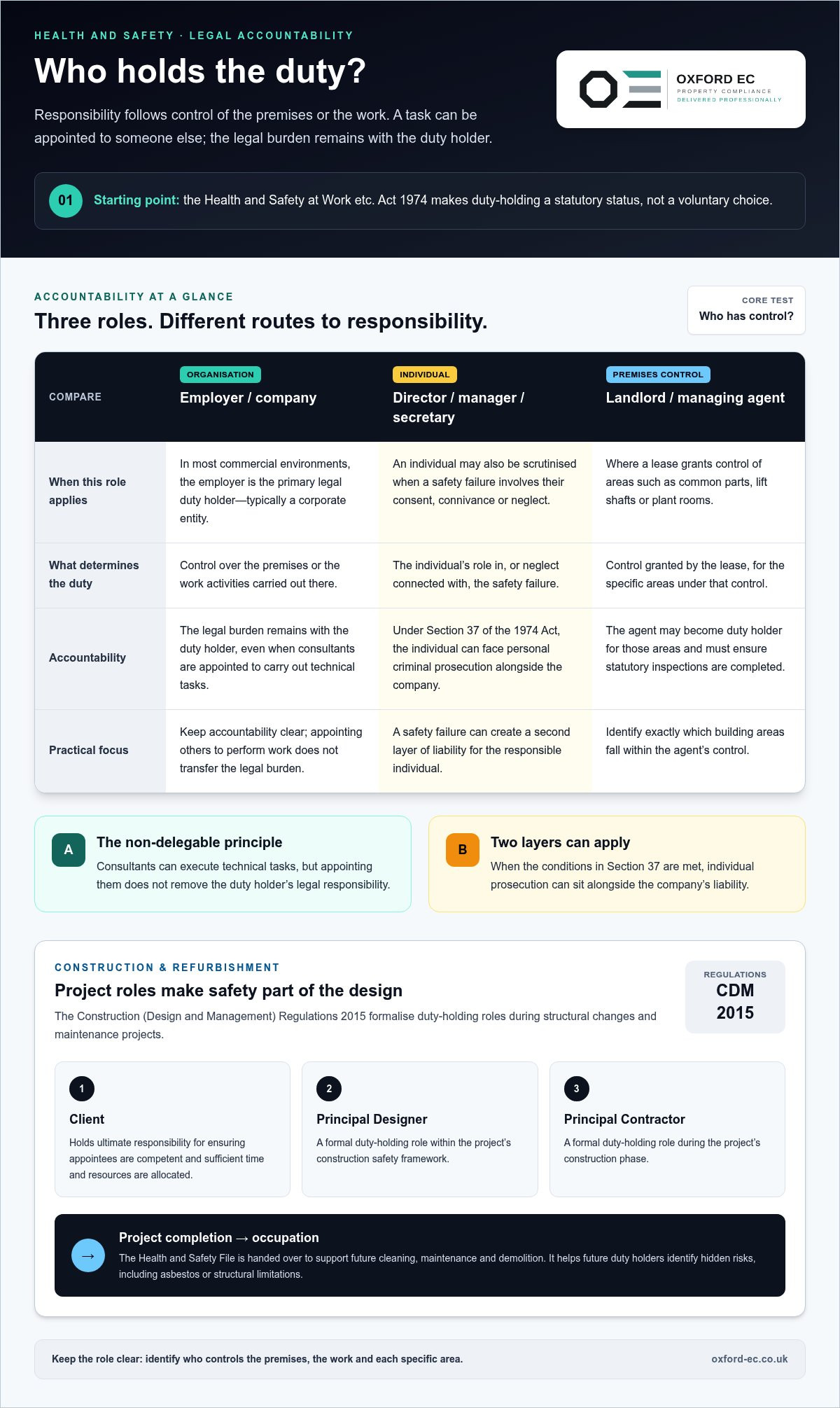
Legal duty-holding is not a voluntary choice. It is a statutory status. This designation applies to any individual or corporate body that exercises control over a premises or the work activities conducted within it. Control. Accountability. Compliance. Under the Health and Safety at Work etc. Act 1974, these obligations are non-delegable. Whilst a business may appoint external consultants to execute technical tasks, the legal burden remains with the duty holder. Mastering duty holder responsibilities health and safety requires a clear understanding that the law prioritises the person in the best position to manage the risk.
The Organisation vs. The Individual
In most commercial environments, the "employer" serves as the primary legal duty holder. This is typically a corporate entity rather than a single person. However, the law provides a mechanism for individual scrutiny through Section 37 of the 1974 Act. If a safety failure occurs due to the consent, connivance, or neglect of a director, manager, or secretary, that individual faces personal criminal prosecution alongside the company. This creates a dual layer of liability. Landlords and managing agents must also exercise caution. If a lease agreement grants control over common parts, lift shafts, or plant rooms, the agent often assumes the role of the duty holder for those specific areas. They must ensure all statutory inspections are completed with absolute precision.
Duty Holders in Construction and Refurbishment
The regulatory landscape shifts significantly during structural changes or maintenance projects. The Construction (Design and Management) Regulations 2015 (CDM 2015) formalise duty-holding roles to ensure safety is designed in from the outset. Key figures include the Client, the Principal Designer, and the Principal Contractor. The Client holds the ultimate responsibility for ensuring that other appointees are competent and that sufficient time and resources are allocated to the project. Properly managing duty holder responsibilities health and safety during these high-risk phases prevents the HSE from issuing costly improvement notices.
Once a construction project concludes, the transition to the occupation phase is critical. This is marked by the handover of the Health and Safety File. This document is a mandatory requirement that provides the information necessary for future cleaning, maintenance, and demolition. It serves as the foundation for comprehensive property compliance throughout the building's lifecycle. Future duty holders rely on this file to identify hidden risks, such as asbestos or structural limitations, ensuring that the Golden Thread of building information remains unbroken and audit-ready at all times.
The Legislative Landscape: From HSWA 1974 to the Building Safety Act
UK safety legislation has evolved from a broad, goal-setting regime into a highly granular, evidence-based system. Whilst the 1974 Act established the fundamental duty of care, the current regulatory environment demands a more sophisticated level of technical rigour. Compliance is no longer a passive state. It is an active management cycle. For those managing modern property portfolios, duty holder responsibilities health and safety now involve navigating a dense web of statutory instruments that culminate in the stringent standards mandated for 2026 and beyond.
The Building Safety Act 2022 and 2026 Standards
The Building Safety Act 2022 represents the most significant change to building safety law in a generation. It introduces the "Accountable Person" (AP) and "Principal Accountable Person" (PAP) for Higher-Risk Buildings (HRBs). These are residential buildings at least 18 metres in height or with at least 7 storeys. The Building Safety Regulator (BSR), operating within the HSE, has been issuing calls for Building Assessment Certificates since April 2024. To comply, duty holders must produce a comprehensive Safety Case Report. This document must demonstrate how major fire and structural risks are being managed with absolute precision.
Central to this new regime is the "Golden Thread" of information. This is not merely a collection of files but a statutory requirement for a digital, structured, and live dataset. It must remain accessible throughout the building’s lifecycle. Identify. Register. Comply. Failure to maintain this thread creates a material breach that the BSR is empowered to penalise through criminal prosecution or improvement notices. For those managing complex multi-occupied assets, seeking professional regulatory guidance ensures that your safety case remains defensible under stringent scrutiny.
Secondary Legislation and Statutory Instruments
The primary duties under the 1974 Act are supported by specific regulations that target high-risk areas. The Management of Health and Safety at Work Regulations 1999 mandate formal risk assessments for all work activities. These intersect with the Regulatory Reform (Fire Safety) Order 2005, which defines workplace fire safety responsibilities for the designated Responsible Person. Additionally, the Control of Asbestos Regulations 2012 (CAR 2012) places an absolute duty on those in control of non-domestic premises to manage the risks from asbestos-containing materials.
Managing these requirements in isolation often leads to administrative friction and compliance gaps. A unified approach is essential. By utilising Oxford Environmental Consultants compliance services, duty holders can align their fire, asbestos, and water hygiene obligations into a single, audit-ready framework. This multi-disciplinary strategy ensures that every statutory instrument is addressed, protecting both the building occupants and the legal standing of the organisation.
Primary Duty Holder Responsibilities: Asbestos, Fire, and Water Hygiene
Managing property compliance in isolation creates critical vulnerabilities. Fire. Asbestos. Water. These are not separate administrative tasks but interconnected legal obligations. For those managing duty holder responsibilities health and safety, the shift from general oversight to technical precision is non-negotiable. This is particularly true for accountable persons under the Building Safety Act, who must now demonstrate how these risks are mitigated across the entire building fabric with absolute transparency.
Asbestos Management and the Duty to Manage
Regulation 4 of the Control of Asbestos Regulations 2012 (CAR 2012) mandates an absolute duty to manage asbestos in non-domestic premises. This requires the execution of asbestos management surveys to locate and assess the condition of any asbestos-containing materials (ACMs). Once ACMs are identified, duty holders must implement a robust Asbestos Management Plan (AMP) and conduct annual reinspections to monitor condition. If structural changes occur, a refurbishment or demolition survey is legally required before any work commences to prevent accidental exposure.
Fire Safety and Building Integrity
Fire safety duties have expanded significantly under Section 156 of the Building Safety Act 2022. All non-domestic premises, regardless of staff size, must now record commercial fire risk assessments in full. This includes the formal identification of the fire risk assessor's credentials. Beyond the assessment, duty holders must maintain building integrity through compartmentation surveys and quarterly fire door inspections for buildings over 11 metres. Regular servicing of fire alarms and emergency lighting remains a fundamental statutory requirement to ensure the safety of all occupants.
Water Hygiene and Legionella Control
Water hygiene remains a high-stakes area of compliance. Under ACoP L8 and HSG274, duty holders must conduct a commercial legionella risk assessment to identify potential colonisation points within water systems. Ongoing monitoring, temperature logging, and water sampling are essential to mitigate the risk of Legionnaires' disease. Additionally, the introduction of Awaab’s Law places a direct legal burden on social housing providers, and increasingly commercial landlords, to address damp and mould within strict timeframes. Failure to act is no longer just a maintenance issue. It is a legal breach.
Maintaining Compliance: Risk Assessment Cycles and the Golden Thread
Statutory compliance is not a destination. It is a continuous cycle of verification and refinement. Many organisations treat safety as a static annual event, yet the reality of UK legislation demands a methodical approach to review and verification. Successfully managing duty holder responsibilities health and safety requires a move away from fragmented paper files towards a structured, live management system. Precision matters. Accountability is absolute. When the Health and Safety Executive (HSE) evaluates your premises, they do not merely look for a certificate; they look for a defensible history of proactive management.
The Review and Audit Cycle
Risk assessments must remain valid and reflective of the current building state. A review is triggered by several factors: structural alterations, changes in building use, or whenever there is reason to suspect the previous assessment is no longer valid. Whilst a routine inspection identifies immediate hazards, a comprehensive audit evaluates the entire management system against statutory benchmarks. Engaging an independent assurance and certification body like International Associates Limited helps organisations evaluate their governance frameworks against rigorous standards, ensuring their operational processes withstand external scrutiny. Duty holders must prioritise remedial actions based on risk ratings. High-risk findings in an asbestos management survey or a fire risk assessment require immediate intervention to prevent legal exposure. Neglecting these triggers can lead to the HSE identifying a "material breach," which currently incurs a Fee for Intervention (FFI) rate of £188 per hour.
Digital Record Keeping and Transparency
The "Golden Thread" of information is now a statutory requirement under the Building Safety Act 2022. This mandates that building safety information is kept in a digital, structured, and easily accessible format across the entire lifecycle of the property. Transitioning from physical binders to digital safety management systems ensures transparency and prevents data loss during management handovers. This digital trail is the primary evidence used to prove "due diligence" during a regulatory inspection or following an incident. For Higher-Risk Buildings (HRBs), the Golden Thread is the foundation of the Safety Case Report required by the Building Safety Regulator.
Competence is the final pillar of a robust compliance trail. Under Section 156 of the Building Safety Act, duty holders must record the identity and credentials of any external fire risk assessor appointed. Appointing unqualified personnel is a significant legal risk. Professional, audit-ready reports from a multi-disciplinary consultancy provide the technical rigour necessary to satisfy regulators and protect the organisation from personal liability. Integrating your property compliance audits into a single, unified framework eliminates the gaps often found in siloed management approaches.
Navigating Complex Compliance with Oxford Environmental Consultants
Oxford Environmental Consultants (OEC) acts as the definitive shield for organisations navigating the intricacies of UK property law. We eliminate the administrative friction inherent in managing multiple, disconnected vendors. By unifying your duty holder responsibilities health and safety under a single, authoritative point of accountability, we ensure that no statutory obligation is overlooked. Precision. Expertise. Protection. Our multi-disciplinary consultancy is built on the principle that property compliance should be a streamlined, logical process rather than a source of persistent legal anxiety or operational disruption.
A Multi-Disciplinary Approach to Safety
Managing asbestos management surveys, fire risk assessments, and Legionella risk assessments through separate contractors is fundamentally inefficient. It leads to communication gaps. It causes repetitive site disruption. OEC provides a "one-stop" logical solution that synchronises these critical audits into a single, cohesive workflow. This integrated approach reduces the burden on your internal teams whilst ensuring that every technical detail is cross-referenced for total consistency. Our reports are meticulously structured for regulatory scrutiny, providing the evidence-based results required by the Health and Safety Executive and the Building Safety Regulator. Beyond the core pillars of safety, we provide specialised damp and mould surveys to ensure your assets meet the rigorous standards of Awaab’s Law and the Building Safety Act 2022.
Secure Your Compliance Today
The cost of regulatory failure is absolute. Between the £188 hourly Fee for Intervention and the potential for criminal prosecution under the Building Safety Act, a passive approach to safety is no longer defensible. OEC provides the independent, professional validation needed to shield your organisation from legal, financial, and reputational risk. We act as your "safe pair of hands," ensuring the Golden Thread of building information remains unbroken and your compliance trail is audit-ready at all times. Peace of mind stems from the knowledge that your legal duties are being executed with absolute precision by a partner who thrives on detail and order. Don't leave your statutory alignment to chance; ensure your property portfolio is managed by a guardian of compliance who understands the high-stakes nature of modern safety legislation.
Securing Your Statutory Future: The Path to Absolute Compliance
The transition from general oversight to technical precision is the defining challenge of modern property management. Successfully executing duty holder responsibilities health and safety requires more than a reactive approach; it demands a continuous, audit-ready management cycle that leaves no room for ambiguity. By identifying your legal role and aligning with the rigorous 2026 standards, you protect both your occupants and your organisation’s legal standing. The Golden Thread isn't a suggestion but a statutory mandate that requires digital accuracy and professional validation across every asset you manage.
Oxford Environmental Consultants provides the multi-disciplinary shield necessary to navigate these complexities with confidence. Our expert guidance on the Building Safety Act 2022 and our comprehensive, audit-ready reporting ensure your assets remain defensible under the highest levels of regulatory scrutiny. We act as your safe pair of hands, unifying fragmented requirements into a single, logical framework for total property compliance. Take the definitive step towards securing your portfolio and meeting your statutory obligations with absolute precision. We look forward to ensuring your properties remain safe and compliant.
Frequently Asked Questions
Who is the legally responsible duty holder in a commercial building?
The legally responsible duty holder is the individual or organisation that exercises control over the premises or the activities conducted within it. In most commercial settings, this is the employer. However, the role also extends to owners and managing agents who maintain control over common parts or building systems. Identifying these duty holder responsibilities health and safety is the first step in establishing a defensible compliance framework across any UK property portfolio.
What are the main duties of a health and safety duty holder?
The primary obligations involve identifying, assessing, and mitigating risks to building occupants and visitors. This includes conducting statutory fire risk assessments, managing asbestos-containing materials, and ensuring water hygiene through Legionella control. Duty holders must also maintain the "Golden Thread" of information. This requires a digital, structured record of building safety that remains accessible throughout the property’s lifecycle to satisfy the Building Safety Regulator's stringent auditing requirements regarding duty holder responsibilities health and safety.
Can a duty holder delegate their responsibilities to a third party?
No, legal liability cannot be delegated. Whilst a duty holder can appoint competent third-party consultants, such as Oxford Environmental Consultants, to perform technical surveys or maintenance, the ultimate statutory accountability remains with the person in control. You are responsible for ensuring that any external partners possess the necessary competency and qualifications. Failure to oversee these tasks correctly leaves the duty holder personally liable for any material breaches identified by the HSE.
How often should a duty holder review fire and asbestos risk assessments?
Fire risk assessments must be reviewed regularly or whenever a significant change occurs in the building's layout or use. For asbestos, the Management Plan must be reviewed at least every 12 months. This ensures that the condition of identified materials is monitored and recorded. If structural refurbishment or demolition is planned, a more intrusive survey is legally required before work begins to prevent accidental exposure to hazardous fibres during construction activities.
What is the "Golden Thread" of information in building safety?
The Golden Thread is a statutory requirement for a digital, structured, and live record of building safety information. It ensures that accurate data regarding a building's design, construction, and ongoing management is available to those who need it. This is particularly critical for Higher-Risk Buildings under the Building Safety Act 2022. Maintaining this thread allows duty holders to demonstrate a continuous and transparent history of safety management to regulators and emergency services.
What happens if a duty holder fails to comply with health and safety laws?
Non-compliance triggers severe legal and financial repercussions. The HSE can issue improvement or prohibition notices and recover costs through the Fee for Intervention scheme, currently charged at £188 per hour for material breaches. Serious failures often lead to criminal prosecution, substantial fines, and even imprisonment for directors under Section 37 of the 1974 Act. Beyond legal penalties, organisations face significant reputational damage and increased insurance premiums following a documented safety failure. To explore suitable cover and ensure your premises are adequately protected against risk, visit Commercial Property Insurance UK.
Does a landlord count as a duty holder for asbestos management?
Yes, a landlord is a duty holder if they have a legal obligation to maintain or repair the premises through a lease or contract. Under Regulation 4 of the Control of Asbestos Regulations 2012, this "duty to manage" applies to the common parts of residential blocks and all non-domestic buildings. Landlords must identify ACMs, assess the risk, and provide this information to anyone likely to disturb the materials during routine maintenance or refurbishment.
Is a Legionella risk assessment a legal requirement for all businesses?
A Legionella risk assessment is a legal requirement for any person in control of a premises where water is used or stored and where there is a risk of exposure to Legionella bacteria. This applies to all businesses, regardless of size. Duty holders must identify potential risks, implement a written scheme for prevention or control, and appoint a competent person to manage the system. Ongoing water sampling and temperature monitoring are essential components of this duty.