

Across 50,195 fire safety audits conducted throughout England in the year ending March 2026, 40% of inspected premises failed basic checks. The severe consequences of non-compliance with fire safety regulations are no longer confined to theoretical warnings or informal advice. Unlimited corporate fines. Immediate operational closures. Personal custodial sentences. If you oversee commercial premises or multi-tenant portfolios, managing shifting post-Grenfell responsibilities can feel like an operational minefield, particularly as corporate shields no longer insulate duty-holders from direct legal accountability.
This guide clarifies the statutory enforcement hierarchy under the Regulatory Reform (Fire Safety) Order 2005 and Section 156 of the Building Safety Act 2022, detailing how regulatory breaches trigger personal director liability and policy voidance under the Insurance Act 2015. You'll explore the real-world financial ramifications of statutory failure, the operational impact of Article 30 and 31 notices, and the technical protocols required to secure an audit-ready, legally defensible compliance posture.
Key Takeaways
- Understand the statutory consequences of non-compliance with fire safety regulations, including unlimited judicial fines, operational closure orders, and personal custodial liability under Article 32 of the Fire Safety Order.
- Examine how statutory Article 30 Enforcement and Article 31 Prohibition Notices disrupt daily operations, often halting business activity immediately without the protection of an automatic stay upon appeal.
- Discover why regulatory failures void commercial property policies under the Insurance Act 2015, turning routine property losses into uninsurable, catastrophic corporate debts through breached conditions precedent.
- Identify the core physical vulnerabilities scrutinised during audits, focusing on breached fire compartmentation barriers, damaged fire door seals, and compromised emergency escape routes.
- Establish a defensible safety posture through professionally executed Fire Risk Assessments and multi-disciplinary passive fire protection surveys that satisfy enforcing authorities.
Table of Contents
- The UK Statutory Fire Safety Framework and the Scope of Non-Compliance
- Statutory Enforcement Notices, Fines, and Custodial Penalties
- Financial and Commercial Repercussions: Insurance Invalidation and Disruption
- Common Physical and Management Deficiencies Identified During Audits
- Building a Defensible Fire Safety Position: Proactive Mitigation Strategies
The UK Statutory Fire Safety Framework and the Scope of Non-Compliance
Statutory fire safety in the United Kingdom is an active legal obligation, not an administrative exercise. Complete structural accountability. Strict personal liability. Uncompromising regulatory enforcement. Statutory non-compliance occurs whenever a duty-holder fails to satisfy the mandatory duties set out across primary legislation, placing relevant persons at risk of death or serious injury in the event of fire. The operational consequences of non-compliance with fire safety regulations extend far beyond remedial warnings, directly exposing corporate entities and senior management to immediate prosecution.
Primary Legislation Governing Non-Domestic Premises
The core legislative foundation across England and Wales rests upon the Regulatory Reform (Fire Safety) Order 2005, which consolidated fragmented legacy statutes into a unified regulatory regime governing virtually all non-domestic buildings, commercial workplaces, and the shared communal areas of multi-occupied residential premises. Following the Fire Safety Act 2021, statutory scrutiny expanded past internal shared hallways. The legislation clarified that the external walls, cladding, balconies, windows, and individual flat entrance doors opening onto common parts fall squarely within the scope of the Fire Safety Order. Supplementary technical mandates codified under the Fire Safety (England) Regulations 2022 further require duty-holders to execute routine fire door checks and provide detailed building designs to local fire services.
The Statutory Role of the Responsible Person
Compliance hinges entirely upon the designated Responsible Person (RP). Under Article 3 of the Fire Safety Order, the RP is typically:
- The employer, where an employment relationship exists within the premises;
- The person having control over the property (such as the building owner, freeholder, or commercial managing agent) where there is no employer; or
- The occupier in non-workplace premises where the owner cannot be identified.
Commercial reality rarely mirrors single-occupier simplicity. In complex multi-tenant environments, Section 156 of the Building Safety Act 2022 imposes mandatory duties on co-existing Responsible Persons to coordinate fire precautions, identify each other in writing, and share recorded safety arrangements. A managing agent handling building services, an employer running an office floor, and a commercial landlord share concurrent statutory obligations. Ignorance of another occupier's failures does not insulate any party from the severe consequences of non-compliance with fire safety regulations. Under Section 156, every RP must record their completed assessment and arrangements in full, regardless of company headcount, retaining comprehensive records via specialist fire safety assessments to maintain a defensible legal audit trail.
Statutory Enforcement Notices, Fines, and Custodial Penalties
Statutory enforcement follows a strict, escalating hierarchy. Binding legal notices. Immediate operational shutdowns. Substantial personal convictions. Enforcing authorities no longer rely on informal advisory letters to manage non-compliant premises. Instead, inspectors increasingly deploy statutory powers under the Fire Safety Order to compel immediate compliance. The financial and legal consequences of non-compliance with fire safety regulations can permanently disrupt commercial operations within hours of an audit failure.
The Fire and Rescue Authority Enforcement Escalation
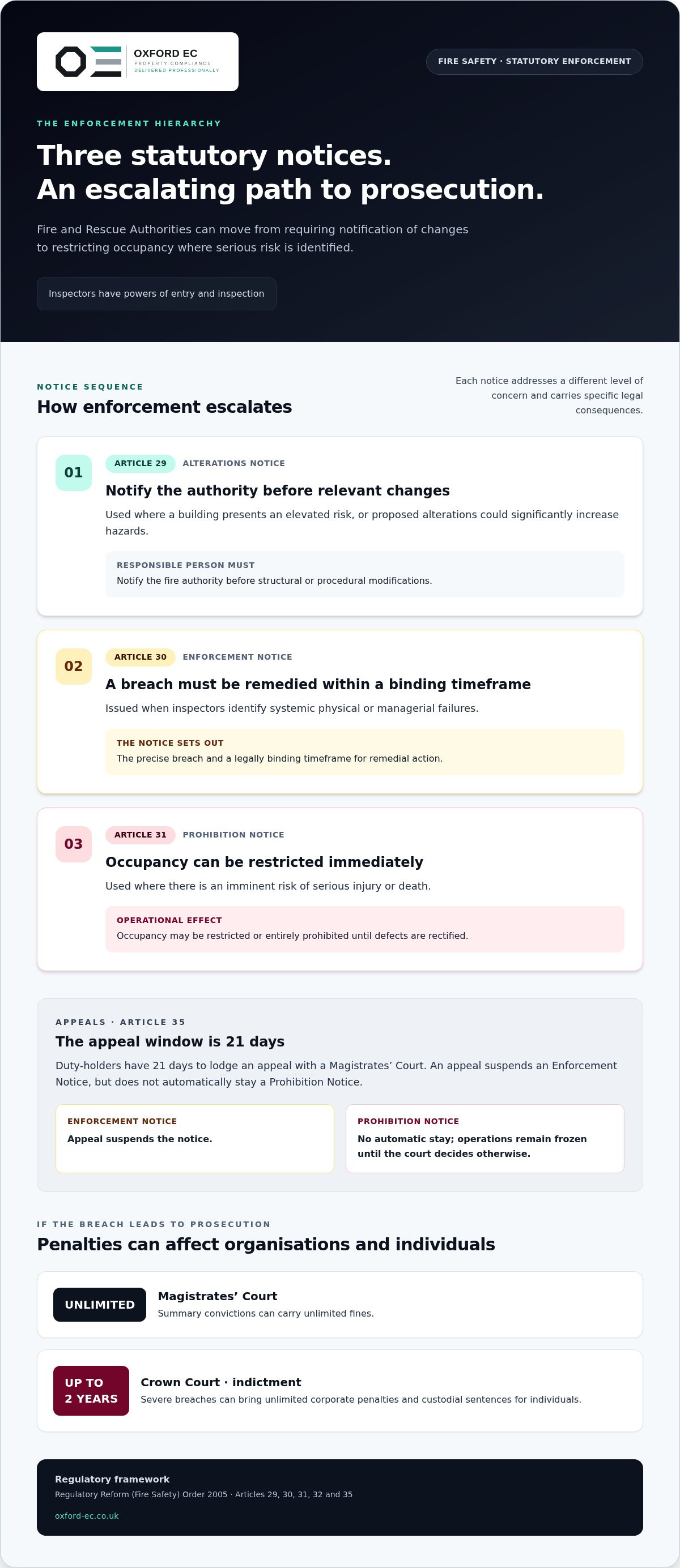
Fire and Rescue Authorities possess clear powers of entry and inspection. Official enforcement typically escalates through three distinct statutory instruments:
- Article 29 Alterations Notices: Served when a building constitutes an elevated risk, or where alterations could significantly compound hazards. The Responsible Person must notify the fire authority before carrying out structural or procedural modifications.
- Article 30 Enforcement Notices: Issued when inspectors identify systemic physical or managerial failures. The notice specifies the precise breach and establishes a legally binding timeframe to execute remedial actions.
- Article 31 Prohibition Notices: Deployed when an imminent risk of serious injury or death exists. These orders immediately restrict or entirely prohibit occupancy until defects are rectified.
Under Article 35, duty-holders have just 21 days to lodge an appeal with a Magistrates' Court. While an appeal suspends an Enforcement Notice, it provides no automatic stay for a Prohibition Notice. Business operations remain frozen until the court decides otherwise, as detailed in the GOV.UK fire safety enforcement and penalties guidance.
Criminal Prosecution and Individual Director Culpability
Summary convictions in the Magistrates' Court carry unlimited fines following recent statutory reforms. For severe breaches referred to the Crown Court on indictment, judicial bodies hand down unlimited corporate penalties alongside custodial sentences of up to two years for individuals. Benchmark actions demonstrate the severe financial reality; Bupa Care Homes received a £937,500 fine with £104,000 in prosecution costs following systemic management failures.
Limited liability protections stop at the boardroom door. Under Article 32(8) of the Fire Safety Order, corporate directors, company secretaries, and senior managers face direct criminal liability if an offence occurred with their consent, connivance, or neglect. Courts regularly issue personal fines, suspended prison terms, and disqualifications under the Company Directors Disqualification Act 1986. Should systemic failures lead to fatalities, prosecutors can pursue Corporate Manslaughter charges with unlimited organisational fines, or charge individuals with Gross Negligence Manslaughter, carrying potential life sentences. Securing defensible documentation through a specialist compliance review safeguards duty-holders before escalating notices trigger irreversible legal scrutiny.
Financial and Commercial Repercussions: Insurance Invalidation and Disruption
Insurance policies do not provide blanket immunity against statutory failure. Commercial coverage requires strict adherence to statutory duties. When an organisation breaches primary safety obligations, it invalidates its contract of insurance. The severe consequences of non-compliance with fire safety regulations often emerge when an underwriter refuses indemnity following a catastrophic blaze, converting routine operational risks into irreversible corporate insolvency.
Insurance Policy Repudiation and Voidance
Under the Insurance Act 2015, commercial policyholders hold a strict duty of fair presentation to their insurers. Commercial property and business interruption contracts frequently incorporate explicit conditions precedent. These clauses demand absolute compliance with statutory safety provisions, including maintaining up-to-date Fire Risk Assessments, fully certified detection infrastructure, and unimpeded escape corridors. Complying with baseline standards, such as those detailed in the Health and Safety Executive guidance on workplace fire and explosion risks, establishes the minimum threshold for valid policy cover.
Following a fire, loss adjusters and forensic investigators scrutinise maintenance logs, FRA action items, and servicing records. Where an investigation uncovers pre-existing regulatory failures that contributed to the loss, underwriters have statutory grounds under Sections 8 and 11 of the Insurance Act 2015 to:
- Void the policy ab initio: In cases of deliberate or reckless statutory breaches, the insurer can treat the contract as if it never existed, retain paid premiums, and refuse all liability.
- Repudiate claims outright: Breaching a condition precedent regarding fire protection mechanisms allows the insurer to reject material property damage and third-party loss claims entirely.
- Apply proportionate claim reductions: If a non-deliberate breach altered the risk profile, claims can be reduced by the percentage of the premium that would have been charged.
Accidental fires remain standard insurable risks. In contrast, fires exacerbated by known, unaddressed non-compliance constitute uninsurable statutory negligence.
Operational Stoppages and Commercial Devaluation
Financial fallout rarely remains limited to direct physical damage. If a commercial premises receives an immediate prohibition order, normal operations freeze entirely. Commercial tenants face catastrophic disruption, yet rent, operational salaries, and plant hire commitments persist. Tenants facing shut-outs often declare operational frustration or launch breach-of-covenant lawsuits against landlords for failing to maintain a legally compliant structure. For larger enterprise and industrial facilities, maintaining continuity requires protecting interconnected building infrastructure alongside physical compliance, with organisations relying on specialists like Bio-Cognitive Solutions to safeguard operational technology environments against cascading operational failures.
Financial fallout rarely remains limited to direct physical damage. If a commercial premises receives an immediate prohibition order, normal operations freeze entirely. Commercial tenants face catastrophic disruption, yet rent, operational salaries, and plant hire commitments persist. Tenants facing shut-outs often declare operational frustration or launch breach-of-covenant lawsuits against landlords for failing to maintain a legally compliant structure.
Asset portfolios suffer immediate devaluation once formal enforcement notices attach to public land registers. Key enterprise clients routinely terminate supplier agreements under corporate governance clauses following regulatory enforcement. Commercial real estate transactions stall, refinancing rates climb, and institutional buyers withdraw offers when audit histories reveal systemic statutory deficiencies.
Common Physical and Management Deficiencies Identified During Audits
Auditing officers target tangible defects and administrative neglect. Breached physical barriers. Unmaintained detection infrastructure. Incomplete compliance documentation. When Fire and Rescue Authority inspectors arrive, they assess both structural integrity and operational procedures against strict statutory standards. The severe consequences of non-compliance with fire safety regulations typically originate from basic maintenance lapses that compromise occupant containment and safe egress during an emergency.
Passive Fire Protection and Compartmentation Failures
Passive fire protection forms the primary defence against toxic smoke spread and structural collapse. During physical site audits, inspecting officers consistently identify three pervasive passive defects:
- Compromised fire doors: Missing or damaged intumescent and cold-smoke seals, uncertified glazing replacements, perimeter gaps exceeding the mandatory 3-4mm tolerance, and malfunctioning overhead self-closers that fail to seat the leaf fully into the frame rebate.
- Unsealed service penetrations: Breaches within structural compartment walls, risers, and ceiling voids where plumbing pipework, electrical cabling, or data lines were retrofitted without certified firestopping collars, ablative batts, or intumescent mastic.
- Degraded sub-compartment walls: Unprotected voids above suspended ceilings where fire-resisting partition walls terminate prematurely, allowing flame and lethal smoke to bypass escape routes entirely.
Locating these hidden defects requires methodical investigation. Commissioning a comprehensive compartmentation survey uncovers breached barriers across voids and shafts before an enforcing authority conducts an audit.
Active Protection Deficiencies and Inadequate Management Records
Physical breaches are compounded when active safety systems and managerial oversights leave building occupants without early warning or clear escape pathways. Routine breaches frequently identified across commercial premises include:
- Means of escape obstructions: Article 14 of the Fire Safety Order remains the most cited audit breach, with inspectors continually penalising padlocked fire exits, stock pallets wedged in fire corridors, and combustible waste stored beneath escape stairwells.
- Unverified active systems: Gaps in testing regimes for fire alarm panels, missing sounder checks, and battery failure across emergency escape lighting units that leave escape routes in darkness during a mains power failure.
- Absent or outdated Fire Risk Assessments: Operating with assessments that omit structural modifications, lack recorded periodic reviews, or fail to satisfy the competency mandates introduced under Article 9A of the Order.
- Deficient fire logbooks: Failure to document weekly alarm tests, monthly emergency lighting flick tests, routine staff training, and six-monthly evacuation drills.
Building a Defensible Fire Safety Position: Proactive Mitigation Strategies
Absolute legal defensibility. Methodical risk reduction. Uncompromising technical rigour. Shielding commercial portfolios against regulatory intervention requires an active, structured compliance methodology. Managing property risks through disjointed, ad hoc assessments leaves duty-holders vulnerable to sudden audit failure. To insulate your organisation from the catastrophic consequences of non-compliance with fire safety regulations, you must replace passive management with an interconnected lifecycle of physical inspections, active testing, and verifiable record-keeping.
Procuring Competent Fire Safety Expertise
Under Article 9A of the Fire Safety Order, appointing an unqualified assessor constitutes an immediate statutory violation. Generic, off-the-shelf templates and superficial walk-arounds cannot withstand enforcing authority audits. True competence demands proven technical expertise across both passive containment and active life safety installations. Partnering with multi-disciplinary specialists ensures your Fire Risk Assessments are backed by detailed fire door inspections, thorough compartmentation surveys, and certified emergency light testing routines across nationwide portfolios.
Establishing an Audit-Ready Compliance Cycle
A legally defensible posture requires perpetual oversight rather than sporadic checks. Responsible Persons must execute a continuous four-stage compliance cycle:
- Systematic physical inspection: Commissioning detailed baseline surveys of passive compartmentation, service penetration firestopping, and escape staircases alongside primary risk assessments.
- Regimented servicing and testing: Maintaining rigorous operational intervals for fire alarm servicing, call-point functionality, and monthly emergency lighting tests. Thorough verification of electrical infrastructure and backup power systems routinely requires dedicated apparatus, with equipment hire specialists such as Zenith Rental illustrating how facilities source precision electrical and industrial testing instruments.
- Structured trigger reviews: Updating assessments whenever structural layouts change, high-risk tenant operations commence, or internal building materials undergo refurbishment.
- Centralised evidence consolidation: Retaining complete digital logs, testing certificates, and remediation evidence in a format immediately accessible to inspecting authorities.
Maintaining clear evidence of proactive management directly neutralises the legal risks of statutory failure, protecting directors against individual culpability and preventing the severe commercial consequences of non-compliance with fire safety regulations. Establishing these standards across every property ensures complete alignment with post-Grenfell scrutiny. To secure your compliance posture before enforcing authorities arrive, Contact Oxford Environmental Consultants to arrange your comprehensive audit.
Securing Total Statutory Compliance Across Your Property Portfolio
Statutory fire safety enforcement in the United Kingdom has permanently shifted. Informal grace periods have ended. Corporate veils no longer protect directors from personal accountability, unlimited judicial fines, or custodial sentences. Simultaneously, commercial insurers continue to repudiate multimillion-pound claims where baseline conditions precedent were breached. Navigating the severe consequences of non-compliance with fire safety regulations requires technical precision, continuous physical verification, and audit-ready documentation across all operational assets.
Eliminating regulatory liability begins with procuring verified competence. Our experienced technical consultants deliver nationwide coverage, providing multi-disciplinary compliance consultancy across fire safety, asbestos management, and building hygiene. We equip commercial landlords, managing agents, and employers with rigorous reporting designed to withstand enforcing authority audits and protect commercial investments.
Taking definitive, proactive action today establishes a legally defensible posture that protects your people, preserves your insurance validity, and guarantees lasting operational continuity.
Frequently Asked Questions
Can a company director be imprisoned for fire safety non-compliance in the UK?
Yes, individual company directors can face custodial sentences of up to two years under UK fire safety law. Under Article 32(8) of the Regulatory Reform (Fire Safety) Order 2005, corporate shields dissolve where an offence is committed with consent, connivance, or neglect. Crown Courts routinely impose suspended or immediate prison terms alongside director disqualifications. In cases involving fatalities, prosecutors can escalate charges to Gross Negligence Manslaughter, which carries potential life imprisonment.
What is the difference between an Enforcement Notice and a Prohibition Notice?
An Enforcement Notice mandates corrective action within a defined timeframe whilst premises continue operating, whereas a Prohibition Notice halts or restricts building access immediately. Under Article 30, fire authorities issue Enforcement Notices for serious systemic deficiencies that don't pose an immediate danger to life. Under Article 31, inspectors serve Prohibition Notices when an imminent risk of serious injury or death exists, shutting down commercial facilities instantly without any automatic stay upon legal appeal.
Does commercial building insurance cover fire damage if a property lacks a valid Fire Risk Assessment?
Commercial insurers routinely repudiate claims and void policies if a property lacks a valid, current Fire Risk Assessment. Under the Insurance Act 2015, maintaining statutory compliance operates as an express condition precedent to liability. If post-incident forensic investigations reveal an absent or inadequate assessment contributed to fire spread, underwriters have legal grounds to refuse payouts completely. These catastrophic financial outcomes represent some of the most destructive commercial consequences of non-compliance with fire safety regulations.
How frequently must commercial premises review their Fire Risk Assessment under UK law?
UK legislation doesn't prescribe a rigid calendar frequency, but statutory guidance requires assessments to be reviewed regularly and immediately following material changes. Industry practice dictates an annual audit review across commercial buildings. Immediate reviews are legally mandatory under Article 9 of the Fire Safety Order whenever building alterations occur, tenancy layouts shift, occupancy numbers increase significantly, high-risk processes commence, or a near-miss fire incident suggests existing precautions have become obsolete.
What are the legal consequences of wedging open fire doors in a commercial building?
Wedging open fire doors constitutes a direct criminal breach of the Regulatory Reform (Fire Safety) Order 2005. Enforcing authorities treat wedged doors as critical compromises of structural compartmentation under Article 14 and Article 17. The physical consequences of non-compliance with fire safety regulations include on-the-spot Article 31 Prohibition Notices, invalidated insurance coverage for resulting smoke damage, and direct prosecution of the Responsible Person for failing to maintain essential passive safety barriers.
Who holds legal responsibility for fire safety compliance in multi-tenant leased premises?
Legal responsibility is shared concurrently between commercial landlords, managing agents, and individual tenant employers. The freeholder or managing agent serves as the Responsible Person for common corridors, shared risers, and plant areas, whilst individual business tenants act as Responsible Persons within their demised leased spaces. Under Section 156 of the Building Safety Act 2022, all duty-holders must actively coordinate precautions, document their identities, and exchange fire risk findings in writing.
Are financial penalties for fire safety breaches capped in UK courts?
No, financial penalties for fire safety offences are completely unlimited across both Magistrates' Courts and the Crown Court in England and Wales. Previous statutory limits in summary proceedings were removed to align enforcement across judicial tiers. Sentencing judges determine fines based on commercial turnover, degree of culpability, and the severity of risk created. Major corporations have faced individual fines approaching £1 million alongside substantial prosecution costs for systemic statutory breaches.