

Did you know that fire and rescue authorities issued 3,355 formal notices in the year ending March 2026? This 11% surge in enforcement actions signals a new era of regulatory scrutiny where "good enough" is no longer a viable legal defence. Managing commercial fire safety testing across a national property portfolio often feels like a constant battle against fragmented data, confusing legislative overlaps, and shifting standards. Rigorous audits. Absolute precision. Legal robustness.
We understand that the shift toward turnover-based fines and the complex interplay between active systems and passive compartmentation creates significant liability anxiety for duty-holders. This definitive guide provides the clear roadmap you need to achieve absolute compliance, mastering the nuances of the Building Safety Act 2022 and updated standards like BS 5839-1:2025 for detection systems. You'll gain a comprehensive understanding of mandatory inspection frequencies, the expanded scope of BS 8214:2026 for fire doors, and the critical documentation required to protect your building occupants whilst maintaining a defensible "golden thread" of safety evidence.
Key Takeaways
- Understand your legal obligations under the Regulatory Reform (Fire Safety) Order 2005 and the heightened accountability demanded by the Building Safety Act 2022.
- Master the updated technical requirements for commercial fire safety testing, specifically regarding the latest BS 5839-1:2025 standards for alarm systems and emergency lighting.
- Recognise the critical role of passive fire protection by adopting a whole-system approach to fire door inspections and structural compartmentation.
- Learn how to organise a robust testing regime that consolidates disparate maintenance frequencies into a single, audit-ready Fire Safety Log Book.
- Evaluate the benefits of a multi-disciplinary compliance strategy that integrates fire safety with asbestos and water hygiene management.
Table of Contents
- The Regulatory Framework: Understanding Your Fire Safety Testing Obligations
- Active Fire Protection: Rigorous Fire Alarm and Emergency Light Testing
- Passive Fire Protection: Scrutinising Fire Doors, Compartmentation, and Staircases
- Establishing a Compliant Testing Regime: Frequency and Asset Management
- Oxford Environmental Consultants: Integrating Professional Fire Safety Solutions
The Regulatory Framework: Understanding Your Fire Safety Testing Obligations
Effective commercial fire safety testing is defined as the systematic, evidence-based audit of a building’s life-protection infrastructure. Rigorous. Integrated. Defensible. It isn't a discretionary maintenance task; it's a statutory requirement to ensure that every active and passive measure performs as intended during a fire event. The primary legislative driver remains the Regulatory Reform (Fire Safety) Order 2005, which has undergone significant refinement to meet the safety demands of 2026. This framework requires a proactive approach to risk management, moving away from reactive repairs toward a culture of continuous technical scrutiny.
The History of fire safety legislation in the UK demonstrates a clear trajectory toward increased duty-holder accountability. For high-occupancy commercial assets and multi-storey developments, the Building Safety Act 2022 has introduced even more stringent layers of oversight. This legislation identifies the "Responsible Person" (RP) as the individual or entity with ultimate legal weight for fire safety. Whether you're a building owner, employer, or managing agent, the law demands that you maintain a comprehensive record of all safety measures to ensure the protection of every occupant.
The Duty Holder’s Legal Responsibility
Accountability is absolute. Precision is mandatory. Protection is paramount. In the current regulatory climate, the chain of responsibility is transparent and unforgiving. With 3,355 formal notices issued by fire authorities in the year ending March 2026, an 11% increase from the previous year, enforcement is at an all-time high. If a fire safety breach occurs, the RP faces severe repercussions that extend far beyond simple administrative warnings. Since October 2023, the courts have been empowered to issue unlimited fines based on an organisation’s turnover and profit rather than fixed penalties. Non-compliance can lead to imprisonment for up to two years and the immediate invalidation of building insurance policies. To mitigate these risks, the law stipulates that technical testing must be conducted by "competent persons" who possess the necessary skills, knowledge, and experience to evaluate complex safety systems.
The Evolution of Building Safety Standards
Recent legislative shifts have replaced generic, surface-level risk assessments with a requirement for granular, data-driven audits. Central to this evolution is the "Golden Thread" of information; it's a digital, live record of a building’s safety design and maintenance history. This requirement ensures that safety data is accessible, accurate, and up to date throughout the property lifecycle. Relying on fragmented schedules or unqualified contractors isn't a viable strategy for modern fire safety services. Professionals now look for integrated solutions that align with the rigorous standards of 2026, ensuring that every fire door, alarm, and emergency light is part of a verified, cohesive defensive system.
Active Fire Protection: Rigorous Fire Alarm and Emergency Light Testing
Active fire protection systems serve as the electronic nervous system of your facility. Prompt detection. Audible warning. Safe passage. These components work in unison to provide the narrow window of time required for a successful evacuation. Professional commercial fire safety testing isn't merely about checking functionality; it's about verifying system integrity against the rigorous benchmarks of 2026. Whilst passive measures contain the threat, active systems are the primary triggers for life-saving action. They must be maintained with absolute precision to ensure they don't fail when the stakes are highest.
Fire Alarm Installation, Maintenance, and Servicing
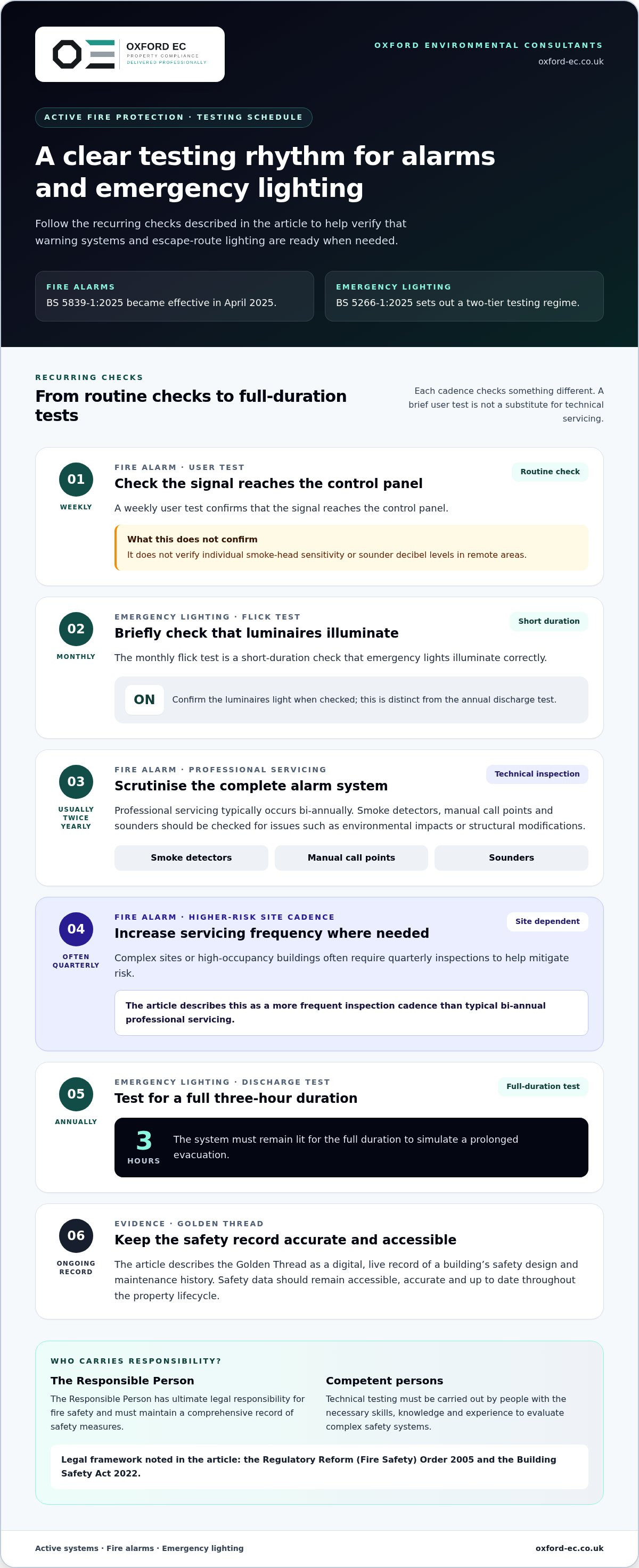
The BS 5839-1:2025 standard, which became effective in April 2025, demands total system reliability across all commercial premises. Every smoke detector, manual call point, and sounder must be scrutinised to ensure they haven't been compromised by environmental factors or structural modifications. Professional servicing typically occurs bi-annually, though complex sites or high-occupancy buildings often require quarterly inspections to mitigate risk. Whilst a weekly user test confirms that the signal reaches the control panel, it doesn't verify the sensitivity of individual smoke heads or the decibel levels of sounders in remote areas. For those managing new developments or system upgrades, adhering to professional fire alarm installation protocols is essential to ensure hardware meets current sensitivity requirements and legislative alignment.
Emergency Light Inspection and Testing Protocols
Illumination is the backbone of safe egress during a crisis. When primary power fails, emergency lighting must activate instantly to guide occupants through corridors and stairwells. Under the updated BS 5266-1:2025 code of practice, duty-holders must implement a rigorous two-tier testing regime. The monthly flick test is a short-duration check to confirm that luminaires illuminate correctly. Conversely, the annual discharge test is more intensive, requiring the system to remain lit for a full three-hour duration to simulate a prolonged evacuation. These systems must work in tandem with the structural protections and escape routes highlighted in the Fire Safety (England) Regulations 2022. A failure in a single luminaire can create a dangerous black spot, significantly increasing the risk of injury during a panicked exit. If your recent audit identified luminaire failures or battery degradation, you should speak with a compliance specialist to schedule immediate remedial repairs.
Passive Fire Protection: Scrutinising Fire Doors, Compartmentation, and Staircases
Passive fire protection is the silent guardian of building structural integrity. Containment. Resilience. Defence. Whilst active systems provide the warning, passive measures are designed to restrict the spread of smoke and flame by physical means. A truly robust commercial fire safety testing programme must move beyond electronic checks to scrutinise the physical barriers that define a building's safety architecture. These measures don't require power to operate, but they do require absolute precision in their maintenance and inspection to ensure they don't fail when subjected to extreme thermal stress.
Fire Door Inspection and Maintenance Compliance
Fire doors are amongst the most critical, yet frequently compromised, safety assets in any commercial facility. They serve as dynamic barriers that must perform perfectly to protect escape routes. Professional inspections focus on a rigorous 5-point check of gaps, seals, hinges, closers, and signage to ensure the entire assembly acts as a single coordinated system. Since the publication of BS 8214:2026 in March 2026, the scope of these audits has expanded to include metal and composite doors alongside traditional timber. For detailed technical specifications on mandatory frequencies, refer to our fire door inspection regulations UK guide.
Compartmentation and Passive Fire Protection Surveys
Compartmentation relies on the "box" principle, which aims to trap a fire within its room of origin to prevent vertical and horizontal spread. This structural strategy is often undermined by "hidden" breaches in fire-resistant walls and floors. Common failures include unsealed cable penetrations, new pipework, and poorly executed service installations that bypass fire-stopping measures. A dedicated passive fire protection survey is mandatory following any building refurbishment to verify that the structural integrity remains uncompromised. It's a meticulous process of identifying every breach and ensuring that fire-stopping materials are installed to the manufacturer’s exact specifications to maintain the building's fire-rated cells.
Fire Escape Staircase Inspections
The final link in the safety chain is the evacuation route. Structural safety. Evacuation capacity. Integrity. Internal and external staircases must be structurally sound and free from any obstruction that could impede a rapid exit. Inspections focus on identifying corrosion in metal fixings, assessing the stability of handrails, and ensuring that staircase capacity is sufficient for the building's maximum occupancy. In high-occupancy assets, even a minor structural defect or a blocked landing can lead to catastrophic failure during a full-building evacuation. Regular audits ensure that these routes remain fit for purpose and aligned with the original fire strategy of the premises.
Establishing a Compliant Testing Regime: Frequency and Asset Management
Structured. Methodical. Uncompromising. A compliant testing regime isn't merely a calendar of events; it's a strategic asset management framework designed to eliminate gaps in building safety. For those managing a national portfolio, the complexity of commercial fire safety testing requires a centralised master schedule that synchronises active and passive streams. This integrated approach ensures that every statutory deadline is met, whilst providing the Responsible Person with a transparent view of their legal standing. The Fire Safety Log Book serves as the primary evidence of this diligence, acting as a critical legal document during any inspection by the Fire and Rescue Service.
Mandatory Testing Frequencies at a Glance
A robust regime categorises tasks by frequency and technical complexity to maintain continuous protection across the premises.
- Daily: Visual inspection of the fire alarm control panel to ensure no faults or isolations are present.
- Weekly: Functional testing of manual call points on a rotational basis and visual checks of fire door self-closing devices.
- Monthly: Brief functional 'flick' tests of all emergency lighting luminaires and visual inspections of fire-fighting equipment.
- Bi-Annually: Comprehensive fire alarm servicing by a competent engineer to verify system electronics.
- Annually: Full three-hour emergency light discharge tests and detailed fire door integrity audits.
Documentation and the Audit Trail
Maintaining "audit-ready" documentation is the only way to demonstrate absolute legal compliance. Digital asset tagging allows for the precise tracking of individual components, ensuring that no detector or fire door is overlooked during a multi-site inspection. This granular level of detail is essential for linking fire safety records with broader property compliance audits, creating a unified "Golden Thread" of safety data. Managing remedial works whilst buildings remain occupied requires a disciplined approach to scheduling, ensuring that safety-critical repairs are prioritised without compromising the operational continuity of the business.
Oxford Environmental Consultants: Integrating Professional Fire Safety Solutions
Managing complex property requirements demands more than just a checklist; it requires a disciplined, high-level consultancy that thrives on detail and order. Oxford Environmental Consultants (OEC) acts as the guardian of your compliance, providing a streamlined, one-stop solution to fragmented safety problems. Integrated. Disciplined. Accountable. We understand that duty-holders face immense pressure to align with the Building Safety Act 2022 and the RRO 2005. By centralising your statutory obligations, we eliminate the risks associated with uncoordinated testing schedules and inconsistent data across national portfolios. Our approach to commercial fire safety testing is rooted in technical mastery and a commitment to providing a safe pair of hands for every client we serve.
A Multi-Disciplinary Compliance Strategy
Fragmented compliance is a significant liability. When fire safety, asbestos management, and water hygiene are handled by disparate contractors, the "Golden Thread" of information often breaks. OEC solves this by providing a multi-disciplinary framework that reduces the administrative burden on duty-holders whilst ensuring absolute precision. We integrate fire risk assessments with rigorous technical testing, ensuring that the findings of your risk assessment are immediately addressed through our maintenance and inspection streams. Founded in 2018, our consultancy provides consistent, high-register standards across the entire UK. This national reach ensures that whether you manage a single high-rise or a diverse commercial estate, your safety protocols remain uniform, defensible, and audit-ready at all times.
The Safe Pair of Hands for Your Business
Technical expertise. Regulatory alignment. Peace of mind. We don't just identify failures; we provide the professional scrutiny required to resolve them. Our detailed reporting doesn't just list defects; it provides clear, prioritised pathways for remedial works to ensure your building remains safe and occupied. We value transparency and evidence-based results, positioning ourselves as an accountable partner rather than a mere service provider. In an era of unlimited fines and heightened legal liability, OEC provides the rigorous oversight necessary to protect both your building occupants and your commercial reputation. Our team is uncompromising when it comes to standards, ensuring that every fire door, alarm system, and compartmentation barrier meets the exactness required by 2026 legislation. Contact Oxford Environmental Consultants today to organise your compliance schedule and secure a comprehensive audit of your fire safety infrastructure.
Securing Your Statutory Compliance for 2026 and Beyond
The landscape of building safety has shifted from discretionary maintenance to a rigorous, evidence-based discipline. Precision. Accountability. Protection. Achieving absolute compliance requires more than isolated checks; it demands an integrated strategy that synchronises active detection with structural passive barriers. By mastering the nuances of commercial fire safety testing, duty-holders can effectively mitigate the risks of turnover-based fines whilst ensuring the highest standards of occupant safety across their entire estate.
Oxford Environmental Consultants provides a robust, multi-disciplinary approach to compliance across the UK. Our expertise in compartmentation surveys and fire door inspections ensures that your property portfolio remains aligned with the latest legislative benchmarks. We act as your safe pair of hands, delivering the technical scrutiny required to maintain a defensible "Golden Thread" of safety documentation. Managing complex property requirements doesn't have to be fragmented or overwhelming when you have a disciplined partner committed to regulatory mastery.
Take the first step toward a more secure, audit-ready future for your business today.
Frequently Asked Questions
How often is commercial fire safety testing required by law?
Statutory frequencies for commercial fire safety testing depend entirely on the specific life-safety system under scrutiny. Under BS 5839-1:2025, fire alarms require professional servicing at least every six months. Emergency lighting demands monthly functional tests and an annual full-duration discharge. Fire doors in high-occupancy buildings often require quarterly inspections. Precise. Methodical. Uncompromising. Adhering to these intervals ensures that your building remains legally defensible whilst protecting all occupants from harm.
What is the difference between a fire risk assessment and fire safety testing?
A fire risk assessment is a holistic evaluation of hazards, people, and management procedures across a premises. Conversely, commercial fire safety testing is a technical audit of specific hardware like detectors, call points, and luminaires. One identifies the risk; the other verifies the solution. Both are mandatory under the Regulatory Reform (Fire Safety) Order 2005. Rigorous technical audits provide the empirical evidence that the active and passive systems recommended in your assessment actually function as intended.
Is it a legal requirement to test emergency lighting every month?
Yes, monthly functional testing of emergency lighting is a mandatory requirement under BS 5266-1:2025. This "flick test" involves a brief simulation of mains power failure to ensure every luminaire illuminates correctly and switches to battery power instantly. It's a critical check for identifying lamp failures or charging issues between annual discharge tests. Documented results. Immediate remediation. Total visibility. Failing to conduct these monthly checks can invalidate insurance and leave duty-holders liable for safety breaches.
Who is qualified to carry out commercial fire alarm servicing?
Fire alarm servicing must be performed by a "competent person" who possesses the necessary technical training, experience, and equipment to evaluate system electronics. This individual must understand the nuances of BS 5839-1:2025 and be capable of identifying subtle faults in detectors or sounder circuits. Expert. Qualified. Accountable. Oxford Environmental Consultants provides these specialist services nationally, ensuring that your fire detection infrastructure is maintained by professionals who prioritise regulatory alignment and occupant safety.
What happens if a business fails to document its fire safety tests?
Failure to maintain a robust audit trail can lead to severe legal repercussions. Since October 2023, courts can issue unlimited fines based on an organisation’s turnover and profit for breaches of the Fire Safety Order. Without a documented Fire Safety Log Book, you cannot prove compliance during an inspection. Negligence. Liability. Loss. Beyond financial penalties, duty-holders face potential imprisonment and the immediate invalidation of building insurance policies if a fire occurs and records are missing.
Can fire door inspections be performed by in-house maintenance staff?
Whilst basic visual checks can be done by staff, professional fire door inspections require a competent person with specific technical knowledge. The 5-point check involves assessing gaps, intumescent seals, hinges, and closing devices against BS 8214:2026 standards. Meticulous. Exact. Defensible. Most in-house teams lack the calibrated tools and regulatory mastery needed for an "audit-ready" report. Utilising a specialist consultancy like OEC ensures that your passive protection meets the rigorous benchmarks required by fire authorities.
What is a compartmentation survey and why is it necessary?
A compartmentation survey is a detailed audit of a building’s fire-resistant walls, floors, and ceilings. It identifies breaches caused by cable penetrations, pipework, or poorly installed services that bypass fire-stopping measures. Containment. Integrity. Resilience. These surveys are essential because they verify the "box" principle of fire safety, ensuring that smoke and flame are restricted to the room of origin. Without this structural scrutiny, active systems may fail to protect occupants in neighbouring zones.
How does the Building Safety Act 2022 affect fire safety testing?
The Building Safety Act 2022 mandates a "Golden Thread" of safety information for high-occupancy commercial and residential assets. It requires duty-holders to maintain live, digital records of all fire safety testing and maintenance activities throughout the building's lifecycle. Transparency. Accountability. Order. This legislation increases the level of scrutiny on the Responsible Person, making it legally necessary to prove that every safety system is managed through a disciplined, integrated, and professionally verified regime.