
Legal accountability. Technical precision. Absolute compliance. Selecting from the available pool of fire risk assessment companies isn't a simple procurement task; it's a high-stakes transfer of risk that dictates your personal liability under the Regulatory Reform (Fire Safety) Order. You likely face the persistent frustration of conflicting contractor advice or the underlying fear that a single oversight across a multi-site portfolio could lead to prosecution. We understand that managing fragmented compliance requires a partner who functions as a meticulous guardian of your legal standing rather than a mere report-generator.
This guide empowers you to master the selection process to ensure absolute legal compliance and robust property safety throughout 2026. You'll gain the technical criteria needed to scrutinise provider competency, align with evolving legislative frameworks, and move away from disjointed safety models toward a streamlined, audit-ready reporting structure. We'll explore the critical pillars of provider evaluation, ranging from multi-disciplinary expertise to the rigorous accountability standards required to protect your assets and your people.
Key Takeaways
- Identify the technical distinctions between basic checklist providers and professional fire risk assessment companies that offer robust legal protection under the Regulatory Reform (Fire Safety) Order.
- Understand the specific accreditation frameworks and competency markers required to validate a provider’s technical authority and organisational reliability.
- Discover the strategic advantages of a multi-disciplinary compliance model that integrates fire safety with asbestos and water hygiene management to eliminate fragmented reporting.
- Utilise a rigorous due diligence checklist to scrutinise provider evidence, ensuring your chosen partner delivers actionable, audit-ready insights rather than generic observations.
- Learn how a consolidated approach to property safety provides a streamlined, one-stop solution for maintaining absolute compliance across complex UK portfolios in 2026.
Table of Contents
- The Critical Role of Professional Fire Risk Assessment Companies
- Essential Accreditations and Competency Frameworks to Scrutinise
- Multi-Disciplinary vs Specialised Providers: A Comparative Analysis
- Due Diligence Checklist: Assessing a Provider’s Capability
- Oxford Environmental Consultants: Your Partner in Integrated Property Compliance
The Critical Role of Professional Fire Risk Assessment Companies
Liability. Accountability. Protection. These aren't merely corporate buzzwords; they represent the legal reality of modern property management. A fire risk assessment is far more than a cursory checklist or a bureaucratic box-ticking exercise. It's a comprehensive technical audit designed to identify life-safety hazards, evaluate structural vulnerabilities, and provide a legally robust framework for risk mitigation. Engaging professional fire risk assessment companies ensures that these audits are conducted with the necessary technical scrutiny to withstand regulatory inspection and legal challenge.
The Regulatory Reform (Fire Safety) Order 2005 remains the bedrock of UK fire legislation, yet the landscape has shifted significantly. In 2026, the Building Safety Act has fundamentally redefined the definition of "competence" for those conducting these assessments. It's no longer sufficient to simply perform an inspection. The assessor must demonstrate a high level of technical mastery and documented evidence of their qualifications to ensure the safety of building occupants. Choosing a provider is now a critical business decision that dictates your exposure to risk.
Duty Holders and the "Responsible Person" Mandate
Identify. Evaluate. Protect. Under current UK law, the legal burden of fire safety falls squarely on the "Responsible Person" (RP). This individual, typically a building owner, employer, or managing agent, carries personal liability for any failures in fire safety management. Non-compliance isn't a minor administrative error. It carries the risk of unlimited fines, custodial sentences, and irreparable reputational ruin. A professional fire safety partner acts as a protective shield for the RP by providing an evidence-based pathway to compliance that transfers technical risk to qualified experts.
The Evolution of Fire Safety Standards in 2026
The 2026 regulatory environment demands a more sophisticated approach to risk categorisation, particularly for high-rise and multi-occupancy residential buildings. Central to this evolution is the "Golden Thread" of information, a digital record-keeping requirement that ensures safety data is accurate, accessible, and up-to-date throughout the building’s lifecycle. Professional fire risk assessment companies are now integral to maintaining this thread. They move beyond static reports to provide dynamic, data-driven insights that account for:
- Structural Scrutiny: Detailed analysis of compartmentation and passive fire protection in high-risk buildings.
- Evidence-Based Reporting: Maintaining a clear, digital audit trail of fire door inspections and alarm maintenance.
- Legislative Alignment: Ensuring every assessment meets the stringent requirements of the Fire Safety (England) Regulations and the Building Safety Act.
Essential Accreditations and Competency Frameworks to Scrutinise
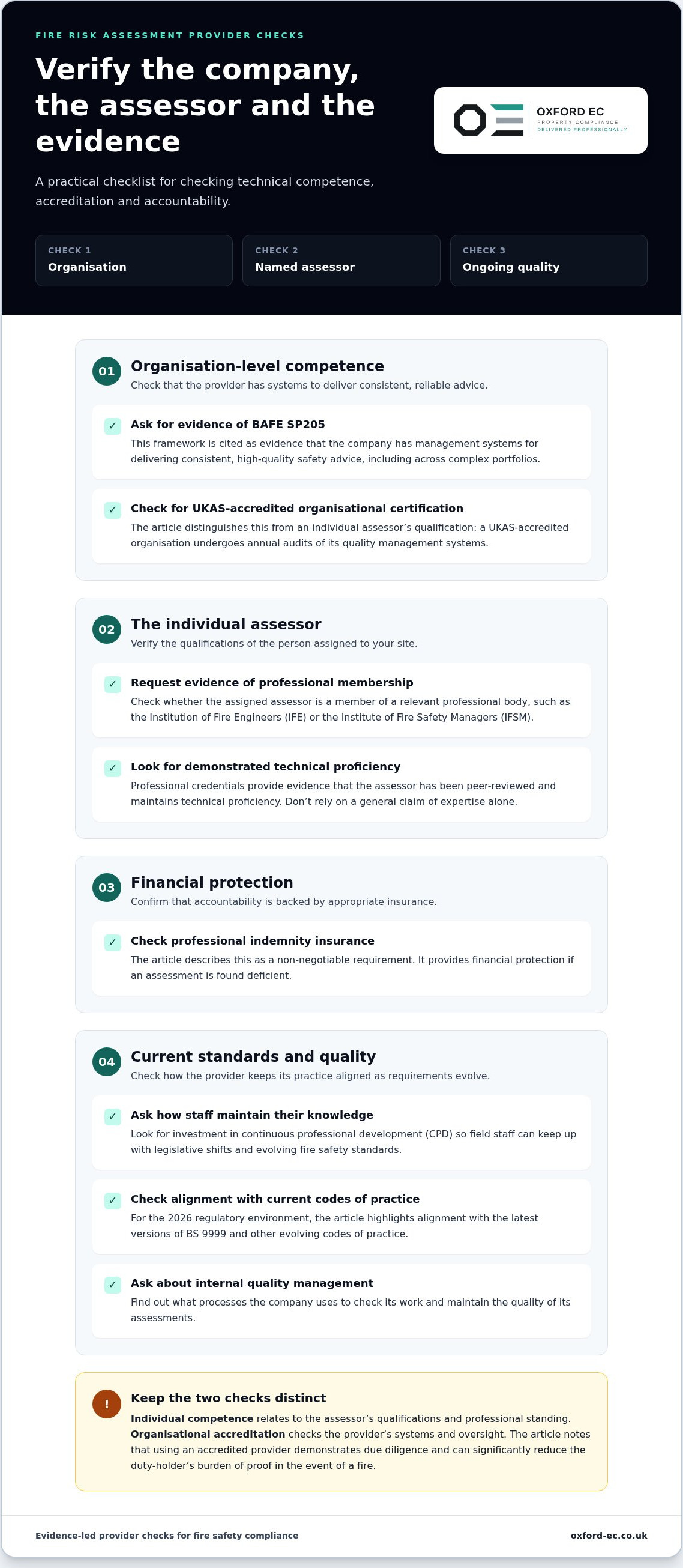
Accreditation. Verification. Validation. These are the three pillars of technical legitimacy. When you evaluate fire risk assessment companies, you're essentially auditing their ability to protect your life and assets. It isn't enough for a provider to claim expertise; they must demonstrate it through a rigorous framework of third-party scrutiny. This starts with organisational competence, often evidenced by frameworks like BAFE SP205, which ensures the company has the management systems to deliver consistent, high-quality safety advice across complex portfolios.
Individual qualifications are equally critical. You should demand evidence that the specific assessor assigned to your site holds professional membership with bodies such as the Institution of Fire Engineers (IFE) or the Institute of Fire Safety Managers (IFSM). These credentials prove that the individual has been peer-reviewed and maintains a high level of technical proficiency. Beyond technical skill, professional indemnity insurance is a non-negotiable requirement. It provides the necessary financial protection should an assessment be found deficient, ensuring that the legal risk remains with the provider and not your balance sheet.
Third-Party Certification: The Gold Standard
Distinguish between individual competence and organisational accreditation. Whilst a single assessor might be "qualified," a UKAS-accredited organisation undergoes annual audits to verify their quality management systems. This distinction is vital for duty-holders. Using an accredited provider significantly reduces your burden of proof in the event of a fire, as it demonstrates you've exercised due diligence by selecting a verified expert. Unaccredited, low-cost consultants often lack this level of oversight, leaving you vulnerable to both physical risk and legal prosecution.
Technical Proficiency and Continuous Professional Development
Fire safety standards aren't static. In 2026, compliance requires deep alignment with the latest versions of BS 9999 and other evolving codes of practice. A professional company must invest in continuous professional development (CPD) for its field staff to stay ahead of legislative shifts. You should ask potential partners about their internal quality management processes. Do they audit their own reports? How often do they refresh their training? A provider that prioritises rigour will always be prepared to provide evidence of their ongoing education. If you're unsure how to verify these credentials, contact a technical advisor to discuss the specific requirements for your property portfolio.
Multi-Disciplinary vs Specialised Providers: A Comparative Analysis
Strategy. Efficiency. Synergy. In the complex ecosystem of property management, viewing fire safety in isolation is a technical oversight. Many fire risk assessment companies operate as silos, focusing exclusively on ignition sources whilst ignoring the structural and environmental overlaps that define building safety. A multi-disciplinary approach transforms compliance from a fragmented series of site visits into a unified strategic asset that protects both the occupants and the duty holder's legal standing.
Consolidating safety requirements under a single expert partner significantly reduces administrative overheads and the pervasive issue of "survey fatigue." Scheduling separate contractors for fire, asbestos, and water hygiene is inherently inefficient. It leads to duplicated site inductions, conflicting technical advice, and fragmented data sets that complicate the "Golden Thread" of information required by 2026 standards. Choosing from the available fire risk assessment companies requires an understanding of how their service scope interacts with other regulatory duties to provide a cohesive narrative of risk across your entire portfolio.
The Interplay Between Fire Safety and Asbestos Management
Fire safety and hazardous materials are inextricably linked. For example, executing compartmentation works or installing new fire doors often requires intrusive access into wall cavities or ceiling voids. If these areas contain unidentified asbestos, a fire-focused contractor might inadvertently trigger a contamination event during remedial work. Ensuring that asbestos management surveys are integrated with fire safety audits prevents these regulatory collisions. This meticulous approach guarantees that fire protection measures don't compromise environmental safety standards or lead to accidental exposure during essential maintenance.
Consolidated Compliance: Fire, Water, and Air
Total site safety requires a holistic view of building health that transcends individual disciplines. Linking fire risk assessments with Legionella risk assessments allows multi-site managers to maintain a singular, high-resolution view of their compliance status. Oxford Environmental Consultants (OEC) facilitates this through a streamlined, "one-stop" solution for complex property requirements. By aligning these pillars of safety, we provide an audit-ready framework that ensures no critical vulnerability is overlooked due to a fragmented procurement strategy. This integrated model is the definitive choice for businesses seeking to eliminate the administrative burden of managing multiple, disconnected safety providers.
Due Diligence Checklist: Assessing a Provider’s Capability
Scrutiny. Rigour. Evidence. Vetting fire risk assessment companies requires a methodical approach that prioritises technical substance over commercial promises. You shouldn't accept surface-level assurances when the legal standing of your organisation is at stake. Instead, you must demand a thorough demonstration of the provider’s technical depth, particularly regarding their compartmentation survey services and their understanding of passive fire protection systems. In the current 2026 landscape, your chosen partner must also demonstrate high technological maturity by providing digital, searchable data that supports the "Golden Thread" of building information, ensuring that every safety critical detail is easily trackable and audit-ready.
The Quality of the Final Report
Actionable. Prioritised. Transparent. A technical report is only as valuable as the clarity of its output. You should request sample reports to verify that the provider delivers a clear, prioritised action plan with realistic, risk-weighted timescales rather than a list of generic observations. Professional reports from established fire risk assessment companies clearly distinguish between "significant findings" that demand immediate intervention and minor recommendations intended for general improvement. Photographic evidence is a non-negotiable requirement in this process; it provides the essential validation for every identified deficiency and allows the Responsible Person to communicate requirements to maintenance contractors with absolute precision.
Post-Assessment Support and Remedial Guidance
Consultancy. Resolution. Partnership. The lifecycle of compliance doesn't end when the assessor leaves the site. You require a partner who provides expert remedial consultancy to assist in the resolution of complex issues, such as ensuring fire alarm maintenance schedules align with the latest standards or managing the technicalities of fire door repairs across a multi-site portfolio. A competent consultant acts as your technical advocate, possessing the authority to liaise with Fire and Rescue Services to ensure your remedial strategy satisfies regulatory expectations. This level of post-assessment support ensures that your property remains safe and your legal exposure is managed with meticulous care.
Oxford Environmental Consultants: Your Partner in Integrated Property Compliance
Precision. Reliability. Mastery. In an era of heightened regulatory scrutiny, Oxford Environmental Consultants (OEC) stands as the definitive choice for UK businesses seeking absolute legal robustness. While many fire risk assessment companies provide a narrow, singular focus, our multi-disciplinary model ensures that your assets are protected across the critical pillars of fire, asbestos, and water hygiene. We don't just deliver reports; we provide a national network of experts dedicated to the meticulous management of high-stakes safety requirements. By positioning ourselves as an accountable partner, we offer the "safe pair of hands" necessary to navigate the complexities of modern property compliance with confidence and technical precision.
Beyond the Assessment: A Total Safety Solution
Safety requires a continuous, evidence-based approach that extends far beyond the initial audit. Integrating regular fire door inspections into your annual safety programme is essential for maintaining the integrity of your building's compartmentation strategy and ensuring legal alignment with the Fire Safety (England) Regulations. Our expertise isn't limited to fire safety; we recognise that building health is multi-faceted and interconnected. For instance, our damp and mould inspection services complement our building safety audits, ensuring that environmental factors don't compromise structural safety or occupant wellbeing over time. Every OEC intervention is underpinned by a commitment to transparency, technical excellence, and the delivery of audit-ready documentation that serves as a protective shield against prosecution.
Securing Your Compliance for 2026 and Beyond
The implementation of the Building Safety Act has transformed the duties of the Responsible Person, requiring a more sophisticated level of technical oversight than ever before. We help duty-holders navigate this evolving landscape by providing the data-driven insights needed to maintain the "Golden Thread" of building information across the entire lifecycle of the asset. Whether you manage a single complex facility or a national property portfolio, we provide bespoke proposals tailored to your specific risk profile and operational requirements. Contacting our consultancy team is the first step toward securing a streamlined, one-stop solution that guarantees absolute compliance and long-term property safety. Our experts are ready to audit your current standing and provide a technical roadmap for total site safety.
Mastering Your Regulatory Strategy for a Safer Future
The landscape of UK property safety isn't a matter of periodic inspections; it's a continuous commitment to technical precision and documented accountability. You've seen that the choice between various fire risk assessment companies represents a fundamental decision regarding your personal and corporate liability. By prioritising third-party accreditations and individual assessor competency, you ensure that your safety framework is built on a foundation of verified expertise rather than commercial convenience. This rigour is the only way to satisfy the stringent requirements of the Building Safety Act in 2026.
A multi-disciplinary approach further strengthens this protective shield. Integrating fire safety with asbestos and water hygiene management eliminates the risks associated with fragmented compliance and disjointed data sets. This unified strategy supports the "Golden Thread" of information, providing you with the peace of mind that comes from a single, high-level consultancy. As multi-disciplinary compliance experts with national UK service delivery, we're ready to provide the safe pair of hands your portfolio requires.
We're dedicated to helping you achieve absolute compliance through our mastery of Fire, Asbestos, and Water Hygiene standards. Your journey toward a robust and legally sound property strategy begins with a single technical consultation.
Frequently Asked Questions
What should I look for when comparing fire risk assessment companies?
Scrutiny. Rigour. Evidence. When comparing fire risk assessment companies, you must prioritise third-party organisational verification and the individual technical competency of their field staff. Look for providers who offer a multi-disciplinary approach, ensuring that fire safety isn't managed in a technical vacuum. A high-quality partner will provide digital, searchable reporting that supports the "Golden Thread" of building information and includes photographic evidence for every significant finding identified during the audit.
Is it a legal requirement to use a professional fire risk assessment company?
Competence. Accountability. Compliance. While the Regulatory Reform (Fire Safety) Order 2005 allow the Responsible Person to conduct their own assessment, they must be "competent" to do so. For most commercial or complex multi-occupancy buildings, demonstrating this level of competence without formal professional qualifications is nearly impossible. Engaging a professional company transfers the technical risk and ensures your documentation is legally robust enough to withstand a rigorous fire authority audit or legal challenge.
How often should a commercial fire risk assessment be reviewed in 2026?
Annual. Dynamic. Responsive. In 2026, a fire risk assessment should generally be reviewed every 12 months to account for structural changes, occupancy shifts, or legislative updates. However, any significant alteration to the building’s layout or purpose triggers an immediate requirement for a new assessment. Maintaining a regular review cycle is essential for meeting the "Golden Thread" requirements under the Building Safety Act and ensuring your safety strategy remains current and compliant.
Can one company handle fire, asbestos, and water hygiene assessments?
Strategy. Efficiency. Synergy. A multi-disciplinary provider like OEC can simultaneously manage fire risk assessments, asbestos management surveys, and Legionella risk assessments across your entire portfolio. Consolidating these services reduces administrative overheads and prevents the technical conflicts that often arise when using multiple disconnected contractors. This integrated approach provides a single, high-resolution view of your property compliance, making it the definitive choice for national managers seeking a streamlined, one-stop solution.
What is the difference between a fire risk assessment and a compartmentation survey?
Scope. Detail. Protection. A fire risk assessment is a broad audit of overall safety management, whereas a compartmentation survey is a technical "deep dive" into the building’s physical fire barriers. Compartmentation surveys involve intrusive inspections of walls, floors, and ceilings to verify that fire and smoke cannot spread between sections. Both are vital, but a compartmentation survey is often required when the assessment identifies potential breaches in the building's passive fire protection systems.
How much does a professional fire risk assessment cost for a UK business?
Complexity. Scale. Detail. The cost of a professional fire risk assessment depends on the size, usage, and structural complexity of the property. Factors such as the number of storeys, the presence of high-risk occupants, and the requirement for intrusive inspections will influence the final proposal. We recommend requesting a bespoke quote based on your specific portfolio requirements to ensure you receive a comprehensive technical audit rather than a generic, surface-level checklist.
What qualifications should an individual fire risk assessor hold?
Validation. Expertise. Authority. Individual assessors should hold professional memberships with recognised bodies such as the Institution of Fire Engineers (IFE) or the Institute of Fire Safety Managers (IFSM). You should check if they're listed on a nationally accredited competency register. These qualifications prove the assessor has undergone peer review and maintains their technical proficiency through continuous professional development, ensuring they can identify complex risks that an unqualified inspector might inadvertently overlook.
Will a fire risk assessment company help me with remedial works?
Consultancy. Resolution. Delivery. Professional fire risk assessment companies often provide a pathway to resolution through remedial consultancy and specialist fire safety services. For example, OEC assists with fire door inspections, fire alarm maintenance, and the implementation of passive fire protection measures. Having a partner who understands the practicalities of these repairs ensures that remedial works are executed to the correct technical standard and align perfectly with the original assessment’s recommendations.