
Could a single refurbishment oversight bankrupt your project? In 2026, the Health and Safety Executive's intensified focus on the Control of Asbestos Regulations 2012 means that "approximate compliance" is no longer a viable legal defence. Precision. Accountability. Protection. For many duty-holders, the primary source of anxiety isn't just the health risk, but the volatile nature of the asbestos removal cost uk during a major renovation. It's a valid concern; failing to account for the distinction between licensed and non-licensed work can lead to catastrophic financial penalties and project stagnation.
You need a clear, evidence-based framework to budget for these essential works without compromising on safety or legal robustness. This guide breaks down the complexities of current pricing models, from residential Artex removal to large-scale industrial decommissioning, whilst providing the technical scrutiny required to compare professional quotes. We'll examine the critical shift toward mandatory analytical independence in the four-stage clearance process and detail how to manage your "Duty to Manage" obligations effectively. By the end of this analysis, you'll possess a comprehensive roadmap to ensure your site is safe, your costs are controlled, and your documentation is audit-ready.
Key Takeaways
- Understand how material friability and the Control of Asbestos Regulations 2012 serve as the primary drivers for the asbestos removal cost uk.
- Distinguish between licensed and non-licensed work to ensure total compliance with mandatory HSE notification requirements for high-risk materials.
- Budget accurately by incorporating essential safety components such as independent four-stage clearance testing and professional air monitoring.
- Leverage a consultancy-led management model to verify contractor performance against rigorous survey specifications and legal standards.
- Establish an audit-ready framework for comparing professional quotes, prioritising technical precision and the mitigation of long-term liability.
Table of Contents
Understanding Asbestos Removal Cost Variables in the UK
The asbestos removal cost uk is rarely a static figure. It functions as a dynamic calculation influenced by material risk, total volume, and the specific legislative requirements of the Control of Asbestos Regulations 2012. Before any physical works commence, a comprehensive asbestos management survey must be conducted to establish a baseline of risk. This document serves as the technical foundation for any financial projection, ensuring that the scope of work aligns with actual site conditions rather than generic estimates.
Why Pricing Isn’t One-Size-Fits-All
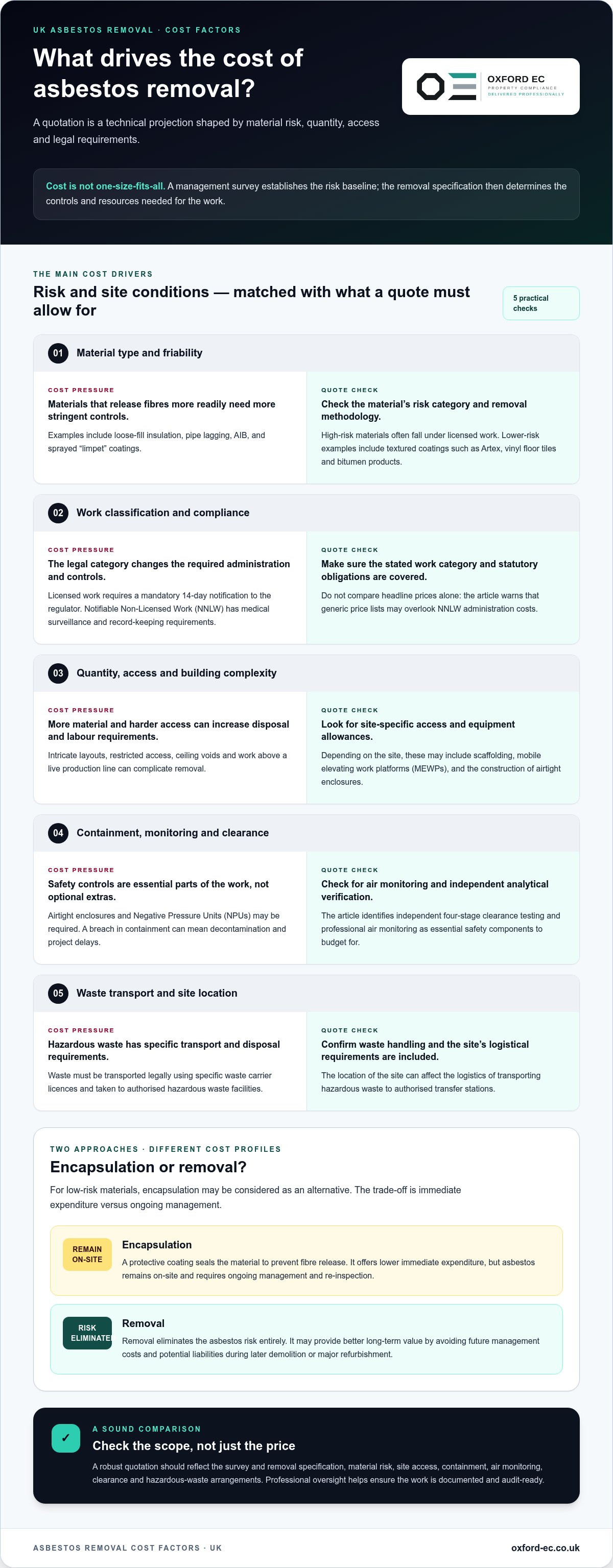
Structural complexity often dictates the total labour hours required for a project. Older buildings with intricate layouts or restricted access points increase the difficulty of establishing negative pressure enclosures, which naturally elevates the total expenditure. Material friability is another critical driver. To understand the risks, one must first identify What is Asbestos in its various forms; high-risk materials like loose-fill insulation or pipe lagging release fibres more readily and require more stringent controls than non-friable cement sheets. Site logistics also play a role, as the legal transport of hazardous waste across the UK requires specific waste carrier licences and disposal at authorised hazardous waste landfill sites.
The Legal Mandate: Compliance vs. Cost
Compliance is not optional. It's mandatory. Under the Control of Asbestos Regulations 2012, duty-holders are legally required to maintain a valid UK Asbestos Management Plan. Choosing the cheapest quote often masks the absence of mandatory safety protocols, such as proper air monitoring or independent analytical verification. The cost of non-compliance is severe. Fines can reach hundreds of thousands of pounds, and the legal liability associated with secondary exposure can lead to permanent business closure. Professional oversight ensures that every stage of the removal process is documented and audit-ready, protecting both the workforce and the long-term viability of the asset.
When evaluating the asbestos removal cost uk, duty-holders should consider encapsulation as a strategic alternative for low-risk materials. Encapsulation involves sealing the material with a protective coating to prevent fibre release, offering a lower immediate expenditure. However, this keeps the asbestos on-site, requiring ongoing management and re-inspection. Removal represents a final solution that eliminates the risk entirely. It often provides better long-term value by removing future management costs and potential liabilities during eventual demolition or major refurbishment works.
Primary Factors Influencing Your Removal Quotation
Quotations are not mere estimates. They are technical projections. The asbestos removal cost uk is fundamentally tied to the physical state, location, and legal classification of the hazardous material. Whilst a survey identifies the presence of asbestos, the removal specification determines the resource allocation required for safe extraction. Precision. Accountability. Rigour. These are the pillars of a compliant quotation that protects the duty-holder from unforeseen financial escalation during the project lifecycle.
Material Type and Risk Categorisation
The friability of a material, or its tendency to crumble and release fibres under pressure, is the primary determinant of removal methodology. High-risk materials such as Asbestos Insulation Board (AIB), sprayed "limpet" coatings, and thermal pipe insulation require the highest level of environmental control. These often fall under the "Licensed" category, necessitating a mandatory 14-day notification to the regulator as part of the UK Asbestos Regulations. Conversely, lower-risk materials like textured coatings (Artex), vinyl floor tiles, and bitumen products may require less intensive containment. The administrative burden of "Notifiable Non-Licensed Work" (NNLW) still carries specific costs for medical surveillance and record-keeping that generic price lists often overlook.
Quantity, Accessibility, and Site Logistics
Volume and surface area provide the baseline for waste disposal fees, but accessibility often dictates the labour cost. Removing asbestos from a ground-floor warehouse is significantly less complex than extracting AIB from a ceiling void ten metres above a live production line. Factoring in specialised scaffolding, mobile elevating work platforms (MEWPs), and the construction of airtight enclosures with Negative Pressure Units (NPUs) is essential for a realistic budget. Environmental controls must be absolute. Any breach in containment necessitates a costly decontamination process and project delays. The geographical location of the site further influences the asbestos removal cost uk due to the logistical requirements of transporting hazardous waste to authorised transfer stations across the UK.
For complex sites involving multi-faceted property requirements, securing a detailed technical breakdown is the only way to ensure the quote covers all statutory obligations. If you are managing a site with diverse material types and require a professional assessment of your specific requirements, you can speak with our compliance team for expert guidance.
Licensed vs. Non-Licensed Removal: Cost and Regulatory Differences
Legal clarity. Risk mitigation. Financial predictability. Distinguishing between licensed and non-licensed works is the most significant factor in determining the asbestos removal cost uk. The Health and Safety Executive (HSE) enforces a strict hierarchy based on the potential for fibre release, ensuring that high-risk materials are handled only by contractors who possess the technical infrastructure to manage them safely. This regulatory split dictates not only the safety protocols required but also the administrative overheads that ultimately shape your project budget.
When You Must Use a Licensed Contractor
Licensed work is mandatory for materials where fibre release is likely to be high or sustained. This includes friable materials like pipe insulation, sprayed coatings, and Asbestos Insulation Board (AIB). For these projects, a statutory 14-day notification period is required before any work begins, adding a temporal overhead to the project timeline. The asbestos removal cost uk for licensed work carries a substantial premium. This reflects the necessity of sophisticated equipment, including Negative Pressure Units (NPUs), decontamination units (DCUs), and the administrative burden of detailed Plan of Works (PoW). Duty-holders must verify a contractor’s HSE licence via the official register; failure to do so constitutes a major breach of the Control of Asbestos Regulations 2012.
Notifiable Non-Licensed Work (NNLW) occupies the regulatory middle ground. Whilst these materials, such as large-scale removal of textured coatings or damaged asbestos cement, don't require a licensed contractor, they do require notification to the HSE before commencement. Costs here increase due to the requirement for medical surveillance for operatives and the maintenance of health records for 40 years. It's a technical nuance that often leads to unexpected budget creep if not identified during the initial consultancy phase. Precision in categorisation ensures that you don't overpay for unnecessary licensing whilst remaining fully compliant with statutory health monitoring requirements.
Budgeting for Non-Licensed Work
Non-licensed work typically applies to lower-risk, non-friable materials like vinyl floor tiles, bitumen products, and intact asbestos cement sheets. Whilst these tasks are generally more cost-effective, they are not unregulated. Contractors must still provide evidence of category B "non-licensed" training, appropriate Personal Protective Equipment (PPE), and Respiratory Protective Equipment (RPE). Budgeting for these works must account for the safe disposal of hazardous waste, which remains a fixed cost regardless of the licence category. By aligning the removal methodology with the specific material risk, businesses can achieve a balance between financial efficiency and absolute regulatory compliance. This structured approach prevents the common pitfall of assuming "non-licensed" equals "no risk," ensuring that your safety liability remains fully managed throughout the removal process.
Hidden Costs and Mandatory Safety Requirements
Initial quotations often provide a fragmented view of the total financial commitment. A robust asbestos removal cost uk must incorporate ancillary services that are legally non-negotiable under the Control of Asbestos Regulations 2012. Omitting these elements from a budget leads to project delays, unforeseen expenditure, and potential regulatory scrutiny. Accountability starts with transparency. It's essential to recognise that the "headline" price for removal rarely covers the full scope of statutory obligations required to return a building to safe use.
Air Monitoring and Four-Stage Clearance
Independent. Mandatory. Definitive. For all licensed asbestos removal projects, a four-stage clearance process is a statutory requirement to ensure the area is safe for re-occupation. This process must be conducted by a laboratory independent of the removal contractor to prevent conflicts of interest and ensure absolute precision. The four stages involve a preliminary assessment of site completeness, a rigorous visual inspection of the work area, clearance air monitoring to detect residual fibres, and a final assessment after the enclosure has been dismantled. Duty-holders should budget for the time required for these tests, as site downtime can extend by several hours or days depending on the project’s scale and the complexity of the environmental controls employed.
Reinstatement and Waste Disposal Fees
Waste disposal encompasses more than simple logistics. Every movement of hazardous material requires a mandatory consignment note, which serves as the legal evidence of safe disposal under the Duty of Care regulations. These documents are essential for your asbestos management file and are subject to rigorous auditing by environmental authorities. Landfill tax also significantly influences the final bill for large-volume projects, as the rates for hazardous waste are substantially higher than those for standard inert materials. Precision in volume calculation is vital to avoid unexpected surcharges at the transfer station.
Reinstatement is the final, often overlooked, pillar of the project. Once asbestos insulation or ceiling tiles are removed, the structural and thermal integrity of the building must be restored. This involves the installation of compliant, non-asbestos materials that meet current fire safety and building regulations. Viewing removal as only half the task ensures that your final budget reflects the reality of a fully restored, compliant facility. This holistic approach is the only way to accurately forecast the total asbestos removal cost uk for your specific asset.
Securing a Professional Asbestos Removal Management Solution
Meticulous. Professional. Compliant. Managing the asbestos removal cost uk requires more than simply reviewing commercial tenders; it demands a consultancy-led strategy that prioritises risk mitigation and legal robustness over superficial savings. By positioning an independent expert as the primary point of control between the duty-holder and the removal contractor, businesses ensure that every technical specification is delivered with precision. This protective shield against risk is essential for navigating the complexities of modern safety standards and avoiding the catastrophic financial consequences of a compliance failure.
The Role of Independent Consultancy
Vetted. Managed. Validated. Independent oversight is the only mechanism that guarantees a contractor's methodology adheres strictly to the asbestos refurbishment survey specifications. Oxford Environmental Consultants (OEC) serves as an accountable partner, vetting potential removal firms for valid HSE licences, comprehensive insurance cover, and a documented history of technical excellence. On-site management involves the continuous scrutiny of environmental controls, ensuring that enclosures and negative pressure units function at peak efficiency throughout the project. This level of meticulous detail prevents the "scope creep" that often arises from poorly defined work scopes, providing duty-holders with the peace of mind that their property is 100% compliant and safe for re-occupation.
Requesting a Compliant Quotation
Granular. Transparent. Accountable. Transparency is the foundation of a safe project. When drafting a Request for Quote (RFQ), duty-holders must insist on a granular breakdown that explicitly includes all mandatory safety requirements, such as air monitoring and independent four-stage clearance. The cheapest quote frequently represents a high-risk gamble, often masking the omission of critical statutory obligations that remain the legal responsibility of the property owner. A professional consultancy ensures that all bids are evaluated against a rigorous technical standard, allowing for a like-for-like comparison that prioritises long-term asset protection. This methodical approach ensures that the asbestos removal cost uk remains predictable and fully aligned with your broader property management goals.
Proactive Management of Your Asbestos Liabilities
Navigating the financial landscape of property compliance requires technical precision and an uncompromising commitment to safety. You have seen that the asbestos removal cost uk is not merely a line item; it is a calculation of material risk, environmental controls, and statutory obligations. By distinguishing between licensed and non-licensed requirements and accounting for mandatory independent air monitoring, you protect your organisation from both physical hazards and catastrophic legal liability. Precision. Accountability. Protection.
Oxford Environmental Consultants (OEC) provides the multi-disciplinary expertise needed to manage national property portfolios with absolute HSE alignment. Our consultancy-led approach ensures that your removal projects are delivered without the risk of scope creep or regulatory breaches. You can move forward with the confidence that your assets are managed by a safe pair of hands. We stand ready to provide the professional oversight your project demands, ensuring every stage of the process is audit-ready and legally robust.
Frequently Asked Questions
How much does it cost to remove an asbestos garage roof in the UK?
Industry averages suggest that removing a single garage roof typically ranges between £400 and £900, whilst a double garage can cost between £750 and £1,400. These figures fluctuate based on the volume of cement sheets and the complexity of the disposal. It's essential to account for professional waste transit to an authorised facility. Accurate. Compliant. Safe.
Do I legally need an asbestos survey before I can get a removal quote?
You are legally required to conduct a survey under the Control of Asbestos Regulations 2012 before any removal or refurbishment work commences. This document defines the material type, extent, and friability, which are the primary drivers of the asbestos removal cost uk. Without a survey, a contractor cannot provide a technically robust quotation. It serves as your primary risk management tool.
What is the difference between asbestos removal and encapsulation costs?
Encapsulation typically involves a lower initial expenditure, often estimated around £30 per square metre for sealing high-risk materials. Removal represents a higher upfront investment but provides a permanent solution by eliminating the hazard entirely. Choosing encapsulation requires ongoing management and periodic re-inspections. This adds long-term administrative costs that removal avoids.
Is air monitoring a legal requirement during asbestos removal?
Air monitoring is a mandatory legal requirement for all licensed asbestos removal projects as part of the four-stage clearance process. It provides the empirical evidence needed to confirm that fibre levels are below the control limit of 0.1 fibres per cubic centimetre. For non-licensed work, air monitoring is strongly recommended to verify that environmental controls remained effective. Precision. Verification. Safety.
How long does the asbestos removal process typically take for a commercial building?
Commercial timeframes vary significantly based on the building's scale and the material's friability. Small-scale retail units may be cleared in one to two days, whilst large industrial decommissioning projects can span several weeks or months. You must factor in the mandatory 14-day HSE notification period for licensed works. This statutory delay is non-negotiable and dictates the project's earliest commencement date.
Can I remove asbestos myself to save on costs?
Whilst it is legal for homeowners to remove certain low-risk, non-friable materials, it is never recommended for business owners or duty-holders. The health risks and legal liabilities associated with accidental exposure are immense. Professional contractors possess the technical infrastructure and insurance needed to manage hazardous waste safely. Protecting your workforce is a statutory obligation that outweighs minor cost savings.
Are there hidden fees in asbestos waste disposal?
Hidden fees often arise from mandatory hazardous waste consignment notes and fluctuating landfill taxes. Many generic estimates exclude the costs of specialised waste transit or the fees charged by authorised transfer stations for processing hazardous material. You must also budget for the administrative time required to maintain an audit-ready waste manifest. Transparency. Accuracy. Accountability.
Does business insurance cover the cost of asbestos removal?
Standard business insurance policies typically exclude asbestos-related claims and the asbestos removal cost uk as a general rule. You should consult with your broker to determine if you have specialised environmental impairment liability cover. Most duty-holders must budget for removal as a capital expenditure or maintenance cost. It is rarely recoverable through standard insurance unless the asbestos was damaged by a covered peril.