

Did you know that asbestos-related diseases still claim approximately 5,000 lives annually in the UK, despite the material being banned for over twenty-five years? Rigorous. Precise. Accountable. For many duty holders, the complexities of the Control of Asbestos Regulations 2012 lead to a justified fear of HSE prosecution and a sense of being overwhelmed by fragmented compliance data, yet commissioning comprehensive asbestos management surveys remains the primary mechanism for identifying asbestos-containing materials and establishing a definitive baseline for risk mitigation.
It's understandable that you want to avoid the legal risks associated with non-compliance whilst ensuring the highest standards of occupant protection. This article promises to help you master the intricacies of modern UK regulations so your property remains safe and audit-ready at all times. We will examine the core requirements for a clear management plan, the technical differences between survey types, and the strategic oversight needed to achieve total regulatory alignment under the latest HSE standards updated in January 2026.
Key Takeaways
- Understand the non-delegable "duty to manage" under Regulation 4 of the Control of Asbestos Regulations 2012 to ensure total legal accountability.
- Commission professional asbestos management surveys to locate and assess the condition of asbestos-containing materials during the normal occupation of your premises.
- Identify the critical trigger points that require an upgrade from a standard management survey to an intrusive Refurbishment and Demolition survey before any construction work begins.
- Develop a live Asbestos Management Plan and register to transform technical data into a practical, audit-ready document for continuous safety monitoring.
- Leverage a multi-disciplinary compliance strategy to align asbestos findings with fire and water hygiene protocols for improved site efficiency and reduced disruption.
Table of Contents
- Understanding the Legal Duty: Regulation 4 and Asbestos Management Surveys
- The Meticulous Process: How an Asbestos Survey is Conducted
- Management vs. Refurbishment and Demolition Surveys
- Beyond the Survey: Developing an Asbestos Management Plan
- Integrated Compliance: The Multi-Disciplinary Safety Strategy
Understanding the Legal Duty: Regulation 4 and Asbestos Management Surveys
Locate. Assess. Manage. Under the Control of Asbestos Regulations 2012 (CAR 2012), specifically Regulation 4, the legal obligation to manage asbestos in non-domestic premises is a non-delegable duty that requires a systematic approach to identifying and controlling the risks posed by asbestos-containing materials (ACMs). Within this legislative framework, asbestos management surveys serve as the fundamental standard inspection designed to locate, as far as reasonably practicable, the presence and extent of any suspected ACMs that could be damaged or disturbed during normal occupancy and routine maintenance. This legal "duty to manage" falls squarely upon the Duty Holder, typically the person or organisation responsible for the maintenance and repair of the building, such as the landlord, tenant, or facility manager.
Rigorous compliance begins with understanding the history of the material. Whilst a comprehensive overview of asbestos reveals its widespread use throughout the 20th century, the UK implemented a total ban on the importation, sale, and use of all asbestos types in 1999. Consequently, buildings constructed after the year 2000 are generally exempt from the requirement for a management survey, as there is a strong presumption that no ACMs were utilised in their construction. For any property built or refurbished prior to this date, the presence of asbestos must be presumed until a competent professional provides evidence to the contrary through a documented survey and management plan.
The Consequences of Non-Compliance
Failure to adhere to CAR 2012 carries severe legal and operational ramifications. Penalties. Fines. Imprisonment. The Health and Safety Executive (HSE) maintains the authority to issue unlimited fines or pursue custodial sentences of up to two years for serious breaches of Regulation 4. Beyond the courtroom, an asbestos incident often triggers an immediate Prohibition Notice, resulting in the summary closure of your building and significant loss of revenue. Maintaining an audit-ready compliance trail is the only robust defence against professional liability and the catastrophic reputational damage associated with exposure incidents.
Scope of a Standard Management Survey
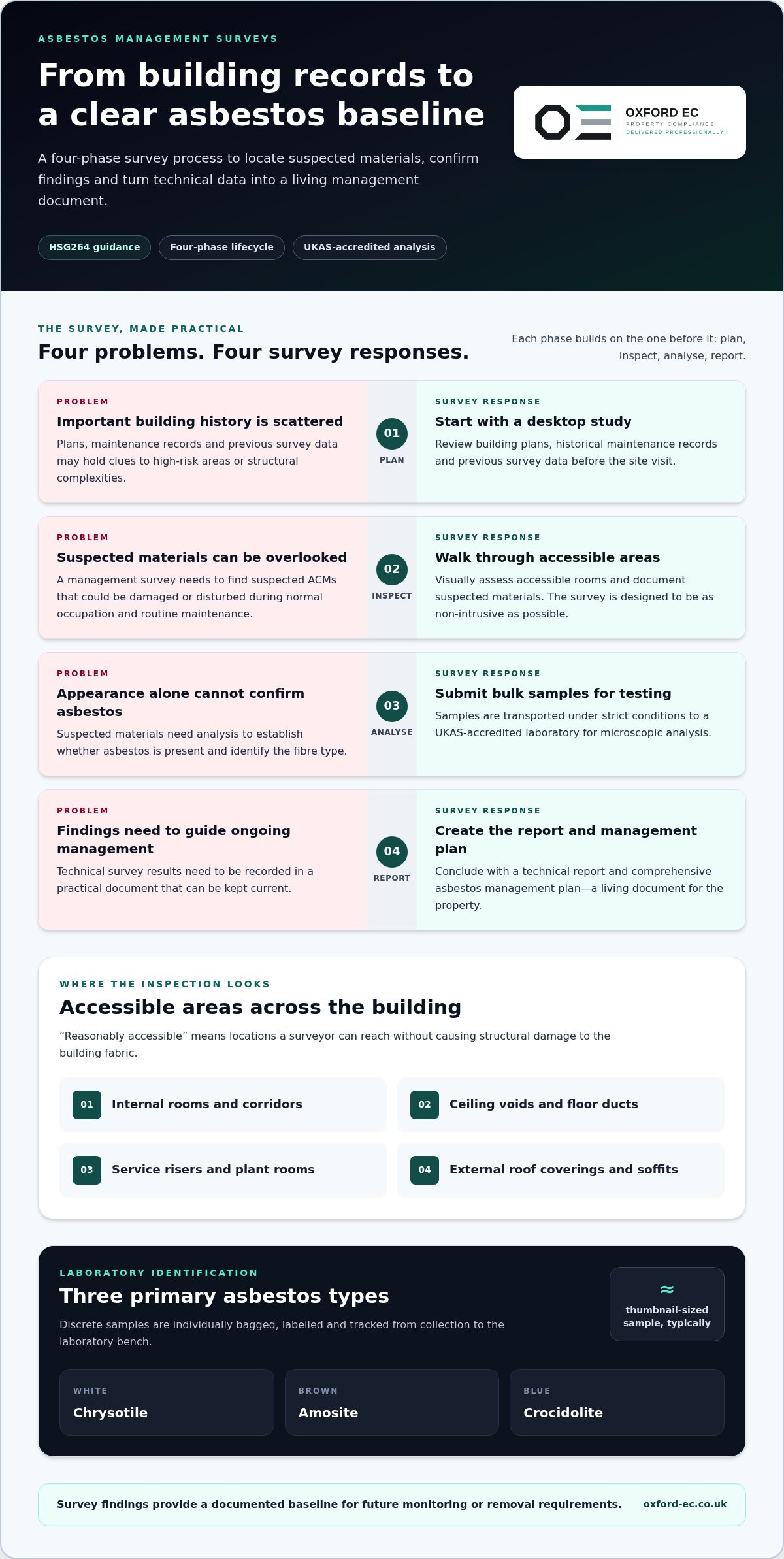
A standard management survey is designed to be as non-intrusive as possible whilst maintaining technical integrity. It involves a thorough inspection of all accessible areas, including:
- Internal rooms and corridors
- Ceiling voids and floor ducts
- Service risers and plant rooms
- External roof coverings and soffits
The surveyor identifies "reasonably accessible" areas, meaning locations that can be reached without causing structural damage to the building fabric. During this process, discrete sampling is conducted on suspected materials, which are then analysed in a UKAS-accredited laboratory to confirm the fibre type and concentration, ensuring that every entry in your asbestos register is backed by scientific evidence.
The Meticulous Process: How an Asbestos Survey is Conducted
Plan. Inspect. Analyse. The Health and Safety Guidance 264 (HSG264) serves as the definitive industry-standard guidance for the effective execution of asbestos surveying within the United Kingdom. Professional asbestos management surveys follow a structured, four-phase lifecycle designed to eliminate ambiguity and provide duty holders with empirical data regarding their property's risk profile. Phase 1 initiates with a comprehensive desktop study and planning stage, where surveyors scrutinise building plans, historical maintenance records, and previous survey data to identify high-risk areas or structural complexities before any personnel arrive on-site.
Phase 2 involves the physical on-site inspection, a methodical walkthrough where every accessible room is visually assessed and suspected materials are documented. During Phase 3, bulk samples are transported under strict conditions to a UKAS-accredited laboratory for microscopic analysis to confirm the presence and specific fibre type of asbestos. Finally, Phase 4 concludes with the generation of a technical report and a comprehensive asbestos management plan that serves as a living document for the property. For those managing complex commercial portfolios, engaging expert asbestos consultancy services ensures these phases are delivered with the precision required for total legal robustness.
Sampling Protocols and Laboratory Analysis
Identify. Categorise. Quantify. Laboratory analysis focuses on identifying the three primary asbestos types found in UK buildings: Chrysotile (white), Amosite (brown), and Crocidolite (blue). Surveyors maintain a rigorous chain of custody, ensuring every bulk sample-typically a thumbnail-sized portion of the material-is individually bagged, labelled, and tracked from the point of collection to the laboratory bench. This high-register scrutiny ensures that the resulting asbestos register is legally defensible and provides an exact baseline for future monitoring or removal requirements.
Minimising Disruption During Site Works
Operational continuity is a priority for any occupied building. Surveyors employ shadow vacuuming and wetting agents during sampling to prevent the release of airborne fibres, ensuring the environment remains safe for immediate re-entry. In high-traffic environments like retail centres or healthcare facilities, out-of-hours surveying is often utilised to prevent interference with staff and public movement. By coordinating access and logistics during the planning phase, the inspection process remains efficient, discreet, and thoroughly mapped out to avoid unnecessary downtime.
Management vs. Refurbishment and Demolition Surveys
Distinguish. Decide. Deliver. While asbestos management surveys provide the essential data required for the safe day-to-day occupation of a building, they are fundamentally limited to surface-level and reasonably accessible areas. The critical distinction between survey types lies in the intended use of the property. If your objective is to maintain a safe environment for staff and visitors during routine operations, a management survey is your baseline requirement. However, the moment the scope of work shifts towards structural alteration or intrusive maintenance, the standard survey is no longer legally sufficient and must be upgraded to a Refurbishment and Demolition (R&D) survey.
This upgrade is mandatory when planned works involve any activity that penetrates the building fabric beyond the scope of routine maintenance. Unlike asbestos management surveys, R&D surveys are fully intrusive and employ destructive techniques to access hidden cavities, floor voids, and structural cores. Because this process involves breaking into the building fabric to locate every potential trace of asbestos, it is a legal and safety necessity that the specific areas under investigation are vacant. Attempting to conduct these works in an occupied environment poses an unacceptable risk of fibre release to building occupants and violates the core principles of the Control of Asbestos Regulations 2012.
When to Commission a Refurbishment Survey
Refurbishment encompasses a broad spectrum of activity, ranging from the removal of internal partition walls to the full strip-out of mechanical and electrical systems. Under the Construction (Design and Management) Regulations 2015 (CDM 2015), the client is legally required to provide specific asbestos information to contractors before any work begins on-site. To maintain project efficiency and control costs, duty holders can commission targeted R&D surveys. These inspections focus exclusively on the specific zones designated for alteration, ensuring that the intrusive data is relevant to the project scope without necessitating a full building closure.
Demolition Surveys: The Final Safeguard
Before a building is decommissioned or razed, an Asbestos Demolition Survey must be executed to ensure that no ACMs remain hidden within the structural foundations or wall cavities. This is the most aggressive form of inspection, designed to locate every trace of asbestos to inform a precise removal specification. By providing this exhaustive data, you protect the safety of demolition contractors and prevent the environmental contamination of the surrounding area. It is the final, uncompromising step in the lifecycle of a building, ensuring that its removal is as controlled and safe as its management.
Beyond the Survey: Developing an Asbestos Management Plan
Identify. Quantify. Control. Whilst asbestos management surveys provide the empirical data required for compliance, the resulting report is merely the foundation of a much broader safety strategy. The legal duty to manage requires the creation of a live Asbestos Management Plan (AMP), a central repository that translates technical findings into actionable maintenance protocols. At the core of this plan lies the Asbestos Register. This document must be treated as an evolving record that tracks the lifecycle of every identified or presumed asbestos-containing material (ACM) within your property portfolio, ensuring that safety data is never static or out of date.
To achieve a robust risk profile, duty holders must employ a dual-assessment scoring system that distinguishes between a material's physical state and its environmental context. This is where many organisations fail; they treat the survey report as a final answer rather than a data source for risk prioritisation. A meticulous management plan integrates these scores to dictate exactly how, when, and by whom a specific area of the building can be accessed. For those seeking to secure their premises against long-term liability, you can book your professional asbestos management surveys and management plans here to ensure every detail is captured with precision.
The Material and Priority Assessment Framework
The Material Assessment focuses exclusively on the physical properties of the ACM. It assigns a score based on the product type, its current state of damage, any surface treatment, and the specific asbestos fibre type confirmed by laboratory analysis. Conversely, the Priority Assessment evaluates the human element. It considers occupant activity, the likelihood of disturbance during routine maintenance, and the frequency of access to the area. By combining these two distinct metrics, you generate a Total Risk Score. This allows you to categorise risks as High (10+), Medium (7-9), or Low (5-6), facilitating a structured and evidence-based approach to remedial works.
Annual Re-inspections and Monitoring
Maintaining this framework requires more than a one-off inspection. Statutory regulations mandate periodic re-inspections, typically conducted every 12 months, to ensure that the condition of ACMs has not deteriorated over time. Any changes in the building's use, or the completion of abatement works, must be meticulously documented to keep the register audit-ready. This information must be accessible and communicated clearly to all contractors and maintenance staff before they commence work on-site. This ensures the chain of safety remains unbroken and the risk of accidental exposure is eliminated through transparent, evidence-based management.
Integrated Compliance: The Multi-Disciplinary Safety Strategy
Efficient. Consistent. Secure. Fragmented compliance data represents a significant risk to property managers and duty holders alike. By integrating asbestos management surveys with other statutory requirements, such as fire safety and water hygiene, organisations can eliminate the technical inconsistencies often found when managing multiple independent service providers. This multi-disciplinary approach ensures that data collected during a compartmentation survey or a Legionella risk assessment is cross-referenced with the existing asbestos register, preventing the dangerous and costly accidental disturbance of hazardous materials during life-safety inspections or maintenance works.
Centralising this information through a single professional partner provides a unified "golden thread" of building safety. It reduces site disruption by synchronising access requirements and allows for a more holistic understanding of risk in technical environments like plant rooms, water storage areas, and service risers. When asbestos data is siloed, the risk of a maintenance contractor breaching a fire seal containing asbestos remains unacceptably high. A consolidated strategy ensures that every property intervention is informed by a comprehensive understanding of the building's entire safety profile.
Aligning Asbestos with Fire Risk Assessments
Precision is paramount. Fire risk assessments and subsequent remediation works, such as fire door inspections or the installation of passive fire protection, frequently occur in areas where ACMs are prevalent. Asbestos was historically utilised in fire-stopping materials, ceiling tiles, and as insulation within fire doors themselves. Upgrading these systems without referencing a detailed management survey can lead to unintended exposure and project delays. By aligning these disciplines, you ensure that every fire safety intervention is planned with absolute awareness of the building's asbestos profile, maintaining the integrity of fire seals without compromising asbestos management protocols.
Why Oxford Environmental Consultants is Your Compliance Partner
Rigorous. Accountable. Dependable. Founded in 2018, Oxford Environmental Consultants (OEC) has established itself as a safe pair of hands for complex, multi-faceted property requirements across the United Kingdom. We provide national UK coverage, delivering technical mastery in HSG264 and CAR 2012 alongside fire and water hygiene expertise. Our streamlined delivery model removes the burden of managing fragmented data, providing you with a single, audit-ready solution for your entire portfolio. We don't just provide a service; we act as a guardian of your compliance standards. Contact our expert team for an asbestos management survey today.
Securing Your Property's Future Through Rigorous Compliance
Effective risk management is not a static achievement but a continuous cycle of scrutiny and strategic oversight. Duty holders must recognise that professional asbestos management surveys are the cornerstone of a legally robust property strategy; they provide the essential empirical data required to satisfy CAR 2012 requirements and protect building occupants. By transitioning from fragmented safety data to an integrated multi-disciplinary approach, you eliminate technical blind spots and ensure that fire safety and water hygiene protocols remain uncompromised throughout your portfolio.
Oxford Environmental Consultants acts as your safe pair of hands. We provide national UK coverage, expertise in CAR 2012 compliance, and a team of multi-disciplinary safety specialists dedicated to maintaining the highest professional standards. Our approach ensures your documentation is always audit-ready and your risks are meticulously controlled. Request a Professional Asbestos Management Survey to secure your premises and protect your occupants today. Achieving total regulatory alignment is the only certain way to ensure your property remains safe and compliant for the long term.
Frequently Asked Questions
Is an asbestos management survey a legal requirement for my building?
Yes, it's a statutory requirement for all non-domestic premises built or refurbished before the year 2000. Under Regulation 4 of the Control of Asbestos Regulations 2012, the duty holder must identify the presence of asbestos-containing materials to prevent accidental exposure. Failure to maintain an accurate record is a breach of health and safety law that can lead to HSE prosecution or building closure.
How much does an asbestos management survey cost for a commercial property?
Costs are determined by specific building variables. Total square footage. Structural complexity. Sample quantity. Fees depend on the time required to inspect all accessible areas and the number of bulk samples that require microscopic analysis in a UKAS-accredited laboratory. You'll find that a larger, multi-room office complex requires a more intensive resource allocation than a standard open-plan warehouse.
What is the difference between an asbestos survey and an asbestos register?
A survey is the investigative process, whilst a register is the resulting live document. Professional asbestos management surveys provide the empirical data required to populate an asbestos register, which serves as the definitive record of the location, type, and condition of all identified materials. The register must be updated regularly to reflect any changes in the material's state or any remedial works performed.
How often should an asbestos management survey be updated?
Statutory guidance recommends a formal review every twelve months. Regular monitoring. Condition assessment. Risk prioritisation. You don't necessarily need a full new survey every year, but you must conduct a documented re-inspection to ensure that identified materials haven't deteriorated and that your management plan remains accurate and audit-ready.
Can I carry out an asbestos survey myself if I am the building owner?
No, you shouldn't attempt this without specific professional competence. Technical mastery. Regulatory knowledge. Laboratory access. The HSE requires that asbestos management surveys are conducted by individuals with the necessary training and experience; this is typically demonstrated through BOHS or equivalent professional certifications to ensure the data is legally defensible.
What happens if asbestos is found during the management survey?
Identify the risk. Assess the condition. Implement control measures. If the material is in good condition and unlikely to be disturbed, it's often managed in situ through regular monitoring. If the asbestos is damaged or located in a high-traffic area, you may need to commission professional encapsulation or removal to maintain a safe environment for your occupants.
How long does it take to receive the final asbestos survey report?
Expect to receive your technical report within five working days following the site inspection. This timeframe allows for the rigorous chain of custody required for bulk sampling and the detailed microscopic analysis of materials in a laboratory setting. Larger sites with hundreds of samples may require a slightly extended period for data processing and technical review.
Does an asbestos survey cover the entire building, including the roof?
Yes, the inspection covers all reasonably accessible areas of the building fabric. Internal rooms. Ceiling voids. External roof soffits. Surveyors examine both the interior and exterior of the property, including roofing materials like asbestos cement sheets or felt, to ensure that every potential risk is identified and documented within your management plan.