

Audit failures. Legal liability. Operational risk. In the 2024/2025 period, 42% of fire safety audits in UK workplaces identified significant failings, exposing responsible persons to unlimited fines and the threat of custodial sentences under the Regulatory Reform (Fire Safety) Order 2005. Executing a suitable and sufficient workplace fire risk assessment is no longer a mere administrative checkbox; it's a critical pillar of property compliance that demands technical precision and unwavering attention to detail.
It's understandable to feel overwhelmed by the shifting requirements of the Building Safety Act 2022 and the mandatory transition to BS 5839-1:2025, especially whilst managing competing priorities such as asbestos management or water hygiene. This definitive guide provides the technical clarity you require to master your statutory obligations and secure a safe environment for every staff member and visitor. We shall scrutinise the legal definition of a competent person, analyse the 2026 enforcement trends from the Building Safety Regulator, and deliver a structured roadmap for achieving absolute regulatory alignment and peace of mind.
Key Takeaways
- Identify the stringent legal obligations mandated by the Regulatory Reform (Fire Safety) Order 2005 and the personal accountability of the designated Responsible Person.
- Master the structured five-step methodology for a workplace fire risk assessment to ensure every hazard is scrutinised and every occupant is protected.
- Understand the criteria for technical competency to secure a professional, audit-ready report that transcends basic "tick-box" exercises.
- Recognise the critical importance of passive fire protection measures, such as fire door inspections and compartmentation surveys, within a multi-disciplinary compliance framework.
- Establish a rigorous review cycle to maintain safety standards whilst adapting to changes in building layout, occupancy, or legislative requirements.
Table of Contents
Understanding the Legal Framework for Workplace Fire Safety
The Regulatory Reform (Fire Safety) Order 2005 remains the primary statutory instrument governing fire safety within non-domestic premises across England and Wales. It establishes a rigorous framework that places the burden of safety management directly upon the building's occupants rather than the local fire authority. Central to this legislation is the requirement for a "suitable and sufficient" workplace fire risk assessment, which serves as the definitive fire safety plan for the premises. Compliance is not optional; it's a mandatory prerequisite for legal operation. The Order demands a proactive approach to risk identification, mitigation, and management, ensuring that safety is woven into the operational fabric of the organisation.
The Role of the Responsible Person
Legal duty. Ultimate accountability. Absolute transparency. The "Responsible Person" (RP) is typically the employer, owner, or landlord who exerts control over the premises. Under the Fire Safety Act 2021, this role has expanded to include specific scrutiny of the building’s external wall system and individual flat entrance doors in multi-occupied residential settings. The law is uncompromising. You can't delegate the legal responsibility for safety, even if you appoint a third party to conduct the survey. In the eyes of the court, "I didn't know" is a void defence that offers no protection against prosecution. This personal liability is particularly acute in high-rise buildings where the Building Safety Act 2022 introduces the role of the "Accountable Person," further tightening the net of responsibility.
Legislative Updates for 2026
The regulatory landscape is shifting towards a model of total evidence-based safety. From 6 April 2026, the Fire Safety (Residential Evacuation Plans) (England) Regulations 2025 will mandate that RPs in specific residential buildings create Personal Emergency Evacuation Plans (PEEPs) for vulnerable residents. Simultaneously, the Building Safety Regulator (BSR) has increased its enforcement activities, focusing on the "golden thread" of building information. Section 156 of the Building Safety Act has removed previous exemptions; now, every workplace fire risk assessment must be recorded in full, regardless of staff numbers. This ensures a permanent, audit-ready trail of safety decisions and remedial actions.
The consequences of failing to align with these standards are severe. Serious breaches of the 2005 Order or the Building Safety Act result in unlimited fines and custodial sentences of up to two years. Beyond the judicial penalties, the reputational damage and the potential for a total loss of business continuity make non-compliance an unacceptable risk. Partnering with a "safe pair of hands" for your fire safety requirements is the only logical solution to manage these complex, high-stakes obligations.
The 5-Step Process of a Professional Fire Risk Assessment
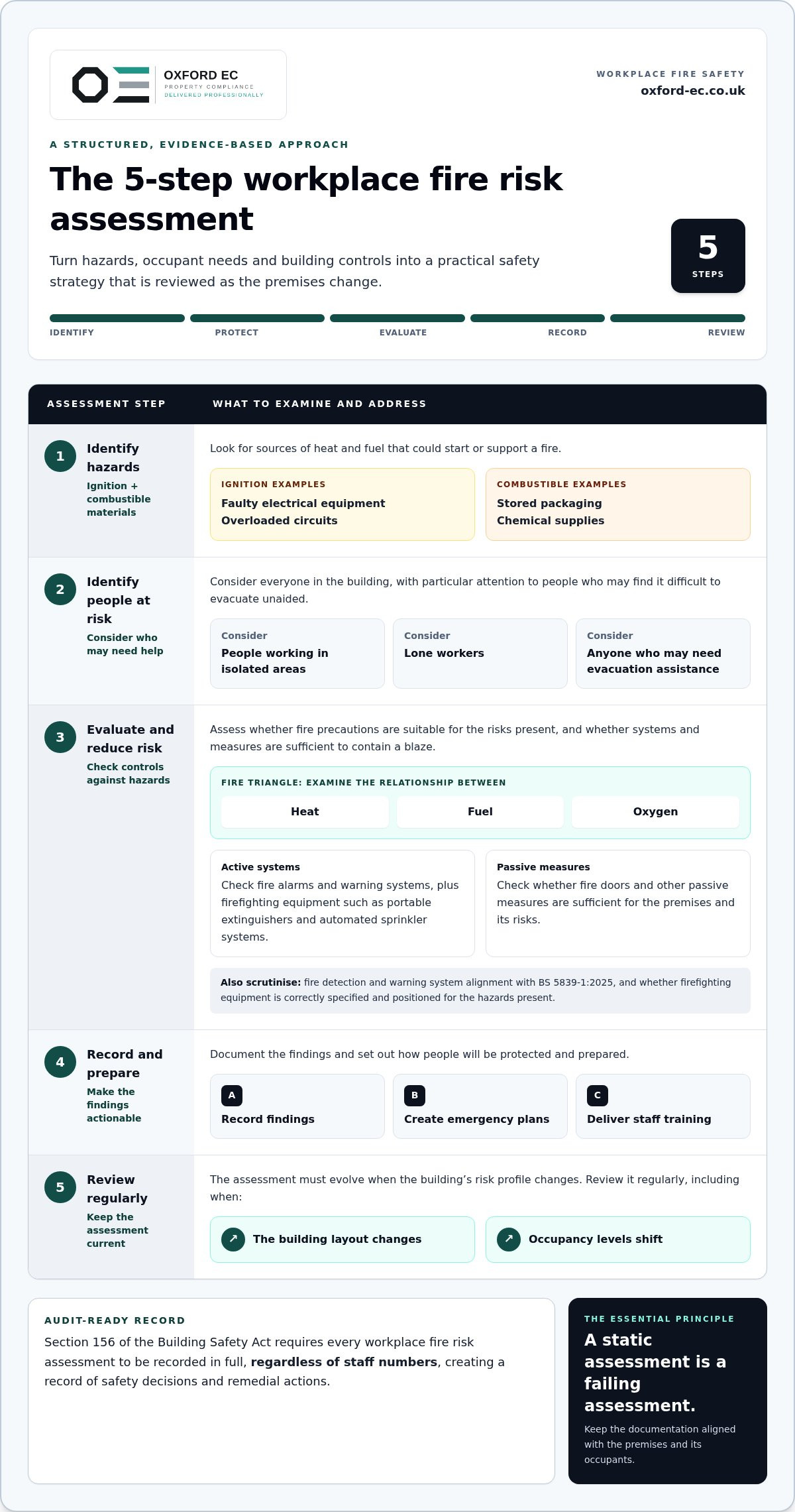
Executing a professional workplace fire risk assessment requires a structured, evidence-based methodology to ensure no vulnerability remains unaddressed. It isn't a cursory walk-through; it's a deep-dive audit into the building's infrastructure and human activity. The legal requirement for a fire risk assessment dictates a specific five-step approach that forms the foundation of life safety management. This process transforms abstract risks into a concrete, manageable safety strategy.
First, we identify hazards. This involves scrutinising ignition sources such as faulty electrical equipment or overloaded circuits alongside combustible materials like stored packaging or chemical supplies. Second, we identify people at risk. Whilst everyone in the building is potentially vulnerable, specific attention is paid to those working in isolated areas, lone workers, or anyone who might struggle to evacuate unaided during an emergency.
Step three focuses on evaluation and reduction. This means assessing whether active systems like alarms and passive measures like fire doors are sufficient to contain a blaze. Step four requires the meticulous recording of findings, the creation of robust emergency plans, and the delivery of staff training. Finally, step five mandates regular reviews. A static assessment is a failing assessment. If your building layout changes or occupancy levels shift, your documentation must evolve to match the new risk profile. If you're concerned about the validity of your current documentation, you can request a professional review from our technical team.
Hazard Identification and Risk Evaluation
Technical mastery of the "Fire Triangle" is essential. By analysing the interplay between heat, fuel, and oxygen within your specific environment, we can pinpoint exact failure points. We scrutinise the alignment of your fire detection and warning systems with BS 5839-1:2025 standards to ensure absolute reliability. This includes verifying that firefighting equipment, from portable extinguishers to automated sprinkler systems, is correctly specified and positioned for the hazards present. Every piece of hardware is an essential link in your safety chain.
Protecting Vulnerable Occupants
Inclusivity is a legal mandate. Protecting staff with disabilities requires the development of Personal Emergency Evacuation Plans (PEEPs), which provide tailored exit strategies and dedicated assistance. We also consider the unpredictable behaviour of visitors and contractors who may be unfamiliar with your site's topography or alarm protocols. From 6 April 2026, the Fire Safety (Residential Evacuation Plans) (England) Regulations 2025 make it a statutory duty for responsible persons in high-risk buildings to maintain and document these critical evacuation strategies for all residents requiring assistance.
Defining Competency: Why Professional Scrutiny Matters
Technical expertise. Regulatory mastery. Institutional knowledge. These are the three fundamental pillars of a legally robust workplace fire risk assessment. Whilst the UK Government Fire Risk Assessment Guidance suggests that a Responsible Person can conduct their own assessment if they feel competent, this "DIY" approach often collapses under the weight of complex modern legislation. Competency is not a self-certified trait; it's a demonstrable standard defined by the ability to identify hazards, evaluate risks, and specify appropriate remedial actions based on current British Standards and legislative frameworks. In a high-stakes environment, the difference between a "tick-box" exercise and a professional audit is the difference between safety and catastrophe.
Evaluating Assessor Credentials
Rigorous. Accountable. Transparent. When procuring professional services, you must scrutinise the specific credentials of the individual assessor to ensure they possess the requisite depth of knowledge. Look for professionals who are registered with recognised bodies such as the Institution of Fire Engineers (IFE) or the Institute of Fire Safety Managers (IFSM). Sector-specific experience is equally critical; an assessor who specialises in small retail units may lack the technical depth required to evaluate a high-rise residential block or a complex industrial facility with hazardous chemical storage. Before appointing a consultant, ask for evidence of their professional indemnity insurance and a portfolio of similar premises they've successfully audited to verify their suitability for your specific project.
The Risk of DIY Assessments
Insurers are increasingly meticulous. If a fire occurs and your assessment is deemed "unsuitable or insufficient" by the fire authority, your insurance cover may be voided, leaving you personally liable for damages. Internal assessments conducted by untrained staff often overlook critical technical details that a professional eye would immediately flag. Common failures identified during expert audits include:
- Misidentification of fire door ratings or missing cold smoke seals.
- Breaches in compartmentation within hidden ceiling voids or service risers.
- Inadequate specification of fire detection zones in relation to the building's specific layout and occupancy.
You can Learn about professional fire safety services to understand how a qualified consultant provides the "safe pair of hands" required to protect your assets and your people. A professional report isn't just a document; it's a defensive shield against legal, financial, and operational failure.
Passive Fire Protection and Multi-Disciplinary Compliance
Containment. Suppression. Structural resilience. Whilst active systems like alarms provide the essential warning, passive fire protection forms the physical barrier that preserves life and property by restricting the spread of flame and toxic gases. A comprehensive workplace fire risk assessment must extend its scrutiny beyond visible hardware to evaluate the building's internal fabric and its ability to withstand thermal stress. This integrated approach ensures that the "golden thread" of safety information remains intact, providing a robust defence against the rapid escalation of a fire event.
Fire Doors and Compartmentation
The integrity of your building's internal divisions is paramount. Professional fire door inspections are critical because even a minor gap in a seal or a faulty self-closing mechanism can render a fire-rated door useless against smoke infiltration. Under the Fire Safety (England) Regulations 2022, multi-occupied residential buildings over 11 metres in height now require quarterly checks of all fire doors in common areas and annual checks of flat entrance doors. These checks must be complemented by compartmentation surveys that look for breaches in hidden voids, ceiling plenums, and service risers where fire-stopping may have been compromised during historical maintenance. For those managing external egress routes, our fire escape staircase inspection guide details the structural standards required to ensure safe passage during an emergency.
The Asbestos-Fire Safety Link
Compliance cannot exist in a vacuum. Fire-stopping remedial works often require drilling into walls or ceilings, which inadvertently creates a significant risk of disturbing asbestos-containing materials (ACMs) if they haven't been properly identified. Aligning fire safety with asbestos management surveys is the only logical way to protect contractors and occupants whilst maintaining structural integrity. By adopting a multi-disciplinary approach, property managers can identify these overlapping hazards early, preventing costly delays and ensuring that one safety intervention doesn't trigger a separate environmental breach. Integrating all aspects of building compliance into a single, cohesive management strategy provides the "safe pair of hands" required for complex property portfolios.
Maintaining a Culture of Compliance and Continuous Review
Persistent vigilance. Rigorous oversight. Uncompromising standards. Achieving initial compliance is merely the first stage of a robust safety strategy; the true challenge lies in maintaining that standard through a culture of continuous review and operational discipline. Your workplace fire risk assessment must function as a dynamic management tool that evolves alongside your business, rather than a static document gathering dust in a compliance folder. By embedding safety protocols into daily operations, you ensure that your premises remain a "safe pair of hands" for staff, visitors, and stakeholders alike.
Review Triggers and Frequency
A review isn't merely a scheduled event; it's a reactive necessity triggered by any material change to the building's risk profile. Whilst an annual review cycle represents the industry gold standard for low-to-medium risk environments, certain events mandate an immediate reassessment. These triggers include structural refurbishments, changes in the nature of stored combustible materials, or significant shifts in occupancy levels that could compromise evacuation times. From 2026, legal standards dictate that every fire risk assessment must be documented in its entirety to provide a transparent and accessible record for the Building Safety Regulator.
Staff Training and Emergency Plans
Hardware alone won't guarantee safety. Fire drills and comprehensive staff training serve as the practical validation of your emergency plan, ensuring that every employee understands their specific role during an evacuation. This human element must be supported by a rigorous maintenance schedule for active safety systems, including quarterly fire alarm servicing aligned with BS 5839-1:2025 and monthly emergency light testing to ensure fail-safe operation. Organising these safety records into a logically structured compliance file is essential for a successful Fire and Rescue Service audit, as it demonstrates a proactive and methodical approach to risk management.
Professional consultancy provides the technical scrutiny required to navigate these evolving obligations with total confidence. By partnering with an accountable expert, you mitigate the risk of oversight and protect your organisation from the severe legal and financial penalties associated with non-compliance. It's about more than just meeting a legal threshold; it's about delivering a demonstrably safe environment through precision, expertise, and a commitment to absolute protection.
Contact Oxford Environmental Consultants for a professional fire risk assessment
Securing Your Statutory Future in 2026
Total regulatory alignment. Absolute workplace safety. Uncompromising technical standards. Mastery of fire safety requires more than a reactive posture; it demands a proactive, evidence-based strategy that aligns with the Building Safety Act 2022. By integrating passive protection scrutinies with a professionally conducted workplace fire risk assessment, you create a resilient shield against both physical hazards and legal liability. This multi-disciplinary approach ensures that hidden risks, such as those found in compartmentation breaches or asbestos-containing materials, are managed with absolute precision and accountability.
Maintaining an audit-ready status is a continuous obligation that safeguards your staff, your visitors, and your professional reputation. As enforcement trends from the Building Safety Regulator become increasingly rigorous, the value of a dependable, expert partner cannot be overstated. We provide national UK coverage and the technical mastery required to navigate these high-stakes requirements with total certainty.
Take the decisive step towards total regulatory alignment and operational peace of mind. Your journey to absolute workplace safety begins with a single, expert audit.
Frequently Asked Questions
Is a workplace fire risk assessment a legal requirement for small businesses?
Yes. Under the Regulatory Reform (Fire Safety) Order 2005, all businesses, regardless of size, must conduct one. Since Section 156 of the Building Safety Act, even those with fewer than five employees must record the assessment in full. Small businesses often mistakenly believe they are exempt, but the law requires a recorded workplace fire risk assessment to demonstrate compliance during any Fire and Rescue Service audit or insurance inquiry.
How often should a workplace fire risk assessment be reviewed in 2026?
Annual reviews represent the industry standard for maintaining safety. However, the legislation mandates an immediate review if there is reason to suspect the current assessment is no longer valid or if significant changes occur. This includes building refurbishments, changes in occupancy, or the introduction of new hazardous materials. A static document is a liability; regular scrutiny ensures your safety protocols remain aligned with the evolving risk profile of your premises.
Who is legally responsible for fire safety in a shared commercial building?
Responsibility is typically shared between the landlord and the individual business tenants. Each party is a "Responsible Person" for the areas they control. Cooperation is mandatory. Tenants manage safety within their demised premises, whilst the landlord or managing agent oversees common parts, structural integrity, and shared active systems. Failure to coordinate these efforts can lead to significant compliance gaps and collective legal liability during a regulatory inspection by the authorities.
Can I carry out my own workplace fire risk assessment?
Legally, yes, provided you are a "competent person" with sufficient training and experience. However, for complex or high-risk buildings, the technical depth required to evaluate passive fire protection and structural compartmentation often exceeds the capability of untrained staff. Appointing a professional assessor provides a "safe pair of hands," ensuring that your workplace fire risk assessment is technically accurate, audit-ready, and capable of withstanding rigorous legal and insurance scrutiny from all relevant stakeholders.
What happens if a business fails to produce a valid fire risk assessment during an audit?
Immediate enforcement action. Fire and Rescue Services can issue alterations, enforcement, or prohibition notices that may restrict your ability to trade. Serious breaches often lead to unlimited fines or custodial sentences for the Responsible Person under the Building Safety Act 2022. Beyond judicial penalties, a lack of valid documentation can void your commercial insurance policy, leaving the business exposed to total financial loss in the event of a fire-related incident.
What is the difference between active and passive fire protection in a risk assessment?
Active systems require a trigger to function. This includes fire alarms, sprinkler systems, and portable extinguishers that actively combat a blaze or warn occupants. Passive fire protection is built into the structure itself. It comprises fire doors, flame-retardant coatings, and compartmentation walls designed to contain smoke and heat. A professional assessment scrutinises both categories to ensure a comprehensive, multi-layered defence that preserves the building's structural integrity and life safety.
Do I need a new fire risk assessment if I have recently had an asbestos survey?
Not necessarily, but the two should be reviewed together. An asbestos survey identifies hazardous materials that could be disturbed during fire-stopping remedial works. If your asbestos survey reveals ACMs in areas where fire protection upgrades are required, your risk assessment must be updated to reflect these operational constraints. Managing these hazards amongst each other through a multi-disciplinary approach prevents accidental exposure and ensures total property compliance for all occupants.
How long does a professional workplace fire risk assessment take to complete?
Duration depends on scale. A small office might be surveyed in a few hours, whereas a complex industrial facility or a high-rise residential block could require several days of detailed on-site scrutiny. Following the site visit, a technical report is compiled to document findings and specify remedial actions. This methodical process ensures every hazard is identified and every safety system is validated against current UK legislative frameworks and British Standards.