

A single oversight in your asbestos register is not merely a clerical error. It is a legal liability. It is a risk to life. Under the Control of Asbestos Regulations 2012, your duty to manage asbestos uk requires more than a passive document tucked away in a filing cabinet; it demands a live, breathing operational strategy that withstands the most rigorous HSE scrutiny. We understand the pressure of navigating complex legislative frameworks whilst attempting to coordinate multiple contractors and decipher the critical nuances between presumed and identified hazardous materials.
This guide provides a definitive, step-by-step roadmap to creating and maintaining a legally robust asbestos management plan for 2026. By following this structured methodology, you'll move beyond the fear of prosecution and achieve a streamlined, audit-ready workflow that ensures absolute safety across your property portfolio. We will examine the essential components of Regulation 4 compliance, including the latest HSE focus on analyst independence, the implementation of digital registers, and the precise protocols required to maintain an uncompromising standard of building safety.
Key Takeaways
- Identify the specific legal parameters of the duty to manage asbestos uk to ensure your organisation is fully aligned with Regulation 4 of CAR 2012.
- Distinguish between material and priority assessment frameworks to move beyond mere identification and establish a robust risk-based scoring system for all hazardous materials.
- Implement a rigorous, step-by-step methodology for commissioning professional management surveys and drafting an operational, audit-ready written management plan.
- Secure long-term compliance through a multi-disciplinary approach that integrates expert asbestos consultancy with broader building safety and maintenance workflows.
Table of Contents
- Understanding the Duty to Manage Asbestos under CAR 2012
- The Essential Components of a Compliant Asbestos Management Plan
- Assessing Risk: Material vs. Priority Assessment Frameworks
- How to Implement and Review Your Asbestos Management Plan
- Professional Asbestos Consultancy: Securing Long-Term Compliance
Understanding the Duty to Manage Asbestos under CAR 2012
Compliance is non-negotiable. Precision is paramount. Safety is absolute. The legal framework governing asbestos in the United Kingdom is anchored by the Control of Asbestos Regulations 2012, specifically Regulation 4. This regulation establishes a clear, proactive mandate known as the duty to manage asbestos uk, which shifts the burden of proof onto those who control non-domestic premises. It's not enough to simply be aware that asbestos might exist; the law requires a systematic, documented approach to identifying, assessing, and managing every risk within the building's fabric.
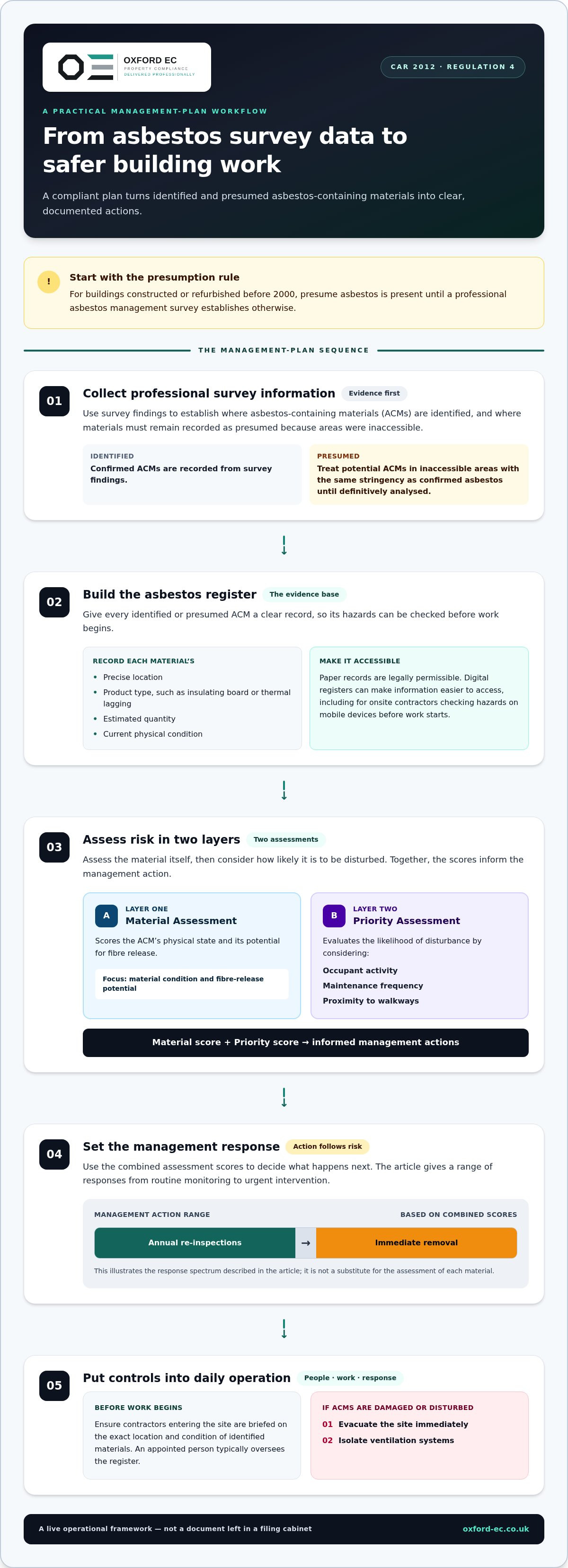
The scope of this duty extends beyond commercial warehouses and office blocks. It encompasses all non-domestic buildings and includes the common parts of domestic premises, such as foyers, lift shafts, and boiler rooms in blocks of flats. If a building was constructed or refurbished before the year 2000, the law presumes asbestos is present until proven otherwise through a professional asbestos management survey. This presumption is a critical pillar of safety, ensuring that no maintenance work proceeds without a verified understanding of the underlying hazards.
Identifying the Statutory Duty Holder
The identity of the duty holder is determined by the extent of their responsibility for maintenance and repair. In many instances, this is the building owner; however, the legal burden often shifts through lease agreements and contractual obligations. Establishing who holds the duty to manage asbestos uk within a complex multi-tenanted building requires a meticulous review of leasehold terms and maintenance contracts. If a tenant is responsible for the upkeep of a specific floor, they become the duty holder for that area. Conversely, managing agents often assume this role when they hold the authority to commission repairs. To ensure daily operational safety, an "Appointed Person" is typically designated to oversee the asbestos register; this individual ensures that every contractor who enters the site is briefed on the exact location and condition of identified materials.
The Consequences of Non-Compliance
Failure to maintain a rigorous management programme leads to severe professional and legal exposure. The Health and Safety Executive (HSE) possesses broad enforcement powers to issue improvement and prohibition notices, which can halt business operations instantly. Beyond operational disruption, the financial and personal risks are significant:
- Financial Penalties: Failure to produce a compliant asbestos management plan can result in fines of up to £20,000, whilst serious breaches often lead to unlimited fines.
- Custodial Sentences: Individuals found guilty of gross negligence can face imprisonment for up to two years.
- Commercial Risk: Non-compliance can invalidate professional indemnity insurance and severely devalue property assets during divestment or refinancing.
The Essential Components of a Compliant Asbestos Management Plan
A static document is a liability. It's a failure of oversight. Your management plan must be an active operational framework. Under the duty to manage asbestos uk, the Health and Safety Executive (HSE) expects a comprehensive strategy that translates raw survey data into actionable safety protocols. This plan serves as the primary mechanism for preventing exposure; it ensures that every occupant, maintenance worker, and contractor remains shielded from the risks associated with asbestos-containing materials (ACMs) through clear, documented control measures.
Structuring the Asbestos Register
The register is the evidentiary foundation of your strategy. It must contain granular data for every identified or presumed ACM, including the precise location, product type, such as insulating board or thermal lagging, estimated quantity, and current physical condition. If certain areas remain inaccessible during a survey, you must categorise any potential materials as "presumed" asbestos. This high-risk designation requires you to treat the material with the same level of stringency as confirmed asbestos until a definitive analysis is performed. Whilst paper records are legally permissible, digital registers offer superior accessibility, allowing onsite contractors to verify hazards via mobile devices before commencing work. If your current records lack this level of detail, you may require asbestos consultancy services to audit and refine your data.
Risk assessment within the plan is a dual-layered process. You must first perform a Material Assessment to score the physical state of the ACM and its potential for fibre release. This is followed by a Priority Assessment, which evaluates the likelihood of disturbance based on occupant activity, maintenance frequency, and proximity to walkways. These scores combine to dictate your management actions, ranging from annual re-inspections to immediate removal. To ensure your documentation meets these rigorous standards, contact our technical team for an expert review of your current management strategy.
Emergency and Contingency Planning
Precision in planning must extend to the unexpected. Your management plan must define clear, non-negotiable procedures for the accidental discovery of damaged materials or the unplanned disturbance of ACMs. This includes immediate site evacuation, the isolation of ventilation systems, and the engagement of licensed professionals to perform air monitoring and decontamination. In the event of a suspected fibre release, you must immediately seal the affected area, post warning signage, and prohibit entry until a four-stage clearance process confirms the environment is safe for re-occupation. Maintaining this level of readiness is a core component of your duty to manage asbestos uk. Your plan is a living document; it requires a formal review at least every 12 months, or sooner if building works occur, to reflect the current risk profile of the premises.
Assessing Risk: Material vs. Priority Assessment Frameworks
Risk is not a subjective variable. It is a calculated value. Identify the hazard. Quantify the risk. Implement the control. To fulfil the duty to manage asbestos uk, duty holders must implement a dual-framework assessment that distinguishes between the physical state of the material and the operational environment in which it exists. This methodology ensures that resources are allocated based on empirical evidence rather than conjecture. By combining the scores from a Material Assessment and a Priority Assessment, you establish a definitive risk profile that dictates your management priorities and determines the necessary frequency of onsite monitoring.
Scoring the Material Assessment
The Material Assessment provides an objective score based on the physical properties of the asbestos-containing material (ACM). This phase is typically executed by a professional surveyor during the initial inspection. The assessment evaluates four critical parameters: the product type, the degree of damage or deterioration, the nature of the surface treatment, and the specific fibre type identified through laboratory analysis. Each parameter is assigned a score from zero to three. A high-scoring material, such as damaged crocidolite pipe insulation, indicates a high potential for fibre release and demands immediate remedial intervention. This data serves as the technical baseline for your safety strategy.
Conducting the Priority Assessment
Whilst the Material Assessment focuses on the ACM, the Priority Assessment evaluates the human element. This is where the duty to manage asbestos uk becomes site-specific. As the duty holder, you possess the requisite knowledge of building occupancy and maintenance patterns to lead this assessment. You must evaluate the likelihood of the material being disturbed by considering several operational factors: the number of occupants in the area, the nature of their activities, the frequency of maintenance work, and the proximity of the ACM to high-traffic walkways or ventilation systems. A stable material in a locked plant room presents a significantly lower priority than the same material in a busy corridor.
The Total Risk Score is the sum of these two assessments. This final figure categorises the risk as high, medium, low, or very low. This score is not merely a number; it is a mandate for action. It directly informs your asbestos reinspection schedule, ensuring that high-risk materials are scrutinised more frequently than those in stable, low-traffic environments. This structured approach provides the peace of mind that your compliance strategy is both scientifically sound and legally robust. Precision in assessment. Accountability in management. Safety in delivery.
How to Implement and Review Your Asbestos Management Plan
Implementation is the final stage of compliance. The duty to manage asbestos uk demands a transition from passive data to active oversight. It requires a structured methodology to ensure that your safety protocols are both effective and legally defensible. Plan. Execute. Verify. This process bridges the gap between a technical survey report and a safe, operational working environment.
Implementation begins with empirical evidence. First, you must commission a professional asbestos management survey to establish a definitive baseline for your property portfolio. Second, draft a written management plan that translates risk scores into specific operational instructions; this document must explicitly define the chain of command and the allocation of resources. Finally, establish a robust monitoring and reinspection schedule to track the physical condition of ACMs over time, ensuring that any deterioration is identified and mitigated before it becomes a health hazard.
Communicating Information to Stakeholders
Communication is a statutory requirement. You are legally obligated to provide the asbestos register to any person likely to disturb the building's fabric, including employees, tenants, and external contractors. To ensure absolute control, you should implement a rigorous asbestos permit-to-work system; this protocol prevents any intrusive activity from commencing until the register has been scrutinised and the work formally authorised. Physical control measures, such as the strategic use of signage and labelling on identified ACMs, serve as a final, visible safeguard against accidental disturbance.
The Annual Review Process
The management plan is not a static record. It is a live operational framework. You must conduct a formal annual review to validate that the asbestos register still accurately reflects the physical condition of the premises and the effectiveness of your control measures. Following any asbestos removal or refurbishment work, the plan must be updated to reflect the altered risk profile of the building. An immediate review is mandatory if you have reason to suspect the plan is no longer valid, if there is a significant change in the building's usage, or if new information regarding the condition of ACMs comes to light.
Professional Asbestos Consultancy: Securing Long-Term Compliance
Complexity breeds risk. Fragmentation creates vulnerability. Oversight ensures safety. For national duty holders and estate managers, maintaining a compliant duty to manage asbestos uk across a diverse property portfolio is an immense logistical challenge. It requires more than just a collection of survey reports; it demands a unified, high-level strategy that withstands legal scrutiny and ensures the safety of every occupant. Engaging professional asbestos consultancy services provides the technical precision necessary to transform fragmented data into a cohesive, audit-ready management programme.
Oxford Environmental Consultants (OEC) acts as a disciplined, accountable partner for organisations navigating these high-stakes requirements. We provide a streamlined, one-stop solution that removes the ambiguity from regulatory alignment. By positioning ourselves as the "safe pair of hands" for your building safety needs, we ensure that your duty to manage asbestos uk is fulfilled with absolute exactness. Our consultancy does not merely identify hazards; we provide the strategic framework to manage them effectively over the long term, integrating asbestos safety with broader building requirements such as fire risk assessments to create a holistic safety culture.
The Value of Expert Oversight
Internal facilities teams often face an overwhelming administrative burden when managing asbestos across multiple sites. Professional consultancy alleviates this pressure by providing independent, third-party verification of all risk management activities. We ensure that every management plan is robust enough to satisfy an HSE inspector, with every risk score and control measure backed by empirical evidence. This meticulous level of detail reduces the potential for clerical errors and provides duty holders with the peace of mind that their legal obligations are fully discharged. By choosing an expert partner, you secure a guardian of compliance who is uncompromising when it comes to safety standards.
Integrating Building Safety
Modern property management requires a multi-disciplinary approach to property compliance. The Building Safety Act 2022 has intensified the focus on building data, requiring a "golden thread" of information that remains accessible throughout the building’s lifecycle. Integrating your asbestos management strategy with other critical safety audits, such as fire safety and water hygiene, creates a logical and efficient workflow. This combined approach ensures that no safety pillar is managed in isolation, reducing the risk of conflicting protocols and streamlining the maintenance process. OEC specialises in these multi-faceted requirements, providing the technical mastery needed to protect your assets and your people.
Contact OEC today to organise a comprehensive compliance audit and secure your property portfolio.
Securing Your Statutory Compliance in 2026
Compliance is not a destination. It is a standard. Fulfilling your duty to manage asbestos uk requires an uncompromising commitment to technical accuracy and operational rigour. We've established that a legally robust management plan must move beyond basic identification to incorporate sophisticated material and priority assessments that dictate the frequency of site monitoring. This structured approach ensures that every asbestos-containing material is managed with the precision required to protect both building occupants and the organisation's legal standing.
By integrating expert consultancy with a multi-disciplinary safety strategy, you create a protective shield against regulatory risk and operational failure. Oxford Environmental Consultants (OEC) provides the comprehensive national coverage and rigorous professional standards necessary to oversee complex property portfolios with absolute confidence. Our expert multi-disciplinary property safety consultancy ensures that your asbestos, fire, and water hygiene obligations are met through a single, streamlined point of accountability that prioritises evidence-based results.
Take the decisive step towards absolute building safety and professional peace of mind today.
Frequently Asked Questions
Who is legally responsible for the asbestos management plan in a commercial building?
The "duty holder" carries the legal burden of responsibility for the management plan. Identify the owner. Verify the lease. Establish the contract. This role is typically held by the person or organisation with clear maintenance and repair obligations for the premises. In multi-tenanted commercial buildings, responsibility may be shared between freeholders and leaseholders depending on the terms of the lease. Clarifying these boundaries is the first step in fulfilling your duty to manage asbestos uk.
How often must an asbestos management plan be reviewed in the UK?
Regulation 4 dictates that an asbestos management plan must be reviewed at least every 12 months. Review the data. Update the register. Validate the controls. This annual cycle is a mandatory statutory requirement to ensure the document remains an accurate reflection of the building’s condition. You must also conduct an immediate review if building usage changes significantly, if refurbishment work is undertaken, or if you suspect existing risk assessments are no longer valid due to material deterioration.
Do I need an asbestos management plan if my building was built after 2000?
Buildings constructed after the year 2000 generally do not require a formal asbestos management plan. The use of asbestos was fully banned in the UK in November 1999; therefore, premises built after this date are presumed to be asbestos-free. Check the records. Verify the date. Confirm the materials. If a building was constructed on a former industrial site or utilised salvaged materials, a cautionary assessment may still be necessary to ensure absolute safety and compliance with broader health and safety legislation.
What is the difference between an asbestos survey and an asbestos management plan?
An asbestos survey is the technical inspection used to identify the location, type, and condition of asbestos-containing materials. In contrast, the asbestos management plan is the operational strategy detailing how those identified risks will be controlled. Data provides insight. Strategy provides safety. Protocols provide protection. Whilst the survey provides raw data, the plan establishes the necessary protocols for monitoring and emergency response. Both are essential components of your duty to manage asbestos uk.
Can I write my own asbestos management plan or do I need a consultant?
Duty holders may draft their own plans provided they possess the necessary competence and technical knowledge. However, for complex property portfolios or high-risk environments, engaging a specialist consultant is the preferred route to ensure legal robustness. Mitigate the risk. Ensure the accuracy. Secure the compliance. Professional oversight provides independent verification of risk scores and ensures the management strategy can withstand rigorous scrutiny from the Health and Safety Executive during a formal compliance audit.
What information must I provide to contractors before they start work on my premises?
You must provide the asbestos register to any contractor or maintenance worker before they commence work on your premises. This data must be specific to the work area and include the location, product type, and condition of any identified or presumed ACMs. Brief the team. Issue the permit. Control the site. Implementing a permit-to-work system ensures this information is formally acknowledged, preventing accidental disturbance and maintaining a safe environment for all site personnel.
What should I do if I discover damaged asbestos in my building?
If damaged asbestos is discovered, you must immediately isolate the affected area and prohibit all access. Stop the work. Seal the area. Call the expert. Notify the designated duty holder or "Appointed Person" without delay. You must then engage a professional consultancy to perform air monitoring and assess the extent of the contamination. Re-occupation should only occur once a four-stage clearance process has been completed and a formal certificate of re-occupation is issued.
Is an asbestos management plan required for the common parts of a block of flats?
Yes, an asbestos management plan is a legal requirement for the common parts of domestic premises. This includes entrance foyers, lift shafts, and plant rooms where a landlord or managing agent holds maintenance responsibility. Assess the foyer. Survey the stairs. Manage the risk. Whilst individual private flats are exempt from Regulation 4, these communal areas are classified as non-domestic, necessitating a full survey and a documented management strategy to protect residents and visiting contractors.