
Your £150 DIY kit might be the most expensive mistake your business ever makes. Whilst the low entry price of a legionella water testing kit vs professional service is initially attractive, it frequently fails to provide the rigorous legal robustness required under ACOP L8. You likely recognise the heavy burden of property compliance and feel the persistent anxiety regarding potential HSE fines or prosecution. This 2026 guide clarifies the technical distinctions between self-administered kits and expert water hygiene services to ensure your building remains legally compliant. We promise to provide the clarity needed to protect your occupants and establish a definitive audit trail for health and safety inspectors. Precise sampling. Regulatory mastery. Absolute accountability. We examine the limitations of DIY accuracy, the necessity of professional interpretation, and the strategic importance of choosing a partner that acts as a protective shield against operational risk. By the end of this analysis, you will understand why a structured, professional approach is the only way to satisfy the meticulous demands of current water safety legislation.
Key Takeaways
- Define the Duty Holder’s mandate under ACOP L8 and the critical distinction between routine sampling and statutory risk assessments.
- Compare the technical accuracy of a legionella water testing kit vs professional service to identify potential gaps in your safety protocols.
- Understand the importance of "Chain of Custody" in professional water sampling and how it serves as a legal shield during HSE inspections.
- Analyse the total cost of ownership, weighing the low initial price of DIY kits against the long-term liability of insufficient data.
- Establish a clear, professional audit trail that protects building occupants and ensures your property remains fully compliant in 2026.
Table of Contents
- The Duty Holder’s Mandate: Navigating Legionella Compliance in 2026
- DIY Legionella Water Testing Kits: Speed vs Technical Certainty
- Professional Water Hygiene Services: Beyond Simple Sampling
- Comparative Analysis: Risk, Liability, and Long-Term Asset Safety
- Oxford Environmental Consultants: Securing Your Statutory Compliance
The Duty Holder’s Mandate: Navigating Legionella Compliance in 2026
The Duty Holder carries an uncompromising legal burden. Responsibility. Accountability. Liability. Under the Health and Safety at Work Act 1974, anyone in control of premises must manage the risks associated with the Legionella bacterium to ensure the safety of employees and the public. This mandate is not satisfied by a cursory glance at a water system or the occasional purchase of a DIY tool. Whilst evaluating a legionella water testing kit vs professional service, the primary factor is not the method of collection but the robustness of the management system that supports it. Statutory compliance requires a level of precision that mere 'snapshot' testing cannot provide; it demands a comprehensive understanding of the entire water infrastructure. A full statutory risk assessment is a multi-faceted evaluation of system design, operation, and maintenance, whereas simple testing is merely a diagnostic data point within that larger framework. The HSE expects a proactive demonstration of control, not just a reactive response to potential contamination.
The Legal Framework: ACOP L8 and HSG274
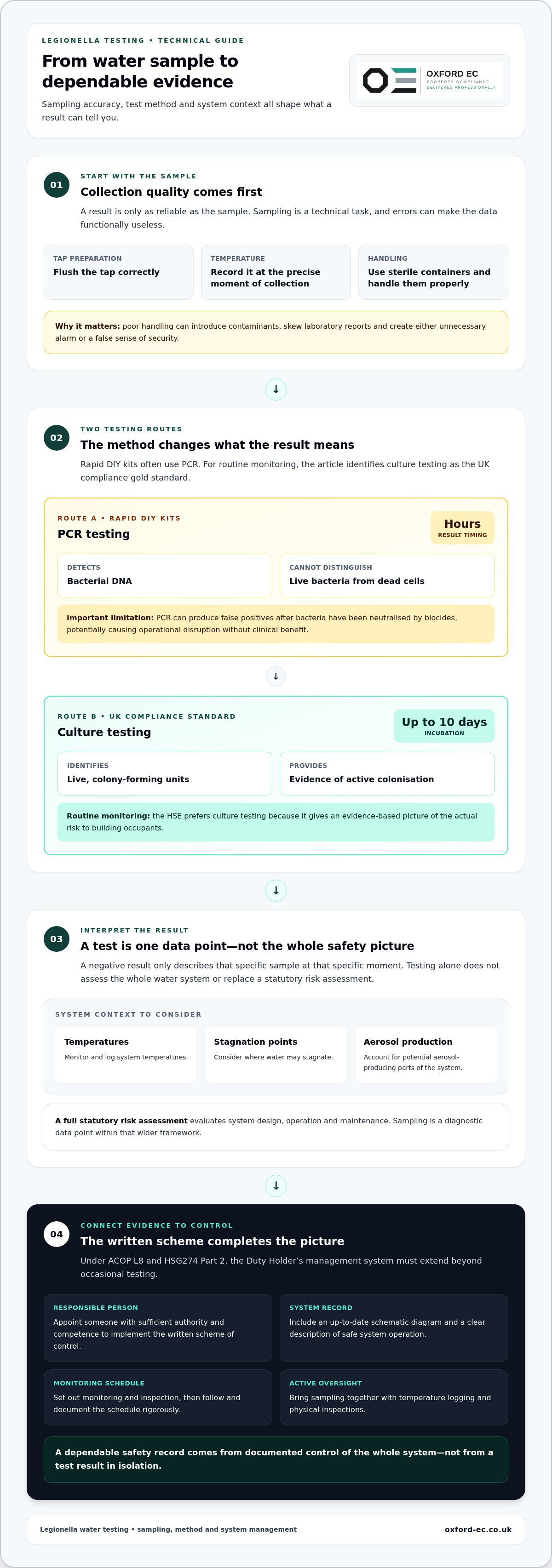
Compliance is anchored in the Approved Code of Practice L8 (ACOP L8), which has special legal status. Failure to comply can be used as evidence in criminal proceedings. The technical delivery of these requirements is detailed in HSG274 Part 2, focusing on the control of legionella in hot and cold water systems. Within this framework, the Duty Holder must appoint a 'Responsible Person' who possesses sufficient authority and competence. This individual is accountable for the implementation of a written scheme of control. It's a role defined by scrutiny. It's a role defined by detail. It's a role defined by safety. This scheme must include an up-to-date schematic diagram, a clear description of the system's safe operation, and a schedule for monitoring and inspection that is rigorously followed and documented.
Why Testing Alone is Never Enough
A single negative test result is often a dangerous illusion of safety. It indicates only that the bacteria were not present in that specific sample at that specific moment. The Health and Safety Executive (HSE) prioritises the active management of risk over reactive sampling. Relying solely on a legionella water testing kit vs professional service often misses the critical context of system temperatures, stagnation points, and aerosol production. A professional water hygiene strategy integrates testing into a wider written scheme of control. Regular monitoring, temperature logging, and physical inspections form the pillars of a dependable safety culture. Without these, a test result is merely data without direction. True protection is found in the meticulous oversight of the entire system, ensuring that every tap, tank, and pipe is accounted for in the audit trail.
DIY Legionella Water Testing Kits: Speed vs Technical Certainty
The market for off-the-shelf solutions is expanding. Low cost. Rapid delivery. Simple instructions. These factors drive the popularity of the DIY legionella water testing kit vs professional service, particularly for smaller duty holders seeking a quick fix for their compliance obligations. Standard kits typically include sample bottles, a return mailer, and occasionally dipslides for general microbial monitoring. However, this convenience often masks a significant deficit in technical certainty. Without a trained professional to manage the environmental variables, the risk of a compromised sample is high. A result is only as reliable as the hands that collect it. Exactness is non-negotiable.
The Problem with Sampling Error
Sampling is a technical discipline, not a clerical task. If a tap is not flushed correctly or if the temperature is not recorded at the precise moment of collection, the resulting data is functionally useless. Non-sterile containers or improper handling can introduce external contaminants, leading to skewed laboratory reports that trigger unnecessary panic or, worse, a false sense of security. Routine Legionella testing guidance emphasises that "instant" kits often lack the sensitivity required to detect low-level colonisation within complex pipework. This leaves the duty holder vulnerable to undetected growth. If you are unsure about your current sampling protocols, you may wish to discuss your requirements with a technical consultant to ensure your data is actually audit-ready.
PCR vs Culture Testing in DIY Kits
Technical distinctions matter. Most rapid DIY kits utilise Polymerase Chain Reaction (PCR) technology to detect DNA. Whilst PCR provides results in hours, it cannot distinguish between live bacteria and dead cells that have already been neutralised by biocides. This frequently results in false positives, causing significant operational disruption for no clinical benefit. Conversely, the gold standard for UK compliance remains culture testing. This method involves incubating samples for up to 10 days to identify live, colony-forming units. It's the only method that proves a system is actively colonised. Regulatory bodies such as the HSE prefer culture testing for routine monitoring because it provides a clear, evidence-based picture of the actual risk to building occupants. A DIY kit might give you a number, but it rarely gives you the truth.
Professional Water Hygiene Services: Beyond Simple Sampling
Rigour. Precision. Accountability. The professional approach to water sampling transcends the mere collection of fluids; it is a legally robust protocol designed to withstand the highest levels of regulatory scrutiny. Whilst a DIY tool provides a basic data point, a professional water hygiene service delivers a comprehensive audit trail. Central to this is the "Chain of Custody," a meticulous record that tracks the sample from the moment of extraction to its arrival at the laboratory. This document is essential for legal and insurance purposes, as it proves that the sample was not tampered with, was stored at the correct temperature, and was analysed within the required timeframe. When comparing a legionella water testing kit vs professional service, the difference lies in the evidentiary weight of the final report. If a positive result is identified, a professional partner provides immediate, expert "next steps" for remediation, ensuring that your response is as disciplined as your monitoring.
The UKAS Accredited Advantage
UKAS accreditation is the definitive hallmark of laboratory competence. It serves as a linguistic handshake between the duty holder and the HSE, proving that the analysis was conducted under strictly controlled, independent conditions. HSE inspectors specifically look for reports from UKAS-accredited laboratories because they provide third-party verification of data reliability. Without this accreditation, your testing results carry little weight in a formal health and safety audit. It is the difference between an unverified claim and a certified fact. This independent scrutiny ensures that the methods used for culture testing are consistent with the highest national standards, providing the peace of mind that your building occupants are truly protected.
Strategic Sampling and System Analysis
Expert technicians do not select sampling locations at random. They identify "sentinel points," such as the furthest and nearest taps on a circuit, which are most representative of the system’s overall health. This strategic oversight includes simultaneous temperature checks and biocidal level monitoring, which are integrated into a single, information-dense report. This multi-disciplinary approach links water hygiene directly to your broader property compliance strategy. By evaluating a legionella water testing kit vs professional service, it becomes clear that a kit offers a snapshot, whereas a professional service offers a shield. We don't just provide data; we provide a structured solution to complex, multi-faceted property requirements, ensuring every tank and calorifier is accounted for in your safety management plan.
Comparative Analysis: Risk, Liability, and Long-Term Asset Safety
The fiscal argument often centres on the immediate invoice. Price vs value. Risk vs reward. Evaluating the legionella water testing kit vs professional service requires looking beyond the initial purchase price to the total cost of ownership, which must account for the potential financial fallout of a compliance failure. A kit is a low-cost commodity; a professional service is a strategic investment in liability protection. Professional certificates carry significant evidentiary weight that DIY results simply cannot match during a forensic audit or HSE investigation. For duty-holders, the peace of mind factor is rooted in the knowledge that their water hygiene strategy is managed by a guardian of compliance rather than a self-administered checklist. This rigorous approach often reflects positively on insurance premiums, as underwriters recognise the reduced risk profile of a property managed with technical precision.
Liability: Who Carries the Burden?
Technical risk is a heavy weight for any business owner to carry alone. If a sample is collected incorrectly, that incompetent sampling can be used as evidence of negligence in a court of law. By engaging a professional service, you effectively transfer the technical risk to a specialist partner. Our reports are designed to be audit-ready, providing a robust defence against HSE enforcement actions. We don't just provide a result; we provide the accountability required to prove you've taken all reasonably practicable steps to ensure safety. It's about precision. It's about protection. It's about legal robustness.
When is a Kit Sufficient? (The Decision Matrix)
Not every environment requires a full-scale consultancy every month. The choice depends on the complexity of the water system and the vulnerability of the occupants. A clear decision matrix helps define the appropriate level of scrutiny for your specific assets:
- Low-Risk Environments: Small retail units with simple water heaters and limited pipework may find a kit sufficient for interim screening, provided a full risk assessment has already established a low-risk profile.
- High-Risk Mandates: Healthcare facilities, care homes, and buildings with cooling towers must never rely on DIY methods. The clinical stakes are too high for anything less than professional mastery.
- The Hybrid Approach: Some organisations use professional services for statutory audits whilst employing kits for internal, non-statutory checks between visits to maintain a continuous record of system health.
This matrix ensures that resources are allocated efficiently without compromising the safety of the building’s inhabitants. Understanding where your property sits on this spectrum is the first step toward a streamlined, logical solution to your compliance requirements.
Oxford Environmental Consultants: Securing Your Statutory Compliance
Oxford Environmental Consultants (OEC) acts as the definitive partner for your Legionella risk assessment and water hygiene requirements. We recognise that the choice between a legionella water testing kit vs professional service is fundamentally a choice between unverified data and total legal robustness. Our reporting is not merely a collection of laboratory results; it is a meticulously structured, audit-ready document designed to provide absolute peace of mind to duty holders. By integrating water hygiene into a broader multi-disciplinary compliance framework, we provide a streamlined solution that addresses the complex, multi-faceted nature of property safety. You can delegate your compliance anxiety to OEC, knowing that your assets are protected by a partner that thrives on detail, order, and uncompromising standards.
Meticulous Expert Scrutiny
Precision. Scrutiny. Exactness. Our commitment to accuracy begins the moment our environmental consultants arrive on site. Every water sample is collected with rigorous attention to technical variables, ensuring that the data we provide is beyond reproach and ready for health and safety inspection. These consultants possess the technical mastery required to identify subtle system risks that a DIY user would almost certainly overlook during a self-assessment. Following the analysis, we provide clear, actionable remedial advice that translates complex laboratory findings into a logical, evidence-based plan for risk mitigation. We don't just identify contamination; we deliver the professional management strategies required to maintain a safe environment for all building occupants whilst ensuring alignment with ACOP L8 standards.
National Reach, Local Precision
National coverage. Consistent quality. Accountable delivery. OEC provides specialist safety services across the United Kingdom, ensuring that multi-site organisations receive a uniform standard of excellence regardless of their location. By consolidating your requirements for water sampling, asbestos consultancy, and fire risk assessments under a single accountable partner, you reduce operational friction and strengthen your audit trail. This holistic approach ensures that no element of your statutory duty is neglected, as we act as a "safe pair of hands" for your entire property portfolio. Contact our team today to organise your professional water hygiene audit and secure the expert protection your property deserves.
Future-Proofing Your Water Hygiene Strategy
The choice between a legionella water testing kit vs professional service is ultimately a choice between data and defence. Whilst off-the-shelf kits provide a cursory glance at system health, they cannot replicate the legal robustness of a professionally managed audit trail. Statutory compliance in 2026 demands more than just a negative result; it requires the meticulous "Chain of Custody" and UKAS-aligned laboratory analysis that only expert consultants can deliver. By choosing a professional partner, you transfer technical risk and ensure your property is protected by multi-disciplinary compliance experts. Precise monitoring. Absolute accountability. Nationwide service delivery. We act as your guardian of compliance, providing the peace of mind that your building occupants are safe and your legal obligations are fully satisfied. It's time to move beyond the uncertainty of DIY methods and embrace a structured, professional solution that stands up to the highest levels of scrutiny.
Take the first step toward absolute regulatory certainty and protect your assets today.
Frequently Asked Questions
Is a Legionella water testing kit legally sufficient for a commercial property?
A legionella water testing kit vs professional service comparison reveals that a kit alone is rarely legally sufficient for commercial properties. Whilst the kit provides data, the Health and Safety at Work Act 1974 requires a demonstrable system of control. Without professional sampling and a full risk assessment, you lack the evidentiary weight needed for HSE audits. Relying on DIY methods often leaves the duty holder vulnerable to prosecution if a system failure occurs.
How often should Legionella testing be carried out in a workplace?
Testing frequency is determined by your specific Legionella risk assessment and the complexity of your water system. Whilst some low-risk environments require only annual monitoring, high-risk assets like cooling towers often necessitate monthly or quarterly sampling. Any significant change to the water system, such as a plant replacement or a change in water temperature, should trigger immediate re-testing. Consistency is the pillar of safety. Precision is the mandate.
Can I take my own Legionella samples and send them to a lab?
You can physically collect samples, but doing so compromises the legal robustness of your compliance records. Professional water sampling involves strict protocols to prevent contamination and ensure a clear "Chain of Custody" for laboratory analysis. Without these expert procedures, your results may be dismissed by inspectors or insurers during a liability claim. Meticulous collection is essential. Technical mastery is required. Entrusting this task to specialists ensures your data remains audit-ready.
What happens if my Legionella test kit returns a positive result?
An immediate response is mandatory if a test returns a positive result for Legionella. You must implement your written scheme’s emergency procedures, which typically include isolating the affected outlet, performing a chemical or thermal disinfection, and conducting follow-up sampling. A professional service provides the expert "next steps" required to mitigate risk effectively. Don't ignore low-level colonisation. Proactive management prevents outbreaks. Safety is the priority. Absolute accountability is required.
What is the difference between a Legionella test and a Legionella risk assessment?
A Legionella test is a snapshot of bacterial presence at a single point in time, whereas a Legionella risk assessment is a comprehensive evaluation of your entire water infrastructure. The assessment identifies potential hazards, evaluates system design, and establishes the written scheme of control required by ACOP L8. Testing is merely one diagnostic tool within this broader safety framework. One provides data; the other provides a strategic shield against operational and legal risk.
Are DIY Legionella testing kits accurate enough for landlords?
Accuracy in DIY kits is frequently undermined by user error during the collection process. For landlords, the primary concern is not just the result but the liability associated with "incompetent sampling." Whilst a kit might appear cost-effective, it lacks the technical certainty required to prove you've met your duty of care. Professional services provide the certified evidence needed to protect both your tenants and your legal standing. Safety. Accuracy. Accountability. These are non-negotiable.
Do I need UKAS accreditation for my water hygiene records?
UKAS accreditation for laboratory analysis is a critical requirement for credible water hygiene records. HSE inspectors and health and safety auditors specifically scrutinise reports to ensure they originate from accredited facilities. This independent verification proves that the testing methods meet rigorous national standards for precision and reliability. Without UKAS-aligned results, your compliance documentation lacks the authority needed to defend your safety protocols during a formal regulatory investigation. It's the gold standard.
How much does a professional Legionella testing service cost compared to a kit?
Evaluating the legionella water testing kit vs professional service requires a focus on total value rather than the initial invoice. A DIY kit is a low-cost commodity, but it carries the hidden price of technical risk and potential legal fees. A professional service includes expert interpretation, a robust audit trail, and the transfer of liability to a specialist partner. It's a strategic investment in asset safety and regulatory mastery that prevents expensive compliance failures.