

With fire-related deaths in England rising by 8% to 271 fatalities in the most recent reporting period, the margin for error in property safety has vanished entirely. Absolute compliance. Uncompromising standards. Total protection. You likely feel the weight of these statistics whilst navigating the complex updates to the Building Safety Act 2022 and the 2026 regulations for residential evacuation. It's an exacting environment for any responsible person tasked with conducting fire risk assessments across a diverse property portfolio.
We understand that managing fragmented safety data and fearing personal liability for non-compliance can be overwhelming. This guide promises to help you master the complexities of fire safety legislation and secure your property with the professional rigour your duty-of-care requires. We provide a clear roadmap for fire safety management, covering the latest 2026 regulatory changes, the critical updates to BS 8214:2026 fire door standards, and the technical requirements for Residential Personal Emergency Evacuation Plans to ensure your premises remain beyond reproach.
Key Takeaways
- Identify your core legal obligations under the Regulatory Reform (Fire Safety) Order 2005 to mitigate the risk of personal liability and uncapped financial penalties.
- Master the rigorous five-step methodology for professional fire risk assessments to ensure all building hazards are systematically identified and documented.
- Navigate the complexities of assessor competency and learn how to verify that your safety providers possess the necessary regulatory mastery.
- Transition from static documentation to a dynamic compliance lifecycle by establishing a robust review framework that adapts to legislative updates and building changes.
- Discover the strategic benefits of an integrated approach that aligns fire safety with broader property requirements like asbestos management and water hygiene.
Table of Contents
- The Statutory Mandate. Understanding your duties under UK Fire Safety Law.
- The Assessment Methodology. A rigorous five-step approach to risk mitigation.
- Strategic Scrutiny. Differentiating between assessment types and assessor competency.
- The Compliance Lifecycle. Establishing a robust review framework.
- Integrated Asset Protection. The OEC approach to property compliance.
The Statutory Mandate. Understanding your duties under UK Fire Safety Law.
Compliance is mandatory. Safety is absolute. Risk is managed. Under current UK legislation, fire risk assessments serve as the foundational document for property safety, acting as a systematic evaluation designed to identify hazards and safeguard every occupant within a premises. The Regulatory Reform (Fire Safety) Order 2005 remains the primary legislative pillar for all non-domestic buildings in England and Wales, yet its application has been significantly sharpened by subsequent acts. These legislative updates have transitioned the industry from a reactive posture to one of proactive, documented scrutiny that leaves no room for ambiguity.
The Fire Safety Act 2021 and the Building Safety Act 2022 have collectively intensified duty-holder accountability, expanding the scope of assessments to include external walls and flat entrance doors. Failure to maintain a valid, professional assessment is no longer a mere administrative oversight; it's a profound criminal risk. Authorities now exercise their power to issue unlimited financial penalties and custodial sentences of up to two years for the most serious breaches. To understand the broader context of these requirements, one should review the fundamental UK fire safety principles that underpin these rigorous standards.
The Role of the Responsible Person
Legal accountability. Personal liability. Professional duty. The 'Responsible Person' (RP) is the individual or entity that bears the ultimate weight of fire safety management. In commercial environments, the employer typically carries this mantle, whilst in residential blocks, it often falls to the building owner or managing agent. The RP holds a non-delegable legal duty to ensure that fire risk assessments are both current and comprehensive. In multi-occupied buildings, the law demands a high degree of cooperation and coordination between different RPs to ensure that safety measures aren't fragmented, particularly regarding shared escape routes and structural integrity.
Legislative Evolution in 2026
As of 6 April 2026, the Fire Safety (Residential Evacuation Plans) (England) Regulations 2025 have come into full force, introducing mandatory Residential Personal Emergency Evacuation Plans (RPEEPs) for specific high-rise buildings. This shift aligns with the 'Golden Thread' of information required by the Building Safety Act, necessitating a digital, verifiable record of safety decisions and structural data. Compliance now requires more than a simple checklist; it demands a culture of continuous scrutiny where every safety asset is tracked, tested, and aligned with the latest British Standards to protect both lives and assets.
The Assessment Methodology. A rigorous five-step approach to risk mitigation.
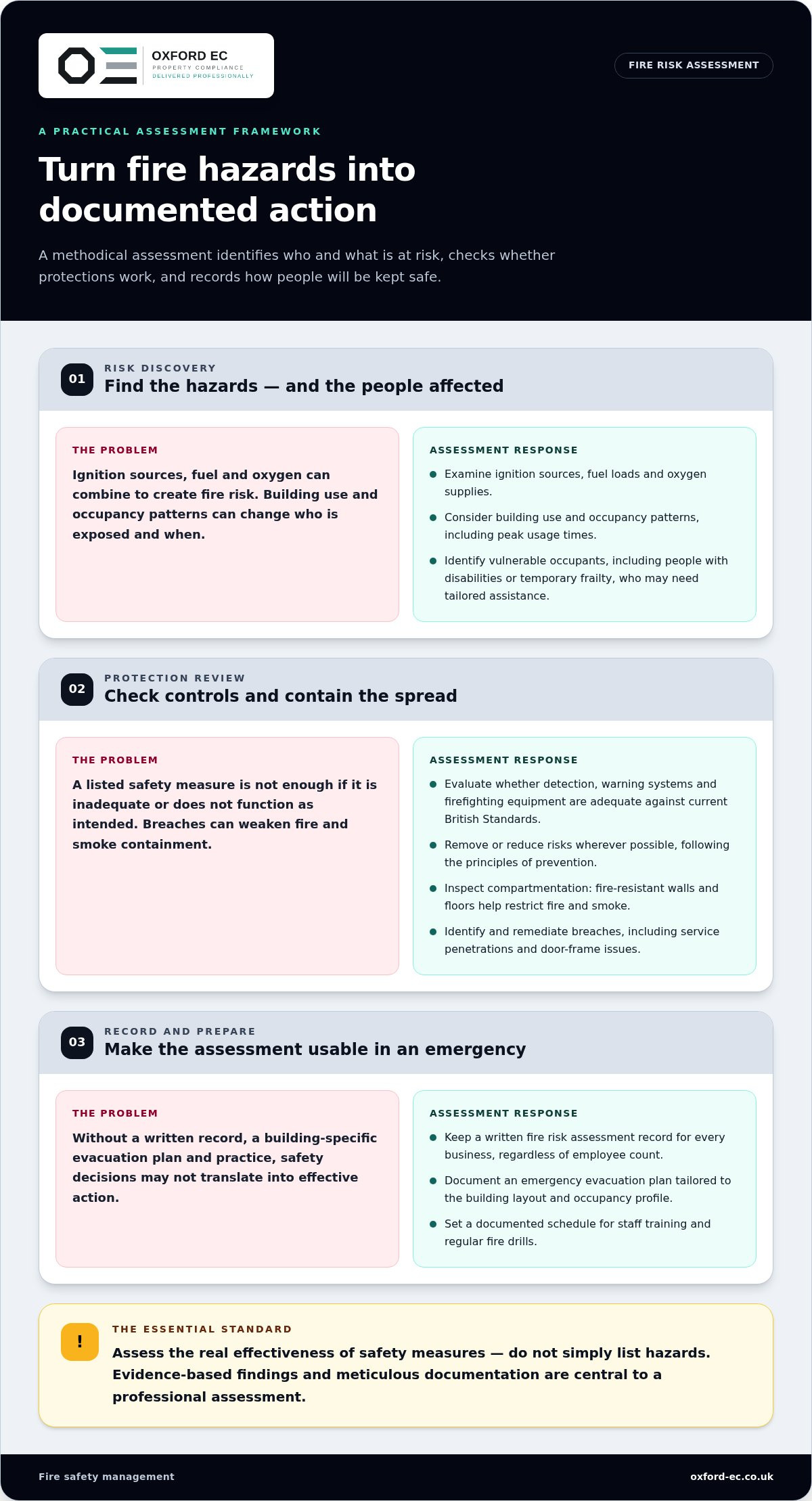
Methodical scrutiny. Precise delivery. Absolute mitigation. A professional execution of fire risk assessments demands an exhaustive examination of every physical and operational facet of a premises. This methodology must be entirely evidence-based and meticulously documented to satisfy the stringent requirements of fire and rescue authorities. It isn't enough to simply list potential hazards; an assessor must evaluate the actual efficacy of existing control measures to ensure they function as intended during a crisis. By integrating this process with other safety disciplines, duty-holders can ensure no hidden risks are overlooked in the broader compliance landscape.
Identifying Hazards and People at Risk
Assessors scrutinise ignition sources, fuel loads, and oxygen supplies to understand the fire triangle's presence within the site. This process extends to evaluating the specific needs of vulnerable occupants, including those with disabilities or temporary frailty who may require tailored assistance. We also examine how building use and favourite occupancy patterns influence risk levels, ensuring that peak usage times don't compromise safety margins. If you're managing complex multi-use sites, you can consult our technical team for a detailed site evaluation.
Evaluation and Remediation
The principles of prevention dictate that we must evaluate, remove, or reduce risk at every opportunity. This involves determining the adequacy of fire detection, warning systems, and firefighting equipment against current British Standards to ensure total coverage. Compartmentation is the structural method of fire containment that uses fire-resistant walls and floors to restrict the spread of fire and smoke within a building. Every breach in these barriers, from service penetrations to door frames, must be identified and remediated to maintain the building's protective envelope.
Recording and Planning
Under current duties under UK Fire Safety Law, there's a strict legal requirement for a written record of fire risk assessments for all businesses, regardless of employee count. This documentation must include a robust emergency evacuation plan tailored to the building's specific layout and its unique occupancy profile. Finally, establishing a documented schedule for staff training and regular fire drills ensures that the theoretical plan translates into effective, life-saving action. This structured approach moves beyond a simple checklist, providing a living roadmap for safety that protects both lives and assets.
Strategic Scrutiny. Differentiating between assessment types and assessor competency.
Precision matters. Expertise counts. Scrutiny delivers. Selecting the appropriate level of investigation for fire risk assessments is a strategic decision that directly influences the safety of a property's occupants and the legal standing of the Responsible Person. A generic approach is insufficient for complex or high-rise structures where hidden defects could lead to catastrophic failure. Professional assessors must go beyond the basic five-step approach to risk mitigation to provide an audit-ready document that reflects the true risk profile of the building. This level of exactness is particularly vital when managing multi-faceted property requirements that involve both life safety and structural compliance.
Assessment Types: From Type 1 to Type 4
Technical depth varies. Scopes differ. Objectives align. A Type 1 assessment is the standard non-destructive evaluation of common parts, suitable for many lower-risk commercial and residential buildings where the compartmentation is assumed to be intact. However, for higher-risk residential buildings or those with complex histories, Type 3 and Type 4 assessments are required to provide deeper scrutiny into individual dwellings and structural integrity. A Type 3 assessment remains non-destructive but extends the scope to include the interior of flats, whilst a Type 4 Fire Risk Assessment involves destructive sampling to inspect hidden voids and the quality of passive fire protection. This intrusive investigation is often the only way to verify that historical remedial work meets current regulatory standards.
Verifying Professional Competency
Regulatory mastery. Proven experience. Absolute accountability. Competency is a legal mandate under the Regulatory Reform (Fire Safety) Order 2005, yet duty-holders often struggle to verify the technical standing of their providers amongst a crowded marketplace. You must ensure your chosen partner demonstrates alignment with recognised industry standards and holds third-party certification from accredited bodies or professional registers. When evaluating a potential assessor, you should ask for evidence of their experience with similar building types and their specific knowledge of the Building Safety Act 2022. Professional indemnity insurance is a non-negotiable requirement for a 'safe pair of hands', providing the necessary legal protection and peace of mind that comes from professional scrutiny. This disciplined approach ensures that your safety management isn't just a paperwork exercise but a robust shield against risk.
The Compliance Lifecycle. Establishing a robust review framework.
Living records. Continuous scrutiny. Total compliance. A fire risk assessment is not a static document but a dynamic shield that requires professional rigour to remain valid. Once the initial audit is complete, the Responsible Person must transition into a lifecycle of proactive management to ensure safety measures don't degrade over time. In the 2026 regulatory environment, authorities expect a verifiable trail of review and remediation that reflects the current state of the building. Maintaining the validity of fire risk assessments is an ongoing commitment to transparency and evidence-based safety management.
The review cycle must be meticulously managed to account for any shifts in the building's risk profile. It's no longer acceptable to wait for a three-year anniversary if the building's use or structure has evolved in the interim. A robust framework ensures that the 'Golden Thread' of safety information remains unbroken, providing a protective envelope for both the occupants and the duty-holders. This methodical approach transforms fire safety from a reactive checklist into a streamlined, one-stop logical solution for property compliance.
Trigger Events for Assessment Review
Proactive management requires identifying specific events that necessitate an immediate re-evaluation of safety protocols. You shouldn't rely solely on annual benchmarks if significant changes occur within the premises. Common triggers include:
- Significant modifications to the building fabric, structural layout, or internal compartmentation.
- Substantial changes to occupancy behaviour, such as a shift in the number of vulnerable persons or a change in the building's primary use.
- Post-incident reviews conducted immediately following a 'near miss' or an actual fire event to identify system failures.
- Annual reviews, which remain the best-practice standard for commercial property compliance and high-risk residential structures.
Managing Remedial Actions
Findings from an assessment are only as valuable as the actions they generate. Every deficiency must be categorised into immediate, short-term, or long-term priorities and tracked through a formal remediation log. This process often involves technical specialists to ensure that hardware meets the required standards. For instance, the critical role of fire door inspections cannot be overstated when maintaining effective compartmentation. Similarly, a fire escape staircase inspection is essential for verifying the structural safety of primary egress routes. By managing these assets within the compliance lifecycle, you ensure the overall integrity of your fire risk assessments remains beyond reproach.
Integrated Asset Protection. The OEC approach to property compliance.
Streamlined solutions. Technical mastery. Absolute accountability. Oxford Environmental Consultants (OEC) provides a meticulous, one-stop framework for duty-holders who refuse to settle for fragmented safety data or disjointed reporting. By positioning fire risk assessments within a broader property compliance audit, we ensure that every vulnerability is identified and managed under a single, authoritative umbrella that prioritises life safety and legal robustness. Our delivery of audit-ready reports provides the transparency required to satisfy both internal stakeholders and external regulatory bodies, ensuring your property remains a safe, compliant environment.
We don't just act as a service provider; we serve as a guardian of your compliance status. Our methodology is built upon professional scrutiny and regulatory mastery, moving logically from the identification of complex requirements to the practicalities of delivery. This structured approach creates a sense of momentum and reliability, leading you through a safety process that feels controlled, thoroughly mapped out, and entirely aligned with the latest British Standards. You won't find colloquialisms or fluff in our reports; instead, you'll receive a linguistic handshake that proves our expertise through technical precision and evidence-based results.
The Benefit of Multi-Disciplinary Scrutiny
Managing safety in silos creates risk. When you integrate disciplines, you enhance protection. For instance, asbestos management and fire safety naturally intersect during building refurbishments or intrusive Type 4 investigations where disturbing the building fabric is a technical necessity. If an assessor identifies a breach in compartmentation that requires drilling or remedial works, knowing the asbestos status of that specific substrate is vital for health and safety. Similarly, managing water hygiene alongside fire safety through a single accountable partner significantly reduces the administrative burden whilst enhancing safety standards across your entire portfolio. This multi-disciplinary scrutiny ensures that a "safe pair of hands" oversees every technical requirement, from legionella sampling to passive fire protection.
Securing Your Property with OEC
Precision. Alignment. Protection. Our commitment to regulatory mastery ensures that your fire risk assessments are always aligned with the latest 2026 standards and the stringent requirements of the Building Safety Act 2022. We provide the professional rigour needed to navigate complex property requirements with total confidence, acting as an accountable partner for business owners and managing agents alike. This disciplined approach thrives on detail and order, ensuring that your safety management isn't just a paperwork exercise but a robust shield against risk. You can discuss your requirements with our technical team today to establish a structured, evidence-based safety roadmap for your assets.
Securing Your Future Compliance
Absolute precision. Legal robustness. Peace of mind. Mastering the 2026 regulatory landscape requires more than surface-level checklists; it demands an uncompromising commitment to the 'Golden Thread' of information and a multi-disciplinary understanding of property risk. By identifying the technical distinction between assessment types and establishing a proactive review framework, you move beyond mere compliance into a culture of total safety. These integrated efforts ensure that every hazard is identified, every remedial action is tracked, and every occupant remains protected under a unified strategy.
OEC was founded in 2018 with a singular focus on providing rigorous compliance solutions for UK duty-holders. Our multi-disciplinary expertise across fire safety, asbestos management, and water hygiene allows us to deliver authoritative reporting that stands up to the highest levels of professional scrutiny. We act as your safe pair of hands, ensuring that your fire risk assessments are accurate, evidence-based, and fully aligned with the Building Safety Act 2022.
Take control of your safety obligations today. Protecting your assets and the people within them is a continuous journey that we are proud to lead through technical excellence.
Frequently Asked Questions
How often should fire risk assessments be reviewed in the UK?
Professional best practice dictates that reviews should occur annually. However, legislative mandates require an immediate update following any significant structural alterations, changes in building use, or after a fire incident. This proactive management ensures that your safety documentation remains a living record rather than a static, obsolete file that fails to reflect current risks.
Is it a legal requirement to have a written fire risk assessment?
Yes. Since October 2023, all businesses in England and Wales must record their fire risk assessments in full, regardless of the number of employees. Previously, a threshold of five employees existed, but this exemption has been removed to ensure absolute transparency and accountability across all commercial and residential premises. Every finding and safety measure must now be documented to satisfy regulatory scrutiny.
Can I carry out my own fire risk assessment for my business?
The law allows the 'Responsible Person' to conduct the assessment if they are competent to do so. In practice, however, the complexity of modern fire safety legislation means most duty-holders lack the technical mastery required for a robust audit. Professional scrutiny is often the only way to guarantee legal robustness and avoid the severe personal liability associated with non-compliance.
What is the difference between a Type 1 and a Type 4 fire risk assessment?
Type 1 assessments are non-destructive and focus on common parts, making them suitable for standard compliance in lower-risk buildings. Type 4 assessments involve destructive sampling to inspect hidden voids and passive fire protection measures within individual dwellings. This intrusive level of detail is typically reserved for high-risk buildings where structural compartmentation must be verified through physical evidence.
Who is legally responsible for fire safety in a shared commercial building?
Legal accountability lies with the 'Responsible Person' for each individual tenancy. In multi-occupied premises, these RPs have a statutory duty to cooperate and coordinate their safety measures with one another. This ensures that individual fire safety strategies don't conflict with the building's overall emergency evacuation plan, providing a unified shield against risk for all occupants.
What happens if a fire risk assessment identifies significant hazards?
Identified hazards must be categorised by risk level and remediated within a specified timeframe. The Responsible Person is legally obligated to act upon these findings to ensure the safety of all occupants. Failure to implement these recommendations can lead to enforcement notices, unlimited fines, and even custodial sentences for the most serious breaches of duty.
How does the Building Safety Act 2022 change fire risk requirements?
This Act intensifies duty-holder accountability by mandating a 'Golden Thread' of digital safety information for higher-risk buildings. It requires more frequent reviews and sets a significantly higher threshold for the competency of those conducting fire risk assessments. The focus has shifted from simple, periodic compliance to a culture of continuous, evidence-based safety scrutiny.
Are fire door inspections part of a standard fire risk assessment?
A standard assessment includes a visual evaluation of fire doors, but it doesn't replace a dedicated fire door inspection. Specialized inspections involve a detailed audit of every component, including hinges, intumescent seals, and self-closing devices, to ensure they meet BS 8214:2026 standards. These surveys provide the technical, audit-ready data required for absolute precision in your safety management.