
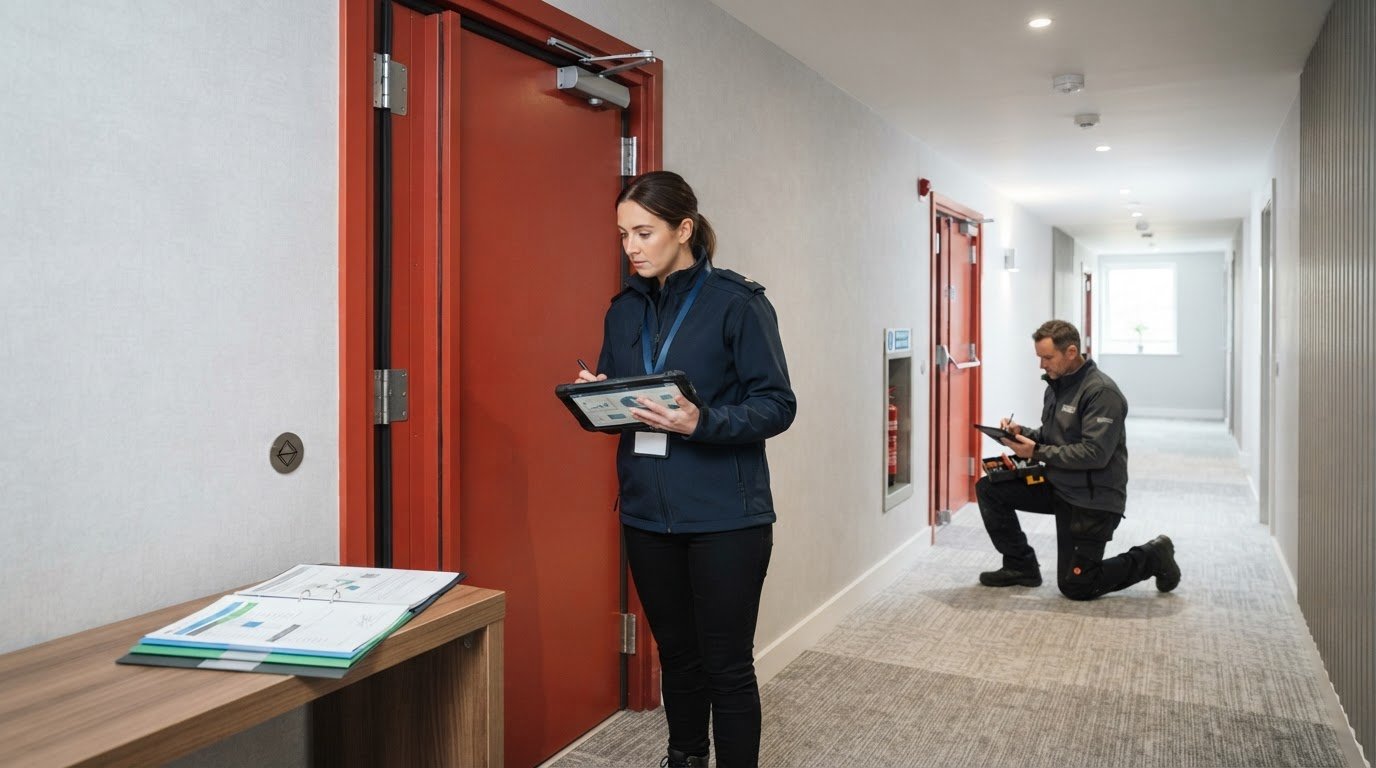
A fire door can be inspected and still leave a compliance gap: a note saying “checked” doesn’t show which door was examined, what was wrong, or whether a repair was verified. A useful record links each door to its findings, actions and follow-up, making fire door maintenance log requirements practical to manage and easier to evidence.
There isn’t one prescribed template for every building. The priority is to keep clear, traceable records that support the responsible person’s fire safety duties, rather than relying on a tick-box with no detail.
This checklist explains what to record for each door, how to assign defects and track repairs through to reinspection, and how to organise records for review. It also explains why inspection frequency depends on building context and risk, including specific requirements for certain residential buildings in England. Professional fire door inspections can provide structured findings for maintenance records and the wider fire safety assessment.
Key Takeaways
- The fire door maintenance log requirements are about keeping clear evidence of checks, defects, decisions, completed work and verification, not finding a particular statutory template.
- Give each door a unique reference and record its location, inspection date, checker, scope and findings so entries can be traced and understood.
- Set inspection intervals according to applicable requirements, building context, fire risk assessment and door use rather than applying one schedule to every site.
- Use a consistent process to prioritise defects, assign actions, record repairs and verify completion, supported by a controlled register or digital system.
- Professional fire door inspections can provide structured findings for maintenance records and help connect door condition with wider fire safety management.
Table of Contents
- Fire door maintenance log requirements: what the law expects
- What to include in a fire door maintenance log
- How often should fire doors be checked and maintained?
- Fire door maintenance log checklist: from inspection to action
- When professional fire door inspections strengthen your maintenance records
Fire door maintenance log requirements: what the law expects
A fire door maintenance log is the evidence trail for how doors are managed. It should show the sequence from checks and identified defects through decisions and completed work to subsequent verification. A tick against “inspected” doesn’t explain what was assessed or whether a problem was resolved.
The legal duty is to maintain relevant fire precautions, not to complete one universal fire door log template. Under the Regulatory Reform (Fire Safety) Order 2005, the responsible person for non-domestic premises in England and Wales must ensure fire safety measures are maintained. The Fire Safety Act 2021 clarified the Order’s scope in relation to external walls and flat entrance doors in relevant premises. Clear, consistent records help demonstrate how these duties are managed.
Is there a legally prescribed fire door log template?
There isn’t a single template that every UK building must use. Keep the distinction clear: legislation sets duties; government guidance helps explain how to meet them; and technical standards provide recommendations and good practice, but aren’t legislation in themselves. The Fire Safety (England) Regulations 2022 add specific fire-door checking duties for certain residential buildings in England, so those provisions don’t apply automatically across the UK.
Scotland and Northern Ireland have separate fire safety legislation and guidance, so the applicable framework depends on where the premises are, as well as their use and occupancy. For general background on doors and their components, see Fire door Wikipedia; use the relevant legislation and official guidance to establish legal duties.
Who should maintain the fire door records?
In England and Wales, the responsible person carries the fire safety duty. They may delegate checks and record-keeping to a facilities team, managing agent or other appointed person, but delegation doesn’t remove the need for oversight. In Scotland and Northern Ireland, identify the dutyholder under the applicable local framework rather than assuming the terminology and arrangements are identical.
Make accountability explicit. Assign who checks each door or area, who records findings, who arranges remedial work and who confirms completion. Owners, agents and facilities teams should agree how information is handed over when responsibilities change. Keep records accurate, accessible to those managing fire safety, and aligned with the building’s fire risk assessment and wider fire safety arrangements. Structured fire safety services can support a coordinated approach to inspection findings and records.
In practice, the fire door maintenance log requirements are easiest to manage when each entry can be traced to a door, a decision-maker and an outcome. The following checklist sets out what to capture.
What to include in a fire door maintenance log
A useful fire door maintenance log links each door’s condition to the actions taken in response and the evidence used to verify that work is complete. Meet the fire door maintenance log requirements with door-by-door entries, not broad notes that leave it unclear which doors were checked or what happened next.
Door identification and inspection details
Start with a stable reference for each door, linked to a floor plan or door register. A location such as “second-floor corridor” helps, but may not identify the door if several are in that area. Record available doorset identification details, such as labels or markings, so the door can be matched to its inspection history.
For every inspection, capture:
- Date and checker: record the inspection date and the checker’s name, role and relevant competence or experience. Don’t imply that one qualification is mandatory for every check.
- Scope and method: note which parts were examined, such as the leaf, frame, hinges, seals, glazing and closing action, and how the check was carried out.
- Limitations: record any access restrictions or components that couldn’t be assessed, why they couldn’t be assessed and what follow-up is needed.
- Observations: describe what was seen, where it was found and its condition. “Smoke seal detached along the lower hinge side” is more useful than “door checked” or “all fine”.
Defects, remedial work and closure evidence
Give each defect its own entry so it can be prioritised and tracked. Record the observed condition, its location and assessed priority, then identify an action owner, target date and current status. If interim controls are needed while work is arranged, document what’s in place, who is responsible and when the controls will be reviewed.
Keep the record open until there’s evidence of resolution. Add the work completed, completion date and relevant repair details, including parts or components used where known. Attach or reference supporting evidence, such as a report or photographs, where appropriate. Then record the post-work check, who carried it out and the outcome. If the repair hasn’t resolved the issue, keep it open and assign the next action.
This creates a clear sequence: finding, responsibility, repair and verification. Oxford Environmental Consultants provides fire door inspections with structured findings to inform maintenance records when doors need professional assessment.
How often should fire doors be checked and maintained?
There isn’t one inspection interval that suits every door or building. Set the schedule according to applicable legal duties, official guidance, the fire risk assessment and how each door is used. A busy door on a frequently used escape route may need closer attention than one with limited use, but any interval should have a clear, documented rationale.
Building context changes the inspection schedule
Distinguish routine observations by staff or building users from planned inspections and remedial maintenance. Routine observations can flag visible damage or doors that fail to close, but they don’t replace a formal inspection. Arrange repairs when defects are identified, with urgency guided by their potential effect on fire safety.
The table separates a specific legal requirement from guidance and risk-based scheduling. The England-specific requirement must not be applied automatically to buildings elsewhere in the UK.
| Building context | Requirement or scheduling basis | Source and scope |
|---|---|---|
| Residential buildings in England over 11 metres | Quarterly checks of fire doors in common areas and annual checks of flat entrance doors. | Fire Safety (England) Regulations 2022. England-specific provisions for relevant multi-occupied residential buildings. |
| General non-domestic buildings | BS 9999 recommends six-monthly fire door inspections; the fire risk assessment should inform the schedule, including whether higher-use areas need more frequent checks. | BS 9999:2017, a technical standard, not legislation. Apply the recommendation in light of the building and its risks. |
| Buildings in Scotland, Wales or Northern Ireland | Determine the applicable local legal duties and guidance, then set and record a suitable schedule for the premises. | Each nation has its own fire safety framework. Don’t transfer England-only requirements without checking scope. |
Building use, occupancy and the door’s function all matter. A door protecting an escape route or separating different areas may have a different risk profile from one in a low-traffic location. Use the fire risk assessment alongside any applicable specific requirements to inform how doors are managed.
Record why the interval was chosen
For each group of doors, note the legal or guidance source, the risk assessment rationale and the approved interval. Link each completed check to the door register. If a check is missed or access is restricted, record why, who is resolving the issue and the revised plan. These details make the schedule accountable.
Review the schedule after damage, building alterations, changes in occupancy or repeated defects. Adjust it if the evidence indicates that the existing interval no longer manages risk adequately. Record the reason and reassess when conditions change.
Fire door maintenance log checklist: from inspection to action
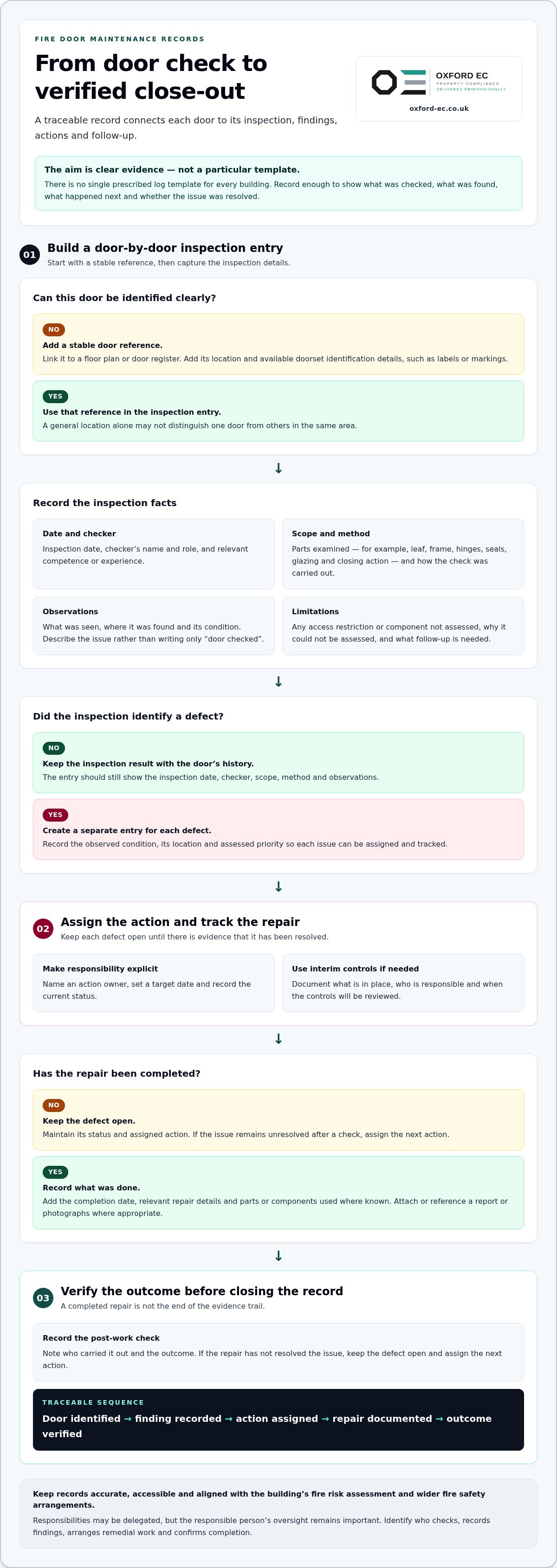
A reliable process stops an inspection finding disappearing into a report or email chain. Use the same door reference in the register, inspection record, repair instruction and verification entry. This turns separate tasks into a traceable control process.
A repeatable fire door log workflow
- Identify the door. Start with the door register and confirm its unique reference and location before checking it.
- Inspect and record. Enter the date, checker, scope, observations and access limitations promptly. Describe defects clearly and attach relevant evidence to the correct door record.
- Prioritise the finding. Assess its significance through the building’s fire safety process. Record the reason for the priority and any immediate risk-management decision.
- Assign the action. Name the responsible role or person, specify the required action and set a target date. Avoid entries such as “maintenance to investigate” without ownership or a next step.
- Track progress. Review open items regularly. Escalate overdue or significant defects through the responsible person’s safety arrangements, and document any revised deadline or control.
- Verify and close. Record the work completed, completion date and post-work check. Close the item only when there’s evidence that the action was completed and the outcome checked.
If a door needs immediate risk management, record the decision, control put in place, person responsible and review point. Mark the measure as temporary. It isn’t a completed repair, so keep the defect open until remedial work and verification are documented.
Keep records clear, controlled and audit-ready
A paper register or digital system can work if entries are dated, attributable and consistently organised. For digital records, use role-based access, version history and reliable backups. For paper records, control amendments and protect the register from loss or unauthorised changes. File inspection reports, photographs and repair evidence against the relevant door reference, not in an unlinked folder.
For example, an anonymised entry might read: Door FD-014, north corridor, 12 May: smoke seal detached at the latch edge. Priority raised for remedial action. Facilities manager assigned replacement by 19 May; temporary control recorded pending repair. Work completed 17 May; follow-up inspection on 18 May confirmed the seal was secure. Closed by inspector, with photograph filed to FD-014.
Consistent records make it easier to review outstanding defects and show how findings were managed. For wider regulatory context, see our fire door inspection regulations guide.
When professional fire door inspections strengthen your maintenance records
In-house checks are an important part of ongoing fire safety management, but some situations call for a more detailed assessment. A professional inspection can be particularly useful across a complex property portfolio, when defects keep recurring, when the condition or specification of doors is unclear, or when the responsible person needs structured findings to guide assurance and follow-up.
The value is more than an additional inspection entry. Clear findings help the person managing the building understand which doors were assessed, what condition was observed and which issues need further action. This gives the maintenance record a stronger basis for prioritising work, while decisions and oversight remain with the responsible person.
What professional findings add to the log
Oxford Environmental Consultants provides professional fire door inspections. Findings can identify the affected door, describe the observed defect and set out recommended follow-up, giving the responsible person useful information to enter against the relevant door record. This is especially helpful when a portfolio has repeated issues or internal records don’t clearly connect an observation with a particular doorset.
Use findings as the start of an action trail, not as evidence that remedial work is complete. Assign each action, record its owner and due date, then add completion details and verification evidence when the work has been checked. Inspection observations should remain traceable through to an evidenced outcome.
Turn inspection findings into a managed compliance record
Keep the inspection report with the corresponding door references and update the register as actions progress. Consider findings alongside the wider fire risk assessment: door condition may affect how fire precautions are managed, while issues involving walls or other building elements may need consideration within the broader compartmentation picture. Each assessment has its own scope, so record relevant findings without treating a door inspection as a substitute for a building-wide fire risk assessment or compartmentation survey.
Professional findings support the process; accountable follow-up completes it. The responsible person or delegated team should decide how actions are prioritised, track outstanding work and retain evidence of completion and any subsequent check. Oxford Environmental Consultants’ fire safety services include fire door inspections, fire risk assessments and compartmentation surveys, supporting a coordinated view of relevant fire safety findings.
Use inspection findings to update the door register, assign actions and track them through to verification.
Make every fire door record count
Effective fire door maintenance log requirements come down to a clear, traceable record: identify each door, document its condition, assign follow-up actions and retain evidence that completed work has been checked. Align the inspection schedule with the building’s legal duties, use and risk, and keep records accessible to those responsible for fire safety.
Professional findings can strengthen this process when door condition is unclear, defects recur or a portfolio is complex. Oxford Environmental Consultants provides fire door inspections, fire risk assessments and compartmentation surveys, helping responsible persons consider door findings within the wider fire safety picture. Its property compliance services support buildings across the United Kingdom.
Clear records and accountable follow-up help you manage defects and build a stronger evidence trail for fire safety decisions.
Frequently Asked Questions
Is a fire door maintenance log a legal requirement in the UK?
Fire safety duties require relevant precautions, including fire doors, to be maintained, but there isn’t one universally prescribed UK log template. In England and Wales, the Regulatory Reform (Fire Safety) Order 2005 sets duties for the responsible person in non-domestic premises. Scotland and Northern Ireland have separate frameworks, and specific provisions apply in some buildings in England. A clear maintenance record helps evidence how doors are checked, defects addressed and work followed up.
What should be included in a fire door maintenance log?
Record a unique door reference and location, inspection date, checker, scope, observations and access limitations. Describe each defect precisely, then note its priority, assigned action owner, target date and status. Add details of completed work and the date and outcome of a follow-up check. These records make it possible to trace each item from the initial finding through to verified closure.
How often should fire doors be inspected and maintained?
Inspection frequency depends on the building, door use, risk assessment and applicable legal requirements. In England, the Fire Safety (England) Regulations 2022 require quarterly checks of common-area fire doors and annual checks of flat entrance doors in relevant residential buildings over 11 metres. For general non-domestic buildings, BS 9999 recommends six-monthly inspections, but this is a technical standard, not legislation. Record the rationale and review it if conditions or risks change.
Can a digital fire door maintenance log be used?
Yes. A digital register can support consistent, searchable records, provided entries remain attributable and accessible to those managing fire safety. Use unique door references, dated entries and appropriate access controls; retain version history and reliable backups so changes and records can be traced. Attach inspection reports, photographs and repair evidence to the relevant door entry. A digital format doesn’t replace the need to assess defects, assign actions and verify completed work.
Who is responsible for keeping fire door maintenance records?
The responsible person holds the relevant fire safety accountability under the applicable framework, although record-keeping and checks can be delegated to facilities teams, managing agents or other appointed staff. Make responsibilities explicit: identify who inspects, records findings, arranges remedial work and confirms completion. Delegation doesn’t remove the need for oversight. Records should remain accurate and accessible, including when building management responsibilities or personnel change.
What should happen when a fire door defect is found?
Record the defect against the correct door, describing its location and condition, then assess its significance through the building’s fire safety arrangements. Assign an action owner and target date, and document any interim risk-management measures and review point. Track the repair to completion, retaining relevant evidence. Close the item only after recording a suitable post-work check. If the defect remains, keep it open and document the next action.
Do fire door inspection records need photographs?
Photographs can help show the location and nature of a defect and provide supporting evidence before and after remedial work. They shouldn’t replace a written description, door reference, inspection date or action record. Label or file images so they can be linked to the correct door and inspection entry. The record should still state what was observed, what action followed and how completion was checked.