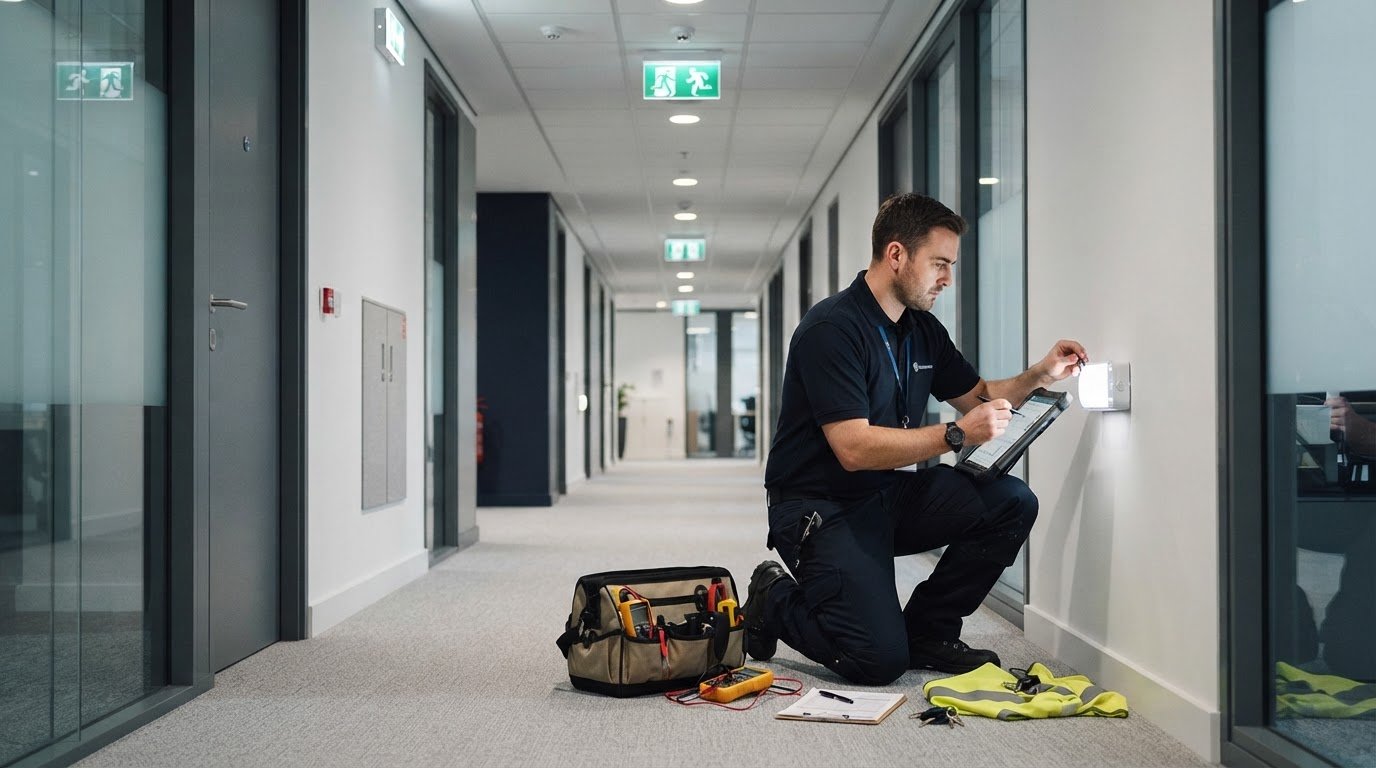
A completed test sheet doesn’t, by itself, prove that an emergency lighting system is suitable for your building. Understanding the emergency lighting testing regulations BS 5266 means distinguishing legal fire safety duties from technical guidance in the British Standard, then applying both in the context of your fire risk assessment. This distinction helps you decide what to check, how often to test and what evidence to retain.
It’s easy to be uncertain about the difference between a routine functional test and a full-duration test, or whether existing records are sufficient. BS 5266-1:2025 provides guidance for emergency lighting systems, while fire safety legislation places duties on responsible persons. The building’s risks and circumstances inform how those duties are managed. This article explains how the requirements fit together, what a practical inspection, testing and record-keeping routine should cover, and when competent professional support may be appropriate. It also explains why monthly functional checks and annual full-duration testing serve different purposes, and how clear records help identify faults and track remedial action.
Key Takeaways
- The emergency lighting testing regulations BS 5266 provide technical guidance, while fire safety duties and the premises’ risk assessment shape what’s appropriate for each building.
- Use the fire risk assessment to review escape routes and check whether emergency lighting remains suitable when the premises or its use changes.
- Understand the different purposes of routine functional checks and full-duration tests, and confirm the testing schedule for your system.
- Keep clear records of assets, locations, test dates, results, faults and follow-up actions so outstanding issues can be tracked and verified.
- Consider competent professional testing support if systems are complex, faults recur, records are incomplete or in-house expertise is limited. Clarify the scope and reporting before work begins.
Table of Contents
- What do emergency lighting testing regulations and BS 5266 mean?
- How do UK fire safety duties shape emergency lighting requirements?
- What is the difference between emergency lighting checks and annual tests?
- How should you document emergency lighting inspections and failed tests?
- When should you use professional emergency light testing support?
What do emergency lighting testing regulations and BS 5266 mean?
If normal lighting fails during a fire or another emergency, people may need to evacuate in darkness or reduced visibility. Emergency lighting helps illuminate escape routes and relevant areas, allowing occupants to find exits and move towards safety. The appropriate provision depends on the building and its risks, so it isn’t automatically the same across all premises.
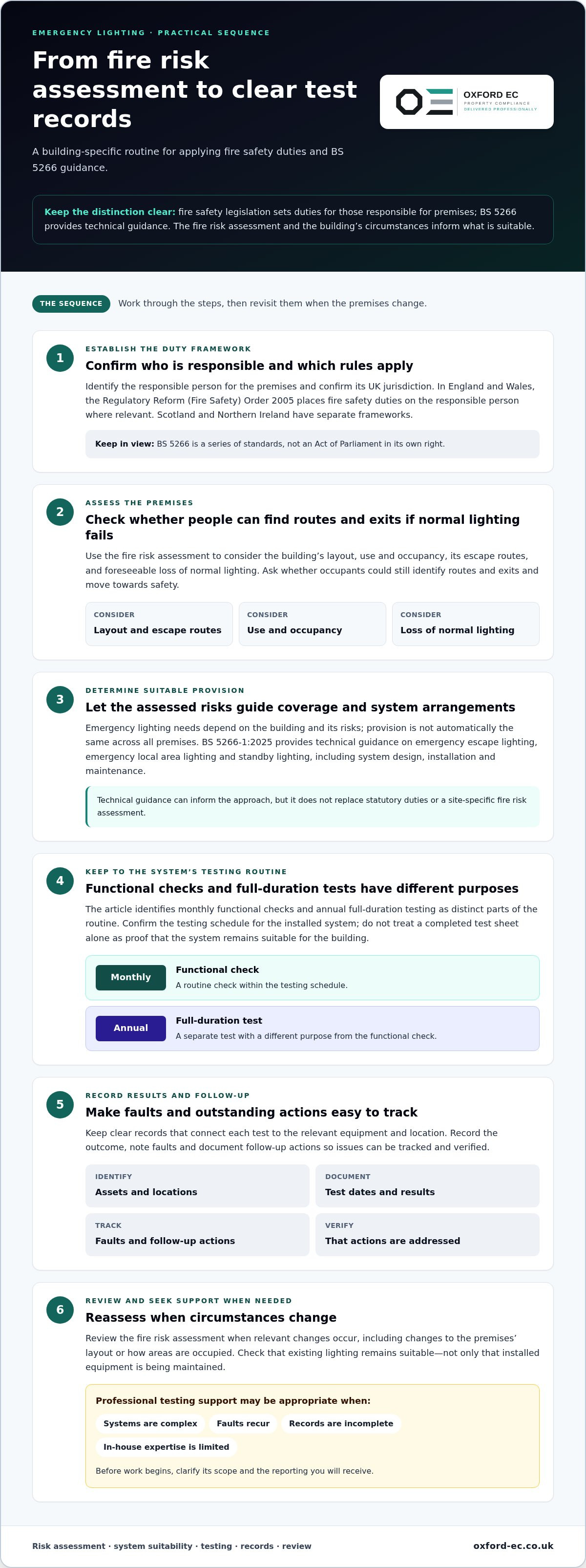
The phrase emergency lighting testing regulations BS 5266 brings together two different things. Fire safety legislation places duties on those responsible for premises, while British Standards provide technical guidance on designing, installing and maintaining systems. BS 5266 is not an Act of Parliament in its own right. Applying the relevant standard can inform a suitable approach, but the building’s fire risk assessment, system design and applicable legal framework remain central.
What is BS 5266, and how does it relate to emergency lighting?
BS 5266 is a series of standards covering emergency lighting. Its key code of practice, BS 5266-1:2025, was published on 31 October 2025, superseding the 2016 edition. It covers emergency escape lighting, emergency local area lighting and standby lighting, and provides guidance on system design, installation and maintenance. The standard aligns with related European standards, including BS EN 50172:2024. For a general overview of Emergency lighting, see the linked reference. For decisions about a particular building, consult the relevant standard and fire risk assessment.
A standard provides technical direction, but it doesn’t replace a site-specific assessment. For example, the escape routes, occupancy and use of a small office may differ considerably from those of a complex, multi-storey building. Those differences can affect the system required and how it should be managed.
Who is responsible for emergency lighting compliance?
Under the Regulatory Reform (Fire Safety) Order 2005, the responsible person in England and Wales must manage fire safety risks within the scope of the legislation. This role may fall to an employer, building owner or another person with control of the premises. Their responsibilities include considering escape routes and whether emergency lighting is needed to support safe evacuation. The fire risk assessment should inform that decision and be reviewed when relevant changes occur.
Fire safety legislation is not identical across the UK. Scotland and Northern Ireland have separate frameworks, so duty-holders should check the rules that apply where their premises are located. In practice, confirm the jurisdiction, fire risk assessment, and system design and maintenance information. These provide a sound basis for applying BS 5266 guidance without treating it as a universal legal checklist.
How do UK fire safety duties shape emergency lighting requirements?
Emergency lighting provision should follow the risks identified for the premises, not a one-size-fits-all checklist. A fire risk assessment considers whether people could use escape routes safely if normal lighting failed, then informs the suitable lighting coverage and system arrangements. A straightforward office layout may present different needs from a building with several floors, varied occupants or more complex escape routes.
This creates two related but distinct responsibilities. First, the duty-holder must assess whether emergency lighting is needed and suitable. Second, if a system is installed, it must be managed and maintained so that it remains capable of performing its intended function. Keeping existing equipment in working order doesn’t, by itself, show that its coverage remains appropriate if the building’s layout, use or risks have changed.
What does a fire risk assessment need to consider?
The assessment should examine escape routes and how occupants are expected to reach safety, taking account of the building’s layout, use and occupancy. It should consider foreseeable situations in which normal lighting could be lost, including a failure during an evacuation, and whether people could still identify routes and exits. These findings help determine suitable coverage and system arrangements. The answer depends on the premises and its risks.
Review the assessment when relevant changes occur, such as alterations to the layout or how areas are occupied. For broader context on fire safety management, see the client’s fire safety services. The British Standards Institution’s BS 5266 code of practice can also inform technical decisions. Confirm the applicable edition and relevant provisions for the project.
Does BS 5266 apply in exactly the same way to every building?
No. Building use, occupancy, layout, existing system design and assessed risks all affect how technical guidance applies. BS 5266-1:2025 is the current key code of practice, but a standard does not replace statutory duties or determine every site’s needs without reference to its circumstances. Maintaining installed equipment is not a substitute for assessing whether the provision is sufficient.
Legal frameworks also vary across the UK. The Regulatory Reform (Fire Safety) Order 2005 applies in England and Wales where relevant; Scotland and Northern Ireland have separate fire safety legislation. Duty-holders should establish which framework governs their premises and seek competent review if the assessment, system design or current standard requirements are unclear. Where specialist input is needed, professional inspection and testing can help assess system operation and identify faults.
What is the difference between emergency lighting checks and annual tests?
These checks answer different questions. A visual inspection looks for visible defects, a functional test confirms that fittings respond when normal power is lost, and a full-duration test assesses whether the system can operate for its designed duration. None of these checks replaces the others.
Monthly functional checks and annual full-duration tests are commonly referenced practice, but they shouldn’t be presented as universal legal wording for every premises or system. Verify the appropriate schedule, test method and duration against the current applicable standard, system design and manufacturer’s instructions. For further context on UK fire safety law and emergency lighting, consult the linked guidance alongside the premises’ own fire safety information.
What is a functional test of emergency lighting?
A functional test briefly interrupts the normal supply, using the system’s test facility where applicable, to check whether the emergency fittings operate. It can reveal a failed lamp, fitting or power source, but cannot show whether a battery will sustain the light for the full duration. Record the locations tested and any failures, then arrange investigation and repair. Confirm the interval and method against the current standard and system documentation.
What happens during a full-duration test?
A full-duration test assesses whether the system operates for the period it was designed to provide. The required duration and procedure depend on the system and applicable requirements. Three hours is commonly referenced, but shouldn’t be assumed to apply to every installation. Plan the test so that any temporary reduction in emergency lighting is managed, then check recharge and operational status in line with manufacturer guidance. Document the result and follow up on faults or incomplete recharging. This is the practical distinction behind the emergency lighting testing regulations BS 5266: check operation, assess endurance and act on findings.
How should you document emergency lighting inspections and failed tests?
A test record should show the responsible person what was checked, what failed and whether corrective action was completed. A tick or general note such as “tested OK” may not provide enough detail to trace a fault or verify that it was resolved. Keep records organised, accessible and linked to the relevant fittings or areas.
What should an emergency lighting test record include?
For each inspection or test, record the date, test type, equipment identifier or location, outcome and name of the person who completed it. Describe defects clearly, including fittings that failed to illuminate or any other abnormal result. Retain records in a logbook or equivalent system accessible to the responsible person and relevant maintenance professionals.
Use a consistent workflow:
- Identify the assets. Maintain a register of fittings and locations so each check can be matched to the correct equipment.
- Perform the planned check. Record the test method and any limitations. Don’t mark the whole system as passed if some areas weren’t checked.
- Document results. Note pass or fail outcomes and describe each defect clearly enough to support follow-up.
- Report and manage faults. Record who was informed, the decision made and any interim safety measures put in place.
- Verify resolution. Add repair details, the retest date and outcome. Close the fault only when follow-up confirms it’s resolved.
This evidence trail supports practical fire safety management and helps reveal recurring faults or overdue actions. Keep the record-keeping approach consistent with the system’s documentation and applicable requirements under emergency lighting testing regulations BS 5266.
What should you do if emergency lighting fails a test?
Act promptly, particularly if failed equipment could affect an escape route or occupant safety. Assess the immediate implications in the context of the building’s fire safety procedures, notify the responsible person and decide whether interim measures are needed while the fault is investigated. Record the defect, your assessment and the actions taken. Don’t assume a fitting will recover without investigation.
Arrange competent investigation and repair, keeping evidence of the work and decisions about temporary precautions. Once remedial work is complete, retest the affected equipment using an appropriate method, record the result and update the fault status. If the retest fails, keep the issue open and escalate it for further action.
When should you use professional emergency light testing support?
Professional support may be appropriate when a system is complex, faults recur, test records are incomplete or in-house staff don’t have the competence to carry out the required checks. It can also help when a change to the building or its use raises questions about system operation. Testing can assess operation and identify faults, but it doesn’t by itself establish that a system is suitable for every risk or guarantee compliance.
Oxford Environmental Consultants provides emergency light inspection and testing. Before arranging work, define what you need assessed and confirm the provider’s scope and reporting arrangements. Ask:
- How will fittings and locations be identified, and which tests will be carried out?
- How will results, limitations and defects be reported?
- What relevant experience, competence and insurance can the provider demonstrate?
- Who is responsible for arranging repairs, retesting affected equipment and updating the building’s records?
Clear answers help you understand what the service covers and what remains your responsibility. They also help ensure findings can be acted on, rather than simply filed away. Apply the emergency lighting testing regulations BS 5266 alongside the relevant standard edition, system documentation and premises-specific fire safety arrangements.
How can emergency lighting fit into wider fire safety management?
Connect inspection and test findings with the premises’ fire risk assessment and relevant safety records. If an escape route has changed, for example, check whether the assessment and emergency lighting information still reflect the current layout. Where emergency lighting and fire alarms are managed together, coordinate relevant records and responsibilities without assuming that testing one system verifies the other.
Keep the evidence trail clear: record findings, escalate defects that may affect escape or occupant safety, and track remedial action through to retest. Oxford Environmental Consultants provides emergency light inspection and testing alongside fire safety services, supporting duty-holders with property compliance. Confirm the current service scope and reporting deliverables before commissioning work.
Put your emergency lighting arrangements into practice
Sound emergency lighting management starts with the building’s fire risk assessment. BS 5266 provides technical guidance, while applicable fire safety duties and premises-specific risks shape the action required. Keep the distinction clear: routine functional checks and full-duration tests serve different purposes, and the appropriate schedule should be confirmed against the system and applicable guidance.
Records matter as much as the checks themselves. Identify the equipment and locations tested, document outcomes and faults, and track remedial work through to a recorded retest. This gives the responsible person a clearer view of system performance and unresolved issues.
Understanding the emergency lighting testing regulations BS 5266 is a practical step towards better-informed fire safety management, not a substitute for assessing the needs of your premises. Oxford Environmental Consultants provides emergency light inspection and testing, alongside fire safety and property compliance services nationally across the UK. Professional testing can help assess system operation and identify faults, but it doesn’t guarantee compliance or replace the duty-holder’s responsibilities.
With a clear assessment, appropriate checks and reliable records, you can manage your next steps with greater confidence.
Frequently Asked Questions
Is BS 5266 a legal requirement for emergency lighting?
No. BS 5266 is a British Standard, not a standalone Act of Parliament. It provides technical guidance that can help duty-holders plan and manage emergency lighting, while applicable fire safety legislation sets legal duties. The relevant framework depends on where the premises are located, and the fire risk assessment informs suitable provision. The emergency lighting testing regulations BS 5266 therefore involve applying guidance in context, not treating the Standard as legislation.
How often should emergency lighting be tested under BS 5266?
Monthly functional checks and annual full-duration tests are commonly referenced practice, but the appropriate schedule must be confirmed for the particular system. Check the current applicable standard, system design and manufacturer’s instructions rather than assuming one interval fits every installation. For central battery systems or other specific arrangements, additional checks may apply. The responsible person should ensure the testing plan reflects the premises’ fire safety arrangements and that results, faults and remedial actions are recorded.
What is the difference between a monthly test and an annual emergency lighting test?
A monthly functional test checks whether emergency fittings illuminate when the normal power supply is interrupted. It’s a brief operational check, not proof of battery endurance. An annual full-duration test assesses whether the system can operate for its designed rated period. Three hours is commonly referenced, but the applicable duration depends on the system and requirements. Record failures from either test, arrange follow-up and confirm the system’s recharge and operational status after a duration test.
What happens if emergency lighting fails its test?
If emergency lighting fails, assess the potential effect on escape routes and occupant safety, then follow the premises’ fire safety procedures. Notify the responsible person and consider appropriate interim safety measures while the fault is investigated. Arrange competent repair, record the defect and actions taken, then retest the affected equipment and document the outcome. Keep a fault open until follow-up confirms resolution. Escalate promptly if the failure could compromise safe evacuation.
Who is responsible for emergency lighting testing in a commercial building?
The responsible person under the applicable fire safety framework oversees fire safety management, including ensuring relevant precautions are maintained. Depending on the premises and jurisdiction, this may be an employer, building owner or another person with control. They may assign routine checks to staff or engage a competent provider, but should retain oversight of the schedule, faults and records. Fire safety legislation differs across the UK, so confirm which framework applies to the building.
Do all UK buildings need emergency lighting?
No single answer applies to every building. Whether emergency lighting is needed depends on factors such as the premises’ layout, use, occupancy and escape arrangements, as considered through the relevant fire risk assessment and applicable requirements. Review existing fittings if the building’s layout or use changes. The duty-holder should establish what provision is suitable for that specific premises rather than assume every building needs identical equipment.
What should an emergency lighting logbook contain?
An emergency lighting logbook should provide a traceable record of inspections, tests and follow-up. Include dates, test type, fitting identifiers or locations, results, faults found and the name of the person who completed the work. Record remedial actions, interim precautions where relevant, repair details and retest outcomes. Keep the logbook accessible to the responsible person and relevant maintenance professionals so unresolved defects can be tracked and completed actions verified.