

A static asbestos survey is not a safety strategy. It is a singular data point that offers zero protection the moment a maintenance contractor disturbs an unrecorded textured coating or hidden pipe lagging. You likely recognise that Regulation 4 of the Control of Asbestos Regulations 2012 demands more than just a folder on a shelf, yet the process of translating complex survey data into a functional asbestos management plan uk remains a constant source of professional anxiety. The burden of legal liability is heavy. The technical requirements are exacting. The margin for error is non-existent.
Rigour. Precision. Compliance. We understand the difficulty of coordinating disparate survey results with daily operational demands. This 2026 compliance guide provides the precise roadmap required to master the complexities of your duty to manage, allowing you to draft, implement, and maintain a robust framework that ensures absolute safety. By following this structured approach, you'll move beyond mere 'paper compliance' to achieve a clear, audit-ready workflow that protects your occupants, your contractors, and your professional reputation. We'll examine the critical pillars of risk assessment, the necessity of regular reviews, and the strategic integration of management actions into your broader building safety programme.
Key Takeaways
- Interpret the legislative framework of Regulation 4 to transition from passive awareness to an active, legally robust risk management strategy.
- Establish an accurate Asbestos Register and detailed site plan to serve as the definitive foundation for all property-related safety decisions.
- Implement a methodical, step-by-step process to develop an asbestos management plan uk that aligns survey findings with practical maintenance workflows.
- Optimise information-sharing protocols to ensure that all contractors and occupants are equipped with precise data before any intrusive works commence.
- Leverage professional consultancy to integrate asbestos management with broader building safety audits for a more resilient and audit-ready compliance posture.
Table of Contents
- Understanding the Asbestos Management Plan: A UK Regulatory Requirement
- The Core Components of a Compliant Asbestos Management Plan
- How to Develop Your Asbestos Management Plan: A Step-by-Step Guide
- Operational Implementation: Sharing Information and Emergency Procedures
- Professional Asbestos Consultancy: Ensuring Long-Term Compliance
Understanding the Asbestos Management Plan: A UK Regulatory Requirement
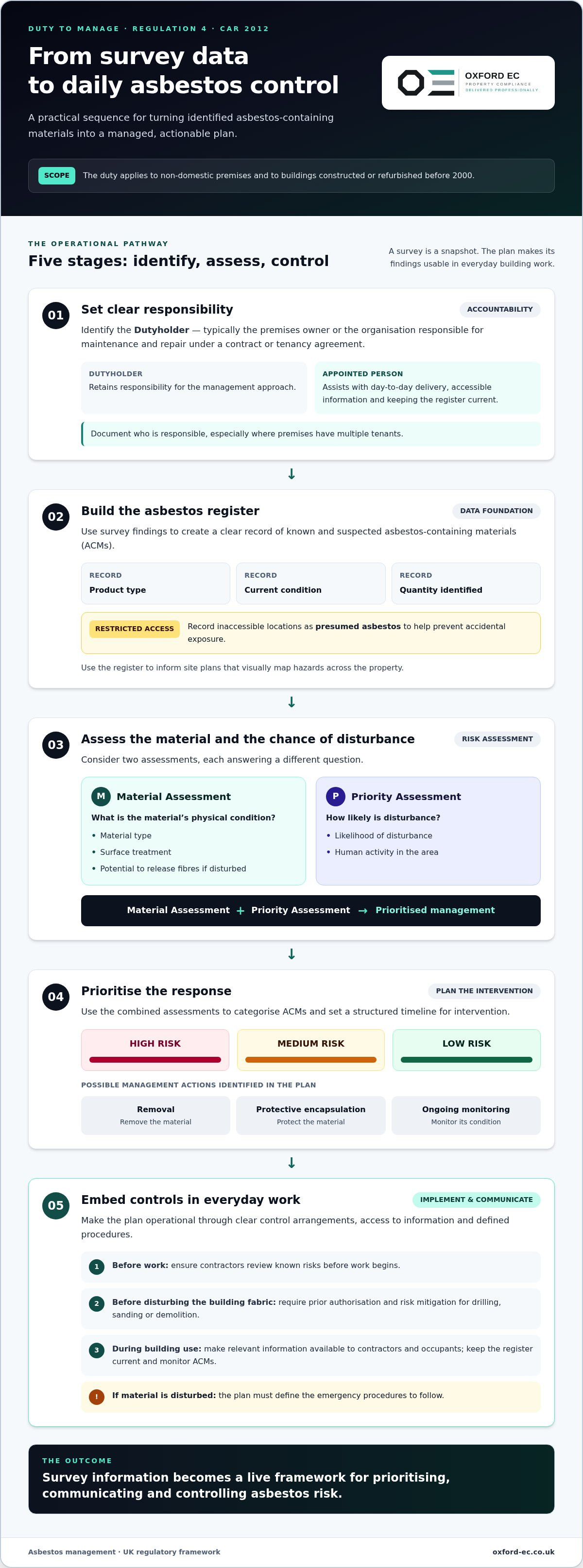
An asbestos management plan uk is not a passive document. It is a live, operational roadmap. It is a shield against liability. Identify. Assess. Control. This document is the definitive strategy for mitigating the risks associated with asbestos-containing materials (ACMs) within non-domestic premises. Under Regulation 4 of the Control of Asbestos Regulations 2012 (CAR 2012), the "Duty to Manage" is an explicit legal requirement that cannot be ignored. This mandate applies to any building constructed or refurbished before the year 2000, as these structures carry a significant probability of containing chrysotile, amosite, or crocidolite. Negligence carries heavy costs. The Health and Safety Executive (HSE) regularly issues improvement notices and substantial fines, whilst persistent failure to maintain an audit-ready plan can lead to custodial sentences for responsible parties.
The Role of the Dutyholder and the Appointed Person
Accountability must be absolute. The Dutyholder is typically the owner of the non-domestic premises or the entity responsible for the maintenance and repair of the building through a contract or tenancy agreement. In complex, multi-tenant commercial environments, these responsibilities must be documented with precision to ensure no gaps in safety coverage exist. Responsibility. Delegation. Oversight. To facilitate day-to-day safety, the Dutyholder often designates an Appointed Person. This individual assists in the practical execution of the strategy, ensuring that all information is accessible and that the asbestos register remains current. They act as the primary point of contact for contractors, ensuring that no work begins without a thorough review of the known risks. This documented accountability is the only way to prove compliance during a formal audit.
Why a Survey is Only the Beginning
A survey is data; a plan is action. Many organisations mistakenly believe that holding a report from Asbestos Consultancy Services fulfils their legal obligations. It doesn't. Whilst Asbestos Management Surveys are the essential first step in identifying the location and condition of ACMs, they are merely a snapshot in time. The "Duty to Manage" requires a continuous, dynamic framework that evolves with the building. The management plan must detail exactly how materials will be monitored, who will be informed of their presence, and what emergency procedures will trigger if materials are disturbed. If you only have a survey, you don't have a plan. You have a vulnerability. A robust plan ensures that the data collected during the survey is used to drive safety every single day.
The Core Components of a Compliant Asbestos Management Plan
A compliant asbestos management plan uk is a master document of technical precision. It must be granular. It must be actionable. It must be definitive. Beyond the survey data, the plan must codify the hierarchy of responsibility, establishing a clear chain of command from the Dutyholder to the site managers. This structure ensures that accountability is never diluted across multi-disciplinary teams. The plan must also include specific Control Arrangements. These are the documented protocols that govern how maintenance staff and external contractors interact with the building fabric, ensuring that no drilling, sanding, or demolition occurs without prior authorisation and risk mitigation.
The Asbestos Register: Your Data Foundation
The register is the core repository of all known and suspected risks. It must meticulously record the product type, its current condition, and the total quantity of the material identified. Precision. Integrity. Safety. In instances where physical access was restricted, the register must document these locations as 'presumed' asbestos to prevent accidental exposure. This data foundation allows for the creation of high-resolution site plans that visually map hazards across the property, providing an essential reference for anyone tasked with building repairs. If your current register feels incomplete or lacks the necessary detail to inform safe working practices, you may wish to speak with our consultancy team to verify your data integrity.
Risk Assessment and Prioritisation
Effective management requires the intelligent prioritisation of remedial actions. The Material Assessment score evaluates the physical state of the material, considering its type, surface treatment, and its potential to release fibres if disturbed. Conversely, the Priority Assessment is the calculation of the likelihood of disturbance based on human activity. By aggregating these scores, the Dutyholder can develop a logical management strategy that categorises ACMs into high, medium, or low risk, resulting in a structured timeline for intervention whether that involves immediate removal, protective encapsulation, or ongoing monitoring. This methodology ensures that resources are allocated where the risk to life is greatest, maintaining a safe environment for all building users.
How to Develop Your Asbestos Management Plan: A Step-by-Step Guide
Developing the plan requires a methodical transition from data collection to operational policy. The asbestos management plan uk must be built on a foundation of verified information. Start by scrutinising your Asbestos Management Surveys to identify any "no access" areas that require immediate resolution. These gaps represent unmanaged risks that could derail your compliance status. Once the data is validated, draft a formal policy statement. This document serves as the organisation's charter, outlining a clear commitment to safety and defining the financial and human resources dedicated to risk mitigation.
Communication is the secondary pillar of development. You must establish a robust protocol for sharing the asbestos register with any individual likely to disturb the building fabric. This is followed by a non-negotiable schedule for periodic reinspections. Condition monitoring is the mechanism that ensures your register remains a living document rather than a historical archive. It accounts for the natural degradation of materials over time, allowing for proactive rather than reactive maintenance.
Setting Your Management Strategy
Dutyholders must define a clear strategy: "Manage in Situ" or "Remediation". If materials are in excellent condition and located in low-access areas, managing them in place is often the most stable approach. However, if you have planned refurbishment or demolition works on the horizon, your timeline must incorporate professional removal or encapsulation. The plan must reflect the actual occupancy of the building. A high-traffic corridor requires a significantly different monitoring frequency compared to a restricted plant room.
Establishing Contractor and Staff Protocols
Operational safety depends on the rigour of your site protocols. Implement a "permit to work" system for all intrusive maintenance tasks. This ensures that no contractor can commence work without first reviewing the asbestos register and providing a signed acknowledgement of the risks present. Training. Awareness. Vigilance. Staff who operate in the vicinity of known ACMs must receive regular asbestos awareness training. They are the eyes and ears of your safety framework, capable of identifying and reporting material degradation long before it becomes a critical failure.
Operational Implementation: Sharing Information and Emergency Procedures
Operational implementation is the bridge between safety policy and site protection. The Dutyholder carries a non-delegable obligation to provide precise information to any person likely to disturb the building fabric. This includes maintenance personnel, visiting contractors, and IT installers. Information. Access. Transparency. Whether utilising centralised digital portals for real-time data distribution or maintaining physical logbooks at building reception points, the asbestos management plan uk must be immediately accessible. Digital solutions offer the advantage of instantaneous updates following remediation, whilst physical records provide a robust fail-safe for on-site operatives. Where appropriate, ACMs should be clearly labelled with industry-standard warning signs, particularly in high-risk zones such as plant rooms and service risers, to serve as a final visual deterrent against accidental disturbance.
A truly resilient safety framework does not exist in isolation. Integrating your asbestos strategy into a broader compliance audit ensures that risks are managed holistically across fire safety, water hygiene, and structural integrity. This multi-disciplinary approach eliminates the silos that often lead to oversight, providing the "safe pair of hands" required for complex property portfolios.
Developing Robust Emergency Procedures
Accidents require immediate, disciplined action. Your plan must codify a "What to do if asbestos is disturbed" protocol that leaves no room for ambiguity. Evacuate. Seal. Notify. The affected area must be immediately vacated and secured to prevent the spread of airborne fibres, followed by the notification of the Appointed Person or Dutyholder. Professional intervention is then mandatory. This involves engaging specialist contractors for decontamination and conducting rigorous air monitoring to verify that the environment is safe for re-occupancy. Documentation of the incident and the subsequent remedial actions must be appended to the management plan to maintain a complete audit trail.
Monitoring and Annual Reinspections
Compliance is not a one-time achievement. The legal framework necessitates a formal review of the plan at least every 12 months to account for the natural degradation of materials or changes in building usage. Meticulous documentation of these reinspections is essential to demonstrate ongoing control. Certain trigger events, such as a change in building occupancy, the commencement of major structural repairs, or the discovery of previously hidden ACMs, must prompt an unscheduled, immediate review of the strategy. This ensures the management framework remains aligned with the physical reality of the property.
Professional Asbestos Consultancy: Ensuring Long-Term Compliance
Expertise. Accountability. Protection. The transition from a static register to a functional asbestos management plan uk is a significant technical undertaking. By utilising professional Asbestos Consultancy Services, Dutyholders can delegate the complexities of risk prioritisation and remediation scheduling to established experts. This partnership drastically reduces the administrative burden, allowing property managers to focus on core operations whilst maintaining a robust legal posture. A professionally drafted plan provides more than safety; it provides evidence. Whether facing a routine HSE inspection or navigating the due diligence of a high-value property transaction, having an audit-ready management framework is the only way to prove that the duty to manage has been fully discharged.
Rigour is essential. An expert consultant does not merely list risks but provides a disciplined strategy for their control. This includes the precise drafting of policy statements, the establishment of communication hierarchies, and the implementation of monitoring frequencies that reflect the actual usage of the building. This level of scrutiny ensures that the plan remains a live, defensive document that evolves alongside legislative changes and structural modifications. It transforms a fragmented set of data points into a cohesive safety shield.
Integrating Asbestos with Fire and Building Safety
Modern property management requires a multi-disciplinary lens. There is an undeniable crossover between asbestos management and fire risk assessments that is often overlooked by single-service providers. Compartmentation surveys, for example, frequently involve the inspection of service risers and ceiling voids where asbestos insulation or boards may be present. If these ACMs are not mapped correctly, fire safety upgrades can lead to accidental exposure, project delays, and severe legal repercussions. Oxford Environmental Consultants (OEC) serves as a unified compliance partner, integrating asbestos data with broader building safety pillars. This holistic approach ensures that one safety measure never compromises another, providing a streamlined and logical solution to fragmented property risks.
Selecting the Right Consultancy Partner
Evaluate. Scrutinise. Decide. Selecting the right consultancy partner is a strategic decision for any organisation. You must look beyond basic certifications to assess technical competency, regulatory mastery, and the ability to deliver consistent results at scale. For organisations with a diverse property portfolio, national reach is a non-negotiable requirement. It ensures that every site, regardless of location, adheres to the same meticulous standards and reporting structures. Oxford Environmental Consultants (OEC) acts as a disciplined guardian for your property requirements. We provide the transparency and evidence-based results necessary to secure your long-term compliance and peace of mind.
Contact Oxford Environmental Consultants (OEC) for expert asbestos management support
Securing Your Property Lifecycle Through Strategic Compliance
Managing asbestos is a continuous commitment to building safety and legal integrity. A compliant asbestos management plan uk requires more than a simple survey; it demands a dynamic strategy that translates technical data into operational maintenance. By establishing clear emergency protocols and maintaining a rigorous annual reinspection schedule, you transition from reactive anxiety to proactive control.
Vigilance. Rigour. Compliance. Oxford Environmental Consultants (OEC) provides the meticulous expert consultancy required to safeguard your complex property portfolio. Our multi-disciplinary safety specialists offer full UK national coverage, ensuring that your asbestos management aligns perfectly with fire risk and water hygiene standards. We act as your safe pair of hands in an increasingly scrutinised regulatory environment.
Achieving absolute compliance and peace of mind is within reach when you have the right technical partner at your side.
Frequently Asked Questions
Is an asbestos management plan a legal requirement in the UK?
Yes, maintaining a written asbestos management plan uk is a mandatory legal requirement under Regulation 4 of the Control of Asbestos Regulations 2012. This duty to manage applies to all non-domestic premises, including industrial, commercial, and public buildings. Failure to produce a compliant plan during an HSE inspection can lead to prosecution, heavy fines, or even imprisonment. It's the definitive operational framework for controlling risks associated with asbestos exposure within the built environment.
How often should an asbestos management plan be reviewed?
The plan must be reviewed at least every 12 months to ensure its continued effectiveness and accuracy. You should also conduct an immediate, unscheduled review if there's a change in the building's use, if maintenance work is planned, or if existing asbestos-containing materials are disturbed. Regular monitoring is essential to document the physical condition of materials. This ensures that your safety strategy remains aligned with the current state of the property.
What is the difference between an asbestos survey and a management plan?
An asbestos survey is a technical inspection designed to identify the location, type, and condition of hazardous materials. In contrast, the management plan is the live, operational strategy that uses that survey data to control risks. Whilst the survey provides the register, the plan dictates how you'll monitor materials, inform contractors, and manage emergencies. One is a snapshot of data; the other's a dynamic framework for ongoing property safety.
Who is responsible for the asbestos management plan in a rented commercial building?
The responsibility lies with the "Dutyholder," which is typically the person or organisation responsible for the maintenance and repair of the premises. In a rented commercial building, this is often the tenant under a full repairing and insuring lease, although the landlord may retain responsibility for common areas. The specific division of duties must be clearly documented in the lease agreement to ensure absolute accountability and a seamless compliance workflow across the property.
What happens if I don’t have an asbestos management plan?
Operating without a compliant asbestos management plan uk exposes you to severe legal and financial repercussions. The HSE can issue improvement or prohibition notices, resulting in substantial fines and potential custodial sentences for responsible officers. Beyond legal liability, you risk the accidental disturbance of fibres, which endangers occupants and contractors. This negligence can also lead to significant project delays and increased remediation costs during property transactions or planned refurbishments.
Do domestic properties need an asbestos management plan?
Individual private dwellings don't typically require a formal asbestos management plan under CAR 2012. However, the legislation does apply to the common parts of domestic premises, such as foyers, lift shafts, and boiler rooms in blocks of flats or social housing. Dutyholders for these shared spaces must identify risks and implement a management strategy. This ensures that maintenance staff and contractors remain safe whilst working in communal areas of residential buildings.
Can I write my own asbestos management plan?
You can technically draft your own plan if you've the necessary competence, knowledge, and experience to interpret complex survey data. However, most Dutyholders engage professional consultancy services to ensure the document meets the rigorous standards required for an HSE audit. An expert-led approach eliminates technical errors, provides a clear hierarchy of responsibility, and ensures that your risk assessments are based on precise, evidence-based prioritisation of remedial actions.
What should I do if I find damaged asbestos in my building?
Immediate action is required to prevent fibre release. You must evacuate the area, seal off all access points, and notify the Appointed Person or Dutyholder as specified in your emergency procedures. Don't attempt to clean or move the material yourself. You must engage a specialist consultancy to conduct air monitoring and manage the safe remediation or removal of the damaged material. This disciplined response is critical for maintaining an audit-ready safety framework.