

Managing a compliance property portfolio in 2026 demands far more than superficial box-ticking. The regulatory landscape has evolved into a complex, interwoven framework where fire safety legislation sits alongside water hygiene protocols, asbestos management intersects with building safety requirements, and damp and mould obligations apply equally to commercial and residential estates. For building owners, property managers, and landlords, understanding what constitutes a truly compliant property-and maintaining that status audit-ready throughout the year-has become both a legal necessity and a reputational imperative.
The Regulatory Foundation of Compliance Property
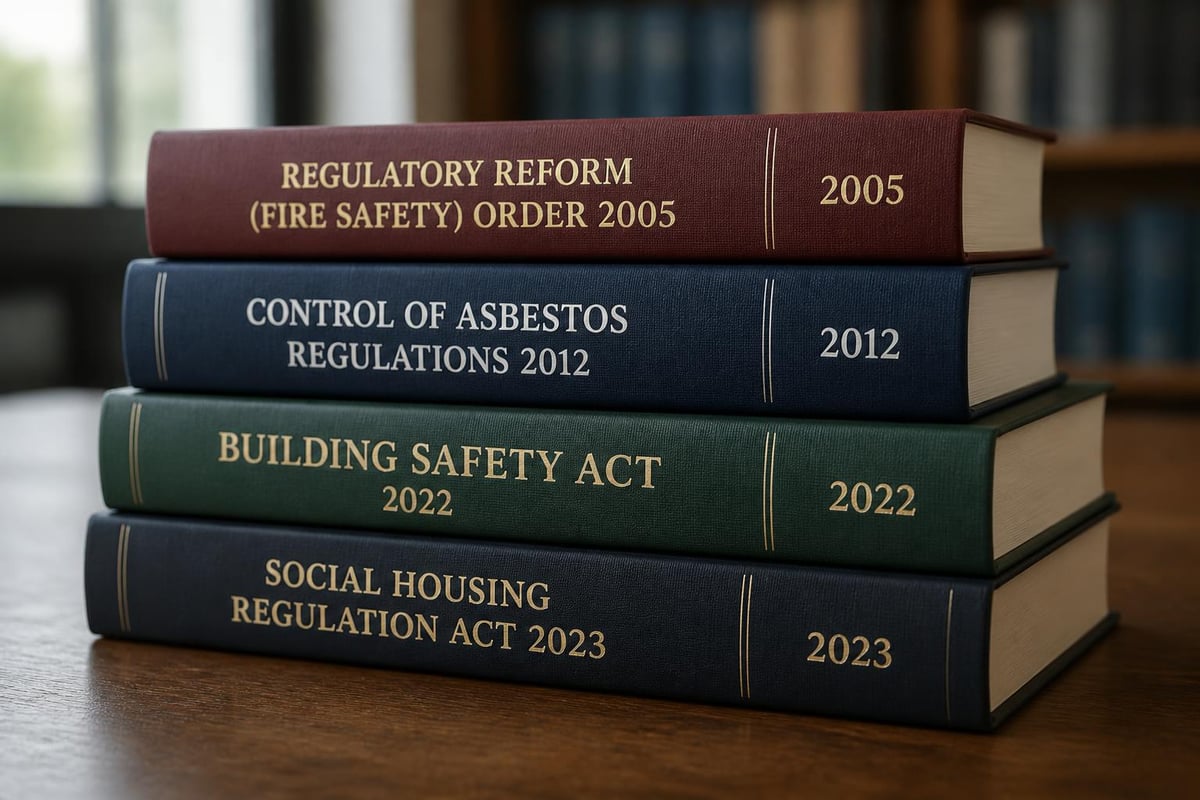
A compliance property operates within multiple statutory frameworks simultaneously. The Building Safety Act 2022 fundamentally reshaped responsibilities for higher-risk buildings, introducing the concept of the Accountable Person and mandating safety case regimes for residential buildings over 18 metres or seven storeys. This legislation doesn't operate in isolation-it interacts with the Regulatory Reform (Fire Safety) Order 2005, the Control of Asbestos Regulations 2012, and Health and Safety at Work etc. Act 1974 to create a comprehensive duty of care.
Understanding these overlapping compliance requirements requires a systemic approach. Each discipline-fire, asbestos, water, structural integrity-has its own risk assessment methodology, inspection frequency, and remediation threshold. Yet they share common ground: competent person requirements, documented management systems, and the principle that risk must be managed to as low as reasonably practicable (ALARP).
The federal landscape in other jurisdictions presents comparable complexity. In the United States, contractors' property management system compliance establishes baseline standards for maintaining acceptable oversight, whilst fair housing marketing regulations impose additional procedural requirements. These international frameworks demonstrate that compliance property management is a universal challenge, though specific obligations vary by jurisdiction.
Commercial vs Residential Compliance Property
The distinction between commercial and residential compliance property has narrowed significantly. Historically, residential landlords faced lighter-touch regulation compared to commercial premises governed by workplace health and safety law. That gap has closed.
Key regulatory drivers for residential compliance property:
- Social Housing (Regulation) Act 2023 and Awaab's Law imposing strict timescales for hazard remediation
- Building Safety Act creating ongoing safety case obligations for higher-risk residential buildings
- Electrical Safety Standards in the Private Rented Sector (England) Regulations 2020 requiring five-yearly inspections
- Smoke and Carbon Monoxide Alarm (England) Regulations 2015 (amended 2022)
Commercial compliance property obligations include:
- Workplace (Health, Safety and Welfare) Regulations 1992 mandating suitable workplace conditions
- Control of Substances Hazardous to Health Regulations 2002 (COSHH) for asbestos and other hazardous materials
- Fire Safety (England) Regulations 2022 requiring premises-specific information for high-rise buildings
- Legionella control under ACoP L8 and HSG 274
The convergence is particularly evident in fire safety and damp and mould management, where the underlying risk is identical regardless of building use. A compliance property strategy must therefore be discipline-led rather than sector-led, with protocols that translate across different property types within a portfolio.
Multi-Discipline Risk Management for Compliance Property
Effective compliance property management integrates multiple technical disciplines under unified oversight. This approach prevents the common failure mode where individual compliance workstreams operate in silos, creating gaps, duplications, and conflicting remediation priorities.
Fire Safety Compliance
Fire safety regulations form the most visible element of compliance property management, particularly post-Grenfell. The Regulatory Reform (Fire Safety) Order 2005 places responsibility on the "responsible person" to conduct suitable and sufficient fire risk assessments and implement appropriate fire safety measures.
For a compliance property, this means:
- Regular fire risk assessments following PAS 79-1 (non-residential) or PAS 79-2 (residential) methodology
- Compartmentation integrity verified through structural surveys of fire-resistant walls, floors, and service penetrations
- Fire door compliance including annual inspection programmes covering all critical fire door installations
- Emergency lighting testing to BS 5266 with duration testing and annual certification
- Fire alarm system maintenance ensuring category L1-L5 or M systems meet design intent
The Fire Safety Act 2021 extended the Fire Safety Order to cover building structure, external walls, and flat entrance doors in multi-occupied residential buildings. This expansion means compliance property portfolios must now include façade inspections, external wall system reviews, and flat entrance door surveys as routine obligations.
| Fire Safety Element | Inspection Frequency | Responsible Standard |
|---|---|---|
| Fire Risk Assessment | Annual (minimum) | PAS 79-1 / PAS 79-2 |
| Fire Doors | Annual visual/functional | BS 9999 / BS 8214 |
| Emergency Lighting | Monthly/Annual | BS 5266-1 |
| Fire Alarm System | Quarterly/Annual | BS 5839-1 |
| Compartmentation | Every 3-5 years | BS 9999 |
Asbestos Management in Compliance Property
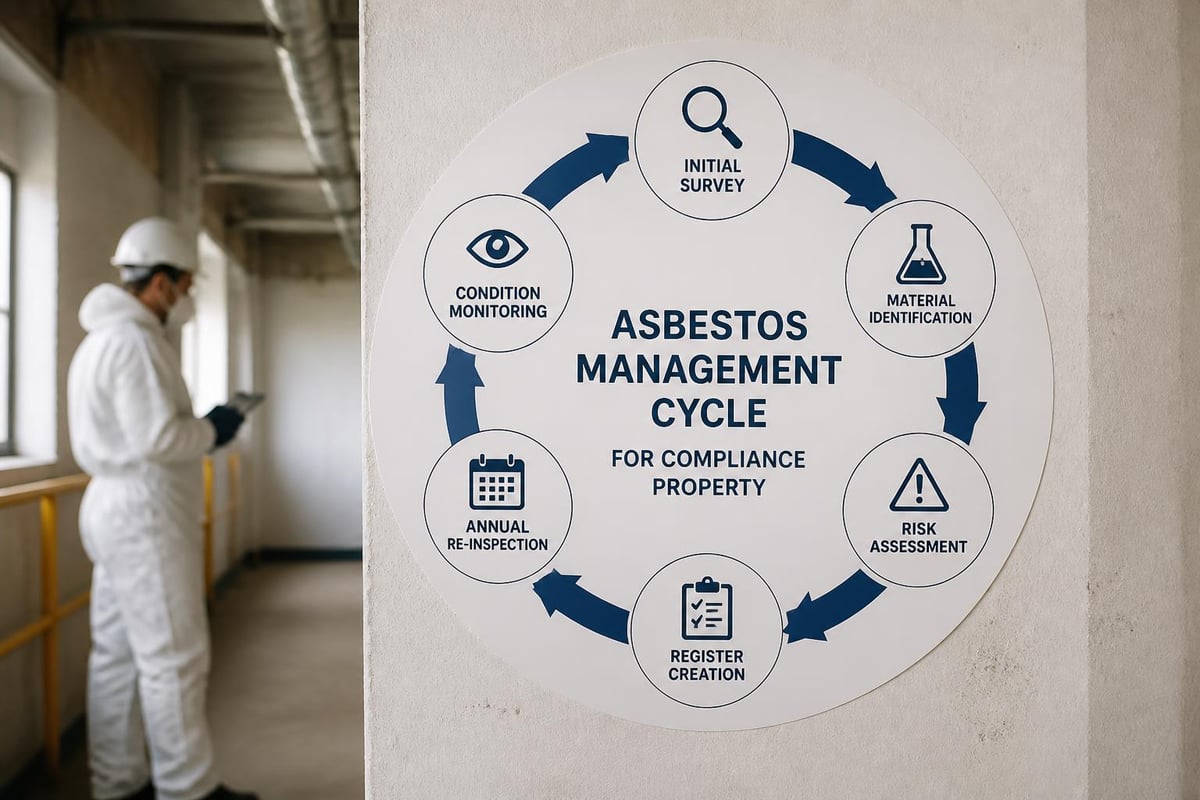
Every non-domestic compliance property built or refurbished before 2000 requires an asbestos management plan under Regulation 4 of the Control of Asbestos Regulations 2012. The duty to manage asbestos is absolute-it cannot be delegated, only competently discharged.
A compliant approach includes:
- Management surveys (HSG 264 compliant) locating and assessing asbestos-containing materials during normal occupation
- Refurbishment and demolition surveys providing fully intrusive pre-works identification of all ACMs
- Annual re-inspections monitoring condition changes of known asbestos materials
- Material risk scoring using the HSE's material assessment algorithm
- Priority assessments determining remediation urgency based on exposure potential
The critical compliance property consideration is documentation. Your asbestos management system must include photographic registers, material sample certificates, priority action plans, and re-inspection schedules that collectively demonstrate ongoing, active management.
Water Hygiene and Legionella Control
Legionella compliance represents one of the most frequently overlooked elements of compliance property management, yet carries both criminal and civil liability risks. The Health and Safety Executive's ACoP L8 sets out legal requirements for controlling legionella bacteria in water systems.
Core compliance property requirements:
- Legionella risk assessment to BS 8580-1 including schematic drawings and asset registers
- Written scheme of control specifying monitoring, cleaning, and temperature checking frequencies
- Monthly temperature monitoring at sentinel outlets
- Quarterly tank inspections and annual disinfection programmes
- UKAS-accredited laboratory analysis for legionella, pseudomonas, and total viable counts
The liability exposure is significant. Unlike fire safety where the "responsible person" is clearly defined, water hygiene duties can fall on multiple parties-building owners, managing agents, and in some cases, individual tenants. A compliance property strategy must clearly delineate responsibilities and ensure contractual arrangements support rather than fragment accountability.
Building a Compliance Property Management System
Moving from reactive compliance-responding to inspection failures or enforcement notices-to proactive compliance property management requires structured systems. The most effective approaches treat compliance as an ongoing operational discipline rather than an annual event.
The Compliance Calendar Approach
A unified compliance property calendar consolidates all inspection, testing, certification, and re-inspection requirements across disciplines. This prevents scheduling conflicts, optimises site access, and identifies opportunities for combined surveys.
Essential calendar elements include:
- Fire risk assessment annual review dates
- Asbestos re-inspection schedules (typically annual for priority materials)
- Legionella temperature monitoring (monthly) and sampling (quarterly/annually)
- Fire alarm quarterly servicing and annual certification
- Emergency lighting monthly function tests and annual duration tests
- Fire door annual inspections
- Electrical installation condition reports (five-yearly for residential, risk-based for commercial)
Digitising this calendar allows for automated alerts, contractor pre-booking, and compliance status dashboards. However, the underlying principle remains analogue: someone must own the calendar, monitor completion, and escalate failures.
Documentation Standards for Audit-Ready Compliance Property
Compliance penalties for residential property violations can include unlimited fines, enforcement notices, and in extreme cases, prosecution. Commercial premises face similar exposure under health and safety legislation. The defence in both contexts rests on documented evidence of systematic risk management.
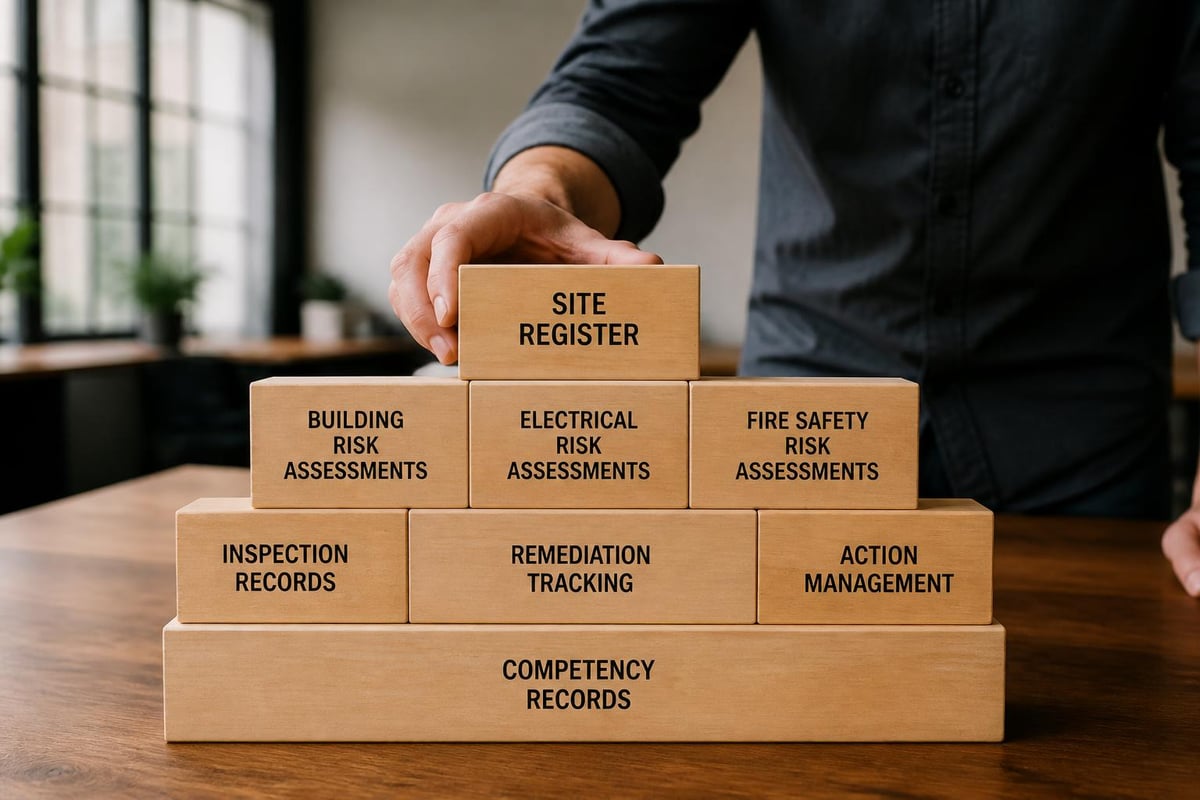
Your compliance property documentation should demonstrate:
- Identification: What hazards exist, where they're located, and their current condition
- Assessment: What risk each hazard presents, using recognised methodology
- Control: What measures you've implemented to manage risk to ALARP
- Review: How and when you monitor whether controls remain effective
- Competence: Who conducted each element and what qualifications they held
This five-point structure applies across asbestos management plans, fire risk assessments, legionella risk assessments, and compartmentation surveys. Consistency in documentation format aids internal auditing and external inspection responses.
Consolidation vs Fragmentation in Compliance Property Delivery
A recurring strategic question for compliance property managers is whether to consolidate multiple disciplines under a single provider or maintain specialist contractors for each technical area. The trend in 2026 strongly favours consolidation, driven by both regulatory and operational factors.
Advantages of multi-discipline consolidation:
- Single point of accountability for cross-discipline issues (e.g., fire-stopping works affecting asbestos materials)
- Reduced site access coordination and induction overhead
- Consistent documentation standards and reporting formats
- Simplified contractor management and performance monitoring
- Often more competitive pricing through bundled service agreements
Potential consolidation challenges:
- Ensuring genuine in-house expertise across all disciplines rather than subcontractor reliance
- Maintaining specialist depth in rapidly evolving technical areas
- Avoiding over-reliance on a single supplier for business continuity
The property managers consolidating compliance typically report improved compliance outcomes, reduced administrative burden, and clearer responsibility matrices. The key discriminator is whether the consolidated provider maintains genuine technical capability across disciplines or simply acts as a management layer over multiple subcontractors.
For fire safety specifically, competence requirements under PAS 79 and the Fire Safety (England) Regulations 2022 demand demonstrable qualifications and experience. A Fire Risk Assessment must be conducted by someone with appropriate technical knowledge, not simply assigned to the lowest bidder. This competence principle extends across all compliance property disciplines.

Emerging Compliance Property Obligations in 2026
The compliance property landscape continues to evolve. Several emerging regulatory areas require forward planning even where formal enforcement hasn't yet commenced.
Building Safety Regulator Oversight
The Building Safety Regulator (BSR), operating within the Health and Safety Executive, now oversees higher-risk buildings through three core functions: building control approval, occupied building management, and industry competence. For compliance property portfolios including residential buildings over 18 metres or seven storeys, this means:
- Safety case regimes documenting how building safety risks are managed
- Accountable Person registration with the BSR including contact details and building information
- Mandatory occurrence reporting for safety-related events
- Resident engagement strategies ensuring effective two-way communication on safety matters
Even buildings below the 18-metre threshold benefit from adopting safety case principles. The structured approach to hazard identification, risk assessment, and control measure verification strengthens any compliance property management system.
Energy Performance and Climate Compliance
Whilst not traditionally considered under "compliance property" in the risk management sense, energy performance obligations increasingly intersect with building safety requirements. The Minimum Energy Efficiency Standards (MEES) already prohibit letting properties below EPC Band E (with planned progression to Band C by 2027-2028 for commercial and 2028-2030 for residential).
Energy improvement works-particularly retrofitted insulation, ventilation systems, and heating upgrades-create potential conflicts with fire safety (combustible materials), asbestos management (disturbing ACMs during works), and damp and mould (inadequate ventilation). An integrated compliance property approach treats energy compliance as another discipline requiring coordination rather than a separate workstream.
Damp and Mould Statutory Timescales
The Social Housing (Regulation) Act 2023 introduced specific timescales for hazard assessment and remediation following tenant reports. Commonly known as Awaab's Law, these provisions require:
- Investigation within 14 days of receiving a health and safety hazard report
- Commencement of remedial works within a further prescribed timeframe (typically 7-14 days depending on hazard severity)
- Completion of remediation within specified periods based on risk classification
Importantly, damp and mould assessment obligations now apply to commercial premises under existing workplace health and safety legislation. The Health and Safety at Work etc. Act 1974 and Workplace Regulations 1992 require employers to provide safe, healthy workplace conditions-which explicitly includes managing damp, mould, and ventilation defects.
| Hazard Category | Investigation Start | Remediation Start | Remediation Completion |
|---|---|---|---|
| Emergency | 24 hours | 24 hours | 7 days |
| High Risk | 7 days | 7 days | 28 days |
| Medium Risk | 14 days | 14 days | 90 days |
| Low Risk | 28 days | 28 days | 6 months |
Technology and Compliance Property Management
Digital compliance property management platforms have matured significantly in recent years. The most effective systems provide:
- Centralised asset registers with hierarchical building/floor/room/asset structure
- Automated compliance calendars triggering pre-inspection alerts and contractor scheduling
- Mobile inspection applications allowing on-site data capture with photographic evidence
- Digital document management with version control and audit trails
- Dashboard reporting showing portfolio-wide compliance status by discipline
- API integration with building management systems, CAFM platforms, and contractor portals
The technology, however, serves the strategy rather than replacing it. A poorly conceived compliance property approach delivered through sophisticated software remains fundamentally flawed. The sequence must be: define compliance requirements, design management processes, then select enabling technology.
Competence and Compliance Property Delivery
Every compliance property discipline specifies competence requirements for those conducting assessments, surveys, and inspections. These aren't merely good practice recommendations-they're legal requirements that determine whether your compliance evidence withstands regulatory scrutiny.
Fire safety competence:
- Fire risk assessors should hold qualifications such as Level 4 Diploma in Fire Safety or equivalent professional experience
- Passive fire protection surveyors require specific training in compartmentation assessment and fire-stopping specification
- Fire door inspectors need practical training aligned to BRE or FDIS certification schemes
Asbestos competence:
- Management survey surveyors require BOHS P402 or equivalent UKAS-accredited training
- Refurbishment and demolition surveyors need BOHS P403 certification
- Asbestos analysts conducting air monitoring must hold BOHS P404 qualification
Water hygiene competence:
- Legionella risk assessors should be trained to City & Guilds Level 3 Award or BOHS W101 standard
- Those conducting temperature monitoring require basic awareness training (typically in-house)
- Laboratory analysts must operate within UKAS ISO 17025 accreditation
These competence requirements create a clear delineation: compliance property management requires specialist technical expertise, not simply property management experience extended into new areas. Understanding where to draw the line between in-house capability and external consultancy input is crucial for maintaining defensible compliance positions.
The case study of a 320-flat block asbestos re-inspection delivered in five working days demonstrates how properly resourced, competent teams can achieve compliance outcomes that seem logistically impossible-but only when competence, methodology, and project management align.
Cost Modelling for Compliance Property
Budgeting for compliance property obligations requires understanding both planned cyclical costs and unplanned remediation liability. The former are predictable; the latter can be substantial if compliance drift occurs.
Typical annual compliance property costs per building (indicative 2026 rates):
- Fire risk assessment (50-100 units): £800-£1,500
- Asbestos management plan annual review: £400-£800
- Asbestos re-inspection (assuming 20-40 samples): £600-£1,200
- Legionella risk assessment (first year): £800-£1,500
- Legionella temperature monitoring (monthly, managed service): £60-£120 per month
- Fire door inspection programme (50 doors): £1,000-£2,000
- Emergency lighting testing (50 luminaires): £600-£1,000
- Compartmentation survey (type-specific, per floor): £800-£1,500
These are inspection and assessment costs only. Remediation costs-fire door replacements, asbestos removal, compartmentation fire-stopping, legionella system modifications-sit above baseline compliance spending and vary enormously based on building condition and historic maintenance investment.
The risk-adjusted approach to compliance property budgeting allocates contingency based on building age, construction type, and compliance history. A 1970s system-built tower with deferred maintenance presents fundamentally different financial exposure compared to a modern purpose-built block with established management systems.
Procurement and Contractor Selection for Compliance Property
Selecting compliance property contractors on cost alone represents false economy and potential compliance failure. The cheapest fire risk assessment may not withstand BSR scrutiny; the lowest-cost asbestos survey may miss critical materials, creating future liability.
Effective procurement criteria should include:
- Demonstrable competence through assessor CVs, qualifications, and CPD records
- Professional indemnity insurance with adequate cover limits (typically £5-10 million for compliance work)
- UKAS accreditation where applicable (essential for asbestos sampling and legionella laboratory analysis)
- Quality management systems certified to ISO 9001 or equivalent
- Health and safety accreditation such as CHAS, SafeContractor, or Constructionline
- Sector experience with demonstrable track record in similar building types
- Reporting standards with sample reports reviewed during tender evaluation
- Contractual service levels specifying report delivery timescales and emergency response times
The multi-discipline approach delivered by oxford-ec.co.uk exemplifies this principle-consolidation only delivers value when underpinned by genuine technical capability, appropriate accreditations, and audit-ready reporting standards across all included disciplines.
Contractual structures should align contractor incentives with compliance outcomes rather than simply minimising findings or accelerating inspections. Performance frameworks that measure report quality, remediation accuracy, and compliance improvement over time create partnership relationships that strengthen overall compliance property positions.
Effective compliance property management in 2026 requires integrating multiple technical disciplines under unified governance, maintaining audit-ready documentation, and ensuring genuine competence across all assessment and remediation activities. Whether you're managing a single higher-risk residential building or a diverse commercial portfolio, the underlying principle remains constant: systematic hazard identification, risk-based prioritisation, and ongoing verification that controls remain effective. Oxford-ec.co.uk delivers exactly this approach-one-stop, multi-discipline risk management across asbestos, fire safety, water hygiene, damp and mould, and building safety, with the technical depth, accredited competence, and audit-ready precision that transforms compliance from administrative burden into operational confidence, delivered nationwide.