
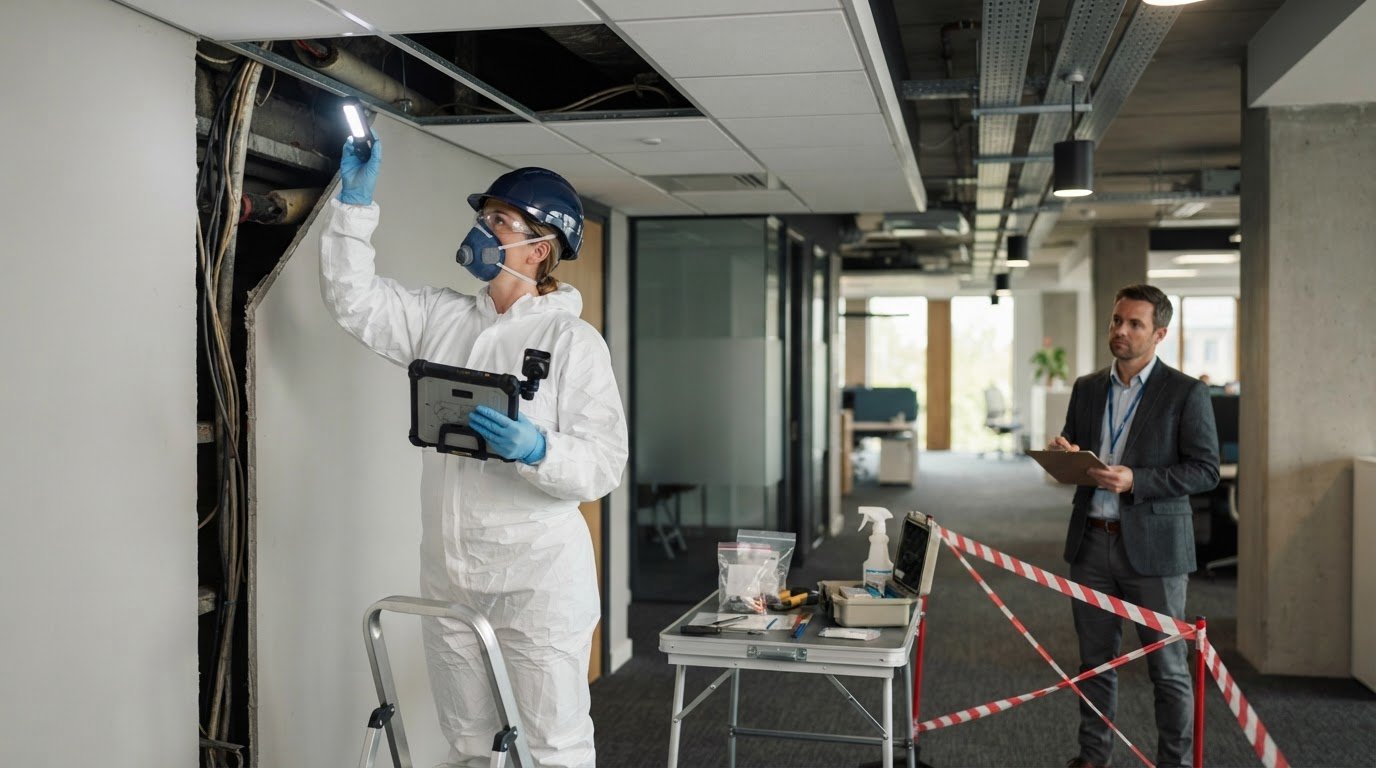
What if an asbestos survey looks complete but doesn’t cover areas your planned work will disturb? Common asbestos survey failures can be hard to spot in a report. Gaps in scope, access or evidence may leave important materials unassessed. A polished document isn’t necessarily a fit-for-purpose one.
A survey’s findings depend on its purpose, the areas inspected and any access restrictions recorded. A management survey, for example, isn’t an intrusive refurbishment or demolition survey, so it may not establish what lies concealed within the building fabric.
This guide explains how to recognise warning signs in a survey’s scope, access records and findings, and what an appropriate survey can and cannot establish. You’ll also learn how to respond to vague, incomplete or outdated records before asbestos is disturbed or work proceeds. For duty-holders managing non-domestic premises under the Control of Asbestos Regulations 2012, understanding asbestos-containing materials is central to proportionate risk management.
Key Takeaways
- Common asbestos survey failures often show up as unclear boundaries, unrecorded access restrictions or findings that lack enough detail to guide decisions.
- Check whether the report identifies material locations, condition and limitations clearly enough to support maintenance planning and communication with contractors.
- Match the survey’s purpose to the decision at hand, especially before refurbishment or demolition work that may disturb building materials.
- If records leave uncertainty, define the decision, document the gaps and prevent disturbance of suspected asbestos-containing materials until suitable follow-up is arranged.
- A fit-for-purpose survey sets out its purpose, scope, access and limitations, then presents findings in a way that supports proportionate asbestos management.
Table of Contents
- What counts as a common asbestos survey failure? Start with scope, not assumptions
- Five common asbestos survey failures: scope, access, identification and evidence
- How poor asbestos survey reports create compliance and project risks
- How to investigate and resolve a suspected asbestos survey failure
- Prevent repeat failures with a fit-for-purpose asbestos survey
What counts as a common asbestos survey failure? Start with scope, not assumptions
A survey failure isn’t simply a report that doesn’t find asbestos. It’s a material gap that prevents someone from making suitable decisions about a building or planned activity. The gap might involve areas or materials outside the agreed scope, or findings that don’t provide enough detail to inform the next step.
A survey is fit for purpose only when its scope answers the decision it supports. That decision depends on the survey’s purpose, the parts of the property the surveyor could access and how the building will be used. A recorded limitation is different from an unreported omission: clear reporting lets the duty-holder understand what remains uncertain and manage it accordingly.
Why the survey’s purpose must match the decision
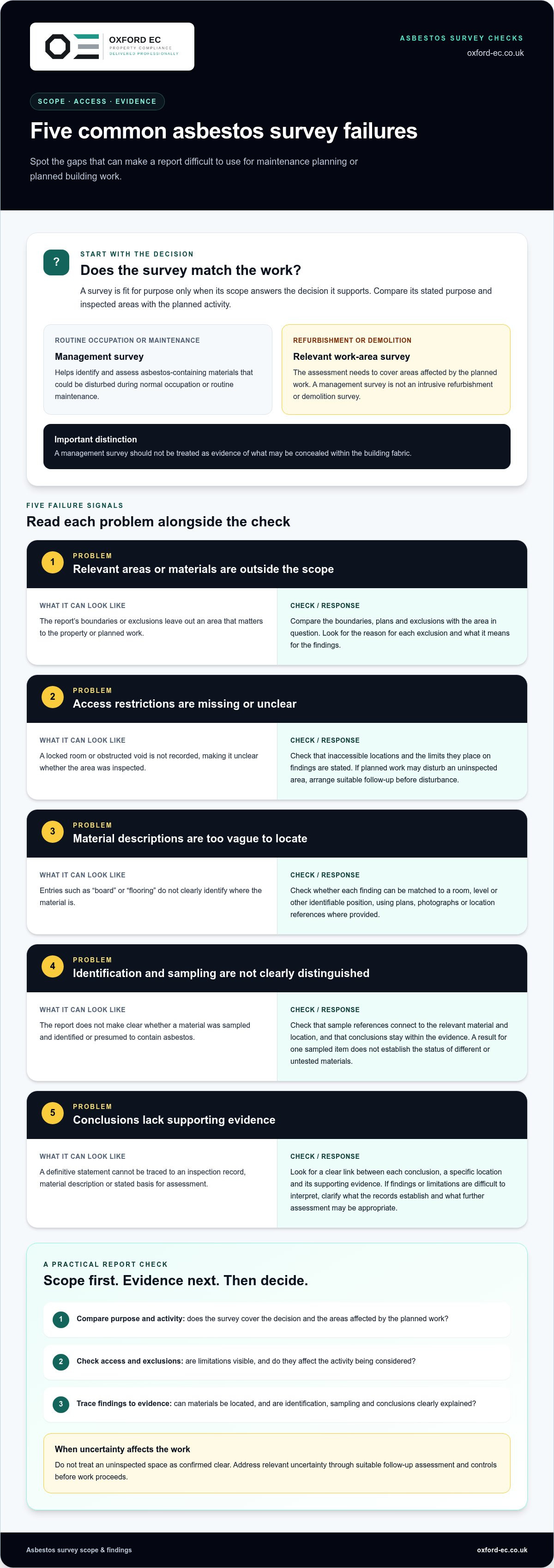
Routine management and planned building work call for different assessments. An asbestos management survey helps identify and assess asbestos-containing materials that could be disturbed during normal occupation or routine maintenance. It isn’t an intrusive refurbishment or demolition survey, and shouldn’t be treated as evidence of what may be concealed within the building fabric.
Before refurbishment or demolition, the relevant survey needs to cover the areas affected by the planned work. A report prepared for ongoing management may therefore be unsuitable for a later project, even if it was appropriate when commissioned. The distinction matters because asbestos was widely used in building materials, and assumptions about what lies behind a surface aren’t a substitute for evidence. For a broader introduction to routine assessment, see OEC’s asbestos management surveys.
When a limitation is not automatically a failure
Some areas may be inaccessible during an inspection, for example because they’re locked, obstructed or unsafe to enter. A useful report identifies the affected locations and explains how access restrictions limit the findings. It shouldn’t present an uninspected space as confirmed clear.
An access limitation doesn’t automatically invalidate the whole survey. Its significance depends on whether the area matters to the decision being made. If planned work will affect an uninspected area, address the uncertainty before work proceeds through suitable follow-up assessment and controls. If the area isn’t relevant to the current activity, record and manage the limitation rather than ignore it.
Common asbestos survey failures often arise when readers treat a report as blanket clearance instead of checking its boundaries. Compare the stated purpose with the intended activity, then check whether access restrictions or exclusions affect that activity. Start with scope, check the evidence, then make the decision.
Five common asbestos survey failures: scope, access, identification and evidence
A report needs to show what was found, where the inspection reached and how its findings support decisions. Spot these common asbestos survey failures by comparing the report with the building and planned work. HSE guidance on a fit-for-purpose asbestos survey provides a reference for understanding survey planning and execution.
- Scope excludes relevant areas or materials. Compare the report’s boundaries, plans and exclusions with the property or work area in question. A survey covering common areas but omitting a relevant plant room, ceiling void or building section may leave a material gap if that space is within the planned activity. Look for the reason for each exclusion and what it means for the findings.
- Access restrictions are missing or unclear. The report should identify inaccessible locations, such as a locked room or obstructed void, rather than imply that every area was inspected. A recorded limitation makes uncertainty visible; an unrecorded omission can conceal it. If work may disturb an uninspected area, arrange suitable follow-up before disturbance.
- Material descriptions are too vague to locate. Entries such as “board” or “flooring” without a precise location can be difficult for maintenance teams and contractors to act on. Check whether each finding can be matched to a room, level or other identifiable position, using plans, photographs or location references where provided.
- Identification and sampling are not clearly distinguished. The report should make clear whether a material was sampled and identified, or presumed to contain asbestos. Check that sample references connect to the relevant material and location, and that conclusions don’t go beyond the evidence. A result for one sampled item should not be assumed to establish the status of different or untested materials.
- Conclusions lack supporting evidence. Watch for definitive statements without a traceable inspection record, material description or stated basis for the assessment. If a conclusion can’t be linked to a specific location and supporting evidence, it may not give the person responsible enough information to plan work or manage risk confidently.
Read the report alongside the property layout and proposed activity. If findings or limitations remain difficult to interpret, asbestos consultancy can help clarify what the records establish and what further assessment may be appropriate. Discuss an asbestos survey concern before relevant work proceeds.
How poor asbestos survey reports create compliance and project risks
A report can identify a material correctly and still be difficult to use. Missing context can make a correct finding difficult to manage safely. If staff can’t establish where the material is, what condition it’s in or whether an area was inspected, they may struggle to plan maintenance, brief contractors or judge whether proposed work could disturb asbestos.
Actionable reporting connects findings to decisions. It gives enough detail to locate and understand materials, records relevant observations and makes limitations visible. Incomplete records can leave uncertainty hidden in broad descriptions, unclear references or conclusions without an obvious basis. These are practical consequences of common asbestos survey failures, not just paperwork defects.
What makes a survey report usable in practice?
Check each finding for a clear location and a description specific enough to distinguish the material from others in the building. Condition observations help readers understand the material’s recorded state, whilst limitations show where inspection was restricted. Plans, photographs or sample references can help trace a finding when included, but no single report layout or set of fields is universally required.
For example, “board in service area” may not help a maintenance team identify the relevant item if the property has several service areas. A room reference, plan marker or other clear location detail makes the record more practical. The test is whether someone responsible for the building can understand the finding and communicate it accurately before work begins.
When existing asbestos information may no longer answer the question
Asbestos records relate to the property and the survey’s purpose at the time of inspection. Alterations may change the building fabric; a change of use may affect which areas need attention; and a new project may involve locations the earlier survey didn’t assess. A record can remain useful for routine management whilst being insufficient for a specific intrusive work proposal.
Under the Control of Asbestos Regulations 2012, duty-holders responsible for non-domestic premises must manage asbestos risks. A survey report informs that work; it doesn’t replace the need to keep relevant information under review, manage identified materials and make information available to people who may disturb them. Reviewing management information isn’t the same as arranging a refurbishment or demolition survey where the planned work requires one.
For broader duty-holder context, read the guide to asbestos management surveys. Ask whether current records answer the decision in front of you. If not, clarify the gap before relying on the report to plan or authorise relevant work.
How to investigate and resolve a suspected asbestos survey failure
A gap in a survey doesn’t always mean the whole report is unusable. First establish whether the uncertainty affects a specific decision, then prevent relevant work from relying on an assumption. A structured review helps identify what’s known, what remains unclear and what follow-up is appropriate.
A practical review sequence for duty-holders
- 1. Define the decision. Identify the maintenance task, alteration or other activity the information needs to support. Note the exact rooms, building elements and materials that could be affected.
- 2. Review the survey scope. Compare its purpose, boundaries, plans and inspection details with the area and activity under consideration. Check whether the survey type suits that decision.
- 3. Log the gaps. Record unclear findings, exclusions, access restrictions and differences between the report and current site conditions. Reference locations precisely, and keep relevant plans or photographs with the review.
- 4. Control disturbance. Don’t drill, cut, remove or otherwise disturb suspected asbestos-containing materials whilst uncertainty is being resolved. Make relevant information available to people planning or undertaking work, and don’t treat the affected area as clear without evidence.
- 5. Arrange suitable follow-up. Seek competent asbestos advice when the available evidence doesn’t support a safe decision. The next step may be clarification of existing records, further inspection or a survey suited to the planned work.
This process helps distinguish an administrative query from a material uncertainty. For example, a missing location reference may be resolved by clarifying the report, whilst an uninspected area within a planned work zone may require further assessment before disturbance. The right response depends on the building, the original survey’s purpose, access conditions and the work proposed.
Choose follow-up to fit the work
An asbestos management survey supports identification and management during normal occupation and routine maintenance. It isn’t an intrusive refurbishment or demolition survey. If planned work will disturb parts of the building fabric, the project may need a survey with a different purpose and scope. A repeat survey alone won’t necessarily resolve every limitation; it must address the specific area and decision at issue.
Keep a record of the concern, its relevance, any interim controls and the follow-up action. This gives duty-holders and project teams a clear basis for reviewing the issue and deciding when work can proceed safely.
Discuss an asbestos survey concern with Oxford Environmental Consultants.
Prevent repeat failures with a fit-for-purpose asbestos survey
Prevention starts before inspection. Be clear about the decision the survey must support, whether managing materials during normal occupation or informing a planned project. A defined purpose helps align the survey scope with the building, areas of concern and activity that may affect them. It also makes common asbestos survey failures easier to spot before incomplete information is relied upon.
What a fit-for-purpose process should establish
Use this checklist when planning a survey or reviewing the resulting information:
- Define the purpose. State the decision the findings need to inform, such as routine asbestos management or work affecting the building fabric.
- Set clear boundaries. Identify the relevant property areas and ensure the survey scope reflects the intended activity.
- Record access. Make clear which areas were inspected and note any access restrictions or exclusions.
- Explain limitations. Document what couldn’t be assessed and why, so uncertainty isn’t mistaken for confirmation that an area is clear.
- Make findings actionable. Present locations, material descriptions, condition observations and limitations clearly enough to inform proportionate next steps.
A survey should give the duty-holder a usable basis for decisions, not create certainty beyond what was inspected. If access is restricted, understand the limitation in relation to the planned work. If the intended activity changes, review whether the original scope still answers the question.
From survey findings to controlled asbestos management
Survey findings can inform asbestos records, help communicate relevant information to people responsible for maintenance or work, and guide appropriate management actions. Identifying asbestos-containing material doesn’t automatically mean it must be removed. The response depends on factors including its condition, likelihood of disturbance and the activity planned; appropriate management may be required instead of immediate remediation.
Oxford Environmental Consultants provides asbestos management surveys and consultancy to help duty-holders identify and assess asbestos-containing materials and interpret findings for risk management. Where project work calls for a different survey purpose, refurbishment and demolition surveys support project-specific assessment. Explore OEC’s asbestos survey and consultancy services to understand how survey findings can inform practical next steps. Clear scope, recorded limitations and informed decisions all help prevent avoidable gaps.
Discuss your asbestos survey requirements.
Make your next asbestos decision with confidence
Common asbestos survey failures often come down to a mismatch between the survey’s scope and the decision it needs to support. Check that relevant areas were assessed, access restrictions and limitations are clear, and findings can guide practical action.
A report is valuable to asbestos risk management, but it isn’t blanket clearance or a substitute for ongoing attention to asbestos information. If records leave uncertainty about materials that planned work could disturb, avoid disturbing them until the gap has been assessed and suitable follow-up is in place.
Oxford Environmental Consultants provides detailed asbestos management surveys to identify and assess asbestos-containing materials, alongside asbestos consultancy to support management strategies and compliance. A clear, survey-led understanding can help duty-holders make proportionate decisions and communicate relevant information effectively.
Discuss your asbestos survey requirements with Oxford Environmental Consultants.
Start with the right question, establish what the evidence shows, and address uncertainty before work proceeds. A clear process helps you take the next step with confidence.
Frequently Asked Questions
What are the most common asbestos survey failures?
Common asbestos survey failures include a scope that doesn’t cover relevant areas, access restrictions that aren’t clearly recorded, vague material descriptions and conclusions that aren’t supported by traceable evidence. A report may also be unsuitable for the decision at hand, such as relying on a management survey to plan intrusive refurbishment. Compare the survey’s purpose and boundaries with the building and proposed activity before treating its findings as sufficient.
Can an asbestos survey miss materials in inaccessible areas?
Yes. If a location couldn’t be accessed, materials there may remain uninspected and unidentified. A clear report should record the affected area and explain the limitation, rather than imply it was confirmed clear. An inaccessible area doesn’t automatically invalidate the entire survey, but if planned work could disturb it, don’t rely on assumptions. Keep the area undisturbed and arrange appropriate follow-up assessment before relevant work proceeds.
How can I tell if an asbestos survey is out of date?
There isn’t a single age that makes every asbestos survey out of date. Consider whether the property has changed since the survey, whether its condition or use has altered, and whether the report’s scope still matches the decision you need to make. Building alterations, new access to previously restricted areas or a refurbishment project may affect the record’s relevance. Review the report date, scope, limitations and subsequent updates together.
Does an asbestos management survey cover refurbishment work?
An asbestos management survey is intended to help manage asbestos-containing materials during normal occupation and routine maintenance. It isn’t an intrusive refurbishment survey, so it may not establish what is concealed within the building fabric. Before refurbishment that could disturb those materials, the survey purpose and scope need to address the planned work. Demolition also requires assessment suited to that activity, rather than reliance on management information alone.
What should an asbestos survey report include?
A useful report should make its purpose and scope clear, identify the areas inspected and record access restrictions or other limitations. Findings should describe materials and locations clearly enough to be traced and acted on, with relevant condition observations and supporting references where provided. It should also distinguish sampled and identified materials from those presumed to contain asbestos. Report formats vary, so assess whether the information supports the decision required.
What should I do if I think an asbestos survey is incomplete?
First, identify the maintenance task or project decision the report needs to support. Compare its scope and site details with the affected areas, then record unclear findings, exclusions, access restrictions and changes to the building. Don’t disturb suspected asbestos-containing materials whilst the uncertainty remains. Seek competent asbestos advice to determine whether clarification, further inspection or a survey with a different purpose is appropriate before relevant work proceeds.
Does finding asbestos mean it must always be removed?
No. Identifying asbestos-containing material doesn’t automatically mean removal is necessary. The appropriate response depends on factors such as its condition, likelihood of disturbance and how the area will be used. Material may be managed in place where appropriate, with its condition and relevant information kept under review. If it is damaged or planned work could disturb it, competent advice can help determine suitable controls or whether removal is warranted.