

Regulatory safety now demands absolute architectural scrutiny. Landlords must organise digital asset intelligence to survive. With the Building Safety Regulator now operating as a standalone body and the Building Safety Levy commencing on 1 October 2026, the margin for error has effectively vanished. This building safety act 2022 summary for landlords provides the technical clarity required to navigate a landscape where non-compliance isn't just a lapse; it's a liability.
We understand that the technical complexity of the Golden Thread requirement and the evolving caps on leaseholder protections feel overwhelming. It's a high-stakes environment. Our guide ensures you master your statutory duties, navigate complex cost recovery limitations, and secure absolute asset compliance across your entire portfolio. You'll find a straightforward roadmap to achieve audit-ready status, covering everything from the 18-metre height threshold for higher-risk buildings to the mandatory September 2026 second staircase requirements for high-rise developments. Precision. Protection. Performance. We've mapped the regulatory pillars so you don't have to.
Key Takeaways
- Identify the non-delegable statutory duties of the Accountable Person (AP) and Principal Accountable Person (PAP) to mitigate the risk of severe legal sanctions and criminal prosecution.
- Utilise this building safety act 2022 summary for landlords to accurately categorise Higher-Risk Buildings (HRBs) based on the specific 18-metre or seven-storey statutory height thresholds.
- Establish a secure Golden Thread of digital information to maintain a transparent lifecycle record of building safety that is accessible to the Building Safety Regulator and emergency services.
- Navigate the complex leaseholder protection caps and the 2026 Building Safety Levy to ensure financial compliance whilst shielding qualifying leaseholders from historical remediation costs.
- Implement an integrated, multi-disciplinary strategy for asset management, aligning fire risk assessments and compartmentation surveys with broader structural and environmental health protocols.
Table of Contents
- Understanding the Building Safety Act 2022: Legal Scope, Timelines, and Asset Categories
- The Accountable Person Regime: Statutory Roles, Regulators, and Enforcement Powers
- The Golden Thread of Information: Digital Records, Safety Cases, and Structural Integrity
- Leaseholder Protections and Remediations: Cost Recovery, Legal Liability, and Landlord Obligations
- Navigating Multi-Disciplinary Asset Compliance: Fire Safety, Risk Assessments, and Consultancy Solutions
Understanding the Building Safety Act 2022: Legal Scope, Timelines, and Asset Categories
The Building Safety Act 2022 represents a profound overhaul of UK property compliance. Rigorous standards. Absolute accountability. Total transparency. This legislative framework creates a new era of scrutiny for the built environment, necessitating a comprehensive Building Safety Act 2022 Overview for all duty-holders. Landlords must evaluate their entire portfolio against these standards to avoid severe penalties and ensure that fire safety protocols are integrated with structural integrity. Providing a clear building safety act 2022 summary for landlords is essential because the legislation establishes strict accountability frameworks designed to prevent catastrophic structural and fire failures.
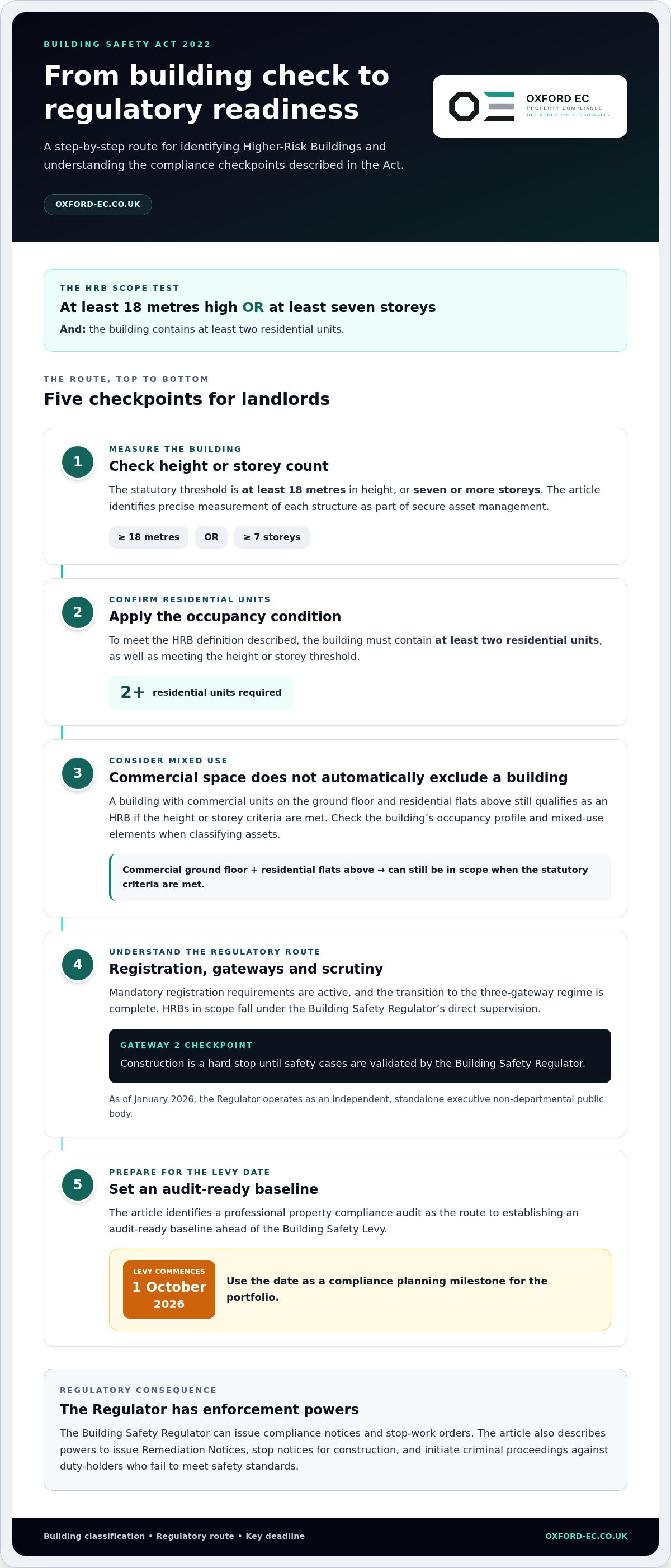
Under the statutory definition, a Higher-Risk Building (HRB) is a structure that measures at least 18 metres in height or possesses seven or more storeys and contains at least two residential units. This definition is the cornerstone of the new regime, dictating which assets fall under the direct supervision of the Building Safety Regulator.
Identifying Higher-Risk Buildings (HRBs) in Scope
The Act specifically targets multi-occupancy residential structures where the risk to life during a fire or structural event is highest. Whilst the height threshold is the primary trigger, landlords must also consider the specific occupancy profile and the presence of mixed-use elements. Properties must contain at least two residential units to qualify under HRB criteria, though nuances exist regarding how non-residential elements affect overall building classification. For example, a building with commercial units on the ground floor but residential flats above still qualifies as an HRB if the height or storey criteria are met. Secure asset management requires precise measurement of every structure to ensure no property falls through the regulatory net.
Legislative Timelines and Enforcement Deadlines for 2026
Mandatory registration requirements enforced by the Building Safety Regulator (BSR) are now fully active. The transition from historical building control systems to the new three-gateway regime is complete. Gateway 2 applications, which require precise determinations by the BSR, serve as a hard stop for construction until safety cases are validated. Waiting for enforcement action is a critical risk for modern asset managers. The BSR now operates as a standalone executive body, possessing the power to issue compliance notices and stop-work orders. Engaging in a professional property compliance audit is the only way to establish an audit-ready baseline before the Building Safety Levy commences on 1 October 2026. Proactive alignment isn't just a recommendation; it's a statutory necessity for those managing complex multi-asset portfolios across the UK.
The Accountable Person Regime: Statutory Roles, Regulators, and Enforcement Powers
The Act introduces clear, non-delegable statutory roles to ensure continuous safety management. Responsibility is no longer diffuse. It's absolute. Failure to correctly identify the duty-holder can result in criminal prosecution and substantial fines. This building safety act 2022 summary for landlords clarifies the hierarchy of responsibility required to maintain compliance across complex multi-landlord structures. Landlords must align their corporate governance to meet these rigorous regulatory expectations seamlessly, ensuring that every asset has a clearly defined line of accountability.
Defining the Principal Accountable Person (PAP)
The Principal Accountable Person (PAP) is the individual or corporate entity holding the primary responsibility for the building's structural envelope and exterior. Whilst multiple Accountable Persons (APs) may exist for different parts of a building, there is only one PAP. Their core duties include registering the building with the regulator, preparing the comprehensive safety case report, and managing the digital records known as the Golden Thread. Identifying the PAP amongst multiple landlords or complex freehold structures requires a meticulous review of leasehold agreements and repair obligations. In most cases, the PAP is the entity responsible for the repair of the building's structure. If you're uncertain about your specific designation, you should consult our technical experts to verify your statutory position.
The Building Safety Regulator (BSR) and Statutory Powers
As of January 2026, the Building Safety Regulator (BSR) operates as an independent, standalone executive non-departmental public body. It possesses unprecedented powers of scrutiny, inspection, and enforcement. The BSR has the authority to issue Remediation Notices, stop notices for construction, and initiate criminal proceedings against duty-holders who fail to meet safety standards. The regulator made a record 727 determinations on Gateway 2 applications in the period since September 2025, demonstrating a shift towards rigorous, evidence-based building inspections. Landlords must provide robust evidence of safety, including detailed fire risk assessments and structural integrity reports, to pass regular certification cycles. Furthermore, the BSR oversees the financial implications of safety work, ensuring adherence to the Government Guidance on Leaseholder Protections. This oversight prevents landlords from unlawfully passing remediation costs to qualifying leaseholders, reinforcing the shift towards owner-led financial responsibility for historical defects.
The Golden Thread of Information: Digital Records, Safety Cases, and Structural Integrity
The Golden Thread refers to the digital lifecycle record of a building’s safety configuration. It's a mandatory requirement. Information must be stored digitally, securely, and be easily accessible to emergency services at all times. This building safety act 2022 summary for landlords clarifies that the thread represents the single source of truth for an asset's safety status. Organising this data requires meticulous oversight and cross-referencing of all historical safety interventions to ensure absolute precision. As defined in the Full Text of the Building Safety Act 2022, the Principal Accountable Person must maintain this information for the entire duration of the building's life. Accuracy is paramount. Security is essential. Accessibility is non-negotiable.
Establishing and Managing the Golden Thread
The digital record must be comprehensive. It must be accessible. It must be secure. Key data components include original structural designs, material specifications (particularly regarding cladding and insulation), and exhaustive maintenance logs for all active fire protection systems. Ensuring information remains live, accurate, and fully updated following any property alterations is a statutory duty that cannot be ignored. Best practices for digital records management involve using structured data environments that allow for audit-ready transparency. Fragmented PDF folders are no longer sufficient. Landlords should implement integrated building safety consulting strategies to centralise these disparate data points into a cohesive, searchable repository that stands up to regulatory scrutiny.
Compiling the Building Safety Case Report
A comprehensive Safety Case Report must justify how building risks are actively controlled. This document is the PAP’s formal argument to the regulator that the building is safe for occupation. It focuses heavily on identifying major accident hazards, specifically targeting structural failure and fire spread risks. You must demonstrate that all reasonable steps have been taken to mitigate these critical dangers through evidence-based analysis. Mandatory occurrence reporting systems play a vital role here; any safety-critical incidents must be logged and reported to the BSR to maintain the validity of the safety case. This process requires a deep dive into fire risk assessments and compartmentation surveys to prove that the building’s safety systems will perform as intended during an emergency. Precision in reporting is the only shield against regulatory intervention.
Leaseholder Protections and Remediations: Cost Recovery, Legal Liability, and Landlord Obligations
The Act fundamentally alters the financial mechanisms for correcting historical building safety defects. Financial burdens shift. Developers bear responsibility. Freeholders face scrutiny. Qualifying leaseholders are legally protected from bearing the costs of cladding remediation entirely, leaving landlords to absorb or recover these expenses through alternative legal channels. Understanding this building safety act 2022 summary for landlords is critical for corporate asset managers who must execute essential safety works whilst strictly adhering to complex financial restrictions. Where remediation involves physical alterations to shared structures or boundary walls, appointing specialists like Christopher Anthony Surveyors helps building owners manage statutory party wall obligations alongside their broader safety duties.
Qualifying Leaseholders and Remediation Cost Caps
Protections apply specifically to "relevant buildings" that are at least 11 metres high or have at least 5 storeys. To qualify, a lease must have been granted before 14 February 2022, serving as the tenant's main residence or forming part of a portfolio containing no more than three residential properties in total. Non-cladding remediation costs are subject to strict statutory caps spread over a rolling ten-year period. Properties valued under £175,000 outside Greater London, or under £325,000 within Greater London, are completely protected from all non-cladding costs. For higher-value assets, the caps are firmly established: £15,000 for London properties valued between £325,000 and £1 million, £50,000 for national properties valued between £1 million and £2 million, and £100,000 for those exceeding £2 million. Landlords with a net worth exceeding £2 million per relevant building as of February 2022 are completely prohibited from passing any non-cladding costs to qualifying leaseholders. This requires precise auditing of corporate group structures to determine actual liability.
Remediation Orders and Landlord Sanctions
The First-tier Tribunal possesses the power to issue binding Remediation Orders against landlords who fail to address historical defects. These orders compel the property owner to remedy specific safety hazards within a definitive timeframe. Failure to comply leads to severe legal sanctions. Criminal prosecution, substantial financial penalties, and potential asset seizure represent real risks for non-compliant landlords. Proactive steps must be taken. Landlords should complete comprehensive structural reviews and fire door inspections to identify vulnerabilities before formal legal orders are issued. Documenting these interventions provides clear evidence of statutory alignment, reducing the risk of tribunal intervention.
Navigating Multi-Disciplinary Asset Compliance: Fire Safety, Risk Assessments, and Consultancy Solutions
Achieving complete building safety requires an integrated, multi-disciplinary approach to asset compliance. Isolation is risk. Fragmentation is liability. Silence is negligence. This building safety act 2022 summary for landlords highlights that fire safety engineering must align perfectly with broader environmental health and structural protocols to ensure no vulnerability remains unaddressed. Landlords must partner with accredited consultants to guarantee their entire portfolio meets the highest standards, ensuring that every safety intervention is documented, validated, and audit-ready. Our approach treats every property as a complex ecosystem where structural integrity, fire protection, and environmental health are inextricably linked.
Integrating Fire Safety and Risk Assessments
The critical intersection between the Building Safety Act and the Regulatory Reform (Fire Safety) Order demands a unified strategy. You can't manage one without the other. Ensuring robust fire safety services are executed regularly by competent professionals is the only way to maintain the integrity of your safety case. This includes a necessity for comprehensive fire door inspection regulations uk alignment to secure compartmentation, as defective fire doors represent one of the most common points of failure in high-rise residential structures. Regular professional inspections ensure that these latent risks are neutralised before they escalate into catastrophic events, providing the evidence-based results required by the Building Safety Regulator during mandatory certification cycles.
Implementing Multi-Disciplinary Property Compliance
True compliance extends beyond the structural envelope. It encompasses every facet of the living environment. Addressing concurrent environmental risks including damp and mould inspection protocols is essential for protecting both the asset and the resident. Managing historical asset hazards through rigorous asbestos management surveys across older portfolios remains a statutory priority that directly impacts the safety case validity. Oxford Environmental Consultants serves as the safe pair of hands for complex, multi-faceted property requirements, offering a streamlined, one-stop logical solution to fragmented problems. Contact the specialists at Oxford Environmental Consultants to secure your portfolio alignment via our dedicated contact landing page. We provide the technical expertise and regulatory mastery required to navigate these overlapping legislative frameworks with absolute precision and legal robustness.
Securing Your Statutory Future: The Path to Absolute Compliance
The shift towards owner-led financial responsibility and digital transparency is now irreversible. Landlords must prioritise the establishment of the Golden Thread and the correct identification of the Principal Accountable Person to avoid severe criminal sanctions. This building safety act 2022 summary for landlords has outlined the critical thresholds and financial caps that define the 2026 regulatory environment. Achieving audit-ready status requires a meticulous integration of fire risk assessments, structural scrutiny, and professional third-party validation across every asset in your portfolio. Our expert building safety consultants specialise in managing these multi-disciplinary property compliance solutions, providing robust, audit-ready digital information management support that satisfies the most stringent regulatory inspections.
With a disciplined approach to asset intelligence, you can transform regulatory burden into long-term property resilience. We're ready to act as your guardian of compliance.
Frequently Asked Questions
What is the primary purpose of the Building Safety Act 2022 for landlords?
The primary purpose is to secure absolute safety for residents in multi-occupancy structures by establishing strict accountability frameworks that prevent catastrophic structural and fire failures. This building safety act 2022 summary for landlords clarifies that the legislation shifts the financial burden of historical defect remediation away from leaseholders and onto developers and building owners. It forces duty-holders to maintain an active, evidence-based safety case for their assets.
Which specific buildings fall within the scope of the Building Safety Act 2022?
The legislation applies to two distinct categories depending on the provision. For the strict Accountable Person regime, "Higher-Risk Buildings" are defined as structures measuring at least 18 metres in height or possessing seven or more storeys and containing at least two residential units. However, leaseholder protections apply more broadly to "relevant buildings," which are defined as being at least 11 metres high or having at least five storeys.
Can landlords pass on the costs of cladding remediation to leaseholders?
No, qualifying leaseholders are completely protected from all costs associated with the remediation of unsafe cladding systems under UK law. Landlords cannot legally use service charges to recover these expenses. Non-cladding defects are also subject to strict statutory caps spread over a ten-year period, with lower-value properties protected entirely from these costs based on their February 2022 valuation.
What exactly is the Golden Thread of Information under UK law?
The Golden Thread is a legal requirement to maintain a comprehensive digital record of a building's design, construction, and management throughout its entire lifecycle. This data must be stored securely and remain accessible to residents and the Building Safety Regulator. Key elements include structural designs, material specifications, and detailed logs of active fire protection systems like fire door inspections and compartmentation surveys.
Who is classified as an Accountable Person under the new safety regime?
An Accountable Person is an individual or corporate entity legally responsible for repairing the common parts, structure, or exterior of a higher-risk building. Every in-scope structure must have at least one identifiable Accountable Person. When multiple duty-holders exist, the entity responsible for the structural envelope and exterior is designated as the Principal Accountable Person, holding the primary duty to register the asset.
What penalties do landlords face for non-compliance with the Act in 2026?
Non-compliance carries severe legal sanctions, including substantial financial penalties, compliance notices, and stop-work orders issued by the independent Building Safety Regulator. Failure to correctly identify the duty-holder or manage building safety risks effectively can result in criminal prosecution and imprisonment for corporate officers. The regulator enforces these standards strictly through evidence-based property inspections and mandatory certification cycles.
How often must a Building Safety Case Report be updated or reviewed?
The Building Safety Case Report must be treated as a live document that requires continuous management. It must be updated immediately following any material alterations to the property's structure or fire safety systems. Additionally, the mandatory occurrence reporting system requires landlords to log and report any safety-critical incidents immediately, ensuring that the evidence supporting the safety case remains fully accurate and valid.
Does the Building Safety Act 2022 affect landlords with properties under 18 metres?
Yes, the legislation impacts properties under 18 metres through the statutory leaseholder protections, which apply to relevant buildings that are at least 11 metres high or have five storeys. Landlords managing these mid-rise portfolios must comply with the strict cost-recovery limitations and net-worth tests. This building safety act 2022 summary for landlords highlights that even lower-rise assets require multi-disciplinary risk assessments to ensure alignment with national standards.