

An asbestos management plan is never truly finished. It is a living document. A legal necessity. A primary defence. For duty holders, the annual asbestos reinspection is the only rigorous mechanism that validates the continued safety of a building's occupants whilst insulating the organisation from the severe penalties associated with HSE non-compliance. Failing to account for the gradual degradation of materials can turn a compliant site into a significant liability overnight.
We understand that managing complex portfolios of asbestos data can be overwhelming, particularly when the threat of prosecution for a single oversight remains a constant concern for property professionals. This guide provides a definitive roadmap to mastering your obligations under CAR 2012 Regulation 4, offering the professional precision required to maintain an audit-ready management plan. You will discover exactly how to structure your 2026 compliance checklist to ensure every material is monitored, every risk is mitigated, and every legal requirement is met with absolute certainty; providing you with the peace of mind that your estate is safe and fully aligned with current standards.
Key Takeaways
- Understand your statutory requirements under Regulation 4 of CAR 2012 to maintain a valid and legally robust Asbestos Management Plan.
- Differentiate between the foundational Management Survey and the recurring asbestos reinspection cycle to ensure your compliance strategy remains accurate and cost-effective.
- Learn the technical nuances of the reinspection process, from reviewing the existing Asbestos Register to conducting precise visual condition assessments of identified materials.
- Access a structured compliance checklist designed to help duty holders organise data and ensure all areas containing ACMs are accessible for professional auditing.
- Discover why professional consultancy is essential for creating an audit-ready safety record that protects building occupants whilst mitigating the risk of HSE prosecution.
Table of Contents
- Understanding the Legal Obligation for Asbestos Reinspection
- The Reinspection Process: What Happens During a Professional Audit?
- Management Survey vs. Reinspection: Navigating Your Compliance Lifecycle
- The Ultimate Asbestos Reinspection Checklist for Property Managers
- Professional Asbestos Consultancy: Maintaining a Robust Management Plan
Understanding the Legal Obligation for Asbestos Reinspection
The Control of Asbestos Regulations 2012 (CAR 2012) establishes a clear, uncompromising framework for property safety. At its core lies Regulation 4. This specific mandate dictates the "Duty to Manage" asbestos in non-domestic premises. A common misconception amongst property owners is that a single Management Survey completes their legal journey; however, compliance is a continuous cycle. An asbestos reinspection is the periodic, systematic monitoring of previously identified asbestos-containing materials (ACMs) to verify their condition and ensure the safety of building occupants. It's the only way to validate that your risk assessments remain accurate over time.
The Duty to Manage: Your Statutory Responsibility
The "Duty Holder" is the individual or entity responsible for the maintenance and repair of a building. This role carries significant personal liability. Under Regulation 4, the duty holder must maintain an accurate, up-to-date Asbestos Register that details the location and condition of all ACMs. Identify. Monitor. Protect. These are the three pillars of the duty to manage. Failing to assess the risk of exposure or neglecting to monitor the physical integrity of these materials is a breach of statutory law. The consequences of such negligence are severe; ranging from heavy HSE fines to custodial sentences in cases of extreme non-compliance. Effective management requires more than just knowing where asbestos is; it requires an active understanding of asbestos abatement procedures and the ongoing state of every identified material.
Why Annual Reinspections are the Industry Standard
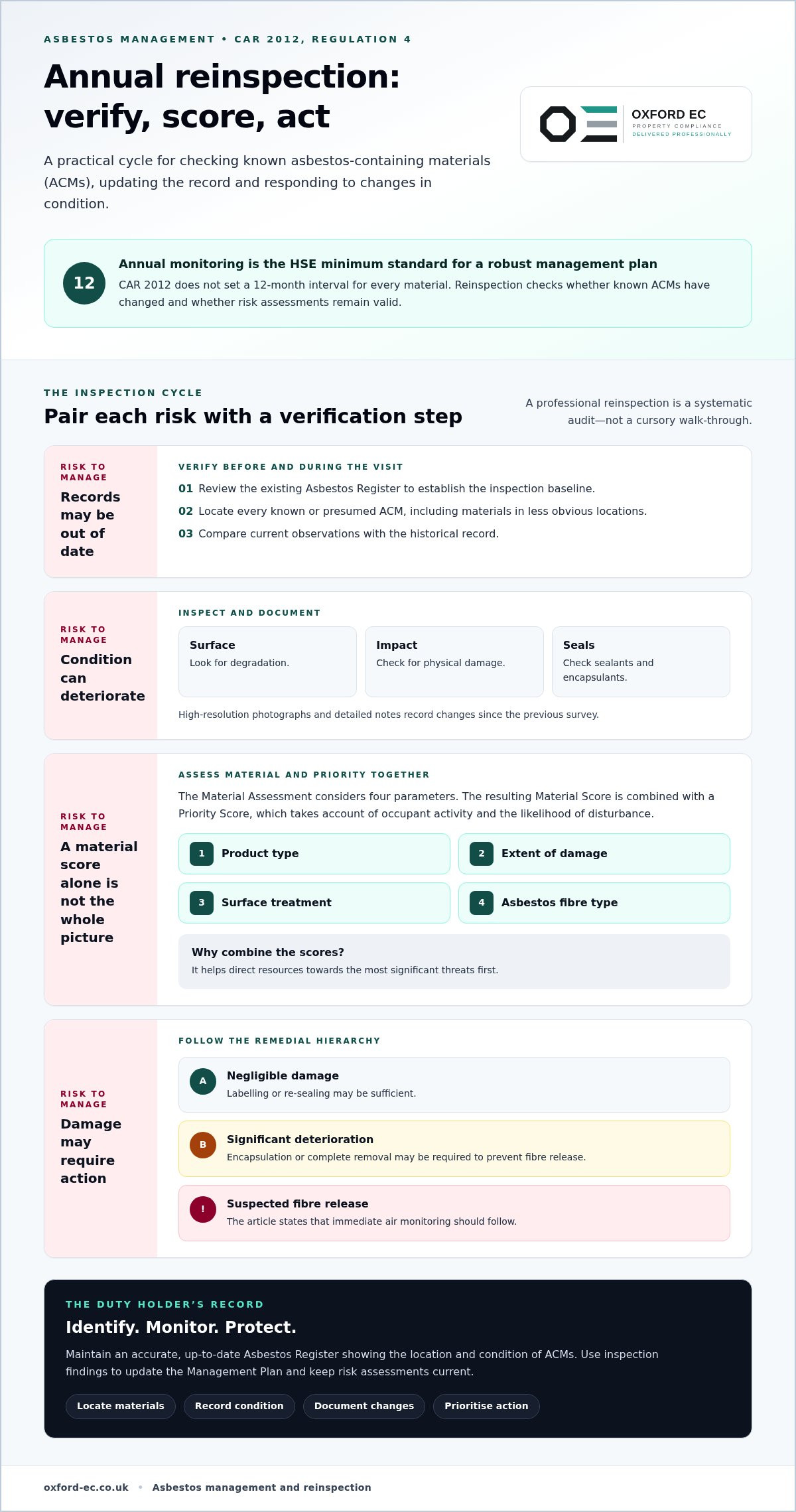
Compliance is not static. It is dynamic. It is rigorous. Whilst CAR 2012 does not explicitly state a 12-month interval for every material, the Health and Safety Executive (HSE) considers annual monitoring the minimum standard for a robust management plan. Environmental stressors such as building vibration, damp ingress, or general wear and tear can rapidly degrade the integrity of ACMs; potentially releasing hazardous fibres into the atmosphere. A professional asbestos reinspection allows the duty holder to update the Management Plan with current data. This process ensures that the risk assessments remain valid and that the safety of the site is never left to chance. Utilising Asbestos Consultancy Services ensures that this monitoring is conducted with the technical precision required for an audit-ready compliance record that protects both the occupants and the duty holder's legal standing.
The Reinspection Process: What Happens During a Professional Audit?
A professional asbestos reinspection is a forensic exercise in validation. It's not a cursory walk-through; it's a systematic audit designed to verify the stability of every known asbestos-containing material (ACM) within a property. Before arriving on-site, the consultant performs a rigorous review of the existing Asbestos Register to establish a baseline for the inspection. This pre-site phase ensures that no previously identified material, however obscurely located, is omitted from the assessment. Once on-site, the surveyor must physically locate every ACM or presumed material to scrutinise its current state against historical data.
The inspection focuses on three critical vectors: surface degradation, evidence of physical impact, and the integrity of existing sealants or encapsulants. Identify. Inspect. Document. Every material is subjected to this triad of scrutiny. High-resolution photography and detailed documentation are utilised to record any changes in condition since the last survey. This comparative approach provides the duty holder with an evidence-based trail of material behaviour, which is essential for maintaining compliance with the Control of Asbestos Regulations 2012 and ensuring the safety of all building occupants.
Assessing Material Condition and Risk Scores
UK compliance relies on a standardised Material Assessment algorithm to quantify risk. This scoring system evaluates four parameters: product type, extent of damage, surface treatment, and asbestos fibre type. There's a vital distinction between "low damage," such as minor surface abrasions, and "high risk" deterioration, where delamination or exposed friable fibres are present. The resulting Material Score is then combined with a Priority Score, which accounts for occupant activity and the likelihood of the material being disturbed. This dual-scoring method ensures that resources are directed toward the most significant threats first.
The Remedial Action Hierarchy
When damage is identified during an asbestos reinspection, the consultant must recommend an immediate course of action based on a defined hierarchy. In cases of negligible damage, simple labelling or re-sealing may suffice. However, significant deterioration requires encapsulation or complete removal to prevent fibre release. Expert asbestos consultancy services are indispensable here; they provide the technical guidance needed to prioritise repairs whilst ensuring that any suspected fibre release is met with immediate air monitoring. If your current management plan feels fragmented, you can speak with our technical team to secure a streamlined, audit-ready solution for your portfolio.
Management Survey vs. Reinspection: Navigating Your Compliance Lifecycle
Foundational data. Recurring scrutiny. Lifecycle management. A Management Survey serves as the primary investigative document that identifies the location, type, and extent of asbestos-containing materials (ACMs) through intrusive sampling and laboratory analysis. It's the baseline. Conversely, an asbestos reinspection represents the maintenance phase of the compliance lifecycle, focusing on the visual assessment of known materials to detect deterioration. It's the check-and-balance. You cannot perform a reinspection without a valid Management Survey; attempting to do so is a fundamental failure of the Duty to Manage that leaves your organisation legally exposed.
Whilst a Management Survey involves taking physical samples for microscopic identification, a reinspection is typically a non-intrusive visual check designed to update the risk scores of previously logged items. It's a targeted audit of the known. It does not search for new materials. If your building has never undergone a comprehensive survey, an asbestos reinspection is not the correct starting point. You must first establish a robust register before you can begin the cycle of monitoring. This distinction is critical for maintaining an accurate, HSE-compliant safety record that truly reflects the risks present within your estate.
When to Upgrade Your Survey Type
Planned works. Structural changes. Risk mitigation. Whilst a reinspection monitors the status quo, it's entirely insufficient for any project involving structural disturbance. Duty holders must trigger a Refurbishment or Demolition (R&D) survey before any intrusive works commence to uncover hidden ACMs within the building fabric. For a deeper understanding of the initial investigative phase, consult our Complete Guide to Asbestos Management Surveys. Relying on a standard visual check during structural alterations is dangerous, as it fails to account for materials behind wall cavities or under floorboards. International protocols, including EPA guidance for building owners, consistently highlight that regular surveillance must be supplemented by project-specific surveys to maintain a safe working environment.
Maintaining the Accuracy of the Asbestos Register
Data integrity. Historical transparency. Audit readiness. Every monitoring cycle provides an opportunity to scrub the Asbestos Register of obsolete information. When materials are removed, they shouldn't just be deleted; they must be recorded as "removed" with a clear audit trail to show when and how the risk was eliminated. This level of timestamped data is vital during legal audits to demonstrate proactive management and accountability. The Asbestos Register is the living document of building safety.
The Ultimate Asbestos Reinspection Checklist for Property Managers
Precision in preparation is the hallmark of a compliant duty holder. An asbestos reinspection is only as effective as the data that precedes it; therefore, property managers must adopt a granular approach to site readiness. This checklist ensures that your annual audit is comprehensive, legally robust, and provides the "audit-ready" transparency required by the HSE. Follow these five essential steps to secure your estate's compliance for 2026.
- Step 1: Collate all previous survey data and the current Management Plan. Historical context is vital. The surveyor must be able to compare the current state of a material against its condition 12 months ago to identify subtle rates of degradation.
- Step 2: Ensure all areas containing ACMs are accessible to the surveyor. Locked risers or sealed ceiling voids create compliance gaps. If a previously identified material cannot be inspected, your Management Plan remains incomplete and legally vulnerable.
- Step 3: Verify that all ACM labels are still present and legible. Warning labels are a primary line of defence for contractors. Ensure they haven't been painted over, removed, or damaged by environmental factors since the last visit.
- Step 4: Review maintenance logs for work conducted near ACM locations. Scrutinise all contractor records from the past year. If work occurred near friable materials, the surveyor should perform a high-intensity check of those specific areas for signs of accidental disturbance.
- Step 5: Formally update the Management Plan based on the reinspection report. Receiving the report is only the midpoint of the process. The findings must be integrated into your central safety document to ensure it remains a "living" record of building health.
Preparation Checklist for the Consultant Visit
Site flow is critical for a thorough asbestos reinspection. Duty holders must ensure all keys, security codes, and escorts for restricted areas are organised in advance. It's equally important to notify building occupants or tenants of the inspection schedule to avoid operational friction. Furthermore, you must provide the surveyor with records of any recent remedial work. If materials have been encapsulated or removed, the surveyor requires the associated clearance certificates to officially update the Asbestos Register.
Post-Inspection Review and Action Items
Once the physical audit concludes, the duty holder's focus shifts to analysis. Cross-reference the new report with the previous register to identify any discrepancies or newly discovered risks. If the consultant identifies "high risk" deterioration, you must immediately prioritise the budget for encapsulation or removal. Finally, communicate any significant changes in risk profiles to the on-site health and safety officer to ensure local safety protocols remain aligned with the latest data.
Professional Asbestos Consultancy: Maintaining a Robust Management Plan
Technical mastery. Statutory protection. Unwavering precision. Whilst a basic visual check might seem sufficient to a layperson, it lacks the forensic depth required to satisfy the rigorous standards of HSE scrutiny. Professional consultancy provides more than a simple update to a spreadsheet; it offers a high-level technical audit that identifies subtle material degradation before it evolves into a significant liability. Relying on internal, non-specialist staff for an asbestos reinspection often results in fragmented data and overlooked risks, which can leave a duty holder personally exposed to legal repercussions.
Oxford Environmental Consultants (OEC) acts as a protective shield for your organisation by providing a disciplined, expert-led approach to property safety. Our consultants don't just identify problems; they deliver structured, evidence-based solutions. If a material is found to have deteriorated beyond the point of safe encapsulation, OEC seamlessly manages the transition from reinspection to professional asbestos removal. This end-to-end oversight ensures that your property remains "audit-ready" 365 days a year, providing the peace of mind that stems from absolute legal and technical robustness.
The Multi-Disciplinary Advantage
Strategic alignment. Operational efficiency. Risk consolidation. Modern property management requires a holistic view of safety that transcends individual silos. There is a powerful synergy between asbestos management, fire safety, and water hygiene compliance. By utilising a multi-disciplinary partner, duty holders can synchronise their inspection cycles to reduce building downtime and eliminate the administrative burden of managing multiple, disconnected contractors. Oxford Environmental Consultants provides a streamlined solution to fragmented safety problems by integrating these critical pillars into a single, cohesive management strategy.
Expert Oversight for National Portfolios
Managing a national estate demands a partner with the scale and discipline to deliver consistency across every site. OEC possesses the capability to execute large-scale asbestos reinspection programmes across the UK, ensuring that reporting standards and risk assessment methodologies remain uniform regardless of location. This standardisation is vital for portfolio managers who require a transparent, bird's-eye view of their compliance status to make informed budgetary decisions. Secure your building's safety and maintain your legal standing by booking your 2026 asbestos reinspection with OEC's technical team today.
Securing Your 2026 Statutory Compliance
Maintaining a robust asbestos management plan is a continuous commitment to property safety. It's the only definitive way to ensure the Duty to Manage is fully discharged in accordance with the law. By prioritising a professional asbestos reinspection, duty holders move beyond simple box-ticking and into a regime of absolute legal robustness. This proactive approach identifies material degradation early, protects building occupants, and ensures your estate remains resilient against HSE scrutiny at all times.
Oxford Environmental Consultants (OEC) provides the meticulous oversight required for complex portfolios. With national UK coverage and expert CAR 2012 guidance, we act as an accountable partner for your property requirements. Our multi-disciplinary safety solutions provide a streamlined, "one-stop" approach that integrates asbestos, fire, and water safety into a single, audit-ready framework. You don't have to navigate these high-stakes regulations alone.
Take the first step toward a safer, more resilient estate by securing your professional audit today. We're ready to protect your legal standing and your occupants' well-being.
Frequently Asked Questions
How often is an asbestos reinspection legally required in the UK?
Statutory compliance. Annual monitoring. Risk mitigation. Statutory compliance usually necessitates a review every 12 months. Whilst CAR 2012 Regulation 4 does not explicitly define a rigid timeframe, HSE guidance considers an annual asbestos reinspection the minimum standard for maintaining a robust Management Plan. The frequency may increase for high-risk materials located in areas of high footfall or environmental stress.
Can I carry out an asbestos reinspection myself if I am the duty holder?
Duty holders may only conduct inspections if they possess the requisite technical competence and training. This is rarely advisable for complex commercial environments. Professional consultants provide the impartial, expert scrutiny required to satisfy legal audits and ensure that subtle material degradation is not overlooked. Relying on non-specialist internal staff often leaves the organisation vulnerable to HSE prosecution if a fibre release occurs.
What is the typical cost of an asbestos reinspection for a commercial building?
Investment levels are determined by the scale of the property and the volume of asbestos-containing materials (ACMs) identified in the original register. Factors such as site accessibility, the total number of items requiring physical inspection, and the complexity of the building's layout influence the final quote. Duty holders should request a bespoke proposal based on their specific Asbestos Management Plan to ensure accurate budgeting for their portfolio.
What happens if the asbestos reinspection identifies damaged materials?
Immediate remedial action is required. The consultant will update the Material Assessment score within the register and recommend a specific course of action based on the risk hierarchy. This may involve labelling, encapsulation, or professional asbestos removal. The Management Plan must then be formally updated to reflect these changes and ensure the safety of building occupants remains uncompromised.
Is an asbestos reinspection required for domestic properties?
Private residential dwellings are generally exempt from Regulation 4 of CAR 2012. However, the "common parts" of multi-occupancy domestic premises, such as foyers, stairwells, and lift shafts in blocks of flats, are classified as non-domestic. These areas require a management survey and regular monitoring. Duty holders for these spaces must maintain a valid compliance record to protect residents and visitors.
How does an asbestos reinspection differ from a management survey?
Baseline data. Recurring audit. Maintenance cycle. A management survey is the foundational investigative document that uses sampling to identify ACMs. In contrast, an asbestos reinspection is a recurring maintenance audit that focuses on assessing the condition of known materials rather than searching for new ones. You cannot conduct a reinspection without the verified data provided by the initial survey.
What documents should I provide to the asbestos surveyor before they arrive?
Surveyors require the current Asbestos Register and the existing Management Plan to establish a baseline for the audit. You should also provide records of any recent remedial works, clearance certificates, or previous reinspection reports. Providing these documents ensures the site visit is efficient and that the historical data trail remains unbroken for audit purposes.
What should I do if I have lost my original asbestos management survey?
Establish a new baseline. Commission a Management Survey immediately. Without the original data, a reinspection is impossible because there is no verified register to monitor. A fresh survey will re-establish your compliance record and allow you to restart the statutory monitoring cycle. This ensures your safety records are accurate, up-to-date, and audit-ready.