

Compliance for apartments represents one of the most complex regulatory challenges facing property managers and building owners in 2026. Unlike single-occupancy dwellings, apartment buildings must navigate overlapping statutory frameworks covering fire safety, structural integrity, environmental hazards, and tenant welfare. The regulatory landscape has intensified following high-profile tragedies and legislative reforms, transforming compliance from a tick-box exercise into a continuous, multi-disciplinary risk management imperative. For duty holders responsible for residential blocks, understanding the full spectrum of compliance obligations is not merely advisable-it is legally mandated and carries significant personal liability.
The Regulatory Framework Governing Apartment Compliance
The foundation of compliance for apartments in the UK rests on several interconnected legislative pillars. The Building Safety Act 2022 introduced the concept of the Accountable Person, establishing clear lines of responsibility for occupied higher-risk buildings. This legislation works alongside the Fire Safety Act 2021, which explicitly extended the Regulatory Reform (Fire Safety) Order 2005 to include flat entrance doors and external wall systems.
The Housing Health and Safety Rating System (HHSRS) continues to provide the assessment framework for residential property conditions, whilst the Social Housing (Regulation) Act 2023 imposed stricter consumer standards and inspection powers. Property managers must also comply with the Control of Asbestos Regulations 2012, the Health and Safety at Work Act 1974, and numerous sector-specific codes of practice.
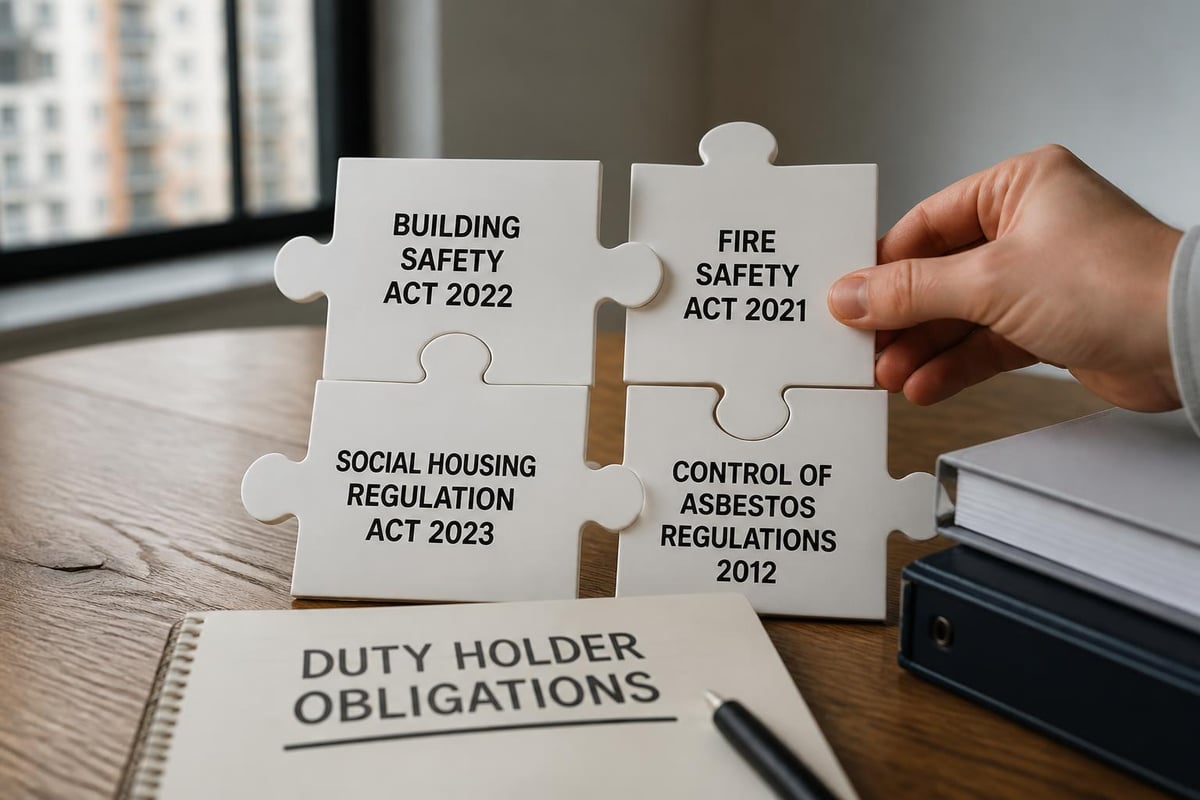
Understanding these frameworks requires specialist knowledge, particularly where regulations intersect. For instance, fire compartmentation works may disturb asbestos-containing materials, triggering both asbestos management protocols and fire safety notification requirements simultaneously.
Fire Safety Compliance: The Non-Negotiable Priority
Fire safety remains the most visible and heavily scrutinised aspect of compliance for apartments. Following the Grenfell Tower tragedy, regulatory enforcement has intensified dramatically, with building owners facing prosecution for failures that would previously have attracted improvement notices.
Core Fire Safety Obligations
Every apartment building requires a suitable and sufficient fire risk assessment, updated regularly and reviewed following any material alteration or incident. Fire Risk Assessment services must align with PAS 79-2 for residential properties, identifying hazards, evaluating risks, and producing prioritised action plans.
Beyond the written assessment, duty holders must ensure:
- Adequate means of escape: Clear, well-lit routes with appropriate signage and emergency lighting
- Fire detection and alarm systems: Properly specified, installed, and maintained to BS 5839 standards
- Passive fire protection: Intact compartmentation, properly fire-stopped service penetrations, and cavity barriers
- Active fire suppression: Sprinkler or mist systems where required or retrofitted
- Fire door integrity: Self-closing devices, intumescent seals, and correct gaps maintained
According to guidance from HUD housing standards, properties must maintain functional smoke detectors and clear egress routes, principles that align closely with UK requirements.
| Fire Safety Element | Inspection Frequency | Responsible Party | Regulatory Standard |
|---|---|---|---|
| Fire Risk Assessment | Annual minimum | Competent Person | PAS 79-2 |
| Fire Alarms | Weekly/Monthly/Annual | Responsible Person | BS 5839 |
| Emergency Lighting | Monthly/Annual | Responsible Person | BS 5266 |
| Fire Doors | Six-monthly minimum | Competent Inspector | BS 9999 |
| Extinguishers | Annual | Competent Technician | BS 5306 |
Fire door compliance alone represents a significant undertaking. Each fire door must close correctly, maintain appropriate gaps, possess functioning intumescent strips and smoke seals, and display correct signage. Across a 100-unit block, this translates to hundreds of individual compliance points requiring documentation and ongoing monitoring.
External escape staircases demand specialist attention. These critical escape routes must undergo visual inspections annually, checking for corrosion, structural integrity, anti-slip surfaces, and handrail security. Any degradation directly compromises life safety, making regular professional inspection essential.
Asbestos Management in Occupied Apartment Buildings
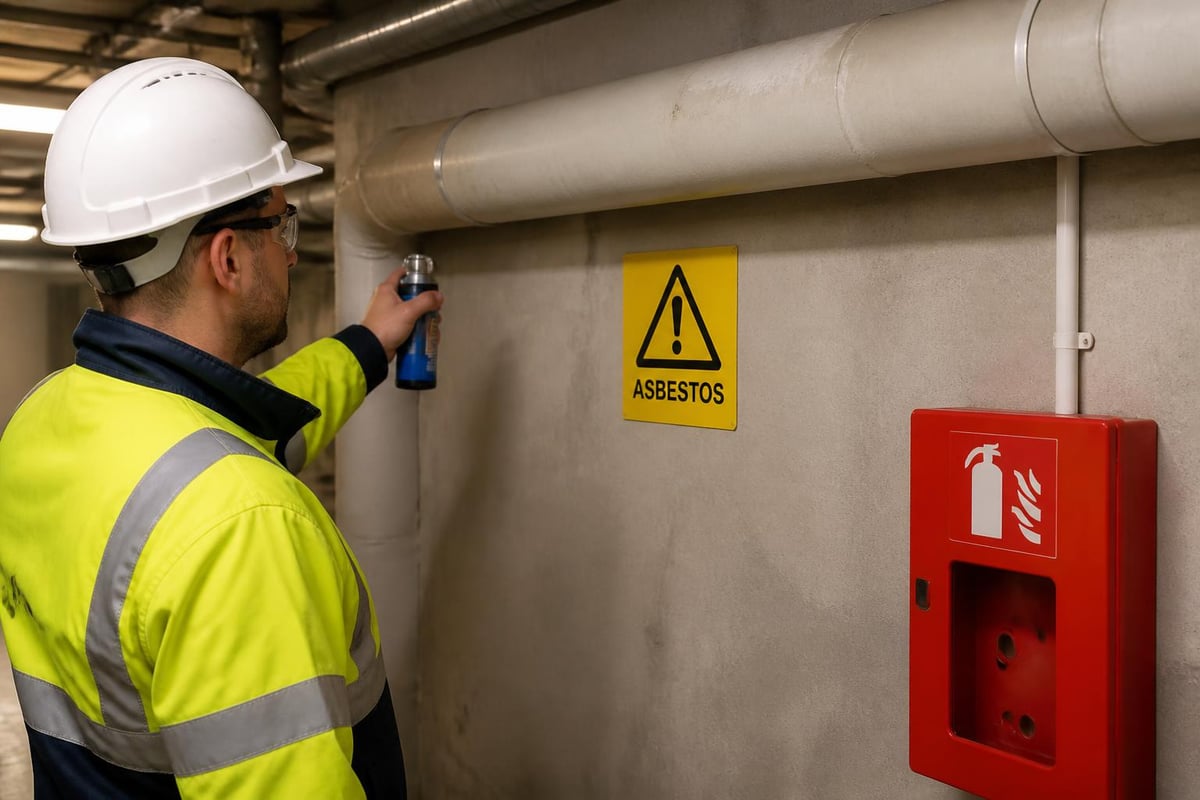
The Control of Asbestos Regulations 2012 impose absolute duties on those who manage non-domestic premises, which includes the common parts of apartment buildings. Compliance for apartments therefore mandates a comprehensive asbestos management programme, regardless of building age or construction type.
Establishing Asbestos Compliance
Every duty holder must:
- Commission a suitable asbestos survey: Management surveys for occupied buildings, refurbishment and demolition surveys before intrusive works
- Maintain an asbestos register: Photographic evidence, location details, material assessment scores, and condition ratings
- Implement a management plan: Procedures for monitoring, controlling access, emergency response, and information sharing
- Conduct annual re-inspections: Material condition monitoring with updated risk scores
Understanding asbestos management obligations is particularly challenging because asbestos-containing materials may be hidden within plant rooms, service risers, lift shafts, and beneath floor coverings. A single missed location can result in uncontrolled exposure during routine maintenance or emergency repairs.
Material risk scores change over time as ACMs deteriorate or become damaged. An artex ceiling rated as low risk during initial survey may progress to high priority if water ingress causes delamination. This dynamic risk profile necessitates ongoing professional monitoring, not one-time assessment.
Contractors working in common areas must receive asbestos information before starting work. This obligation applies to electricians, plumbers, decorators, and anyone whose activities might disturb building fabric. Failure to provide this information breaches Regulation 4 and creates prosecution risk.
Water Hygiene and Legionella Control
Legionella bacteria thrive in poorly maintained water systems, presenting serious health risks in apartment buildings with complex pipework, dead legs, infrequently used outlets, and storage tanks. The Health and Safety Executive's Approved Code of Practice L8 establishes clear requirements for water system risk management.
Compliance for apartments requires written legionella risk assessments identifying potential hazard sources, vulnerable populations, and control measures. These assessments must consider:
- Cold water storage tanks and distribution temperatures
- Hot water calorifiers, circulation systems, and sentinel outlet temperatures
- Shower heads and rarely used taps
- Cooling towers and evaporative condensers (where present)
Monthly temperature monitoring, quarterly TMV servicing, and annual system reviews form the backbone of ongoing compliance. Water sampling and laboratory analysis provide verification that control measures remain effective.
The water hygiene obligations extend beyond technical compliance to include tenant communication. Where individual apartments contain private water heaters or showers, residents must receive guidance on maintaining appropriate temperatures and managing infrequently used outlets.
Damp, Mould and the Awaab's Law Imperative
The tragic death of Awaab Ishak catalysed fundamental reform in how the sector addresses damp and mould. The Social Housing (Regulation) Act 2023 introduced statutory timescales for hazard investigation and remediation, commonly known as Awaab's Law.
Statutory Response Times
Property managers must now:
- Investigate reported health hazards within 14 days
- Commence remedial works within a further seven days
- Complete works within reasonable timescales appropriate to the hazard severity
These timescales apply to social housing providers initially, but establish a clear expectation that regulators will enforce across all residential tenures. More importantly, they recognise that damp and mould constitute serious health hazards requiring urgent professional response.
Effective compliance demands understanding root causes. Surface mould treatments without addressing underlying moisture sources provide temporary cosmetic improvement whilst health risks continue. Professional diagnosis must identify whether condensation, penetrating damp, rising damp, or building defects drive mould growth.
Guidance from property owner responsibilities emphasises the landlord's duty to maintain habitable conditions, a principle equally applicable in UK residential management. Addressing damp and mould is not discretionary maintenance-it is a fundamental compliance obligation.
Building Safety and the Accountable Person Role
The Building Safety Act 2022 created a new regulatory regime for higher-risk buildings (18 metres or seven storeys). Accountable Persons must register buildings with the Building Safety Regulator, prepare safety case reports, and implement safety management systems demonstrating ongoing compliance.
Even for buildings below statutory thresholds, the principles of proactive safety management represent best practice. Regular structural inspections, maintenance of building records, assessment of external wall systems, and emergency planning all contribute to comprehensive compliance.
The Accountable Person role carries personal responsibility and potential criminal liability. This responsibility cannot be delegated, though specialist consultancies can provide the technical expertise and audit trail documentation required to discharge duties competently.

Compartmentation represents a critical building safety element requiring specialist assessment. Fire-resistant walls and floors prevent fire spread, protecting escape routes and limiting building damage. However, service penetrations, alteration works, and building settlement can compromise compartmentation integrity. Compartmentation surveys identify breaches in fire-resistant construction, enabling targeted remedial fire-stopping works that restore designed protection levels.
Inspection Regimes and Documentation Requirements
Compliance for apartments generates substantial documentation obligations. Every inspection, test, maintenance activity, and remedial work must be recorded, creating an audit trail demonstrating ongoing duty discharge.
Best practice inspection regimes typically include:
- Daily: Visual checks of escape routes, emergency lighting charge indicators
- Weekly: Fire alarm system testing, temperature checks on critical water outlets
- Monthly: Emergency lighting duration tests, water temperature monitoring
- Quarterly: Thermostatic mixing valve servicing, fire extinguisher visual checks
- Six-monthly: Fire door inspections, external staircase assessments
- Annual: Fire risk assessment reviews, asbestos re-inspections, legionella risk assessments, comprehensive building surveys
This schedule represents minimum frequencies. Risk assessment may dictate more frequent interventions for specific buildings or systems.
| Compliance Task | Frequency | Output Document | Retention Period |
|---|---|---|---|
| Fire Risk Assessment | Annual | FRA Report | Life of building |
| Asbestos Survey | Triennial/Pre-works | Survey Report | Life of building |
| Legionella Risk Assessment | Biennial | LRA & Written Scheme | Current + 5 years |
| Fire Alarm Service | Quarterly | Service Certificate | 5 years minimum |
| Emergency Light Test | Annual | Test Certificate | 3 years minimum |
| Electrical Installation | 5 yearly | EICR | Life of installation |
Digital compliance management systems increasingly replace paper records, offering searchable databases, automated reminders, and integration with maintenance workflows. However, the underlying requirement remains constant: demonstrable evidence of systematic compliance management.
Resources such as the property management compliance checklist provide frameworks for tracking these multiple obligations, though sector-specific guidance tailored to UK residential property offers greater relevance.
Multi-Disciplinary Risk Management
The complexity of compliance for apartments demands coordinated multi-disciplinary expertise. Fire safety engineers, asbestos analysts, water treatment specialists, building surveyors, and facilities managers must work collaboratively, recognising where their disciplines intersect.
Consider a typical major works project: external wall insulation installation. This single project triggers:
- Pre-works asbestos surveys to identify ACMs requiring removal
- Fire safety assessment of proposed insulation materials and fixing methods
- Compartmentation surveys ensuring works don't compromise fire resistance
- Building control notifications and sign-off requirements
- Resident communication and temporary risk mitigation measures
- Updated building records and golden thread documentation
Fragmented procurement across multiple unconnected consultancies creates coordination challenges, communication gaps, and delayed project delivery. Increasingly, property managers recognise value in consolidating compliance under one consultancy capable of delivering integrated multi-disciplinary services.
This consolidation approach ensures consistent standards, simplified communication, coordinated scheduling, and comprehensive understanding of building-specific compliance requirements. It also streamlines invoicing, reporting, and relationship management.
Enforcement Trends and Prosecution Risk
Regulatory enforcement has intensified markedly since 2020. Fire and rescue services actively prosecute Regulatory Reform (Fire Safety) Order 2005 breaches. The Health and Safety Executive pursues asbestos management failures. Local authority housing teams enforce Housing Act provisions with increasing vigour.
Understanding what compliance departments do for apartments helps contextualise the severity of potential consequences. Prosecution can result in unlimited fines, director disqualification, and imprisonment for serious breaches. Civil liability following injury or death compounds these criminal sanctions.
Recent case law demonstrates courts' willingness to impose substantial penalties. A 2025 case saw a property management company fined £1.2 million following a fire where inadequate compartmentation contributed to rapid spread. The managing director received a suspended prison sentence and five-year directorship ban.
Beyond formal prosecution, improvement and prohibition notices disrupt operations, damage reputation, and undermine stakeholder confidence. Insurance implications further compound financial impact, with premiums rising sharply following enforcement action.
Tenant Communication and Resident Engagement
Effective compliance for apartments requires resident cooperation and awareness. Tenants must understand their responsibilities for testing smoke alarms, reporting defects, maintaining ventilation, and avoiding alterations compromising building safety.
Regular communication through newsletters, notice boards, and digital platforms keeps safety matters visible. Fire safety instructions, emergency evacuation procedures, and reporting mechanisms should be clearly accessible to all residents including those with language barriers or disabilities.
Guidance on apartment inspection practices highlights the importance of transparent communication about inspection schedules and purposes. Whilst US-focused, the principles of notice provision and respectful access equally apply in UK contexts.
Documenting resident communications forms part of the compliance audit trail. Where tenants decline access for inspections or refuse remedial works, written records protect duty holders from liability arising from non-compliance outside their control, though documenting problem residents requires care to avoid discrimination or privacy breaches.
Technology and Compliance Management Systems
Digital transformation offers significant potential for improving compliance for apartments. Cloud-based compliance platforms centralise inspection schedules, certificate storage, contractor management, and defect tracking. Mobile applications enable on-site inspectors to record findings, capture photographs, and generate reports in real-time.
Automated reminders prevent inspections lapsing beyond due dates. Dashboard visualisations provide compliance status overviews, highlighting upcoming obligations and overdue actions. Integration with building management systems enables automated data capture from fire alarms, emergency lighting, and water temperature monitoring.
However, technology alone cannot deliver compliance. Human expertise remains essential for risk assessment, professional judgement, and strategic decision-making. Technology should enhance, not replace, competent professional input.
The Cost of Non-Compliance Versus Investment in Compliance
Budget-conscious property managers sometimes view compliance as discretionary expenditure, deferring inspections or remedial works to preserve cash flow. This perspective fundamentally misunderstands both legal obligations and financial exposure.
Non-compliance costs manifest through:
- Prosecution fines ranging from thousands to millions of pounds
- Civil damages following injury or death, often exceeding insurance limits
- Increased insurance premiums or policy voidance
- Property devaluation as compliance defects emerge during transactions
- Reputational damage affecting tenant retention and new lettings
- Emergency remedial costs significantly exceeding planned maintenance
By contrast, systematic compliance investment:
- Protects life safety, the overriding priority
- Demonstrates duty discharge, providing prosecution defence
- Maintains property value and marketability
- Reduces insurance costs through demonstrated risk management
- Extends asset life through proactive maintenance
- Supports ESG objectives increasingly important to investors
Standards established by minimum housing codes internationally recognise that compliance represents fundamental property stewardship, not optional enhancement.
Future Regulatory Developments
The regulatory landscape governing compliance for apartments continues evolving. Several developments will likely intensify obligations during 2026 and beyond:
- Extended Accountable Person regime potentially lowering the 18-metre threshold
- Strengthened resident engagement requirements following Building Safety Act reviews
- Enhanced golden thread expectations for building information management
- Stricter energy efficiency standards intersecting with building safety requirements
- Increased local authority enforcement powers and inspection capacity
Staying ahead of regulatory change requires engagement with industry consultation processes, professional body guidance updates, and specialist advisory services. Reactive compliance approaches struggle with accelerating regulatory development.
Compliance for apartments demands coordinated expertise across multiple technical disciplines, systematic documentation, and ongoing proactive risk management. The regulatory framework in 2026 leaves no room for complacency, with enforcement focused on outcomes and duty holder accountability. For property managers seeking audit-ready precision across fire safety, asbestos, water hygiene, damp and mould, and building safety obligations, partnering with a specialist multi-disciplinary consultancy ensures comprehensive coverage and defensible compliance positions. Discover how oxford-ec.co.uk delivers nationwide risk management services tailored to the complex demands of residential property compliance.