
Compliance is no longer a discretionary administrative task. It's a legal fortress. It's your shield. Under the stringent requirements of the Building Safety Act 2022, the margin for error has effectively vanished, leaving duty-holders vulnerable to significant prosecution and reputational damage. Undertaking a thorough commercial building safety inspection is the only way to verify that your property remains within the bounds of the law whilst protecting the lives of every occupant.
Precision. Accountability. Protection. You understand the exhaustion that comes from managing a fragmented network of contractors and the anxiety of maintaining a disjointed compliance record. We've developed this definitive checklist to offer you absolute technical rigour and the peace of mind that comes from a centralised, multi-disciplinary approach. This guide provides an actionable roadmap through the complexities of statutory requirements, including asbestos management, fire risk assessments, and water hygiene protocols, ensuring your property aligns perfectly with the latest UK safety standards.
Key Takeaways
- Legislative Rigour. Identify the critical statutory mandates for Duty Holders under the Building Safety Act 2022 to ensure your organisation remains protected from legal liability and potential prosecution.
- Integrated Auditing. Learn why a multi-disciplinary commercial building safety inspection is the most efficient method for maintaining a centralised, audit-ready compliance record for your entire property portfolio.
- Strategic Oversight. Distinguish between mandatory statutory requirements and recommended best practices to mitigate long-term asset risk whilst effectively controlling maintenance expenditure.
- Rigorous Maintenance. Access a comprehensive checklist of fire safety inspections to ensure your alarms, doors, and escape staircases remain fully compliant with the Regulatory Reform (Fire Safety) Order 2005.
- Absolute Accountability. Establish a defensible legal position by leveraging professional property audits that align your assets with the most stringent UK safety frameworks and technical standards.
Table of Contents
The Duty Holder’s Mandate: Building Safety Legislation in 2026
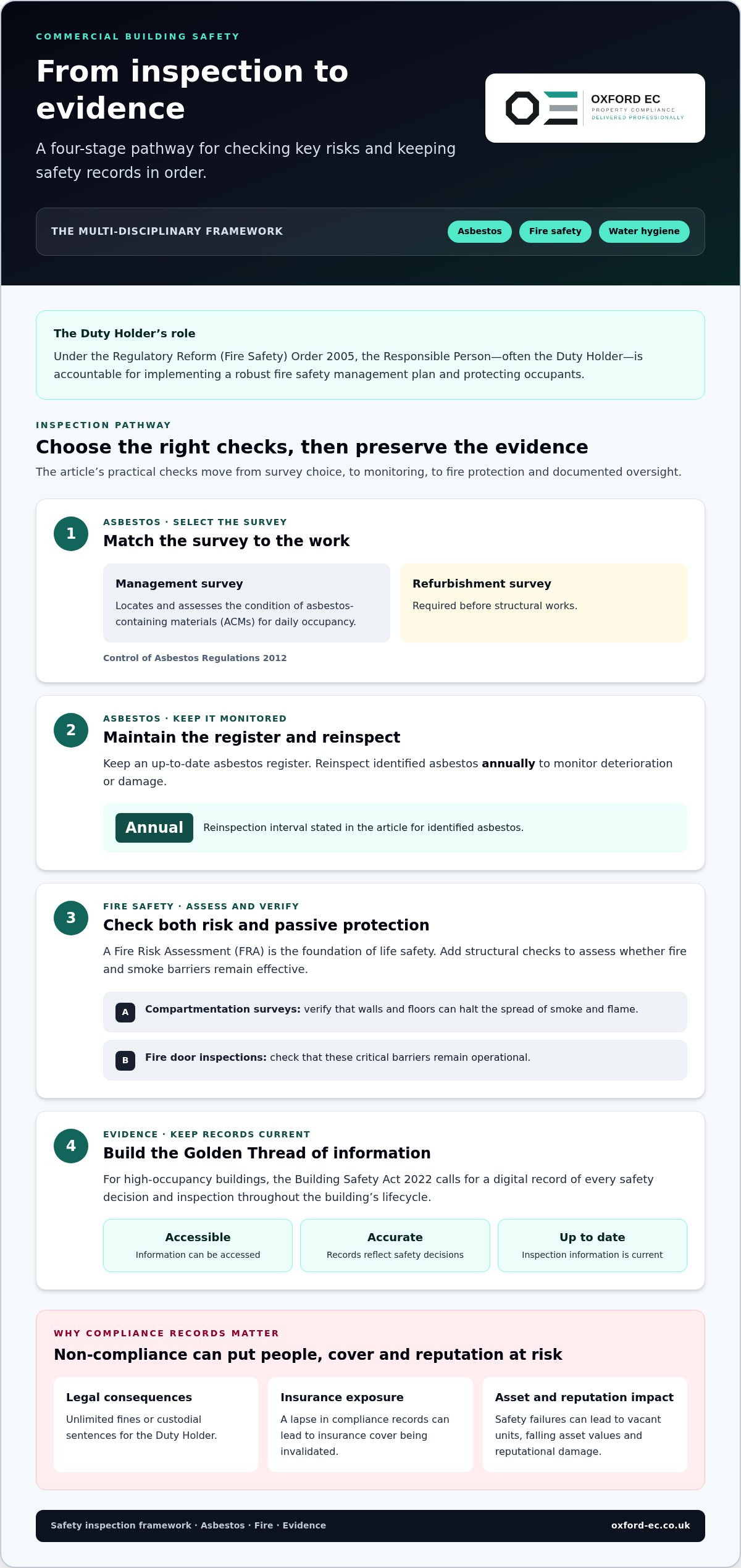
Identify. Manage. Protect. Under the Regulatory Reform (Fire Safety) Order 2005, the "Responsible Person", often termed the Duty Holder, carries the full weight of legal accountability for the safety of a premises. This individual, whether an employer, owner, or managing agent, is strictly mandated to implement a robust fire safety management plan and ensure the protection of all occupants. A comprehensive commercial building safety inspection serves as the primary evidence that these obligations are being met with technical rigour. Statutory compliance in the UK property sector is the absolute adherence to all legislative requirements and regulatory standards that govern the safety, maintenance, and operational integrity of a built asset.
Expertise. Reliability. Compliance. For duty holders seeking to establish this level of operational integrity, you can check out UK Fire Risk Assessments for professional guidance on statutory fire safety compliance across the UK.
The Building Safety Act 2022 and its Evolution
Precision. Accountability. Transparency. The Building Safety Act 2022 has redefined commercial asset management by demanding a "Golden Thread" of information for high-occupancy buildings. This digital record must capture every safety decision and inspection throughout the building's lifecycle, ensuring that data is accessible, accurate, and up to date. For those seeking a wider building inspection overview, it's clear that the shift towards high-register documentation is now a global standard for mitigating structural and operational risk. Directors and property managers now face heightened personal liability, as the Act removes the corporate veil for safety failures. Regular safety case reports are no longer optional; they're a technical necessity to prove that risks are being managed through a structured, evidence-based approach.
Expansion. Integration. Compliance. For organisations navigating these global standards during international expansion, Encor Group provides the specialised corporate services needed to manage market entries and cross-border mergers with technical precision.
Consequences of Non-Compliance
Failure is costly. Negligence is criminal. The legal landscape in 2026 doesn't tolerate administrative oversights, with non-compliance often resulting in unlimited fines or custodial sentences for the Duty Holder. Beyond the immediate threat of prosecution, failing to maintain a valid commercial building safety inspection record can instantly invalidate your commercial insurance policies. Insurers increasingly demand proof of rigorous property compliance before honouring claims, and a single lapse can lead to a total loss of cover. The reputational damage is equally severe. Safety failures lead to vacant units, plummeting asset values, and a permanent stain on an organisation's professional standing, making compliance the ultimate shield for your business interests.
The Multi-Disciplinary Inspection Framework: Core Pillars
Efficiency. Oversight. Control. Fragmented safety management is a liability. Managing disparate contractors for individual disciplines often leads to data silos and critical oversight gaps that a commercial building safety inspection is designed to close. By implementing property compliance audits, duty holders can synchronise the "Big Three" risks, asbestos, fire safety, and water hygiene, into a manageable lifecycle. This holistic framework doesn't just simplify administration; it builds a robust, defensible record of due diligence across your entire portfolio.
Asbestos Management and Scrutiny
Knowledge. Scrutiny. Compliance. Under the Control of Asbestos Regulations 2012, the duty to manage is absolute. It's vital to distinguish between asbestos management surveys, which locate and assess the condition of ACMs for daily occupancy, and refurbishment surveys required before structural works. Once identified, asbestos requires annual reinspections to monitor deterioration or damage. Maintaining an up-to-date asbestos register is a technical necessity that protects both occupants and the organisation from legal exposure.
Fire Safety and Passive Protection
Containment. Prevention. Integrity. A comprehensive Fire Risk Assessment (FRA) is the foundation of life safety. However, passive fire protection requires deeper technical scrutiny. Compartmentation surveys verify that walls and floors can effectively halt the spread of smoke and flame, whilst fire door inspections ensure these critical barriers remain operational. These structural checks are non-negotiable components of a rigorous commercial building safety inspection programme that safeguards your physical assets.
Maintaining the integrity of metal structural components is a vital part of this process; for expert fabrication and precision welding that meets these high safety requirements, visit Global Montage ApS.
Beyond structural integrity, maintaining kitchen equipment to prevent grease-related fire hazards is a key part of operational safety; you may wish to check out Premium Oven Cleaner for professional cleaning services that help mitigate these risks.
Water Hygiene and Legionella Control
Monitoring. Hygiene. Safety. Legionella control is a statutory requirement under ACoP L8 and the Health and Safety at Work Act 1974. Commercial water systems must undergo regular risk assessments to identify potential stagnation or temperature issues. Monthly temperature monitoring and periodic water sampling are essential to prevent the growth of harmful bacteria. Ensuring water hygiene is a direct extension of your duty of care to every individual who enters the premises.
This commitment to water safety and hygiene is particularly vital in clinical environments; for instance, Peacock Dental Spa maintains rigorous protocols to ensure patient safety across all their general and cosmetic dental services.
If your current safety records are fragmented, it may be time to speak with a compliance specialist to align your assets with national standards.
Statutory vs. Recommended Inspections: A Comparative Analysis
Mandatory. Discretionary. Strategic. Navigating a commercial building safety inspection requires a clear understanding of the hierarchy of requirements. Statutory inspections are those mandated by specific UK legislation, such as the Health and Safety at Work Act 1974 or the Regulatory Reform (Fire Safety) Order 2005. Best practice inspections, whilst not always legally enforced, provide a protective layer that mitigates long-term maintenance costs and structural degradation. For instance, proactive damp and mould surveys prevent the biological deterioration of building fabrics, ensuring that minor moisture ingress doesn't escalate into a multi-million-pound remedial project.
Precision timing is critical. Emergency lighting must undergo monthly functional tests and an annual full-duration discharge test to ensure fail-safe operation during a power loss. Similarly, fire alarm systems require weekly testing of manual call points alongside six-monthly professional servicing to maintain the integrity of the life safety network. These intervals aren't suggestions; they are the technical pulse of a safe building. Adhering to these schedules ensures that your safety systems remain audit-ready and functional when they are needed most.
Statutory Inspections (The Non-Negotiables)
The baseline of compliance. Statutory inspections represent the minimum legal standard for safe operation. This category includes Fire Risk Assessments, asbestos management surveys, and annual gas safety checks. You must also ensure that Electrical Installation Condition Reports (EICR) are completed every five years for most commercial properties, and that passenger lifts receive thorough examinations every six months under LOLER regulations. Enforcement bodies, including the Health and Safety Executive (HSE) and local Fire and Rescue Services, maintain the authority to issue improvement notices or shut down operations where these standards aren't met.
Recommended Safety Surveys
Beyond the baseline. Recommended surveys act as an early warning system against latent defects. The principles behind Awaab’s Law damp surveys, though originating in the social housing sector, are increasingly influencing commercial standards as duty holders seek to provide healthier, higher-quality working environments. Specialist audits for fire escape staircases and passive fire protection ensure that secondary escape routes remain structurally sound and free from obstruction. By utilising thermal imaging during a commercial building safety inspection, consultants can identify hidden heat loss or electrical hotspots before they manifest as catastrophic failures, providing a level of technical rigour that goes far beyond basic legal requirements.
The Ultimate Commercial Building Safety Checklist
Structure. Discipline. Continuity. A commercial building safety inspection is not a one-off event; it's a perpetual cycle of scrutiny that ensures operational resilience. To maintain a defensible compliance position, duty holders must adopt a tiered approach that categorises tasks by their required frequency. This framework ensures that high-risk elements, such as fire alarm systems and water sentinel points, are monitored with the necessary precision to prevent system failure. By integrating asbestos management and structural safety into this routine, you create a comprehensive audit trail that meets the most stringent UK regulatory demands.
Daily and Weekly Maintenance Checks
Constant vigilance. Internal teams should conduct weekly tests of manual fire alarm call points, ensuring that a different zone is activated each time to verify system integrity. Daily visual inspections of escape routes are essential to ensure they remain unobstructed and that fire doors are not propped open or damaged. Housekeeping scrutiny must be rigorous, focusing on the immediate removal of combustible materials from high-risk areas like plant rooms or electrical cupboards. For those seeking professional oversight of the mechanical infrastructure within these spaces, you can visit E.R.S. Heating & Cooling to learn about expert HVAC and refrigeration maintenance. These frequent checks form the first line of defence against physical risk and administrative negligence.
Monthly and Quarterly Professional Reviews
Technical scrutiny. Professional reviews bridge the gap between daily operations and annual audits. Monthly "flick tests" of emergency lighting systems verify that batteries and lamps are functional, whilst water temperature logging at sentinel points ensures the system remains outside the range for Legionella proliferation. Quarterly audits should include a review of the asbestos management plan to account for any site changes or minor repairs. Specialist fire door inspections during this period can identify wear and tear that compromises compartmentation before it becomes a major non-conformance.
Annual Statutory Audits
Absolute verification. The annual audit is the definitive record of your property's safety status. This includes a comprehensive Fire Risk Assessment review to reflect any changes in occupancy or building use. Statutory asbestos reinspections must be conducted to update the register and confirm the condition of known materials. For water systems, a deep-system analysis and Legionella risk assessment review are mandatory to ensure ongoing hygiene. These high-level inspections provide the technical evidence required to satisfy insurers and regulatory bodies that your commercial building safety inspection programme is robust and effective.
Securing Your Assets: Professional Property Compliance Audits
Evidence. Authority. Defence. In the event of a regulatory investigation or legal challenge, the quality of your documentation is your only shield. A professionally executed commercial building safety inspection provides the technical evidence required to establish a "due diligence" defence in court, proving that you've taken every reasonable step to manage risk. By engaging a multi-disciplinary consultant, you eliminate the inconsistencies inherent in fragmented reporting and ensure that every safety discipline, from asbestos management to fire compartmentation, is held to the same exacting standard.
Precision is paramount. Our reporting process transitions seamlessly from the initial identification of physical hazards to the formulation of a prioritised remedial action plan, ensuring that your resources are allocated where they'll have the greatest impact on life safety and legal compliance. This structured approach moves beyond simple "pass/fail" metrics, providing duty holders with a comprehensive analysis of their asset's health and a clear roadmap for necessary remedial works. It's about more than just checking boxes; it's about building a legal fortress around your commercial interests.
To further strengthen this fortress, industrial and commercial clients can rely on professional consultancies like afnindustrialservices.co.uk for specialised health, safety, and environmental compliance support.
Similarly, for those operating within the construction and industrial sectors, DL Safety provides specialised support packages to ensure all technical and safety requirements are met with precision.
Furthermore, for organisations needing support with governance and professional practice, IntegraSense provides multidisciplinary consultancy to help maintain statutory excellence across all operational areas.
This commitment to precision and safety is a hallmark of any premium service provider. For those interested in how these standards are applied in the personal care sector, you can explore Ear Piercing Service options from Stellar SG, where clinical hygiene and professional care are the top priorities.
The OEC Approach: Meticulous and Rigorous
Expertise. Reliability. Scale. Oxford Environmental Consultants (OEC) projects the persona of a meticulous expert and an accountable partner, acting as the "safe pair of hands" for complex, multi-faceted property requirements. Founded in 2018, OEC has established a national reach that allows us to manage large property portfolios with the same level of scrutiny applied to individual assets. We utilise industry-specific shorthand and high-register technical terminology to deliver audit-ready documentation that satisfies the most demanding regulatory bodies. Just as English Explorer helps professionals master the nuances of business communication, our consultants don't just identify problems; they provide the technical mastery needed to solve them whilst ensuring your organisation remains fully aligned with the Building Safety Act 2022.
Next Steps for Duty Holders
Action. Resolution. Peace of mind. Your first priority should be the centralisation of all safety records to ensure that a "Golden Thread" of information is accessible and current. This centralisation simplifies the management of disparate safety streams and makes it easier to track the progress of remedial works across your site. Once your records are organised, you must prioritise actions based on risk-level assessments, addressing high-priority fire safety or asbestos issues before moving to secondary maintenance tasks. For organisations seeking absolute precision, contacting Oxford Environmental Consultants for a bespoke compliance audit is the most effective way to secure your assets. A rigorous commercial building safety inspection is the foundation of a safe, compliant, and legally defensible property strategy.
Future-Proofing Your Property Portfolio
Precision. Accountability. Resilience. Managing a modern commercial asset requires a decisive shift from reactive maintenance to a proactive, multi-disciplinary framework. By integrating fire safety, asbestos management, and water hygiene into a single commercial building safety inspection programme, duty holders can effectively navigate the complexities of the Building Safety Act 2022. This centralised approach doesn't just satisfy statutory mandates; it builds a robust, defensible record of due diligence that protects your occupants and your professional reputation whilst ensuring long-term asset value.
Maintaining the digital infrastructure required for these centralised records is a critical component of modern compliance; Networking2000 provides the managed IT support and infrastructure services businesses need to ensure their data remains secure and accessible.
Beyond standard IT, protecting industrial control systems is paramount for critical infrastructure; you may visit OT Sec UK, US, AE and IN for specialist Operational Technology (OT) cyber security consultancy.
Oxford Environmental Consultants offers meticulous multi-disciplinary expertise with full UK national coverage. Our specialist fire, asbestos, and water hygiene divisions provide the technical rigour and audit-ready documentation needed to secure even the most complex property portfolios. You don't have to manage these high-stakes risks in isolation. Rely on a partner that prioritises transparency, evidence-based results, and an uncompromising commitment to national safety standards.
Take the decisive step towards absolute precision and legal robustness today to secure the future of your assets.
Frequently Asked Questions
How often should a commercial building safety inspection be carried out?
Statutory intervals depend on the specific safety discipline being audited. A comprehensive commercial building safety inspection should typically include an annual Fire Risk Assessment review and annual asbestos reinspections. Electrical installations generally require an EICR every five years, whilst water hygiene monitoring occurs monthly or quarterly depending on system complexity. Adhering to these tiered schedules ensures your property remains within the bounds of UK law.
Who is legally responsible for building safety in a commercial property?
Legal responsibility lies with the "Responsible Person" or "Duty Holder" as defined under the Regulatory Reform (Fire Safety) Order 2005. This role is usually held by the employer, the building owner, or the managing agent. They're strictly accountable for ensuring all safety measures are implemented and that a valid audit trail is maintained for regulatory scrutiny. This person carries the weight of liability for any safety failures.
What happens if a commercial building fails a fire risk assessment?
Failing a fire risk assessment triggers an immediate requirement for remedial action to mitigate identified hazards. Enforcement bodies, such as the local Fire and Rescue Service, may issue formal improvement or prohibition notices if risks are severe. Failure to address these points can lead to unlimited fines, custodial sentences, and the invalidation of your commercial insurance cover. Prompt resolution is the only way to restore your legal standing.
Is an asbestos survey mandatory for all commercial buildings in the UK?
Yes, an asbestos management survey is mandatory for all non-domestic premises constructed before the year 2000. Under the Control of Asbestos Regulations 2012, you must identify any asbestos-containing materials (ACMs) and maintain a live asbestos register. This ensures that maintenance staff and contractors aren't accidentally exposed to hazardous fibres during routine works. Failure to hold a valid register is a significant breach of health and safety law.
Can I perform a commercial building safety inspection myself?
You may only perform an inspection if you're deemed a "competent person" with the necessary training, skills, and experience. To ensure your team meets these requirements, you can discover Insight Security Training for accredited industry education. Whilst basic housekeeping checks can be done internally, technical audits like Fire Risk Assessments or Legionella surveys require professional expertise. Most duty holders appoint specialist consultants to ensure their commercial building safety inspection meets the required legal rigour and provides a defensible record of compliance.
What is the difference between a management survey and a refurbishment survey?
A management survey is a standard inspection used to locate ACMs for daily building occupancy. In contrast, a refurbishment or demolition survey is a fully intrusive inspection required before any structural works begin. It's designed to identify asbestos hidden within the building fabric that wouldn't be found during a routine management audit. Using the wrong survey type before construction can lead to dangerous exposure and heavy legal penalties.
Do I need a Legionella risk assessment if my building is currently empty?
Yes, empty buildings often present a higher risk due to water stagnation in the pipework. Legionella bacteria thrive in still water between 20°C and 45°C, making regular risk assessments and flushing regimes essential for vacant properties. You must ensure the system is safe and fully maintained before occupants return to the site. Neglecting water hygiene during void periods can lead to catastrophic health outbreaks upon reopening.
How does the Building Safety Act 2022 change my responsibilities as a landlord?
The Building Safety Act 2022 introduces a "Golden Thread" of digital information that landlords must maintain throughout a building's lifecycle. It increases personal liability for directors and requires more rigorous safety case reports for high-occupancy buildings. Landlords are now held to a higher standard of accountability regarding structural integrity and fire safety management. This legislation effectively removes the corporate veil, making safety a matter of individual professional responsibility.